
Delimitation in India: Articles 82 and 170, Four Commissions, the Seat Freeze and the North-South Debate (UPSC Notes + PYQs)
UPSC has already asked about this. Read the story with these questions in mind.
Background: one person, one vote
Delimitation means fixing the number of seats and the boundaries of constituencies so that each seat represents roughly the same number of people. Without it, a voter in a fast-growing city would count for less than a voter in a shrinking rural district. Article 82 requires the readjustment of Lok Sabha seats and constituencies after every census, and Article 170 does the same for State Legislative Assemblies. Delimitation Commissions were set up under Acts of Parliament in 1952, 1963, 1973 and 2002. Their orders have the force of law and cannot be questioned in any court, under Article 329(a), as the Supreme Court confirmed in Meghraj Kothari (1967). This finality ensures that elections are not stalled by endless litigation over boundaries.
Who does it
Parliament passes a Delimitation Act; the Centre appoints a Commission, usually headed by a retired Supreme Court judge, with the Chief Election Commissioner and State Election Commissioners. Its orders have the force of law and cannot be questioned in any court (Art. 329(a)). They are laid before the Lok Sabha and Assemblies, which cannot modify them.
- 197642nd Amendment freezes seats at 1971 Census till 2001
- 200184th Amendment extends freeze till after first census after 2026
- 200387th Amendment: boundaries on 2001 Census
- 20082002 Commission orders take effect
- 2023106th Amendment links women's quota to delimitation
The freeze
- 42nd Amendment (1976): froze inter-State allocation of seats at the 1971 census until 2000, so States that controlled population would not lose seats.
- 84th Amendment (2001): extended the freeze to the first census after 2026, but allowed boundaries to be redrawn within States on the 2001 census.
- 87th Amendment (2003): boundaries readjusted on 2001 census figures; SC/ST seats recalculated.
The 2002 Commission
Headed by Justice Kuldip Singh, it redrew constituency boundaries without changing State totals; its orders came into effect for the 2008 Karnataka and later elections. Separate exercises: Jammu and Kashmir (Justice Ranjana Desai, 2022) and Assam (by the Election Commission, 2023).
The coming round and the North-South debate
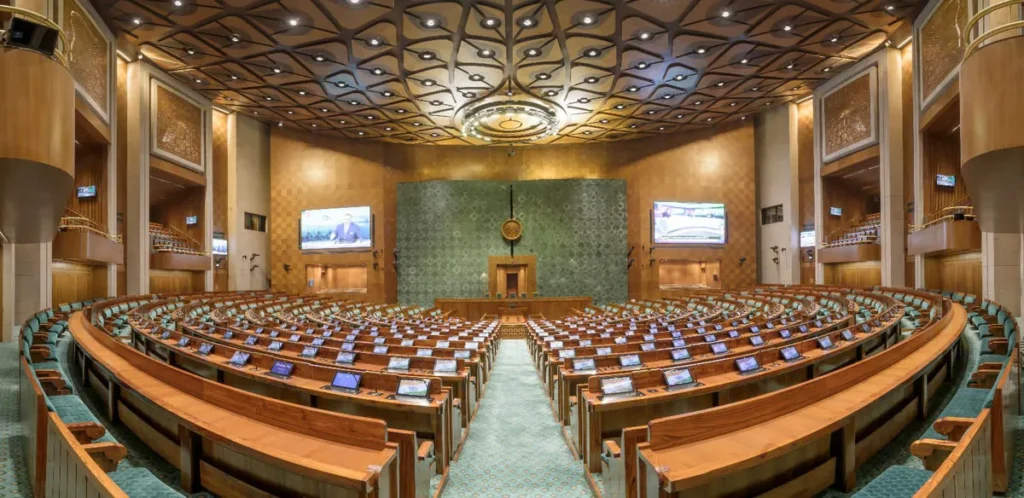
If seats were reallocated purely on current population, Uttar Pradesh, Bihar, Rajasthan and Madhya Pradesh would gain heavily while Tamil Nadu, Kerala and Andhra Pradesh would gain little or lose share. Southern States call this a penalty for success in population control. Options under discussion: keep the State share frozen and raise total seats, use a weighted formula, or strengthen the Rajya Sabha’s federal role. The new Parliament chamber seats 888, hinting at a larger Lok Sabha.
- 1Parliament passes a Delimitation Act
- 2Commission appointed by the Centre
- 3Draft proposals published for objections
- 4Public sittings in each State
- 5Final orders in the Gazette; beyond court challenge
Delimitation Commissions so far
| Commission | Census used | Chair | Lok Sabha seats |
|---|---|---|---|
| 1952 | 1951 | Justice N. Chandrasekhara Aiyar | 494 |
| 1963 | 1961 | Justice J.L. Kapur | 522 |
| 1973 | 1971 | Justice J.L. Kapur | 543 |
| 2002 | 2001 (boundaries only) | Justice Kuldip Singh | 543 (unchanged) |
Link with women’s reservation
The Constitution (106th Amendment) Act, 2023 reserves one-third of Lok Sabha and Assembly seats for women, but only after delimitation based on the first census after the Act. So the timing of the census and of delimitation decides when the reservation begins.
Composition and working of the Commission
A Delimitation Commission is a high-powered body. It is usually chaired by a retired Supreme Court judge and includes the Chief Election Commissioner or an Election Commissioner nominated by the CEC, and the State Election Commissioners of the States concerned. Five MPs and five MLAs from each State are associate members; they take part in discussions but do not vote. The Commission publishes draft proposals in the Gazette and in local newspapers, holds public sittings in each State, considers objections, and then issues final orders. Its guiding principles include compact geographic areas, physical features, administrative boundaries, ease of communication and public convenience, and keeping each constituency within a single district where possible.
Arguments in the North-South debate
| For population-based reallocation | Against, or for safeguards |
|---|---|
| Equal value of every vote is a democratic principle | States that controlled population would be penalised |
| Northern States are under-represented now | Southern and smaller States would lose relative voice |
| The freeze was always meant to be temporary | Federal balance matters as much as numbers |
| Seats can be increased so no State loses in absolute terms | A larger House may be harder to run |
Options discussed include raising the total number of seats so that no State loses seats, giving more weight to the Rajya Sabha as a federal chamber, or extending the freeze further. Whatever path is chosen will need careful consensus with the States.
Reserved constituencies and delimitation
Delimitation also decides which constituencies are reserved for Scheduled Castes and Scheduled Tribes under Articles 330 and 332. The number of reserved seats in each State is worked out from the share of SCs and STs in its population at the relevant census. ST seats are placed where the tribal share of the population is highest, and SC seats are spread across the State in areas with a relatively high SC share, so that reservation does not become concentrated in one region. Because the 2002 Commission used the 2001 Census for this purpose, the number of reserved seats changed in several States, even though total seats did not. A future delimitation would again reshuffle reserved seats, and, once the 106th Amendment’s women’s quota takes effect, would also determine the rotation of seats reserved for women, including within SC and ST seats.
For Mains, remember that delimitation is not a single issue of seat totals. It touches representation of social groups, the federal balance, and the practical running of a much larger legislature.
Delimitation in Assam and Jammu and Kashmir
Some regions were handled separately. Delimitation in Assam, Manipur, Arunachal Pradesh and Nagaland was deferred in 2008 because of security concerns and objections. The Election Commission later redrew Assam’s constituencies in 2023 under Section 8A of the Representation of the People Act, 1950. In Jammu and Kashmir, a Delimitation Commission under Justice Ranjana Prakash Desai issued its final order in 2022, raising Assembly seats to 90.
Delimitation: UPSC angle
For UPSC CSE
Prelims: number of commissions, Art. 82, 170, 329, amendments that froze seats. Mains GS-II: representation vs federal balance, the 2026 debate, women’s reservation timeline.
Delimitation UPSC PYQs (Prelims)
Questions UPSC has actually asked, from the official papers. Pick an option to check yourself.
With reference to the Delimitation Commission, consider the following statements :
– 1. The orders of the Delimitation Commission cannot be challenged in a Court of Law.
– 2. When the orders of the Delimitation Commission are laid before the Lok Sabha or State Legislative Assembly, they cannot effect any modifications in the orders.
Which of the statements given above is/are correct?
The Delimitation Commission’s orders have the force of law and cannot be questioned in any court (Art. 329). They are laid before the Lok Sabha and the State Assemblies, but these cannot change them. Answer as per the official UPSC key · Battle IAS PYQ bankAnswer (c) & why
How many Delimitation Commissions have been constituted by the Government of India till December 2023 ?
Delimitation Commissions were set up under Acts of 1952, 1962, 1972 and 2002. That makes four. The last one, under Justice Kuldip Singh, redrew constituencies on the 2001 Census but kept the number of seats frozen. Answer as per the official UPSC key · Battle IAS PYQ bankAnswer (d) & why
Mains PYQs on this topic
No UPSC Mains question from 2023-2026 is directly on this topic. Older papers (2013-2022) will be added as the Mains bank grows.
Quick quiz
How many Delimitation Commissions have been constituted so far?
1952, 1963, 1973, 2002.Answer (b)
The freeze on inter-State allocation of Lok Sabha seats was extended till the first census after 2026 by the
2001.Answer (b)
Orders of the Delimitation Commission
Article 329(a).Answer (c)
FAQs
Why were Lok Sabha seats frozen at the 1971 census?
To avoid penalising States that controlled population growth.
Who headed the 2002 Delimitation Commission?
Justice Kuldip Singh.
Does delimitation change reserved SC/ST seats?
Yes, reservation is recalculated on the latest census figures.
How is delimitation linked to women’s reservation?
The 106th Amendment applies only after a delimitation based on the first census after 2023.
Can delimitation orders be challenged in court?
No. Article 329(a) bars courts from questioning laws on delimitation and allotment of seats, and the Commission’s orders have the force of law.
Who sits on a Delimitation Commission?
A retired Supreme Court judge as chair, the Chief Election Commissioner or his nominee, and the State Election Commissioner concerned, with MPs and MLAs as non-voting associate members.
What did the 87th Amendment do?
It allowed constituency boundaries to be redrawn on the 2001 Census, while seat totals stayed fixed on the 1971 Census.
Spotted an error? Tell us. We correct within 48 hours.
Image: Ministry of Parliamentary Affairs, Wikimedia Commons, GODL-India
How to use this in Mains
If asked: Delimitation after the next Census could reshape Indian federalism. Discuss. (GS-II)
Quote: “If seats were reallocated purely on current population, Uttar Pradesh, Bihar, Rajasthan and Madhya Pradesh would gain heavily while Tamil Nadu, Kerala and Andhra Pradesh would gain little or lose share.”
Use it: The key federal concern for the body.
In the news

Supreme Court: no prior approval under Section 17A needed to probe a bribe demand
In a judgment of 16 October 2026, a Supreme Court Bench of Justices S.V.N. Bhatti and N.V. Anjaria held that investigating a bribe demand by a public servant does not need prior approval under Section 17A of the Prevention of Corruption Act. Asking for a bribe, the court said, is not part of discharging official duties.
19 Oct 2026
CCPA acts against online sale of explosives: 3,940 sellers delisted from seven platforms
The Central Consumer Protection Authority (CCPA) said on 19 October 2026 that 3,940 sellers of regulated explosives such as ammonium nitrate, picric acid and PETN have been delisted from seven online platforms after its action. It has fined Dial4Trade and ExportersIndia ₹10 lakh per order, and other cases are under hearing or investigation.
19 Oct 2026
India to host 61st CIML meeting on legal metrology in New Delhi, 26–28 October
India will host the 61st meeting of the International Committee of Legal Metrology (CIML) for the first time, in New Delhi from 26 to 28 October 2026. The Department of Consumer Affairs is organising it with the International Organization of Legal Metrology (OIML), and more than 100 delegates are expected, PIB said on 19 October.
19 Oct 2026
NMC withdraws MSMER-2023: medical colleges lose the fixed penalty rulebook, annual disclosure stays
The National Medical Commission (NMC) has de-notified the Maintenance of Standards of Medical Education Regulations, 2023 (MSMER-2023) by a notification dated 14 October 2026, published in the Gazette on 16 October. Its fixed penalties, including seat cuts and fines of up to ₹5 lakh for false records, go with it. The Annual Disclosure Report stays.
19 Oct 2026