
UPSC Mains 2019 GS Paper 1 Q12: model answer
Assess the role of British imperial power in complicating the process of transfer of power during the 1940s.
What the question wants
Assess how British imperial policy complicated the process of transferring power in the 1940s.
How to structure it
Assess: weigh British actions against other factors (Indian divisions), then judge.
- Proposals and their design
- Use of the League and divide and rule
- Haste in 1947
- Other factors and verdict
How to think it through
Every British plan in the 1940s came with an exit clause that someone could use. Cripps offered provinces the right to opt out; Wavell gave the League a veto at Simla; the Cabinet Mission's groupings left room for deadlock; Mountbatten advanced the date to August 1947. Assess: they weren't the only cause of the Partition tragedy, but they made it messier.
Model answer
The 1940s saw several British proposals for a transfer of power. Their design and timing often complicated, rather than eased, the process.
Proposals that encouraged division
- August Offer (1940): assured minorities that no constitution would be adopted without their consent, giving the League a veto.
- Cripps Mission (1942): dominion status after the war and the right of provinces to stay out of the Union, a door to Partition.
- Simla Conference (1945) failed when Wavell accepted Jinnah's demand that the League alone nominate Muslim members.
- Cabinet Mission (1946): grouping of provinces, which created ambiguity and conflict; the League's Direct Action Day (August 1946) followed.
Divide and rule
- Britain used the League as a counterweight to the Congress throughout the war while imprisoning Congress leaders after Quit India.
Haste of the final phase
- Attlee's declaration (February 1947) set June 1948 as a deadline; Mountbatten advanced it to 15 August 1947.
- The Radcliffe boundary was drawn in about five weeks and announced after independence, contributing to violence and migration.
Other factors
- Communal politics, the Congress–League rivalry and the failure of the interim government also mattered.
The princely states problem
- The lapse of paramountcy under the Indian Independence Act, 1947 left over 560 states free to choose; Hyderabad, Junagadh and Kashmir became flashpoints.
Assessment
- Partition killed between several lakh and perhaps a million people and displaced about 1.5 crore, a cost the hasty timetable worsened.
British policy was not the only factor, but its concessions to separatism and its hasty withdrawal made the transfer of power more complicated and violent than it needed to be.
Draw: Timeline 1940–47 of proposals with the 'complication' each added.
Keywords, cases and data to drop in
August Offer 1940, Cripps 1942, Simla 1945, Cabinet Mission 1946, Direct Action Day, Attlee Feb 1947, Mountbatten Plan, Radcliffe.
Where most answers lose marks
- Blaming only the British, or only Indian leaders.
Related Mains PYQs
- Why did the armies of the British East India Company - mostly comprising of Indian soldiers - win consistently against the more… UPSC 2022 · GS-I
- Why was there a sudden spurt in famines in colonial India since the mid-eighteenth century? Give reasons. UPSC 2022 · GS-I
- Bring out the constructive programmes of Mahatma Gandhi during Non-Cooperation Movement and Civil Disobedience Movement. UPSC 2021 · GS-I
- Trace the rise and growth of socio-religious reform movements with special reference to Young Bengal and Brahmo Samaj. UPSC 2021 · GS-I
Fresh examples from current affairs
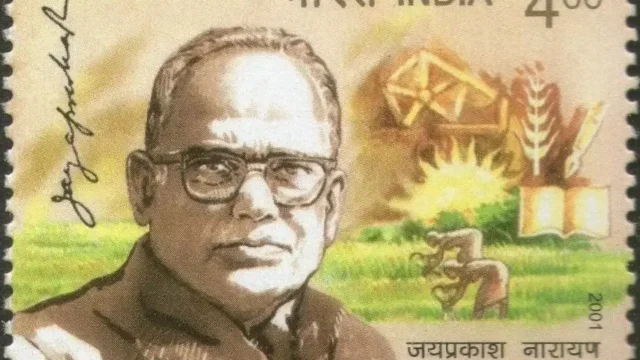
Birth anniversaries: Jayaprakash Narayan and Nanaji Deshmukh
11 October is the birth anniversary of Loknayak Jayaprakash Narayan and Nanaji Deshmukh, both Bharat Ratna awardees. The Prime Minister recalled JP's voice during the Emergency and his concern for good governance, and Nanaji's work in rural development and community participation. Treat this as a personality note for Prelims.
UPSC angle: Prelims: personalities, Bharat Ratna years. · Mains: limited; GS-IV examples of public service.
11 Oct 2026
ASI and Denmark museum to search for 1619 Danish shipwreck Oresund off Karaikal
The Archaeological Survey of India's Underwater Archaeology Wing and the National Museum of Denmark (Njord Centre, Copenhagen) signed an MoU to locate and document the Danish ship Oresund, wrecked off Karaikal, Puducherry, in 1619 CE. It is described as the first Danish ship known to have reached India.
UPSC angle: Prelims: Danish settlements in India.
15 Jun 2026
Veer Bal Diwas and the Rashtriya Bal Puraskar
The PM announced the day on 9 January 2022 and the first Veer Bal Diwas was held on 26 December 2022 [PMO].
UPSC angle: Prelims: Sikh history.
26 Dec 2025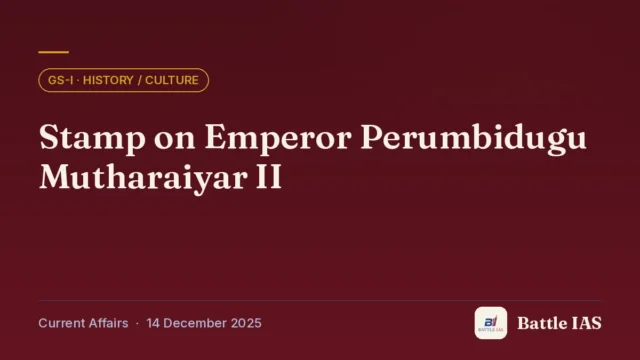
Stamp on Emperor Perumbidugu Mutharaiyar II
Questions on lesser-known regional dynasties are common in Prelims. Stamps and anniversaries often bring them into the news.
UPSC angle: Prelims: early medieval Tamil dynasties.
14 Dec 2025Learn the concept
Question text as printed in the official UPSC Civil Services (Main) question paper. The model answer is original Battle IAS work; use it to learn structure, not to memorise.
Want every PYQ in one place? See the Battle IAS PYQ Book.