
UPSC Mains 2025 GS4 Q8: model answer
In line with the Directive Principles of State Policy enshrined in the Indian Constitution, the government has a constitutional obligation to ensure basic needs — “Roti, Kapda aur Makan (Food, Clothes and Shelter)” — for the under-privileged. Pursuing this mandate, the district administration proposed clearing a portion of forest land to develop housing for the homeless and economically weaker sections of the society.
The proposed land, however, is an ecologically sensitive zone densely populated with age-old trees, medicinal plants and vital biodiversity. Besides, these forests help to regulate micro-climate and rainfalls; provide habitat for wildlife, support soil fertility and prevent land/soil erosion and sustain livelihoods of tribal and nomadic communities.
Inspite of the ecological and social costs, the administration argues in favour of the said proposal by highlighting that this very initiative addresses fundamental human rights as a critical welfare priority. Besides, it fulfils the government’s duty to uplift and empower the poor through inclusive housing development. Further, these forest areas have become unsafe due to wild-animal threats and recurring human-wild life conflicts. Lastly, clearing forest-zones may help to curb anti-social elements allegedly using these areas as hideouts, thereby enhancing law and order.
(a) Can deforestation be ethically justified in the pursuit of social welfare objectives like, housing for the homeless?
(b) What are the socio-economic, administrative and ethical challenges in balancing environmental conservation with human development?
(c) What substantial alternatives or policy interventions can be proposed to ensure that both environmental integrity and human dignity are protected?
What the question wants
Judge whether clearing forest for housing can be justified, list challenges, and suggest alternatives protecting both people and nature.
How to structure it
Intro: The case sets two constitutional duties side by side. Body: (a) Can deforestation be justified?; (b) Challenges (socio-economic, administrative, ethical); (c) Alternatives. Conclusion: Shelter and forests both sustain human dignity.
- 1(a) Can deforestation be justified?
- 2(b) Challenges (socio-economic, administrative, ethical)
- 3(c) Alternatives
Model answer
The case sets two constitutional duties side by side: the State's duty to provide shelter (Art. 21 and DPSPs) and the duty to protect forests and wildlife (Arts. 48A, 51A(g)).
(a) Can deforestation be justified?
- Utilitarian view: houses for many seem to outweigh trees.
- But the forest also serves the poor: tribals and nomads lose livelihoods, and everyone loses water, soil and climate services.
- Housing can be built elsewhere; old-growth forest cannot be recreated.
- Arguments of wildlife threat and hideouts are better solved by management, not destruction.
So clearing an ecologically sensitive forest is not ethically justified when alternatives exist. It would help one group of the poor by harming another.
(b) Challenges
- Socio-economic: displacement of tribals; housing far from jobs; high land prices in cities.
- Administrative: clearance under the Forest (Conservation) Act and Forest Rights Act requires Gram Sabha consent; land records disputes; pressure for quick results.
- Ethical: intergenerational justice; voice of those not in the room (wildlife, future generations); risk of using welfare as cover for land grab.
(c) Alternatives
- Use degraded or government land, vacant public housing, in-situ slum redevelopment and rental housing under PMAY-Urban.
- Vertical, low-cost housing on smaller land.
- Recognise forest dwellers' rights under FRA; involve them in joint forest management.
- Deal with human-wildlife conflict through corridors, fencing and quick compensation.
- Improve policing of the forest rather than clearing it.
- If any diversion is unavoidable, minimal area, compensatory afforestation and strict EIA.
Shelter and forests both sustain human dignity. Good policy finds land for homes without destroying the land that feeds and protects people.
Keywords, cases and data to drop in
Art. 21 Art. 48A FRA Gram Sabha intergenerational justice PMAY compensatory afforestation
Where most answers lose marks
- Supporting clearance without alternatives.
- Ignoring tribal rights.
Fresh examples from current affairs
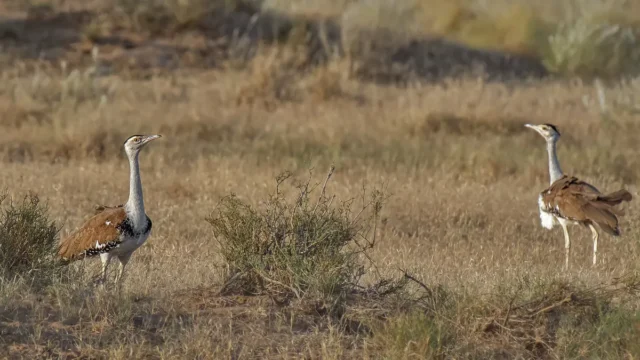
National Red List of birds: 1,211 species under assessment, 107 done in first review
India has begun a national Red List assessment of its 1,211 regularly occurring bird species using the IUCN framework. By 19 October 2026, a preliminary review of 107 species was complete, with the Great Indian Bustard proposed as Critically Endangered and the Indian Roller as Vulnerable. A final assessment is expected towards the end of 2027.
UPSC angle: Prelims: IUCN categories, species and their proposed status, lead institutions. · Mains GS-III: biodiversity conservation and data gaps.
20 Oct 2026
NBA shares Rs 1.19 crore with 29 State Biodiversity Boards from use of crop genetic resources
On 17 October 2026 the National Biodiversity Authority (NBA) said it had shared ₹1.19 crore with 29 State Biodiversity Boards and one UT Biodiversity Council. The money came from seed companies that used Indian maize, rice, pearl millet and cotton for research and commercial hybrids. As the crops were bought from markets and the original holders could not be traced, the amount was split in proportion to each State’s cultivation area. The release comes two days before the CBD COP 17 opens in Yerevan.
UPSC angle: Prelims: NBA, BD Act 2002, Nagoya Protocol, BMCs, CBD COP 17. · Mains GS-III: benefit sharing and community-led conservation.
18 Oct 2026
Sukhna Wetland and Sauj Jheel become Ramsar sites; India’s tally reaches 103
India added Sukhna Wetland in Chandigarh (Ramsar Site 2602) and Sauj Jheel in Mainpuri, Uttar Pradesh (Site 2603) to the List of Wetlands of International Importance on 15 October 2026. This takes India’s tally of Ramsar sites to 103. Sukhna is Chandigarh’s first Ramsar site. Sauj Jheel is UP’s 14th, and it makes Mainpuri the only district in the country with two.
UPSC angle: Prelims: Ramsar criteria, site locations, IUCN status of species. · Mains GS-III: wetland conservation and governance.
15 Oct 2026
National Biodiversity Authority shares ₹2.02 crore Access and Benefit-Sharing money from seed companies
The National Biodiversity Authority distributed ₹2.02 crore of Access and Benefit-Sharing money, paid by seed companies using crops such as rice, tomato and okra, among 27 State Biodiversity Boards and 3 UT councils by cultivation area. Its total ABS disbursement has now reached ₹202 crore, ahead of CBD COP 17 in Yerevan from 19 October 2026.
UPSC angle: Prelims: ABS, KMGBF targets, COP 17 venue. · Mains GS-III: biodiversity conservation and benefit-sharing.
10 Oct 2026Learn the concept
Question text as printed in the official UPSC question paper: https://www.upsc.gov.in/sites/default/files/GENERAL-STUDIES-PAPER-IV-QP-CSM-25-010925.pdf The model answer is original Battle IAS work; use it to learn structure, not to memorise.