
UPSC Mains 2026 GS2 Q12: model answer
What is meant by judicial legislation? In this context, discuss the verdicts of the apex court allowing “passive euthanasia” and a “living will”.
What the question wants
Define judicial legislation (courts filling legislative gaps through guidelines), then use Aruna Shanbaug (2011) and Common Cause (2018, modified 2023) as the case study; weigh legitimacy.
How to structure it
Intro: definition and examples (Vishaka). Body: the euthanasia journey; why it is judicial legislation; arguments for and against. Conclusion.
- 1The euthanasia journey
- 2Why it is judicial legislation
- 3Arguments for and against
Model answer
Judicial legislation means courts laying down binding rules where Parliament is silent, through Articles 32, 141 and 142. Vishaka (1997) and D.K. Basu (1997) are the classic cases.
| Case | What the court laid down |
|---|---|
| Vishaka (1997) | Sexual harassment guidelines until the 2013 Act |
| D.K. Basu (1997) | Arrest and custody safeguards |
| Prakash Singh (2006) | Police reform directions |
| Limit | Separation of powers; Art. 142 used sparingly |
The passive euthanasia journey
- Gian Kaur (1996): no right to die, though dying with dignity was noted.
- Aruna Shanbaug (2011): passive euthanasia allowed with High Court approval, through interim guidelines.
- Common Cause (2018): dying with dignity is part of Article 21; living wills recognised with detailed procedure.
- 2023 modification: notary attestation, time-bound medical boards, no prior magistrate approval.
Why it counts as judicial legislation
- No statute exists; the guidelines work as law under Articles 141/142.
- The Court designed procedures, boards and timelines, which is legislative work.
Assessment
- For: it protected autonomy (Puttaswamy) where Parliament did nothing; the Law Commission's 241st Report agreed on passive euthanasia.
- Against: it strains separation of powers; courts lack a legislature's consultation and data; the 2018 rules proved hard to use.
Conclusion: judicial legislation should prod Parliament, not replace it. An end-of-life care law with palliative care and anti-misuse safeguards would give the right a sturdier home.
Keywords, cases and data to drop in
Articles 32, 141, 142 Vishaka 1997 Gian Kaur 1996 Aruna Shanbaug 2011 Common Cause 2018 2023 simplification advance medical directive 241st Law Commission Report
Where most answers lose marks
- Not defining judicial legislation before the cases.
- Confusing active and passive euthanasia.
- Missing the 2023 modification, which shows the court refining its own 'law'.
Same theme in Prelims
A Writ of Prohibition is an order issued by the Supreme Court or High Courts to :
Answer (c) & explanation
Prohibition stops a lower court from continuing a case (c). A writ of Prohibition is issued by a higher court to a lower court or tribunal, telling it to stop a case it has no jurisdiction to hear. It is issued only to judicial and quasi-judicial bodies. Option (a) is wrong: it is never issued to a government officer. Options (b) and (d) are wrong: courts cannot use it against Parliament, a legislature or the government's policy.
Notice the five writs under Articles 32 and 226: Habeas Corpus (produce the person), Mandamus ("we command", to perform a duty), Prohibition, Certiorari and Quo Warranto (by what authority). Think of Prohibition as "stop before you decide", and Certiorari as "your decision is quashed".
option (a) describes mandamus in reverse. Prohibition is aimed at courts, not officers.
Answer as per the official UPSC answer key.
With reference to the writs issued by the Courts in India, consider the following statements :
- 1. Mandamus will not lie against a private organisation unless it is entrusted with a public duty.
- 2. Mandamus will not lie against a Company even though it may be a Government Company.
- 3. Any public minded person can be a petitioner to move the Court to obtain the writ of Quo Warranto.
Which of the statements given above are correct?
Answer (d) & explanation
All three statements are correct (d). Statement 1 is right: mandamus commands a body to perform a public duty, so it does not lie against a private organisation unless that body has been given a public duty. Statement 2 is right per the key: in Praga Tools (1966), the Supreme Court held that mandamus does not lie against a company, even a government company, unless a public duty is involved. Statement 3 is right: for quo warranto, which asks "by what authority" someone holds a public office, the petitioner need not be personally affected; any member of the public can apply.
Notice the five writs: habeas corpus, mandamus, prohibition, certiorari and quo warranto, under Articles 32 and 226. High Courts can issue writs for any legal right.
statement 2 sounds wrong because a government company feels "public". UPSC followed the line in Praga Tools.
UPSC repeats traps like this year after year. The PYQ Book gathers every trap in one place, so you see them coming. Try the free sample
Answer as per the official UPSC answer key.
Consider the following statements :
- 1. Pursuant to the report of H.N. Sanyal Committee, the Contempt of Courts Act, 1971 was passed.
- 2. The Constitution of India empowers the Supreme Court and the High Courts to punish for contempt of themselves.
- 3. The Constitution of India defines Civil Contempt and Criminal Contempt.
- 4. In India, the Parliament is vested with the powers to make laws on Contempt of Court.
Which of the statements given above is/are correct?
Answer (b) & explanation
Statements 1, 2 and 4 are correct (b). Statement 1 is right: the H.N. Sanyal Committee (1963) led to the Contempt of Courts Act, 1971. Statement 2 is right: Article 129 and Article 215 make the Supreme Court and the High Courts courts of record, with power to punish contempt of themselves. Statement 4 is right: Parliament can make laws on contempt, under Entry 77 of the Union List and Entry 14 of the Concurrent List. Statement 3 is wrong: civil and criminal contempt are defined in the 1971 Act, not in the Constitution.
Notice the 2006 amendment, which made truth a defence if in the public interest. Contempt of court is also a ground for restricting free speech under Article 19(2).
statement 3. The Constitution gives the power; the Act gives the definitions.
Answer as per the official UPSC answer key.
Fresh examples from current affairs

Supreme Court: no prior approval under Section 17A needed to probe a bribe demand
In a judgment of 16 October 2026, a Supreme Court Bench of Justices S.V.N. Bhatti and N.V. Anjaria held that investigating a bribe demand by a public servant does not need prior approval under Section 17A of the Prevention of Corruption Act. Asking for a bribe, the court said, is not part of discharging official duties.
UPSC angle: Prelims: Sections 7, 7A, 17A and 19 of the PC Act. · Mains GS-II/GS-IV: honest officers versus accountability.
19 Oct 2026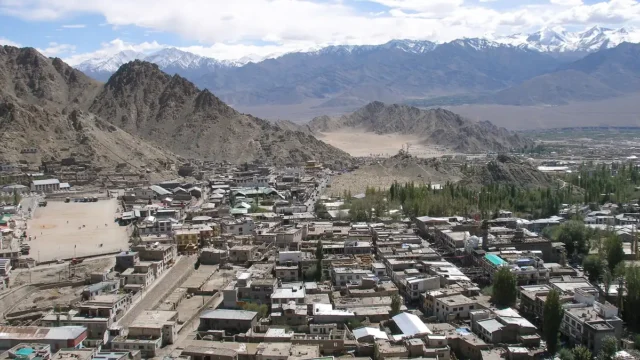
CJI Surya Kant inaugurates the first permanent High Court bench in Leh
On 18 October 2026 Chief Justice of India Surya Kant inaugurated a permanent bench of the High Court of Jammu and Kashmir and Ladakh in Leh. Until now, a person in Ladakh who wanted to file a writ petition had to travel to Srinagar or Jammu, across high passes and harsh winters. The bench was made possible by a regulation that the President promulgated on 27 August and that came into force on 5 September. It is a simple idea with a big effect: bring the court to the people.
UPSC angle: Prelims: Arts. 214, 231, 241, 226, 39A; common High Court. · Mains GS-II: access to justice, judicial infrastructure.
18 Oct 2026
Three High Court Chief Justices appointed as Supreme Court judges
On 5 October 2026 the President appointed three High Court Chief Justices as judges of the Supreme Court: Justice Sunita Agarwal (Gujarat), Justice Devendra Kumar Upadhyaya (Delhi) and Justice Aparesh Kumar Singh (Telangana). The first two have Allahabad as their parent High Court and the third Jharkhand.
UPSC angle: Prelims: Article 124. · Mains GS-II: judicial appointments.
5 Oct 2026
President at NGT climate conference: community-based adaptation rooted in traditional knowledge
On 20 September 2026 President Droupadi Murmu spoke at the valedictory session of the International Conference on "The Future of Environment and Climate Dynamics", organised by the National Green Tribunal in New Delhi. She called for people-centric, community-based climate adaptation rooted in traditional knowledge, and for afforestation that restores whole ecosystems.
UPSC angle: Mains: Role of traditional knowledge in climate adaptation.
20 Sep 2026Learn the concept
Question text as printed in the official UPSC question paper: https://www.upsc.gov.in/sites/default/files/QP-CSM-26-010926-GENERAL-STUDIES-PAPER%20-%20II.pdf The model answer is original Battle IAS work; use it to learn structure, not to memorise.