
Chapter 9 · Topic 9.2 · Prelims + Mains2 of 3
Agriculture: Irrigation, MSP and marketing
Key points
- MSP and buffer stocks.
- Marketing and e-NAM.
12 PYQs 2015–2026
Prelims box: facts and traps
| Point | Detail |
|---|---|
| Sources | Groundwater (tubewells and wells) is now the largest source; then canals and tanks |
| PMKSY (2015) | Pradhan Mantri Krishi Sinchayee Yojana: 'Har Khet Ko Pani' and 'Per Drop More Crop' (micro-irrigation) |
| Micro-irrigation | Drip and sprinkler irrigation; fertigation delivers fertiliser through drip lines |
| Problems | Groundwater depletion (free power), incomplete projects, low water-use efficiency, rain dependence |
| Related | Atal Bhujal Yojana (groundwater, 2019); AIBP for large projects. |
- CCEA MSP items in Prelims 2018 were barley, finger millet, groundnut and sesamum, not areca nut, coffee or turmeric.
- FCI's economic cost is MSP plus bonus plus procurement incidentals and distribution cost (Prelims 2019).
- The reply (PIB, 28 July 2026) said 1.89 crore farmers and 2.78 lakh traders were registered on e-NAM as on 30 June 2026, and that average trader bids per lot rose from 2.1 (2016-17) to 2.8 (2025-26), showing more competition.
- Trap (UPSC Prelims 2017): all the statements are correct.
- Trap (UPSC Prelims 2023): all the statements are correct.
On this page (3 sections)
Irrigation
| Point | Detail |
|---|---|
| Sources | Groundwater (tubewells and wells) is now the largest source; then canals and tanks |
| PMKSY (2015) | Pradhan Mantri Krishi Sinchayee Yojana: ‘Har Khet Ko Pani’ and ‘Per Drop More Crop’ (micro-irrigation) |
| Micro-irrigation | Drip and sprinkler irrigation; fertigation delivers fertiliser through drip lines |
| Problems | Groundwater depletion (free power), incomplete projects, low water-use efficiency, rain dependence |
| Related | Atal Bhujal Yojana (groundwater, 2019); AIBP for large projects |
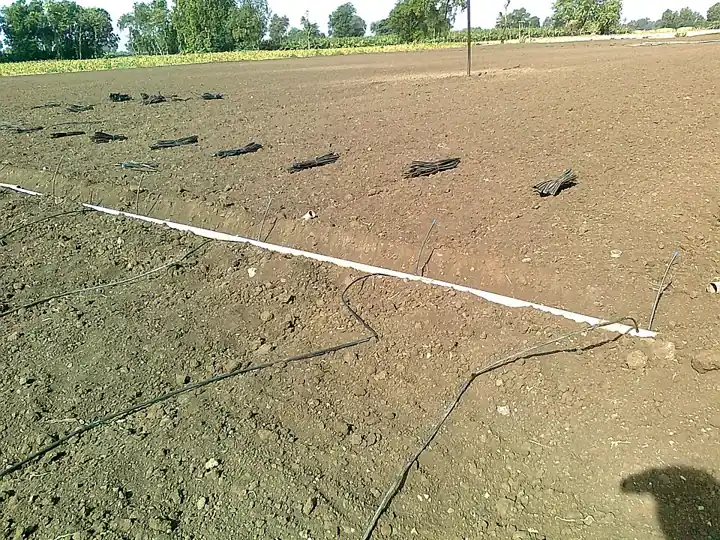
Drip irrigation reduces weeds and soil erosion, but it does not reduce soil salinity. The 2016 answer was 1 and 3 only.
Which of the following is/are the advantage/advantages of practising drip irrigation? 1. Reduction in weed 2. Reduction in soil salinity 3. Reduction in soil erosion Select the correct answer using the code given below.
- 1 and 2 only
- 3 only
- 1 and 3 only
- None of the above is an advantage of practising drip irrigation
Show answer
Answer: (c) · UPSC official key
Mains 2021: How and to what extent would micro-irrigation help in solving India ‘s water crisis? It saves 30–50% of water in many crops, raises yields and cuts power use. But costs, small plots
and maintenance limit its spread.
How and to what extent would micro-irrigation help in solving India’s water crisis?
MSP, procurement and buffer stocks
| Point | Detail |
|---|---|
| Who recommends | CACP (1965); the CCEA announces MSP for 22 mandated crops, plus FRP for sugarcane |
| Formula | Since 2018-19, at least 1.5 times A2+FL cost (paid-out cost plus family labour) |
| Paddy MSP, KMS 2026-27 | ₹2,441 per quintal (common), up ₹72; Grade A ₹2,461 (Cabinet decision) |
| Procurement | FCI (1965) and State agencies; decentralised procurement (1997-98); mostly wheat and rice |
| Buffer stock | Minimum stock norms for each quarter; Open Market Sale Scheme to cool prices |
Procurement at MSP is not unlimited for all crops in every State. MSP is also not a level above which the market price can never rise. The 2020 answer was Neither 1 nor 2.
Consider the following statements : 1. In the case of all cereals, pulses and oil-seeds, the procurement at Minimum Support Price (MSP) is unlimited in any State/UT of India. 2. In the case of cereals and pulses, the MSP is fixed in any State/UT at a level to which the market price will never rise. Which of the statements given above is/are correct ?
- 1 only
- 2 only
- Both 1 and 2
- Neither 1 nor 2
Show answer
Answer: (d) · UPSC official key
CCEA MSP items in Prelims 2018 were barley, finger millet, groundnut and sesamum, not areca nut, coffee or turmeric. Answer: 2, 4, 5 and 6 only. Niger seed also gets MSP; it is a kharif crop used by tribal people for cooking oil (Prelims 2023: All three).
Consider the following : 1. Areca nut 2. Barley 3. Coffee 4. Finger millet 5. Groundnut 6. Sesamum 7. Turmeric The Cabinet Committee on Economic Affairs has announced the Minimum Support Price for which of the above ?
- 1, 2, 3 and 7 only
- 2, 4, 5 and 6 only
- 1, 3, 4, 5 and 6 only
- 1, 2, 3, 4, 5, 6 and 7
Show answer
Answer: (b) · UPSC official key
Consider the following statements : 1. The Government of India provides Minimum Support Price for niger (Guizotia abyssinica) seeds. 2. Niger is cultivated as a Kharif crop. 3. Some tribal people in India use niger seed oil for cooking. How many of the above statements are correct?
- Only one
- Only two
- All three
- None
Show answer
Answer: (c) · UPSC official key
FCI’s economic cost is MSP plus bonus plus procurement incidentals and distribution cost (Prelims 2019). Mains 2018: What do you mean by Minimum Support Price (MSP)? Mains 2018 Mains 2024: Elucidate the importance of buffer stocks for stabilizing agricultural prices in India and the storage problems: CAP storage, losses and high carrying cost.
The economic cost of food grains to the Food Corporation of India is Minimum Support Price and bonus (if any) paid to the farmers plus
- transportation cost only
- interest cost only
- procurement incidentals and distribution cost
- procurement incidentals and charges for godowns
Show answer
Answer: (c) · UPSC official key
What do you mean by Minimum Support Price (MSP)? How will MSP rescue the farmers from the low income trap?
Elucidate the importance of buffer stocks for stabilizing agricultural prices in India. What are the challenges associated with the storage of buffer stock? Discuss.
Agricultural marketing and e-NAM
| Point | Detail |
|---|---|
| APMC mandis | State laws; licensed traders and commission agents; market fees; few mandis per farmer |
| Model laws | Model APMC Act (2003); Model APLM Act (2017); Model Contract Farming Act (2018) |
| Farm laws 2020 | Three central laws passed in 2020 and repealed in 2021 after farmer protests |
| e-NAM (April 2016) | Online trading platform linking APMC mandis; run by SFAC |
| FPOs | Scheme for 10,000 Farmer Producer Organisations (2020) for collective bargaining |
Prelims 2017: the National Agriculture Market is a pan-India e-trading portal that gives farmers a nationwide market with quality-linked prices. Answer: Both 1 and 2.
What is/are the advantage/advantages of implementing the ‘National Agriculture Market’ scheme ? 1. It is a pan-India electronic trading portal for agricultural commodities. 2. It provides the farmers access to nationwide market, with prices commensurate with the quality of their produce. Select the correct answer using the code given below :
- 1 only
- 2 only
- Both 1 and 2
- Neither 1 nor 2
Show answer
Answer: (c) · UPSC official key
Mains box: analysis and answer points
- Drip irrigation reduces weeds and soil erosion, but it does not reduce soil salinity.
- Procurement at MSP is not unlimited for all crops in every State.
- Likely next angle: Drip
- Asked: Mains 2021 (GS Paper III, 10 marks): How and to what extent would micro-irrigation help in solving India’s water crisis?
Practice
Practice MCQs (8)
With reference to the National Agriculture Market (e-NAM), consider the following statements:
1. It was launched in April 2016.
2. The Small Farmers' Agribusiness Consortium (SFAC) is its lead implementing agency.
3. It is a virtual market with a physical mandi at the back end, where the produce is actually delivered.
Which of the statements given above are correct?
Answer (d) & explanation
e-NAM was launched by the Prime Minister on 14 April 2016 with 21 mandis of eight States. It is implemented by the Small Farmers' Agribusiness Consortium (SFAC) as Lead Implementing Agency under the Ministry of Agriculture and Farmers Welfare. The scheme guidelines describe it as a 'virtual' market with a physical market at the back end: registration, assaying, bidding and payment happen online, but the produce moves physically through the mandi. All three statements are correct. SFAC, a registered society promoted by the Department of Agriculture in 1994, was chosen as lead agency and works through a technology partner that runs the platform. The date of launch, 14 April 2016, is Ambedkar Jayanti. On e-NAM the farmer's lot is registered at the gate, assayed for quality, put up for online bidding, and the payment can be made online to the farmer's account. Because the produce stays in the physical mandi, e-NAM depends on the yard's assaying, weighing and storage facilities, which is why the scheme funds such equipment.
The National Agriculture Market (e-NAM) is best described as
Answer (a) & explanation
PIB describes e-NAM as a pan-India electronic trading portal which networks the existing APMC mandis to create a unified national market for agricultural commodities. It offers online competitive bidding, assaying and online payment. It is a spot market, not a futures exchange, and it does not replace State mandis. The DMI's price-reporting portal is Agmarknet, a different system that only disseminates prices and arrivals. e-NAM differs from three neighbours. Agmarknet, run by the Directorate of Marketing and Inspection with NIC, reports prices and arrivals but has no trading. Commodity exchanges such as NCDEX deal in futures and are regulated by SEBI. Private e-commerce platforms sell to consumers. e-NAM is a government spot market for wholesale trade, built on existing mandis, aiming at One Nation One Market. Questions often give four portals and ask which one fits a description, so knowing these contrasts is useful.
Under the e-NAM scheme, the main financial support that the Union Government gives for each mandi integrated with the platform is
Answer (d) & explanation
e-NAM is completely funded by the Central Government. The e-NAM software is given to States/UTs free of cost, and the Department gives a one-time grant of up to Rs 30 lakh per market for hardware, five internet connections, assaying equipment and related infrastructure. SFAC, through its strategic partner, also places a mandi analyst in each market for one year. States bear any extra cost. The NABARD-linked interest subsidy belongs to the separate Agri-Market Infrastructure Fund. The Central grant is aimed at making a mandi capable of electronic trade: computers, internet links, assaying equipment for quality testing, and other basic items. Beyond that, the State or market committee bears the cost of further infrastructure. Assaying matters because buyers bidding from far away must trust the quality report. The Agri-Market Infrastructure Fund, set up with NABARD in 2019, is a different instrument that gives States subsidised loans for building market infrastructure, especially in Gramin Agricultural Markets.
With reference to features added to e-NAM, consider the following statements:
1. Its FPO trading module allows Farmer Producer Organisations to trade produce from their collection centres without bringing it to the APMC yard.
2. Its warehouse-based trading module allows trade from warehouses on the basis of electronic negotiable warehouse receipts (e-NWR).
3. The 'Platform of Platforms' launched in 2022 replaced the e-NAM mandi network with private commodity exchanges.
Which of the statements given above are correct?
Answer (b) & explanation
During the COVID-19 period an FPO trading module was added so that FPOs could trade from their collection centres without moving produce to the APMC. A warehouse-based trading module enables trade from warehouses based on e-NWR. The Platform of Platforms (PoP), launched on 14 July 2022, integrates service providers (assaying, logistics, warehousing, fintech, market information) with e-NAM so that farmers can reach more buyers and services; it builds on the mandi network rather than replacing it. Statements 1 and 2 are correct. The FPO module recognises that many FPOs aggregate produce at their own centres; listing such lots on e-NAM saves the cost of carrying them to a yard. Warehouse-based trade uses electronic negotiable warehouse receipts issued by warehouses registered with the Warehousing Development and Regulatory Authority, so a farmer can store, borrow against the receipt and sell when prices are better. The Platform of Platforms connects e-NAM with other digital services so a farmer can find buyers, testing, transport and finance in one place.
With reference to the High Level Committee on reorienting the role and restructuring of FCI (2015), consider the following statements about its views on buffer stocks:
1. It found that over the previous five years, buffer stocks with FCI had on average been more than double the stocking norms.
2. It called for a transparent liquidation policy that would kick in automatically whenever stocks exceed the norms.
3. It recommended restricting cereal exports so that surplus stocks remain available within the country.
Which of the statements given above are correct?
Answer (a) & explanation
The Shanta Kumar High Level Committee named excess stocking as one of FCI's key problems: over the previous five years its buffer stocks averaged more than double the norms, costing the nation thousands of crores with no worthwhile purpose served. Among the reasons it listed were export bans, open-ended procurement distorted by bonuses and high statutory levies, and above all the lack of a pro-active liquidation policy. It therefore asked for a transparent liquidation policy that would kick in automatically when stocks exceed the norms, and for more flexibility for FCI to sell in OMSS and export markets. Statement 3 reverses this: the Committee treated export bans as a cause of the glut and saw exports as an outlet for surplus stocks.
With reference to the Royal Commission on Agriculture (1928), consider the following statements:
1. It recommended regulation of marketing practices and the establishment of regulated markets.
2. Its recommendations, together with those of the Central Banking Enquiry Committee (1931), led to the setting up of a central marketing organisation, the Directorate of Marketing and Inspection, in 1935.
Which of the statements given above is/are correct?
Answer (c) & explanation
The Royal Commission on Agriculture (report 1928, chaired by Lord Linlithgow) observed that the prosperity of cultivators depended heavily on marketing facilities and recommended regulated markets and fair trade practices. Its recommendations and those of the Central Banking Enquiry Committee (1931) led the Government of India to set up the Directorate of Marketing and Inspection (DMI) in 1935. The DMI later administered the Agricultural Produce (Grading and Marking) Act, 1937. Both statements are correct. The DMI is now an attached office of the Department of Agriculture and Farmers Welfare, with its head office at Faridabad and the Central Agmark Laboratory at Nagpur. Under the 1937 Act it frames grade standards and certifies produce under the AGMARK mark. The Royal Commission, chaired by Lord Linlithgow, is also remembered for its broader advice on agricultural research, which led to the Imperial Council of Agricultural Research in 1929, the forerunner of ICAR. One commission thus shaped both marketing and research institutions.
Consider the following statements: Statement-I: A State or Union Territory that has no agricultural marketing law in force can still have its markets integrated with e-NAM. Statement-II: The e-NAM scheme guidelines allow such a State or UT to identify an institution and frame legally enforceable guidelines for trading on the e-NAM portal.
Which one of the following is correct in respect of the above statements?
Answer (a) & explanation
Both statements are correct and linked. Para 4.4 of the e-NAM scheme guidelines says that States/UTs which do not have marketing regulation, or have one not in force, can integrate with e-NAM and avail grants if they identify an institution and frame legally enforceable guidelines covering registration of traders, transaction fees and other trading provisions. The identified entity builds the back-end infrastructure. Statement-II is the mechanism that makes Statement-I possible. This provision is relevant for places like Kerala and some Union Territories, which had no APMC law or had one not in force. Instead of forcing them to pass an APMC Act first, the scheme let them name an institution and frame rules covering who may trade, what fees apply and how disputes are handled. The aim was national coverage of e-NAM. The general lesson is that e-NAM needs a legal basis for online trade, which can come from an APMC Act or from such enforceable guidelines.
According to the Union Agriculture Ministry's Lok Sabha reply of July 2026 on e-NAM, consider the following statements:
1. As on 30 June 2026, more than 1.8 crore farmers were registered on e-NAM.
2. The average number of trader bids per lot rose from 2.1 in 2016-17 to 2.8 in 2025-26.
3. The cumulative value of inter-State trade on e-NAM had crossed Rs 4 lakh crore.
Which of the statements given above are correct?
Answer (d) & explanation
The reply (PIB, 28 July 2026) said 1.89 crore farmers and 2.78 lakh traders were registered on e-NAM as on 30 June 2026, and that average trader bids per lot rose from 2.1 (2016-17) to 2.8 (2025-26), showing more competition. Inter-State trade, however, remains small: cumulative inter-State trade was 28,566 MT worth only Rs 83.95 crore. The figure of over Rs 4 lakh crore is the total value of all trade on e-NAM (Rs 4,39,941 crore by June 2025), most of it within States. Statements 1 and 2 are correct. Inter-State trade is small because it depends on several things working together: trust in quality reports from distant mandis, transport and logistics across States, payment security and differences in State rules. Most trade on e-NAM happens within a mandi or within a State, which still adds competition through more bidders. The rise in bids per lot is a better sign of the scheme's effect than headline totals. Read official data carefully: a cumulative total, an inter-State total and registration figures measure different things.
0 / 0 correct
Prelims PYQs on this topic (8)
What are the advantages of fertigation in agriculture ?
- 1. Controlling the alkalinity of irrigation water is possible.
- 2. Efficient application of Rock Phosphate and all other phosphatic fertilizers is possible.
- 3. Increased availability of nutrients to plants is possible.
- 4. Reduction in the leaching of chemical nutrients is possible.
Select the correct answer using the code given below :
Answer (c) & explanation
Statements 1, 3 and 4 are correct (c). Fertigation feeds dissolved fertiliser through drip or sprinkler lines. Statement 1 is right: acids can be added to the water to correct its alkalinity, which also keeps drippers clean. Statement 3 is right: nutrients reach the roots in small, timely doses, so plants take up more. Statement 4 is right: because less fertiliser is applied at once, less is leached below the roots into groundwater. Statement 2 is wrong: rock phosphate does not dissolve in water, so it cannot be applied this way, and nor can all phosphatic fertilisers.
Notice that fertigation pairs naturally with micro-irrigation, promoted under Per Drop More Crop (PMKSY). Fertigation is common in Israel.
the word "all" in statement 2. Fertigation needs fully water-soluble fertilisers.
Answer as per the official UPSC answer key.
The Fair and Remunerative Price (FRP) of sugarcane is approved by the
Answer (a) & explanation
The Fair and Remunerative Price of sugarcane is approved by the Cabinet Committee on Economic Affairs (a). The CACP (b) only recommends it. The Directorate of Marketing and Inspection (c) handles grading and AGMARK, and the APMC (d) regulates mandis, so neither fixes the FRP.
Sugar mills must pay farmers at least the FRP, under the Sugarcane (Control) Order issued under the Essential Commodities Act. Some States, such as Uttar Pradesh, announce a higher State Advised Price. The FRP replaced the Statutory Minimum Price in 2009. Notice how cane pricing ties farmer welfare to mill finances.
CACP only recommends. UPSC asked who approves.
Answer as per the official UPSC answer key.
Which among the following is/are the objective(s) of the Rainfed Area Development (RAD) initiative under the National Mission for Sustainable Agriculture (NMSA) ?
- 1. Encouraging monoculture in rainfed areas
- 2. Increasing rice cultivation in irrigated regions
- 3. Enhancing productivity and minimising climatic risks through Integrated Farming Systems (IFS)
Select the answer using the code given below :
Answer (d) & explanation
Only objective 3 belongs to RAD (d). Item 3 is right: Rainfed Area Development (RAD), an area-based part of the National Mission for Sustainable Agriculture (NMSA), promotes Integrated Farming Systems. It grows crops along with horticulture, livestock, fishery and agro-forestry, so a farmer in a dry area has more than one income source when the rain fails. Item 1 is wrong: monoculture raises risk. Item 2 is wrong: irrigated rice has nothing to do with a rainfed programme.
Notice why it matters: about half of India's net sown area is rainfed, growing much of its pulses, millets and oilseeds. NMSA is one of the eight missions under the National Action Plan on Climate Change (2008). Related: Per Drop More Crop for micro-irrigation.
statement 2 talks of "irrigated regions" in a scheme named "Rainfed". Read the scheme's own name before the statements.
Answer as per the official UPSC answer key.
Consider the following statements :
- 1. India has more arable area than China.
- 2. The proportion of irrigated area is more in India as compared to China.
- 3. The average productivity per hectare in Indian agriculture is higher than that in China.
How many of the above statements are correct?
Answer (a) & explanation
Only one statement is correct (a). Statement 1 is right: India has about 156 million hectares of arable land, among the largest in the world and more than China's roughly 120 million. Statement 2 is wrong: by the data used for the question, China irrigated a larger share of its farmland than India, where much farming still depends on the monsoon. Statement 3 is wrong: China's yields per hectare of rice and wheat are much higher than India's, thanks to more fertiliser, seeds and mechanisation.
Notice the lesson: India's problem is not land but productivity. Small fragmented holdings, rain-fed farming and low investment hold it back, which is why schemes stress micro-irrigation and seeds.
India's big farm area tempts you to tick all three. Area is not productivity.
Answer as per the official UPSC answer key.
With reference to the "Tea Board" in India, consider the following statements :
- 1. The Tea Board is a statutory body.
- 2. It is a regulatory body attached to the Ministry of Agriculture and Farmers Welfare.
- 3. The Tea Board's Head Office is situated in Bengaluru.
- 4. The Board has overseas offices at Dubai and Moscow.
Which of the statements given above are correct ?
Answer (d) & explanation
Statements 1 and 4 are correct (d). Statement 1 is right: the Tea Board was set up under the Tea Act, 1953, so it is a statutory body. Statement 4 is right: it keeps overseas offices in Dubai and Moscow to promote Indian tea in key markets. Statement 2 is wrong: like the Coffee, Rubber and Spices boards, it works under the Ministry of Commerce and Industry, because these are export crops, not under the Agriculture Ministry. Statement 3 is wrong: its head office is in Kolkata; it is the Coffee Board that sits in Bengaluru.
Notice the other boards: the Spices Board is in Kochi and the Rubber Board in Kottayam. The commodity boards have long been under review for merger and reform.
plantation crops are farm products, but their Boards sit with Commerce. Bengaluru belongs to the Coffee Board.
Traps like this come back in new clothes. The PYQ Book collects all of them, topic by topic, so none catch you twice. Try the free sample
Answer as per the official UPSC answer key.
In the context of India's preparation for Climate-Smart Agriculture, consider the following statements :
- 1. The 'Climate-Smart Village' approach in India is a part of a project led by the Climate Change, Agriculture and Food Security (CCAFS), an international research programme.
- 2. The project of CCAFS is carried out under Consultative Group on International Agricultural Research (CGIAR) headquartered in France.
- 3. The International Crops Research Institute for the Semi-Arid Tropics (ICRISAT) in India is one of the CGIAR's research centres.
Which of the statements given above are correct?
Answer (d) & explanation
All three statements are correct (d). Statement 1 is right: Climate-Smart Villages in Haryana, Punjab, Bihar and other States were set up under CCAFS (Climate Change, Agriculture and Food Security), an international research programme. They test farm practices that adapt to climate change and cut emissions. Statement 2 is right: CCAFS ran under the CGIAR, whose system office is in Montpellier, France. Statement 3 is right: ICRISAT at Patancheru, Hyderabad, is one of the CGIAR research centres.
Notice other CGIAR centres: IRRI (Philippines, rice), CIMMYT (Mexico, maize and wheat) and IWMI (Sri Lanka). India's own programme is NICRA (National Innovations in Climate Resilient Agriculture) of the ICAR.
Answer as per the official UPSC answer key.
Mains PYQs on this topic (4)
- UPSC Mains 2026 · GS Paper III · Q3Describe the various Technology Missions initiated in Indian agriculture and examine their role in food security.How to approach: Intro: the 'mission mode' idea from 1986. Body: a table-like walk through oilseeds, cotton, horticulture and the newer missions; food-security link. Conclusion:…
- UPSC Mains 2026 · GS Paper III · Q13How Indian agriculture has been transformed from food scarcity to food surplus level? Explain the various government policies implemented for diversification of Indian agriculture.How to approach: Intro: PL-480 imports versus today's output. Body: drivers of transformation; diversification policies; why diversify. Conclusion: from surplus to nutrition and…
- UPSC Mains 2026 · GS Paper III · Q14Discuss the different types of subsidies and supports provided by the Government of India to agricultural sector. Examine the related issues pertaining to Agreement on Agriculture of World Trade Organisation (WTO).How to approach: Intro: why support is needed. Body: types; WTO boxes; India's issues. Conclusion: shift toward green-box support.
- UPSC Mains 2025 · GS Paper III · Q15How does nanotechnology offer significant advancements in the field of agriculture ? How can this technology help to uplift the socio-economic status of farmers ?How to approach: Intro: definition. Body: (1) Advancements; (2) Socio-economic uplift; (3) Concerns; (4) Way forward. Conclusion: Nanotechnology can help Indian farmers if scien…
Write an answer
In 150 words, explain the significance of Agriculture with one recent example.
Flashcards (6)
PMKSY slogans?
Har Khet Ko Pani; Per Drop More Crop.
Who recommends MSP?
CACP.
MSP formula since 2018-19?
At least 1.5 × A2+FL.
Paddy MSP 2026-27 (common)?
₹2,441 per quintal.
FCI set up?
1965.
e-NAM launched?
April 2016.
Read more: related explainers
- Agricultural Marketing in India: APMC System, Model Acts, e-NAM, FPOs, Warehousing, the 2020 Farm Laws and Reform Options
- Minimum Support Price (MSP): How It Is Fixed, CACP, A2+FL and C2 Costs, Procurement, PM-AASHA and the Legal Guarantee Debate
- World Trade Organization: Origin, Principles, Key Agreements, Agriculture Boxes and India's Stakes
In the news
- 22 Oct 2026Agrivoltaics World Conference in Delhi: PM-KUSUM’s next phase and the small-farmer test
- 20 Oct 2026Agrivoltaics: Centre plans a scheme to push solar panels above farms; 5 GW seen in 3–4 years
- 18 Oct 2026Kufri Jamunia: ICAR-CPRI’s purple potato to fight hidden hunger
- 18 Oct 2026Oil companies bar sugar-based ethanol for 2026-27; maize incentive cut to ₹2.79 a litre
 Next topic · 9.3 →Agriculture: Chapter test
Syllabus: GS-III · Issues related to direct and indirect farm subsidies and minimum support prices;…