
Chapter 9 · Topic 9.3 · Prelims + Mains3 of 3
Environmental Conventions: Chapter test
Key points
- Ramsar and CITES.
- CMS and UNCCD.
Prelims box: facts and traps
| CITES appendix | Trade rule |
|---|---|
| Appendix I | Species threatened with extinction; commercial trade generally banned |
| Appendix II | Trade allowed but controlled by permits so it does not threaten survival |
| Appendix III | Species protected in at least one country that asks others for help. |
- The Convention on the Conservation of Migratory Species of Wild Animals (CMS), also called the Bonn Convention, was concluded at Bonn on 23 June 1979 and entered into force on 1 November 1983 (UN Treaty Collection.
- CITES, the Convention on International Trade in Endangered Species of Wild Fauna and Flora, was signed at Washington DC on 3 March 1973 and amended at Bonn on 22 June 1979.
- The Ramsar Convention on Wetlands was signed at Ramsar, Iran, in 1971; World Wetlands Day on 2 February marks its adoption on 2 February 1971.
- Trap (UPSC Prelims 2014): all the statements are correct.
- Trap (UPSC Prelims 2016): “It has a special/particular focus on South Asia and North Africa regions, and its Secretariat facilitates the allocation of major portion of financial resources to these regions” is incorrect.
Ramsar and CITES
The Ramsar Convention on Wetlands was signed at Ramsar, Iran, in 1971; World Wetlands Day on 2 February marks its adoption on 2 February 1971. India ratified it on 1 February 1982 (PIB). Sites are listed as Wetlands of International Importance. Parties commit to the ‘wise use’ of all wetlands in their territory, not only listed ones.
Mains 2018: What is wetland? Explain the Ramsar concept of ‘wise use’ in the context of wetland conservation. Mains 2018 Cite two examples of Ramsar sites from India.
What is wetland? Explain the Ramsar concept of ‘wise use’ in the context of wetland conservation. Cite two examples of Ramsar sites from India.
CITES, the Convention on International Trade in Endangered Species of Wild Fauna and Flora, was signed at Washington DC on 3 March 1973 and amended at Bonn on 22 June 1979. The Wild Life (Protection) Amendment Act, 2022 brought it into Indian law (Gazette of India, 2022). Species are listed in three appendices according to how much trade control they need.
| CITES appendix | Trade rule |
|---|---|
| Appendix I | Species threatened with extinction; commercial trade generally banned |
| Appendix II | Trade allowed but controlled by permits so it does not threaten survival |
| Appendix III | Species protected in at least one country that asks others for help |
IUCN runs thousands of field projects around the world, and CITES is legally binding on the States that have joined it but does not take the place of national laws. IUCN is not a UN organ (Prelims 2015: 2 and 3 only).
With reference to the International Union for Conservation of Nature and Natural Resources (IUCN) and the Convention on International Trade in Endangered Species of Wild Fauna and Flora (CITES), which of the following statements is/are correct? 1. IUCN is an organ of the United Nations and CITES is an international agreement between governments. 2. IUCN runs thousands of field projects around the world to better manage natural environments. 3. CITES is legally binding on the States that have joined it, but this Convention does not take the place of national laws. Select the correct answer using the code given below.
- 1 only
- 2 and 3 only
- 1 and 3 only
- 1, 2 and 3
Show answer
Answer: (b) · UPSC official key
CMS and UNCCD
The Convention on the Conservation of Migratory Species of Wild Animals (CMS), also called the Bonn Convention, was concluded at Bonn on 23 June 1979 and entered into force on 1 November 1983 (UN Treaty Collection; CMS secretariat). It protects animals that cross borders, such as birds, whales, turtles and bats.
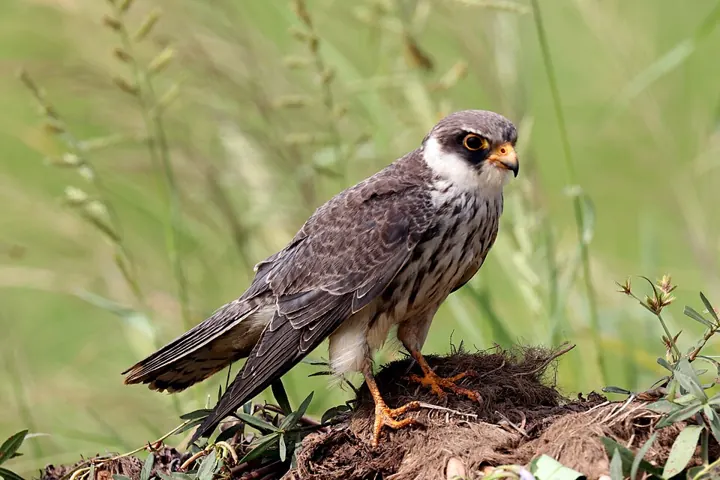
The yearly arrival of Amur falcons at Doyang Lake in Nagaland, on their journey from Mongolia, showcases how sustained local conservation efforts can help migratory birds; it is not due to tracking technology, and the falcons have not become permanent residents (Prelims 2026: 1 only; answer key provisional).
Which of the following statements with regard to the arrival of Amur Falcons at Doyang Lake in Nagaland each year from Mongolia is/are correct ? 1. It showcases how sustained local conservation efforts can contribute to the arrival and protection of international migratory birds. 2. It reflects the global success of advanced tracking technologies that guide migratory birds back to their stopover sites. 3. It confirms that Amur Falcons have adapted to permanent residency in India due to favourable habitat changes. Select the answer using the code given below :
- 1 only
- 1 and 2
- 2 and 3
- 3 only
Show answer
Answer: (a) · UPSC provisional key (final key awaited)
The UN Convention to Combat Desertification in those countries experiencing serious drought and/or desertification, particularly in Africa (UNCCD), was adopted at Paris on 14 October 1994 and entered into force on 26 December 1996. India signed on 14 October 1994 and ratified on 17 December 1996 (UN Treaty Collection). It covers land degradation in drylands.
The UNCCD aims to promote effective action through innovative national programmes and supportive international partnerships, and is committed to a bottom-up approach with participation of local people. It has no special focus on South Asia and North Africa (Prelims 2016: 1 and 3 only).
What is/are the importance/importances of the ‘United Nations Convention to Combat Desertification’? 1. It aims to promote effective action through innovative national programmes and supportive international partnerships. 2. It has a special/particular focus on South Asia and North Africa regions, and its Secretariat facilitates the allocation of major portion of financial resources to these regions. 3. It is committed to bottom-up approach, encouraging the participation of local people in combating the desertification. Select the correct answer using the code given below.
- 1 only
- 2 and 3 only
- 1 and 3 only
- 1, 2 and 3
Show answer
Answer: (c) · UPSC official key
The International Treaty on Plant Genetic Resources for Food and Agriculture, the UNCCD and the World Heritage Convention all have a bearing on biodiversity (Prelims 2014: 1, 2 and 3).
Consider the following international agreements : 1. The International Treaty on Plant Genetic Resources for Food and Agriculture 2. The United Nations Convention to Combat Desertification 3. The World Heritage Convention Which of the above has/have a bearing on the biodiversity?
- 1 and 2 only
- 3 only
- 1 and 3 only
- 1, 2 and 3
Show answer
Answer: (d) · UPSC official key
Mains box: analysis and answer points
- Sites are listed as Wetlands of International Importance.
- Parties commit to the 'wise use' of all wetlands in their territory, not only listed ones.
- Likely next angle: CITES appendices
- Asked: Mains 2018 (GS Paper III, 10 marks): What is wetland? Explain the Ramsar concept of ‘wise use’ in the context of wetland conservation. Cite two examples of Ramsar sites from India.
Practice
Practice MCQs (8)
On 16 September 2009, the Vienna Convention for the Protection of the Ozone Layer and the Montreal Protocol achieved a distinction for the first time in the history of the United Nations. What was it?
Answer (c) & explanation
With the accession of Timor-Leste on 16 September 2009, the Convention and the Protocol became the first treaties in UN history to achieve universal ratification. South Sudan (2012) and the State of Palestine (2019) joined later, so each has 198 parties as of October 2026. The date chosen, 16 September, is also International Day for the Preservation of the Ozone Layer.
The Vienna Convention for the Protection of the Ozone Layer, adopted in 1985, is best described as
Answer (b) & explanation
The Vienna Convention (22 March 1985) is a framework convention. Its parties agreed to cooperate in research, systematic observation of the ozone layer and exchange of information, and to take 'appropriate measures', but it set no quantities or dates. Binding cuts in CFCs and halons came two years later in the Montreal Protocol (1987), adopted under the Convention. The Multilateral Fund was created only in 1990 by the London Amendment.
Which one of the following is NOT provided for in the Vienna Convention for the Protection of the Ozone Layer (1985)?
Answer (b) & explanation
The Convention provides for research and systematic observation (Article 3 and Annex I), exchange of information (Article 4 and Annex II) and the adoption of protocols (Article 8), which is how the Montreal Protocol came about. It contains no fixed timetable or quantity for cutting CFCs; those control measures are in the Protocol and its later amendments and adjustments.
With reference to the Ozone Secretariat, consider the following statements:
1. It is hosted by the United Nations Environment Programme in Nairobi and serves both the Vienna Convention and the Montreal Protocol.
2. It also functions as the Secretariat of the Multilateral Fund and approves projects for developing countries.
Which of the statements given above is/are correct?
Answer (a) & explanation
Statement 1 is correct: the Ozone Secretariat, hosted by UNEP at Nairobi, is the secretariat for both the Vienna Convention and the Montreal Protocol and their meetings. Statement 2 is wrong: the Multilateral Fund has its own Fund Secretariat in Montreal, and projects are approved by the Fund's Executive Committee and carried out by implementing agencies.
Consider the following statements about the relationship between the Vienna Convention and the Montreal Protocol:
1. The Conference of the Parties to the Vienna Convention and the Meeting of the Parties to the Montreal Protocol are separate bodies, though they are sometimes held back to back.
2. The Vienna Convention entered into force only after the Montreal Protocol had entered into force.
3. A State cannot become a party to the Montreal Protocol unless it is, or becomes at the same time, a party to the Vienna Convention.
Which of the statements given above is/are correct?
Answer (c) & explanation
Statement 1 is correct: the Convention has its own Conference of the Parties, which meets about every three years, usually together with the Protocol's annual Meeting of the Parties, but the two are legally distinct. Statement 2 is wrong: the Convention entered into force on 22 September 1988, before the Protocol (1 January 1989). Statement 3 is correct under Article 16 of the Convention, which is why both treaties have the same 198 parties.
With reference to India and the Nagoya Protocol, consider the following statements:
1. India ratified the Nagoya Protocol in October 2012, the month in which it hosted the eleventh Conference of the Parties to the CBD in Hyderabad.
2. The preamble of the Biological Diversity (Amendment) Act, 2023 refers to India being a Party to the Nagoya Protocol.
3. The Biological Diversity Act, 2002 was originally enacted to give effect to India's obligations under the Nagoya Protocol.
Which of the statements given above are correct?
Answer (a) & explanation
India deposited its instrument of ratification of the Nagoya Protocol on 9 October 2012, while COP11 was being held in Hyderabad (8–19 October 2012). The Biological Diversity (Amendment) Act, 2023 recites in its preamble that India is a Party to the Nagoya Protocol, and the amendment aligned Indian law with Nagoya ideas such as compliance and monitoring. Statements 1 and 2 are correct. Statement 3 is wrong on chronology: the Biological Diversity Act, 2002 received assent on 5 February 2003 to give effect to the CBD of 1992. The Nagoya Protocol was adopted only in 2010, so a 2002 law could not have been enacted to implement it.
Consider the following statements regarding the Ramsar Convention and other global frameworks:
1. The Conference of the Parties to the Convention on Biological Diversity has recognised the Ramsar Convention as its lead implementation partner on wetlands.
2. The Ramsar Convention Secretariat is a co-custodian, along with UNEP, of the Sustainable Development Goal indicator on change in the extent of water-related ecosystems (SDG 6.6.1).
Which of the statements given above is/are correct?
Answer (c) & explanation
Both statements are correct. By Decision III/21 (1996) the CBD Conference of the Parties recognised the Ramsar Convention as the lead implementation partner on wetlands, and later CBD decisions recall this role. The Ramsar Secretariat is engaged in the SDG process as co-custodian with UNEP of indicator 6.6.1 (change in the extent of water-related ecosystems over time), as noted in the MoEFCC backgrounder for World Wetlands Day 2023.
Under Section 3 of the Biological Diversity Act, 2002, as amended in 2023, a body corporate incorporated or registered in India must obtain prior approval of the National Biodiversity Authority, like a foreign entity, for accessing biological resources when it
Answer (c) & explanation
Section 3 lists who needs the NBA's prior approval: foreigners, non-resident Indians, and certain bodies. The original Act of 2002 covered an Indian-registered body with 'any non-Indian participation in its share capital or management', so even a small foreign shareholding brought an Indian company into the approval regime. The 2023 amendment substituted a narrower test: a body incorporated or registered in India that is controlled by a foreigner within the meaning of section 2(27) of the Companies Act, 2013, which looks at the right to appoint a majority of directors or to control management or policy decisions. Other Indian entities follow the lighter route of prior intimation to the State Biodiversity Board.
0 / 0 correct
Write an answer
In 150 words, explain the significance of Environmental Conventions with one recent example.
Flashcards (4)
India ratified Ramsar on?
1 February 1982.
CITES Appendix I?
Threatened with extinction; commercial trade banned.
Bonn Convention is?
CMS, migratory species (1979).
UNCCD adopted at?
Paris, 14 October 1994.
Read more: related explainers
In the news
- 22 Oct 2026GRAP Stage I invoked in Delhi-NCR as AQI turns ‘Poor’: the 25 actions and what comes next
- 20 Oct 2026National Red List of birds: 1,211 species under assessment, 107 done in first review
- 16 Oct 2026CAQM orders PTZ cameras at all polluting industries in NCR by 30 November 2026
- 15 Oct 2026Sukhna Wetland and Sauj Jheel become Ramsar sites; India’s tally reaches 103
 Next chapter · 10. Environmental Organisations →Environmental Organisations: UNEP, IPCC, IUCN and NGOs
Syllabus: GS-III · Conservation, environmental pollution and degradation, environmental impact asse…