
Chapter 2 · Topic 2.3 · Prelims + Mains3 of 4
Geomorphology: Rocks, weathering, rivers and glaciers
Key points
- Igneous, sedimentary, metamorphic rocks and the rock cycle; primary rocks (2022); chalk and
- Weathering, mass wasting, landslides (2021, 2016); soil horizons and factors.
- River and glacial landforms; no deltas on Western Ghats rivers (2013); shrinking glaciers (2014).
Prelims box: facts and traps
| Group | How formed |
|---|---|
| Igneous (primary) | Cooling of magma or lava. Intrusive cools slowly underground, coarse crystals; extrusive cools fast on the surface, fine grains |
| Sedimentary | Layers of fragments, chemicals or organic remains compacted and cemented (lithification); may hold fossils |
| Metamorphic | Existing rock changed by heat and pressure without melting. |
- The Himalaya are young, still rising, made of weak, fractured sedimentary rocks, seismically active (Zones IV and V), and heavily cut for roads, dams and towns, so landslides are frequent and large.
- Trap: Porosity (how much space) is not the same as permeability (how easily water passes).
On this page (3 sections)
Rocks, the rock cycle and minerals
A mineral is a naturally occurring inorganic substance with a definite chemical composition and crystal structure: quartz, feldspar, mica, calcite. A rock is an aggregate of one or more minerals. Oxygen and silicon are the two most abundant elements of the crust, so silicate minerals (feldspar is the most common) dominate. Rocks fall into three groups by how they form.
| Group | How formed | Examples (and Indian cases) |
|---|---|---|
| Igneous (primary) | Cooling of magma or lava. Intrusive cools slowly underground, coarse crystals; extrusive cools fast on the surface, fine grains | Granite (intrusive); basalt (extrusive, the Deccan Traps) |
| Sedimentary | Layers of fragments, chemicals or organic remains compacted and cemented (lithification); may hold fossils | Sandstone, shale, limestone, coal (Gondwana coal of the Damodar valley) |
| Metamorphic | Existing rock changed by heat and pressure without melting | Limestone to marble (Makrana, Bhedaghat); shale to slate; granite to gneiss; sandstone to quartzite |
Mains 2022 said: Describe the characteristics and types of primary rocks. Primary rocks are igneous rocks, the first to form from molten material and the source of all others. They are crystalline, hard, usually without layers or fossils, and they hold metallic ores. By where they cool: intrusive or plutonic (granite; forms like batholiths, laccoliths, sills and dykes) and extrusive or volcanic (basalt). By chemistry: acidic, rich in silica and light in colour (granite), and basic, poorer in silica, dark and heavy (basalt, gabbro). Basalt weathers into the black cotton soil of the Deccan.
Describe the characteristics and types of primary rocks.
Prelims 2025 tested how rocks treat water, with Statement I: chalk is known as a very permeable rock whereas clay is known as quite an impermeable or least permeable rock. Statement II said chalk is porous and can absorb water; Statement III said clay is not at all porous. Answer (c): only Statement II is correct, and it explains I. The trap: clay is in fact very porous, but its pores are so tiny that water cannot flow through. Porosity (how much space) is not the same as permeability (how easily water passes).
Consider the following statements : Statement I : In the context of effect of water on rocks, chalk is known as a very permeable rock whereas clay is known as quite an impermeable or least permeable rock. Statement II : Chalk is porous and hence can absorb water. Statement III : Clay is not at all porous. Which one of the following is correct in respect of the above statements?
- Both Statement II and Statement III are correct and both of them explain Statement I
- Both Statement II and Statement III are correct but only one of them explains Statement I
- Only one of the Statements II and III is correct and that explains Statement I
- Neither Statement II nor Statement III is correct
Show answer
Answer: (c) · UPSC official key
Weathering, mass wasting, erosion and soil
formation Weathering breaks rock down where it lies; nothing is carried away. Erosion picks the material up and carries it away, by running water, glaciers, wind, waves or groundwater; deposition drops it somewhere else. Together these exogenic processes wear down relief (denudation).
Mass wasting (mass movement) is the movement of weathered material downslope under gravity, without a carrier such as water or ice doing the transport. Slow forms: soil creep and solifluction (waterlogged soil flowing over frozen ground). Fast forms: mudflows, debris avalanches, landslides, rockfalls and slumps. Triggers: steep slopes, heavy rain soaking the soil, earthquakes, removal of vegetation, and road cutting or quarrying at the foot of slopes.
Mains asks about landslides again and again. Mains 2021: Differentiate the causes of landslides in the Himalayan region and Western Ghats. The Himalaya are young, still rising, made of weak, fractured sedimentary rocks, seismically active (Zones IV and V), and heavily cut for roads, dams and towns, so landslides are frequent and large. The Western Ghats are older and made of hard basalt and gneiss, but have steep slopes, very heavy monsoon rain and a thick weathered layer (laterite), so landslides cluster in the monsoon, often where forests have been cleared or slopes quarried (Malin, 2014; Wayanad, 2024). Mains 2016 quoted “The Himalayas are highly prone to landslides.” and added: Discuss the causes and suggest suitable measures of mitigation. Measures: hazard zonation mapping, banning construction on unstable slopes, retaining walls and drainage, afforestation and terracing, and early warning based on rainfall.
Differentiate the causes of landslides in the Himalayan region and Western Ghats.
“The Himalayas are highly prone to landslides.” Discuss the causes and suggest suitable measures of mitigation.
Soil forms when weathered rock (regolith) is enriched with organic matter (humus) and colonised by living things. Five factors control it: parent material, climate (the most important over time), topography or relief, biological activity, and time. A mature soil shows layers called horizons: O (organic litter), A (topsoil, rich in humus), B (subsoil, where washed-down minerals collect) and C (weathered parent rock), above bedrock. In hot, wet climates heavy rain leaches silica and leaves iron and aluminium oxides: that is how laterite forms.
Landforms made by rivers and glaciers
| Stage of a river | Erosional landforms | Depositional landforms |
|---|---|---|
| Youth (upper course) | V-shaped valleys, gorges and canyons, waterfalls, rapids, potholes | Few |
| Maturity (middle course) | Wider valleys, meanders begin | Alluvial fans at the foot of hills, floodplains, natural levees |
| Old age (lower course) | Large meanders, oxbow lakes | Broad floodplains, braided channels, deltas or estuaries at the mouth |
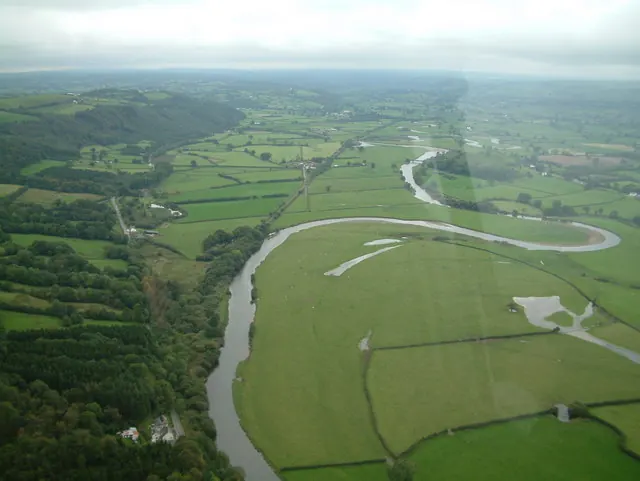
A meander is a loop in a river on a gentle slope: water erodes the outer bank (the undercut or cliff slope) and deposits on the inner bank (the point bar). When the neck of a loop is cut through during a flood, the abandoned loop becomes an oxbow lake. Gorges in India: the Marble Rocks gorge of the Narmada at Bhedaghat (on the cover) and the gorges cut by Himalayan rivers such as the Indus, Sutlej and Brahmaputra across the ranges.
A delta forms where a river carries a big load of sediment into calm, shallow water and deposits it faster than waves and currents can remove it. Mains 2013 said: There is no formation of deltas by rivers of the Western Ghats. Why? The west-flowing rivers are short and swift, flow over hard rock and carry little sediment; they fall steeply into the sea, the continental shelf is narrow, and strong waves and currents wash away what they bring. So they end in estuaries (the Narmada and Tapi too, which flow through rift valleys). The long east-flowing rivers (Mahanadi, Godavari, Krishna, Kaveri) carry heavy loads over gentle slopes into a calmer Bay of Bengal and build large deltas; the Ganga– Brahmaputra (Sundarbans) delta is the world’s largest.
There is no formation of deltas by rivers of the Western Ghats. Why?
Glaciers are masses of ice that move slowly downhill. Erosional landforms: the cirque (an armchair-shaped hollow at the head, often holding a tarn lake), the arête (a knife-edged ridge between two cirques), the horn (a pyramid peak where several cirques meet, such as the Matterhorn), the U-shaped valley, hanging valleys, and fjords (drowned U-shaped valleys, as in Norway). Depositional landforms: moraines (unsorted debris along the sides, middle and snout), drumlins (egg-shaped mounds of till), eskers (winding ridges of gravel from meltwater streams) and outwash plains.
Mains 2014 asked about the relationship between the shrinking Himalayan glaciers and the symptoms of climate change in the Indian sub-continent. Rising temperatures make most Himalayan glaciers retreat and thin (the Gangotri glacier, source of the Bhagirathi, has been retreating for decades). Effects: more glacial lakes and a higher risk of glacial lake outburst floods (South Lhonak lake, Sikkim, October 2023), more meltwater for some years and then less, which threatens summer flows in the Indus, Ganga and Brahmaputra, and changes in farming and hydropower.
Bring out the relationship between the shrinking Himalayan glaciers and the symptoms of climate change in the Indian sub-continent.
Mains box: analysis and answer points
- A mineral is a naturally occurring inorganic substance with a definite chemical composition and crystal structure: quartz, feldspar, mica, calcite.
- Oxygen and silicon are the two most abundant elements of the crust, so silicate minerals (feldspar is the most common) dominate.
- Primary rocks are igneous rocks, the first to form from molten material and the source of all others.
- Likely next angle: Rock cycle; Indian rock systems
- Asked: Mains 2022 (GS Paper I, 10 marks): Describe the characteristics and types of primary rocks.
Practice
Practice MCQs (8)
NCERT describes weathering as an in situ or on-site process. This is because
Answer (d) & explanation
NCERT defines weathering as the mechanical disintegration and chemical decomposition of rocks by the elements of weather and climate, and adds that, as very little or no motion of materials takes place, it is an in situ process. Transport of material is the work of erosion and mass movement, not weathering, and weathering occurs in every climate, though its type and depth vary.
With reference to the rock cycle, consider the following statements:
1. Igneous rocks can be changed into metamorphic rocks.
2. Sedimentary rocks can themselves break into fragments that become a source of new sedimentary rocks.
3. Once formed, crustal rocks can never return to the mantle to melt into magma.
Which of the statements given above is/are correct?
Answer (c) & explanation
Statements 1 and 2 are correct. NCERT describes the rock cycle as a continuous process in which old rocks become new ones: igneous rocks can turn metamorphic, and fragments of any rock, including sedimentary rock, can form new sedimentary rocks. Statement 3 is wrong: crustal rocks can be carried down into the mantle by subduction at convergent plate boundaries, where they melt into magma, the source of igneous rocks.
Consider the following statements about chemical weathering:
1. In carbonation, carbon dioxide from the air and soil is absorbed by water to form a weak carbonic acid that dissolves calcium and magnesium carbonates.
2. In hydration, minerals take up water and expand; calcium sulphate, for example, takes in water and turns into gypsum.
3. Oxidation is most active below the water table and in waterlogged ground where oxygen is absent.
Which of the statements given above is/are correct?
Answer (b) & explanation
Statements 1 and 2 are correct. Carbonation is the reaction of carbonate and bicarbonate with minerals: carbon dioxide absorbed by water forms carbonic acid, which dissolves calcium and magnesium carbonates, as in limestone. Hydration is the chemical addition of water; minerals swell, and calcium sulphate becomes gypsum. Statement 3 describes reduction, which takes place where oxygen is absent, such as below the water table or in stagnant, waterlogged ground; oxidation needs oxygen.
Consider the following statements:
1. The black soil of the north-western Deccan has developed largely from the weathering of basaltic lava of the Deccan Traps.
2. Chemical weathering is generally most intense in hot and humid tropical regions, which have deep weathering mantles.
3. Granite weathers chiefly by carbonation, because its main minerals are carbonates.
Which of the statements given above is/are correct?
Answer (a) & explanation
Statements 1 and 2 are correct. NCERT links black soil to its parent rock: it is typical of the Deccan Trap (basalt) region of the north-western Deccan, built of lava flows. Warmth and moisture speed chemical reactions, so the humid tropics have the deepest weathering mantles, as NCERT's figure on climatic regimes shows. Statement 3 is wrong: granite is made of silicates (feldspar, quartz, mica); its feldspar decays to clay mainly by reactions with water and weak acids, while carbonation acts chiefly on carbonate rocks such as limestone.
Consider the following statements: Statement-I: Frost weathering of rocks is most effective at high elevations in the mid-latitudes. Statement-II: At such places, the water held in the pores and cracks of rocks freezes and thaws repeatedly.
Which one of the following is correct in respect of the above statements?
Answer (a) & explanation
Both statements are correct and Statement-II explains Statement-I. Frost weathering occurs as ice grows in pores and cracks during repeated cycles of freezing and thawing; water expands by about 9 per cent on freezing, widening joints until the rock breaks. NCERT notes that it is most effective at high elevations in the mid-latitudes, precisely because freezing and melting are often repeated there; where it stays frozen all the time, the process is weaker.
When oxidised iron-bearing minerals come to lie below the water table or in waterlogged ground where oxygen is absent, reduction takes place. In this process, their red colour tends to change to
Answer (c) & explanation
In reduction, oxidised minerals placed in an oxygen-free setting, such as below the water table, in stagnant water or waterlogged ground, lose oxygen, and NCERT notes that the red colour of iron changes to greenish or bluish grey. The change of red iron to brown or yellow is what NCERT describes for oxidation, where oxygen is available.
Consider the following statements about physical weathering:
1. Most physical weathering processes are caused by thermal expansion and pressure release.
2. Weathering by temperature-driven expansion and contraction is most effective in dry climates and at high elevations, where diurnal changes of temperature are drastic.
3. Exfoliation domes result mainly from unloading, while tors result mainly from thermal expansion.
Which of the statements given above is/are correct?
Answer (d) & explanation
All three statements are correct. NCERT says most physical weathering is caused by thermal expansion and pressure release, that the repeated fatigue of expansion and contraction is most effective in dry climates and high elevations with drastic daily temperature changes, and that exfoliation domes and tors result from unloading and thermal expansion respectively. It adds that exfoliation is a result, not a process.
In hot deserts, crystals of sodium chloride and gypsum growing in the pores of rocks heave up the overlying surface layers and cause granular disintegration and flaking. This process is known as
Answer (b) & explanation
This is salt weathering. NCERT explains that salts in rocks expand through thermal action, hydration and crystallisation, that sodium chloride and gypsum crystals in desert areas heave up the overlying layers, and that salt crystallisation is the most effective of the salt- weathering processes. Hydration is a part of salt action but is defined as the chemical addition of water to minerals; unloading is pressure release on exposed rock.
0 / 0 correct
Write an answer
In 150 words, explain the significance of Geomorphology with one recent example.
Flashcards (5)
Limestone becomes which metamorphic
rock? Marble.
Is clay porous?
Yes, but it is impermeable.
Weathering versus erosion?
Weathering breaks rock in place; erosion carries it away.
Why do Western Ghats rivers form no
deltas? Short, swift, little sediment, narrow shelf, strong waves.
Armchair-shaped glacial hollow?
Cirque.
Read more: related explainers
In the news
- 25 Oct 2026Bleached corals revived in the lab: two studies on algae transfer and heat-tolerant symbionts
- 25 Oct 2026Niño 3.4 crosses 30°C for the first time: a possibly record El Niño and what it means for India
- 25 Oct 2026North India is drying: IMD–IITM study on shifting climate zones and the Pacific ‘Victoria Mode’
- 16 Oct 2026Neyveli, Tiruchirappalli and Atacama: Indian scientists identify Martian analogue sites
 Next topic · 2.4 →Geomorphology: Landforms made by wind, waves and groundwater
Syllabus: GS-I · Salient features of world’s physical geography.