
Chapter 22 · Topic 22.2 · Prelims + Mains2 of 4
Elections: Parties, Model Code and EVMs
Key points
- National party: 6% votes in four or more States + four Lok Sabha seats; or 2% of LS seats from three States; or State party in four States.
- Symbols Order, 1968; split disputes use the majority test (Sadiq Ali, 1971). 2023: six national parties remain.
- MCC: began in Kerala 1960; not a law; enforced under Art 324; strict since 1991.
- VVPAT: Subramanian Swamy 2013; five per segment (Chandrababu Naidu 2019); ADR v ECI April 2024.
10 PYQs 2017–2026
Prelims box: facts and traps
- State party: 6% votes + two Assembly seats; or 3% of seats (minimum three); or one LS seat per 25; or 8% votes.
- Registered unrecognised: Section 29A, RP Act 1951; no reserved symbol.
Political parties and symbols
Like a league: winning teams keep their own jersey.
| Status | How a party earns it (any one) |
|---|---|
| National party | 6% of valid votes in four or more States plus four Lok Sabha seats; or 2% of Lok Sabha seats from at least three States; or recognition as a State party in four States |
| State party | 6% of votes plus two Assembly seats; or 3% of Assembly seats (minimum three); or one Lok Sabha seat per 25; or 8% of votes in the State |
| Registered unrecognised | Registered under Section 29A of the RP Act, 1951; no reserved symbol |
Symbols are allotted under the Election Symbols (Reservation and Allotment) Order, 1968; a recognised party gets a reserved symbol. When a party splits, the Commission applies the test of majority (Sadiq Ali, 1971), counting organisation and legislators. In 2023 the Commission withdrew national status from three parties, leaving six national parties.
Mains 2022: “While the national political parties in India favour centralisation, the regional parties are in favour of State autonomy.” Comment.
- The pattern holds broadly: regional demands for Art 356 restraint, more tax share, the Rajamannar and Anandpur Sahib resolutions.
- But: national parties in opposition also defend federalism, and regional parties in Union coalitions have supported central schemes.
While the national political parties in India favour centralisation, the regional parties are in favour of State autonomy.” Comment.
What UPSC asks: Prelims: recognition criteria; symbols order. Mains: national vs regional parties (2022). Next likely angle: splits and the majority test.
→ Parliament The Tenth Schedule and defection.
Model Code, EVMs and VVPAT
The Model Code of Conduct (MCC) is a set of rules for parties and governments during elections. It began in Kerala in 1960 as a code agreed by parties; the Commission adopted it nationally and since 1991 has enforced it strictly. It is not a law, but the Commission enforces it through its Art 324 powers.
Mains 2022 asked about the Election Commission’s role as the MCC evolved. It bars new schemes and transfers once polls are announced and checks hate speech, but critics point to slow and uneven action.
Discuss the role of the Election Commission of India in the light of the evolution of the Model Code of Conduct.
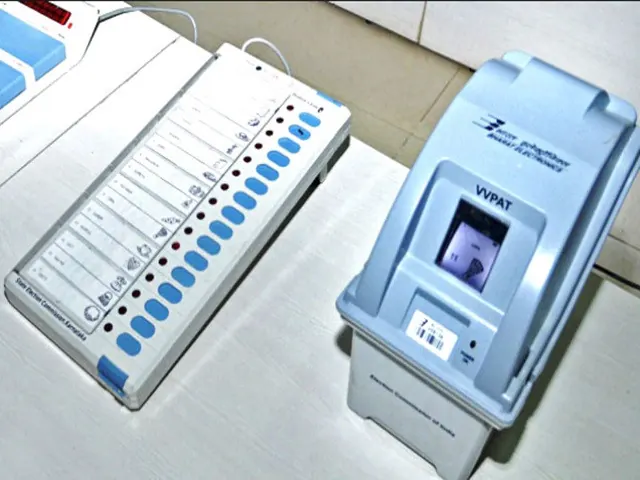
EVMs and VVPAT. A VVPAT (Voter Verifiable Paper Audit Trail) prints a slip the voter can check.
- EVMs have been used in all constituencies since 2004.
- VVPAT paper slips were ordered by the Supreme Court in Subramanian Swamy (2013).
- Slips from five VVPATs per Assembly segment are counted (Chandrababu Naidu, 2019).
- In April 2024, in ADR v Election Commission, the Court refused to go back to paper ballots or count all slips, but let the second- and third-placed candidates seek a check of EVM memory by engineers.
These answer Mains 2018 on EVM trust.
In the light of recent controversy regarding the use of Electronic Voting Machines (EVM), what are the challenges before the Election Commission of India to ensure the trustworthiness of elections in India?
What UPSC asks: Prelims: VVPAT cases. Mains: MCC and ECI’s role (2022); EVM trust (2018). Next likely angle: ADR v ECI (2024).
Mains box: analysis and answer points
- 2022: national vs regional parties on centralisation; ECI and the MCC. 2018: EVM trust.
Practice
Practice MCQs (8)
Consider the following statements:
1. Independent candidates are allotted symbols from the list of symbols reserved for national parties.
2. Registered but unrecognised parties choose their symbols from the list of free symbols.
Which of the statements given above is/are correct?
Answer (b) & explanation
Statement 2 is correct: candidates of registered unrecognised parties choose from the Election Commission's list of free symbols, as do independents. Statement 1 is incorrect: a reserved symbol belongs only to the recognised party it is reserved for, and no other candidate may be given it in a constituency where that party is contesting. The Commission notifies a list of free symbols before elections, and a candidate of a registered unrecognised party or an independent names a few in order of preference; the Returning Officer allots them, drawing lots if two candidates want the same symbol. Under paragraph 10B of the Symbols Order, a registered unrecognised party can sometimes get a common free symbol for all its candidates in a State if it fields candidates in a set minimum share of the seats. A reserved symbol, however, cannot be given to any other candidate in a constituency where its party is contesting.
The right of citizens to form political parties is protected mainly by which provision of the Constitution?
Answer (a) & explanation
Article 19(1)(c) guarantees the freedom to form associations or unions, and a political party is an association of this kind. The right is subject to reasonable restrictions under Article 19(4) in the interests of sovereignty, integrity, public order or morality. Article 19(1)(a) protects speech, Article 21 life and liberty, and Article 14 equality. The words 'sovereignty and integrity of India' were added to Article 19(4) by the 16th Amendment (1963), so even the freedom to form a party can be limited on those grounds. That is why an association may be declared unlawful under the Unlawful Activities (Prevention) Act, 1967. The 97th Amendment (2011) also added co-operative societies to Article 19(1)(c). Note that the original Constitution did not mention political parties at all; the term entered only with the Tenth Schedule in 1985.
Consider the following statements:
1. Political parties are registered by the Election Commission under the Election Symbols (Reservation and Allotment) Order, 1968.
2. The registration of political parties is provided for in Section 29A of the Representation of the People Act, 1951.
Which of the statements given above is/are correct?
Answer (b) & explanation
Statement 2 is correct: Section 29A of the Representation of the People Act, 1951, added in 1989, provides for the registration of associations as political parties by the Election Commission. Statement 1 is incorrect: the Symbols Order, 1968 deals with the recognition of registered parties as national or State parties and with the reservation and allotment of symbols, not with registration. Section 29A was inserted by the Representation of the People (Amendment) Act, 1988, which took effect in 1989. Registration brings concrete benefits: the right to receive contributions under Section 29B, income-tax exemption under Section 13A of the Income-tax Act, and preference over independents when free symbols are allotted. The Symbols Order, by contrast, was issued by the Commission under Article 324 read with the Conduct of Election Rules, 1961, and it builds on registration by sorting registered parties into recognised and unrecognised ones.
Consider the following statements:
1. In Sadiq Ali v. Election Commission (1971), the Supreme Court upheld the Symbols Order and the Commission's power to decide disputes between rival groups of a recognised party.
2. Such disputes between rival groups of a recognised party are decided under paragraph 15 of the Symbols Order.
Which of the statements given above is/are correct?
Answer (c) & explanation
Both statements are correct. Sadiq Ali (1971) arose from the 1969 Congress split and upheld the Commission's power, drawn from Article 324, to decide which group is the real party. Such disputes are decided under paragraph 15 of the Symbols Order, usually by testing which group has majority support in the party's organisation and legislature wing. Paragraph 15 has been used in many famous splits since 1969. More recently, in February 2023 the Commission awarded the Shiv Sena name and the bow-and-arrow symbol to the faction led by Eknath Shinde, and in February 2024 it recognised the faction led by Ajit Pawar as the Nationalist Congress Party, relying mainly on support among legislators. Sadiq Ali also clarified that Article 324's superintendence power lets the Commission fill gaps where the law is silent, so its orders on splits are not merely administrative.
Match List-I (Provision) with List-II (Subject): List-I A. Section 29A, RP Act, 1951 B. Section 29C, RP Act, 1951 C. Paragraph 15, Symbols Order, 1968 D. Section 77, RP Act, 1951 List-II
1. Declaration of donations received by parties
2. Registration of political parties
3. Election expenses, including those of star campaigners
4. Disputes between rival groups of a recognised party
Select the correct answer using the code given below:
Answer (c) & explanation
Section 29A covers registration, Section 29C the declaration of donations above the set limit, paragraph 15 of the Symbols Order rival-group disputes, and Section 77 the account of election expenses, including the rule on star campaigners' travel. So the correct code is A-2, B-1, C-4, D-3. Sections 29B and 29C were inserted by the Election and Other Related Laws (Amendment) Act, 2003, which also added Section 39A on sharing broadcast time on electronic media. Section 77 requires every candidate to keep an account of election expenses, and its Explanation says that travel expenses of the party's leaders named as star campaigners are not added to the candidate's account. The ceiling itself is fixed under Rule 90 of the Conduct of Election Rules; since 2022 it has been 95 lakh rupees for a Lok Sabha seat in the larger States.
Under Section 29A of the Representation of the People Act, 1951, an association seeking registration as a political party must apply to the Election Commission within
Answer (c) & explanation
Section 29A(2) requires an association that wants to be registered as a political party to apply to the Election Commission within thirty days of its formation. The application must be signed by the party's chief office-holder and include its memorandum or rules, with particulars such as its name, office-bearers and number of members. The Commission then decides whether to register it. Under the Commission's registration guidelines, the applicant also pays a processing fee and publishes the proposed party name in newspapers, so that objections can be raised before the Commission decides. Section 29A(7) then lets the Commission register the association or refuse, after hearing its representatives, and Section 29A(9) says that once registered, any change in the party's name, address or office-bearers must be communicated to the Commission without delay. The thirty-day window ensures that new outfits announce themselves quickly instead of appearing just before polling.
Consider the following statements:
1. The Election Commission has a general power to deregister a registered party for violating the Model Code of Conduct.
2. The Election Commission's decision to register a party under Section 29A is purely administrative and not quasi-judicial.
Which of the statements given above is/are correct?
Answer (d) & explanation
Both statements are incorrect. In Indian National Congress v. Institute of Social Welfare (2002), the Supreme Court held that registration under Section 29A is a quasi-judicial act, so the Commission cannot review it at will. The Act gives no general power to deregister; the Court allowed it only in narrow cases, such as registration obtained by fraud or a party being declared unlawful. Section 29A(8) makes the Commission's decision on registration final, and the Act contains no clause for cancelling it, which is why the 2002 judgment treated registration as quasi-judicial. The Commission does have a different, narrower tool: under paragraph 16A of the Symbols Order it may suspend or withdraw a party's recognition, not its registration, if the party fails to observe the Model Code of Conduct or the Commission's lawful directions. The Commission has repeatedly asked Parliament for an express power to deregister parties, but no such amendment has been made.
Consider the following:
1. A reserved symbol
2. Up to forty star campaigners during elections
3. Free broadcast and telecast time on public broadcasters during general elections
4. Exemption of their candidates from the limit on election expenses
How many of the above are available to recognised national parties?
Answer (c) & explanation
Only three. A recognised national party gets a reserved symbol, may name up to forty star campaigners under Section 77 (a registered unrecognised party may name twenty), and is given free broadcast time on Doordarshan and All India Radio during general elections. Its candidates are not exempt from the expenditure limit; the limit applies to every candidate. Section 39A, inserted in 2003, lets the Commission allocate time on electronic media among recognised parties, and the Commission does this through a formula that combines a base share with a share based on past performance. Under Section 77, a recognised party may name up to forty star campaigners and a registered unrecognised party up to twenty. The candidate's expenditure limit, fixed under Rule 90 of the Conduct of Election Rules, applies to every candidate equally, whether from a national party or an independent.
0 / 0 correct
Prelims PYQs on this topic (8)
Consider the following statements :
- 1. The Election Commission of India is a five-member body.
- 2. Union Ministry of Home Affairs decides the election schedule for the conduct of both general elections and bye-elections.
- 3. Election Commission resolves the disputes relating to splits/mergers of recognised political parties.
Which of the statements given above is/are correct?
Answer (d) & explanation
Only statement 3 is correct (d). Statement 1 is wrong because the Election Commission has been a three-member body since 1993: the Chief Election Commissioner and two Election Commissioners. Statement 2 is wrong because the Commission itself fixes the schedule for general elections and by-elections, not the Home Ministry. Statement 3 is right because, under paragraph 15 of the Election Symbols (Reservation and Allotment) Order, 1968, it decides disputes between rival groups of a recognised party, as it did for the Shiv Sena and NCP in 2023–24.
Under the CEC and Other ECs Act, 2023, a panel of the PM, the Leader of the Opposition and a Union Minister chooses the members. Notice the earlier case Anoop Baranwal (2023), which had included the CJI on that panel.
Answer as per the official UPSC answer key.
Consider the following statements :
- 1. If the election of the President of India is declared void by the Supreme Court of India, all acts done by him/her in the performance of duties of his/her office of President before the date of decision become invalid.
- 2. Election for the post of the President of India can be postponed on the ground that some Legislative Assemblies have been dissolved and elections are yet to take place.
- 3. When a Bill is presented to the President of India, the Constitution prescribes time limits within which he/she has to declare his/her assent.
How many of the above statements are correct?
Answer (d) & explanation
None of the statements is correct (d). Statement 1 is wrong: Article 71(2) says acts done by the President before the election is declared void stay valid. Statement 2 is wrong: the election cannot be put off because some Assemblies stand dissolved, and under Article 71(4) the poll cannot be questioned on that ground. Statement 3 is wrong: Article 111 sets no time limit for assent. The President may give assent, withhold it, or return a non-money Bill once.
Notice the recent debate. In 2025, a Supreme Court bench set timelines for Governors in a Tamil Nadu case, but on a Presidential Reference later that year, a Constitution Bench held that courts cannot impose such fixed timelines. This is why people speak of the President's pocket veto.
"None" feels risky, so students force one statement to be true. Write T or F against each line first, then trust the count.
Answer as per the official UPSC answer key.
Consider the following statements in respect of election to the President of India :
- 1. The members nominated to either House of the Parliament or the Legislative Assemblies of States are also eligible to be included in the Electoral College.
- 2. Higher the number of elective Assembly seats, higher is the value of vote of each MLA of that State.
- 3. The value of vote of each MLA of Madhya Pradesh is greater than that of Kerala.
- 4. The value of vote of each MLA of Puducherry is higher than that of Arunachal Pradesh because the ratio of total population to total number of elective seats in Puducherry is greater as compared to Arunachal Pradesh.
How many of the above statements are correct?
Answer (a) & explanation
Only statement 4 is correct (a). Statement 1 is wrong: only elected members of Parliament and of State Assemblies, including Delhi and Puducherry, vote; nominated members are left out. Statement 2 is wrong: an MLA's vote value is the State's 1971 population divided by its elected seats, then by 1,000, so more seats for the same population means a lower value. Statement 3 is wrong: a Kerala MLA's vote (152) is worth more than a Madhya Pradesh MLA's (131). Statement 4 is right: Puducherry's value (16) is higher than Arunachal's (8), for the reason given.
Notice that Uttar Pradesh has the highest value, 208, and Sikkim the lowest, 7. An MP's vote is the total value of all MLAs divided by the number of elected MPs, about 700.
statement 2 sounds logical but has the ratio upside down. Population is on top, seats below.
Answer as per the official UPSC answer key.
With reference to Deputy Speaker of Lok Sabha, consider the following statements :
- 1. As per the Rules of Procedure and Conduct of Business in Lok Sabha, the election of Deputy Speaker shall be held on such date as the Speaker may fix.
- 2. There is a mandatory provision that the election of a candidate as Deputy Speaker of Lok Sabha shall be from either the principal opposition party or the ruling party.
- 3. The Deputy Speaker has the same power as of the Speaker when presiding over the sitting of the House and no appeal lies against his rulings.
- 4. The well established parliamentary practice regarding the appointment of Deputy Speaker is that the motion is moved by the Speaker and duly seconded by the Prime Minister.
Which of the statements given above are correct?
Answer (a) & explanation
Statements 1 and 3 are correct (a). Statement 1 is right: under Rule 8 of the Lok Sabha's Rules of Procedure, the election of the Deputy Speaker is held on a date the Speaker fixes. Statement 2 is wrong: no rule ties the post to the opposition or the ruling party; giving it to the opposition is only a custom. Statement 3 is right: when presiding, the Deputy Speaker has the Speaker's full powers, and no appeal lies against his rulings. Statement 4 is wrong: the motion is moved by a member, not by the Speaker.
Notice that Article 93 says the Lok Sabha "shall" choose a Deputy Speaker, yet the post stayed vacant through the whole 17th Lok Sabha (2019–24). The Deputy Speaker sends any resignation to the Speaker.
"mandatory provision" for what is only a convention.
Answer as per the official UPSC answer key.
Consider the following statements :
- 1. In India, there is no law restricting the candidates from contesting in one Lok Sabha election from three constituencies.
- 2. In 1991 Lok Sabha Election, Shri Devi Lal contested from three Lok Sabha constituencies.
- 3. As per the existing rules, if a candidate contests in one Lok Sabha election from many constituencies, his/her party should bear the cost of bye-elections to the constituencies vacated by him/her in the event of him/her winning in all the constituencies.
Which of the statements given above is/are correct?
No official answer (question dropped) & notes
UPSC dropped this question from evaluation, so no answer was scored. The likely trouble was statement 2: Devi Lal did contest from three Lok Sabha seats in 1991 (Sikar, Rohtak and Ferozepur), but the wording was disputed. The current law is clear. Statement 1 is wrong: since 1996, Section 33(7) of the Representation of the People Act, 1951 lets a candidate contest from at most two constituencies. Statement 3 is wrong: no rule makes the party pay for bye-elections; the Election Commission has only suggested that the candidate pay.
Notice that a winner of two seats must quit one within 14 days under Section 70. Before 1996, there was no limit on the number of seats.
UPSC did not evaluate this question, so no official answer exists. Use it for practice only.
UPSC dropped this question from evaluation; there is no official answer.
Consider the following statements :
- 1. According to the Constitution of India, a person who is eligible to vote can be made a minister in a State for six months even if he/she is not a member of the Legislature of that State.
- 2. According to the Representation of People Act, 1951, a person convicted of a criminal offence and sentenced to imprisonment for five years is permanently disqualified from contesting an election even after his release from prison.
Which of the statements given above is/are correct?
Answer (d) & explanation
Neither statement is correct (d). Statement 1 is wrong because Article 164(4) lets a non-member be a State minister for six months, but that person must be qualified to become an MLA. That requires a minimum age of 25, not just being a voter, who can be 18. Statement 2 is wrong because, under Section 8(3) of the Representation of the People Act, 1951, a person sentenced to two years or more is disqualified from the date of conviction for the period of the sentence plus six years after release, not permanently.
In Lily Thomas (2013), the Court removed the protection that let sitting MPs and MLAs keep their seats while appealing. Notice the 2025 debate on a lifetime ban for convicted politicians, which the Centre opposed.
"eligible to vote" (age 18) slipped in for "qualified to be a member" (age 25).
Answer as per the official UPSC answer key.
Mains PYQs on this topic (2)
- UPSC Mains 2026 · GS Paper II · Q4Is the right to vote a fundamental right? Discuss the position of the Election Commission of India while undertaking the revision of electoral rolls. Can it also examine the question of citizenship of voters?How to approach: Intro: Article 326 and adult suffrage. Body: case law on the nature of the right; legal basis of roll revision (Article 324, RP Act 1950); the citizenship quest…
- UPSC Mains 2024 · GS Paper II · Q1Examine the need for electoral reforms as suggested by various committees with particular reference to “one nation — one election” principle.How to approach: Intro: Free and fair elections are part of the basic structure. Body: (1) Committees; (2) Case for ONOE; (3) Concerns. Conclusion: ONOE needs wide consensus. Re…
Write an answer
In 150 words, explain the significance of Elections with one recent example.
Flashcards (4)
Under which order are symbols allotted?
The Election Symbols (Reservation and Allotment) Order, 1968.
Which test decides a party split?
The test of majority (Sadiq Ali, 1971).
Where did the Model Code begin?
Kerala, 1960.
Which case ordered VVPAT?
Subramanian Swamy v ECI (2013).
Read more: related explainers
- Election Commission of India (Article 324): Composition, 2023 Appointment Law, Powers, Model Code and Reforms
- Uniform Civil Code (Article 44): Meaning, Constituent Assembly Debate, Court Cases, Goa and Uttarakhand Models and the Way Forward
- Pressure Groups in India: Meaning, Types, Methods, Difference from Political Parties and Role in Democracy (UPSC Notes)
In the news
- 24 Oct 2026Any voter can prosecute a candidate for a false affidavit: Supreme Court on Section 125A of the RP Act
- 24 Oct 2026Legislative Council polls in four States: why only six States have a second chamber
- 23 Oct 2026Election Commissioners’ letters to the Cabinet Secretary: what the RTI reply reveals about the ECI
- 26 Sep 2026ECI eases SIR verification: BLOs to collect documents at home, hearings online only in exceptional cases
 Next topic · 22.3 →Elections: Corrupt practices and election disputes
Syllabus: GS-II · Salient features of the Representation of People’s Act.