
Chapter 15 · Topic 15.3 · Prelims + Mains3 of 3
Federal System: Inter-State Council, Zonal Councils and other forums
Key points
- Forums: Inter-State Council (Art 263, 1990); Zonal Councils (1956 Act, Home Minister chairs);
- Water: Art 262; Inter-State River Water Disputes Act 1956; award = Supreme Court decree
- Commissions: ARC 1966, Rajamannar 1969, Sarkaria 1983–88, Punchhi 2007–10.
1 PYQ 2016–2025
Prelims box: facts and traps
| Body | Basis |
|---|---|
| Inter-State Council | Art 263; Presidential order of 1990 |
| Zonal Councils (5) | States Reorganisation Act, 1956 |
| North Eastern Council | North Eastern Council Act, 1971 |
| NITI Aayog | Cabinet resolution, 2015. |
- The National Security Council (1998) was set up by executive order, and the Zonal Councils by the States Reorganisation Act, 1956.
- Of three bodies asked in 2025, only the Inter-State Council was established as per the provisions of the Constitution of India: Art 263 lets the President set it up, and it was created in 1990 on the Sarkaria Commission's advice.
- Asymmetry: special provisions for some States (Art 371 to 371J), the Fifth and Sixth Schedules for tribal areas, linguistic reorganisation of States (1956), and the former Art 370 (removed in 2019.
- Trap (UPSC Prelims 2013): all the statements are correct.
- Trap (UPSC Prelims 2024): “The Home Minister of India” is incorrect.
On this page (3 sections)
Inter-State Council, Zonal Councils and other forums
Of three bodies asked in 2025, only the Inter-State Council was established as per the provisions of the Constitution of India: Art 263 lets the President set it up, and it was created in 1990 on the Sarkaria Commission’s advice. The National Security Council (1998) was set up by executive order, and the Zonal Councils by the States Reorganisation Act, 1956. Answer: only one.
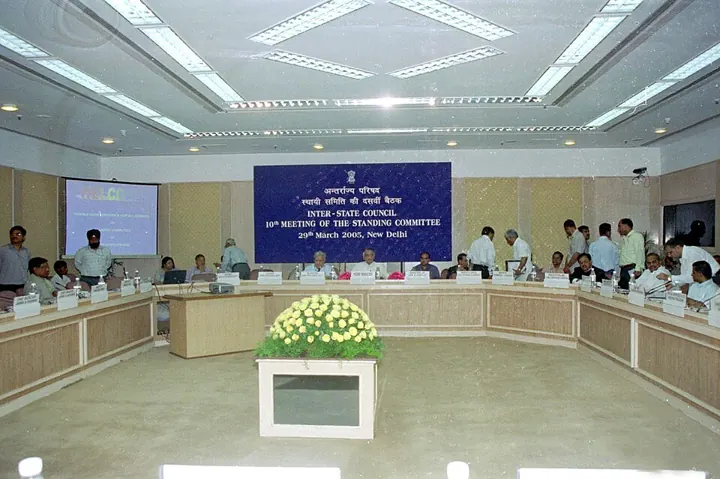
With reference to India, consider the following : I. The Inter-State Council II. The National Security Council III. Zonal Councils How many of the above were established as per the provisions of the Constitution of India?
- Only one
- Only two
- All the three
- None
Show answer
Answer: (a) · UPSC official key
| Body | Basis | Members |
|---|---|---|
| Inter-State Council | Art 263; Presidential order of 1990 | PM (chair); CMs of all States and of UTs with legislatures; Administrators of other UTs; six Union Cabinet ministers chosen by the PM |
| Zonal Councils (5) | States Reorganisation Act, 1956 | Union Home Minister (chair); CMs of the zone, one as vice-chair by rotation |
| North Eastern Council | North Eastern Council Act, 1971 | After the 2002 amendment: the Governors and CMs of the member States, and three members nominated by the President |
| NITI Aayog | Cabinet resolution, 2015 | Governing Council includes all CMs and UT Lieutenant Governors |
The North Eastern Council was originally an advisory body; after the amendment of NEC Act in 2002 it became a regional planning body, with Sikkim as its eighth member. Its membership is the Governors, the Chief Ministers and three Members to be nominated by the President of India, so the 2024 key is 1, 2 and 3 only.
The North Eastern Council (NEC) was established by the North Eastern Council Act, 1971. Subsequent to the amendment of NEC Act in 2002, the Council comprises which of the following members ? 1. Governor of the Constituent State 2. Chief Minister of the Constituent State 3. Three Members to be nominated by the President of India 4. The Home Minister of India Select the correct answer using the code given below :
- 1, 2 and 3 only
- 1, 3 and 4 only
- 2 and 4 only
- 1, 2, 3 and 4
Show answer
Answer: (a) · UPSC official key
The National Development Council, the Planning Commission and the Zonal Councils do not find mention in the Constitution: all three were set up outside it (2013: 1, 2 and 3). The NDC and the Planning Commission were created by executive resolutions in 1952 and 1950.
Which of the following bodies does not/do not find mention in the Constitution? 1. National Development Council 2. Planning Commission 3. Zonal Councils Select the correct answer using the codes given below.
- 1 and 2 only
- 2 only
- 1 and 3 only
- 1, 2 and 3
Show answer
Answer: (d) · UPSC official key
Mains 2015 asked about the drawbacks in the existing structure and the extent to which cooperative federalism would answer the shortcomings. Drawbacks: the Inter-State Council meets rarely; the Zonal Councils are advisory; Governors are seen as the Centre’s agents; transfers carry conditions. Cooperative federalism (NITI’s Governing Council, the GST Council, the Aspirational Districts programme) helps, but needs regular meetings and real power-sharing. Add competitive federalism: States ranked on indices compete for investment.
The concept of cooperative federalism has been increasingly emphasized in recent years. Highlight the drawbacks in the existing structure and the extent to which cooperative federalism would answer the shortcomings.
Inter-State water disputes
Art 262 lets Parliament provide by law for adjudicating disputes over inter-State rivers, and to bar the Supreme Court and other courts from hearing them. Parliament passed the Inter-State River Water Disputes Act, 1956 (tribunals) and the River Boards Act, 1956. Since a 2002 amendment, a tribunal’s award has the same force as a Supreme Court order.
| Dispute | Tribunal or outcome |
|---|---|
| Cauvery (Karnataka, Tamil Nadu, Kerala, Puducherry) | Tribunal award 2007; modified by the Supreme Court in 2018, which called the river a national asset; Cauvery Water Management Authority set up |
| Krishna | Two tribunals; the second re-examining shares after Telangana was created |
| Mahadayi / Mandovi (Goa, Karnataka, Maharashtra) | Tribunal award 2018 |
| Ravi-Beas | Tribunal set up in 1986; still unresolved |
Mains 2013: constitutional mechanisms to resolve the inter-state water disputes have failed. Is it structure or process? Structure: tribunals are ad hoc, the Centre has no enforcement power, data are poor, and courts still hear appeals under Art 136. Process: tribunals take decades, awards are notified years later, and States treat water as a political issue. Fixes: a permanent tribunal with fixed timelines (the Inter-State River Water Disputes (Amendment) Bill, 2019 proposed one; the Lok Sabha passed it but the Rajya Sabha did not), basin authorities, and shared data.
Constitutional mechanisms to resolve the inter-state water disputes have failed to address and solve the problems. Is the failure due to structural or process inadequacy or both? Discuss.
Mains view: commissions, asymmetry and trust
| Commission | Year | Key ideas |
|---|---|---|
| Administrative Reforms Commission | 1966 | Set up an Inter-State Council; Governors from outside active politics |
| Rajamannar Committee (Tamil Nadu) | 1969 | Greater State autonomy; abolish All India Services |
| Sarkaria Commission | 1983– 88 | Use Art 356 sparingly; set up the Inter- State Council; consult CMs on Governors |
| Punchhi Commission | 2007– 10 | Fixed tenure for Governors; ‘localised emergency’; reform of the Inter-State Council |
Mains 2026 asked how far the Indian federal framework has accommodated regional and cultural diversities, and the role of asymmetric federalism. Asymmetry: special provisions for some States (Art 371 to 371J), the Fifth and Sixth Schedules for tribal areas, linguistic reorganisation of States (1956), and the former Art 370 (removed in 2019; upheld by the Supreme Court in December 2023). Dispute resolution can be made more effective by a revived Inter-State Council, permanent water tribunals and the use of Art 131 suits.
How far has the Indian federal framework been successful in accommodating regional and cultural diversities? Highlight the role of asymmetric federalism and suggest measures to make dispute resolution mechanisms more effective.
Mains 2024 asked what changes the Union Government has recently introduced in Centre-State relations and how to build the trust between the Centre and the States. Changes: GST and the GST Council, NITI Aayog in place of the Planning Commission, the reorganisation of Jammu and Kashmir into UTs, wider use of Central agencies, and disputes over Governors’ delay on State bills (in November 2025 the Supreme Court advised that courts cannot fix timelines for assent, but prolonged inaction is open to limited review). Trust: regular Inter-State Council meetings, consulting States before laws on Concurrent subjects, sharing cess revenue, and following the Sarkaria and Punchhi advice on Governors.
What changes has the Union Government recently introduced in the domain of Centre-State relations? Suggest measures to be adopted to build the trust between the Centre and the States and for strengthening federalism.
| Cooperative | Fiscal | Political |
|---|---|---|
| Joint bodies: GST Council, | Divisible pool, cesses, | Governors, Art 356, |
| NITI, Inter-State Council. | borrowing limits. | Central agencies. |
→ State Government The Governor’s role in Centre-State relations.
Mains box: analysis and answer points
- The North Eastern Council was originally an advisory body; after the amendment of NEC Act in 2002 it became a regional planning body, with Sikkim as its eighth member.
- Likely next angle: Inter-State Council meetings; competitive federalism indices
- Asked: Mains 2015 (GS Paper II, 12.5 marks): The concept of cooperative federalism has been increasingly emphasized in recent years. Highlight the drawbacks in the existing structure and the extent to which cooperative federalism would answer the shortcomings.
Practice
Prelims PYQs on this topic (1)
With reference to India, consider the following :
- I. The Inter-State Council
- II. The National Security Council
- III. Zonal Councils
How many of the above were established as per the provisions of the Constitution of India?
Answer (a) & explanation
Only one was set up under the Constitution (a). Item I is right: the Inter-State Council rests on Article 263, which lets the President set it up; it was formed in 1990, after the Sarkaria Commission advised it. Item III is wrong: Zonal Councils come from the States Reorganisation Act, 1956, an ordinary law, so they are statutory. Item II is wrong: the National Security Council (1998) was set up by an executive decision. So options (b), (c) and (d) fail.
Notice the pattern UPSC tests: constitutional bodies (Finance Commission, Election Commission, CAG), statutory bodies (NHRC, Zonal Councils) and executive bodies (NITI Aayog, NSC). The Union Home Minister chairs all five Zonal Councils. The North Eastern Council is a separate statutory body.
"council" in all three names. Ask where each one's power comes from: Constitution, Act or government order.
Answer as per the official UPSC answer key.
Write an answer
In 150 words, explain the significance of Federal System with one recent example.
Flashcards (4)
Under which law were Zonal Councils set
up? The States Reorganisation Act, 1956.
Who chairs a Zonal Council?
The Union Home Minister.
Which Article deals with inter-State water
disputes? Art 262.
Which commission (1983–88) studied
Centre–State relations? The Sarkaria Commission.
Read more: related explainers
- Inter-State Council (Article 263), Zonal Councils and Inter-State Water Disputes: Cooperative Federalism Tools
- Fifth Schedule of the Constitution: Scheduled Areas, Governor's Powers, Tribes Advisory Council, Samatha Case and Sixth Schedule Compared
- Rajya Sabha (Council of States): Composition, Election, Special Powers and the Debate on its Role
In the news
- 22 Oct 2026Cooperative federalism and law reform: Law Commission proposes a ‘citizen friction test’
- 13 Oct 202621st Maritime State Development Council: first MSDC under the Indian Ports Act, 2025
- 8 Oct 202657th GST Council: arrest provisions to go, prosecution threshold raised to ₹5 crore
- 6 Oct 2026VB–G RAM G: 375 permissible rural works notified, 41% more than the previous scheme
 Next chapter · 16. State Government →State Government: The Governor
Syllabus: GS-II · Functions and responsibilities of the Union and the States, issues and challenge…