
Chapter 20 · Topic 20.1 · Prelims + Mains1 of 4
Non Constitutional Bodies: NITI Aayog and the NDC
Key points
- Statutory bodies (NHRC, CVC, CIC, Lokpal, NGT): by Act of Parliament. Executive bodies (NITI Aayog, earlier Planning Commission, NDC): by government resolution. Some are quasi-judicial (NGT, consumer commissions).
- Not in the Constitution (2013, d): NDC, Planning Commission, Zonal Councils (States Reorganisation Act, 1956). Planning is in the Concurrent List; Art 243G panchayat plans (2013, b).
- NITI Aayog from 1 January 2015: think tank, no fund allocation; Governing Council of all CMs and UT LGs.
- NDC (1952): PM, Cabinet Ministers, CMs, UT administrators, Planning Commission members; not the Finance Commission chair (2013, b). Not met since 2014.
2 PYQs 2010–2019
Prelims box: facts and traps
- Parliament reviews regulators through its committees (2019, a).
Statutory, executive and quasi-judicial bodies
Like a school club: the principal can start or close it by notice, unlike the posts written into the school’s founding rules.
- Statutory bodies are set up by an Act of Parliament (NHRC, CVC, CIC, Lokpal, NGT). Their powers can be changed by ordinary law.
- Executive bodies are set up by a government resolution (NITI Aayog, and earlier the Planning Commission and the National Development Council).
- Some statutory bodies are quasi-judicial: they hear parties and decide, like a court, in a narrow field (NGT, consumer commissions).
Prelims 2013: which of the bodies does not/do not find mention in the Constitution? The National Development Council, the Planning Commission and the Zonal Councils (created by the States Reorganisation Act, 1956). All three: option d.
Prelims 2013 also asked:
- Is the National Development Council an organ of the Planning Commission? It was not.
- Economic and social planning is in the Concurrent List. Right.
- The Constitution does ask panchayats to prepare plans for economic development and social justice (Art 243G). Right.
- Key: 2 and 3 only.
Which of the following bodies does not/do not find mention in the Constitution? 1. National Development Council 2. Planning Commission 3. Zonal Councils Select the correct answer using the codes given below.
- 1 and 2 only
- 2 only
- 1 and 3 only
- 1, 2 and 3
Show answer
Answer: (d) · UPSC official key
Consider the following statements : 1. National Development Council is an organ of the Planning Commission. 2. The Economic and Social Planning is kept in the Concurrent List in the Constitution of India. 3. The Constitution of India prescribes that Panchayats should be assigned the task of preparation of plans for economic development and social justice. Which of the statements given above is/are correct?
- 1 only
- 2 and 3 only
- 1 and 3 only
- 1, 2 and 3
Show answer
Answer: (b) · UPSC official key
How UPSC asks this chapter. Prelims: composition and selection committees (NDC, Lokpal, NHRC), and which ministry controls what. Mains: CBI and State consent, weak Human Rights Commissions, RTI amendments, the limits of Lokpal.
What UPSC asks: Prelims: bodies not in the Constitution (2013); NDC and planning (2013). Mains: constitutional vs statutory vs executive bodies. Next likely angle: statutory bodies changed by ordinary amendments.
NITI Aayog, the Planning Commission and the NDC
| Feature | Planning Commission (1950– 2014) | NITI Aayog (from 1 January 2015) |
|---|---|---|
| Created by | Cabinet resolution | Cabinet resolution |
| Chair | Prime Minister | Prime Minister; a full-time Vice-Chairperson and a CEO |
| States’ role | Through the NDC | Governing Council of all Chief Ministers and UT Lieutenant Governors |
| Money | Allocated plan funds to States and ministries | No power to allocate funds; a think tank |
| Approach | Top-down Five-Year Plans | Cooperative and competitive federalism; indices such as the SDG India Index |
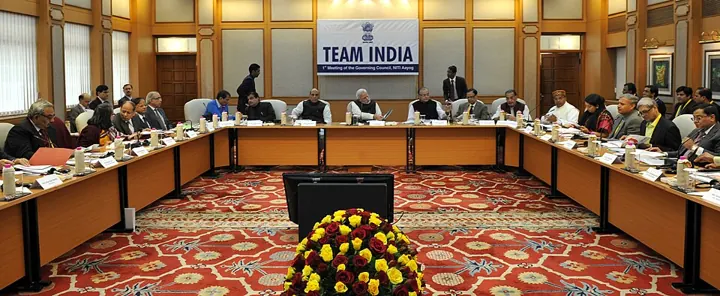
The National Development Council (1952) brought the Planning Commission together with the States. Its members:
- the Prime Minister;
- all Union Cabinet Ministers;
- the Chief Ministers of the States;
- UT administrators;
- the members of the Planning Commission.
The Chairman of the Finance Commission was not a member (2013: 1, 3 and 4 only). The NDC approved the Five-Year Plans but has not met since 2014. NITI’s Governing Council does that job now.
Who among the following constitute the National Development Council? 1. The Prime Minister 2. The Chairman, Finance Commission 3. Ministers of the Union Cabinet 4. Chief Ministers of the States Select the correct answer using the codes given below.
- 1, 2 and 3 only
- 1, 3 and 4 only
- 2 and 4 only
- 1, 2, 3 and 4
Show answer
Answer: (b) · UPSC official key
Prelims 2019: who in India can review the independent regulators in sectors like telecommunications, insurance, electricity, etc.?
- Parliament does, through ad hoc committees and its Department Related Standing Committees.
- The Finance Commission, the Financial Sector Legislative Reforms Commission and NITI Aayog do not.
- Answer: 1 and 2.
In India, which of the following review the independent regulators in sectors like telecommunications, insurance, electricity, etc.? 1. Ad Hoc Committees set up by the Parliament 2. Parliamentary Department Related Standing Committees 3. Finance Commission 4. Financial Sector Legislative Reforms Commission 5. NITI Aayog Select the correct answer using the code given below.
- 1 and 2
- 1, 3 and 4
- 3, 4 and 5
- 2 and 5
Show answer
Answer: (a) · UPSC official key
What UPSC asks: Prelims: NDC membership (2013); who reviews regulators (2019). Mains: NITI Aayog vs Planning Commission; cooperative federalism. Next likely angle: NITI indices and the Governing Council.
→ Federal System Inter-State Council and Zonal Councils, the other forums of federal cooperation.
Mains box: analysis and answer points
- NITI Aayog vs Planning Commission; cooperative federalism.
Practice
Practice MCQs (8)
Consider the following statements:
1. NITI Aayog was set up on the recommendation of the Fourteenth Finance Commission.
2. The Chairperson of NITI Aayog is the President of India.
Which of the statements given above is/are correct?
Answer (d) & explanation
Neither statement is correct. NITI Aayog was created by a Union Cabinet resolution of 1 January 2015, as a policy decision of the government; it was not recommended by the Fourteenth Finance Commission, whose task under Article 280 was the sharing of tax revenue for 2015–20. Its Chairperson is the Prime Minister, and it also has a Vice-Chairperson, full-time and part-time members, ex officio Union ministers and a CEO. The President has no role in it.
NITI Aayog came into existence on which date?
Answer (a) & explanation
NITI Aayog was created by a resolution of the Union Cabinet and came into existence on 1 January 2015. The idea was announced earlier, when the Prime Minister declared in his Independence Day speech of 15 August 2014 that the Planning Commission would be replaced. Thus 2014 is the year of the announcement and 2015 is the year of birth; 26 January and 1 April 2015 have no link with its creation.
Consider the following:
1. The Prime Minister
2. Chief Ministers of the States
3. The Chief Justice of India
4. The Comptroller and Auditor-General of India
How many of the above are members of the Governing Council of NITI Aayog?
Answer (b) & explanation
Two of the four are members. Under the 2015 Cabinet resolution, the Governing Council of NITI Aayog consists of the Prime Minister as Chairperson, the Chief Ministers of all States and of UTs with legislatures, and the Lieutenant Governors of the other UTs, with the Vice-Chairperson and members taking part. The Chief Justice of India heads the judiciary and the CAG is the constitutional auditor of government accounts; neither has any place in an executive policy forum.
With reference to NITI Aayog, consider the following statements:
1. It was set up by an Act of Parliament.
2. Its Governing Council includes the Chief Ministers of all the States.
Which of the statements given above is/are correct?
Answer (b) & explanation
Only statement 2 is correct. The Governing Council of NITI Aayog, chaired by the Prime Minister, includes the Chief Ministers of all States and of the Union Territories with legislatures, and the Lieutenant Governors of the other UTs; it is the main forum of cooperative federalism. Statement 1 is wrong: NITI Aayog was set up by an executive (Cabinet) resolution of 1 January 2015, so it is neither a constitutional nor a statutory body.
What is the full form of NITI in NITI Aayog?
Answer (a) & explanation
NITI stands for National Institution for Transforming India; 'Aayog' is the Hindi word for commission. The Cabinet resolution of 1 January 2015 describes it as the government's premier policy think tank, meant to foster cooperative federalism with the States and to give strategic and technical advice. Unlike the Planning Commission, it has no role in allocating funds, which the name 'Institution' rather than 'Commission' was meant to signal.
The Planning Commission of India was set up in which year?
Answer (c) & explanation
The Planning Commission was set up in March 1950 (15 March) by a resolution of the Government of India, with Jawaharlal Nehru as its first Chairman. It was an extra- constitutional, non-statutory body that drew up twelve Five-Year Plans, the first starting in 1951, and it was replaced by NITI Aayog on 1 January 2015. 1952 is the year of the National Development Council, and 1947–48 predate the Republic.
With reference to the National Development Council, consider the following statements:
1. It was established by the Constitution (Seventh Amendment) Act.
2. It was chaired by the Deputy Chairman of the Planning Commission.
Which of the statements given above is/are correct?
Answer (d) & explanation
Neither statement is correct. The National Development Council was set up on 6 August 1952 by an executive resolution of the Union Government; the Constitution (Seventh Amendment) Act, 1956 reorganised the States and has nothing to do with it. The NDC was chaired by the Prime Minister, and its members were the Union Cabinet ministers, the Chief Ministers of all States, UT administrators and members of the Planning Commission. It gave final approval to the Five-Year Plans, the Deputy Chairman only served it.
Who was the first Vice-Chairperson of NITI Aayog?
Answer (c) & explanation
Arvind Panagariya, an economist at Columbia University, was the first Vice- Chairperson of NITI Aayog, from January 2015 to August 2017. He was followed by Rajiv Kumar (2017–2022) and then by Suman Bery (from 2022). Montek Singh Ahluwalia was the last Deputy Chairman of the Planning Commission (2004–2014); the post of Vice-Chairperson is the NITI Aayog counterpart of that office.
0 / 0 correct
Prelims PYQs on this topic (2)
In India, which of the following review the independent regulators in sectors like telecommunications, insurance, electricity, etc.?
- 1. Ad Hoc Committees set up by the Parliament
- 2. Parliamentary Department Related Standing Committees
- 3. Finance Commission
- 4. Financial Sector Legislative Reforms Commission
- 5. NITI Aayog
Select the correct answer using the code given below.
Answer (a) & explanation
Ad hoc and standing committees of Parliament review regulators (a). Regulators such as TRAI, IRDAI and CERC are created by laws passed by Parliament and answer to it. They are examined by Parliament's ad hoc committees (1) and Department-Related Standing Committees (2), which question officials and study their reports. The Finance Commission (3) divides tax revenue between the Centre and states. The FSLRC (4), led by Justice B.N. Srikrishna, was a one-time body that suggested reforms to financial laws. NITI Aayog (5) is an advisory think tank. None of these reviews regulators.
India has 24 DRSCs, set up in 1993. Notice the debate on stronger oversight of regulators, such as the FSLRC's call for regular performance reviews.
Answer as per the official UPSC answer key.
The Government of India has established NITI Aayog to replace the
Answer (d) & explanation
NITI Aayog was set up on 1 January 2015, by a Cabinet resolution, to replace the Planning Commission (1950) (d). Neither body is constitutional or statutory. The Finance Commission (b) is a constitutional body under Article 280 and continues. The Human Rights Commission (a) is statutory under the 1993 Act, and the Law Commission (c) is set up by the government for fixed terms; neither was replaced.
NITI Aayog works as a think tank and promotes cooperative federalism, with a Governing Council of the PM and all Chief Ministers. Notice how planning shifted from top-down plans to advice and indices.
Answer as per the official UPSC answer key.
Write an answer
In 150 words, explain the significance of Non Constitutional Bodies with one recent example.
Flashcards (5)
When was NITI Aayog set up?
1 January 2015, by Cabinet resolution.
Who sits on NITI's Governing Council?
The PM, all CMs and UT Lieutenant Governors, and others.
Was the Finance Commission chairman an
NDC member? No.
Who reviews independent regulators?
Parliament's committees.
Who removes a State Human Rights
Commission member? The President.
Read more: related explainers
- NITI Aayog: Why It Replaced the Planning Commission, Structure, Functions, Indices and Criticism
- Waqf in India: Meaning, the Waqf Act 1995, the Waqf (Amendment) Act 2025, What Changed, the Constitutional Challenge and the Way Forward
- Article 32 (Right to Constitutional Remedies): Meaning, Writs, Article 32 vs 226, Suspension and PIL
In the news
- 23 Oct 2026Prasar Bharati at 29: why India’s public broadcaster still lacks the autonomy its law promised
- 22 Oct 2026Cooperative federalism and law reform: Law Commission proposes a ‘citizen friction test’
- 15 Oct 2026NITI Aayog’s Data Centre Evaluation Framework: five pillars to help States plan sustainable growth
- 17 Aug 2026CIC launches AppCoMS 2.0 portal for RTI appeals and complaints
 Next topic · 20.2 →Non Constitutional Bodies: NHRC, CBI and CVC
Syllabus: GS-II · Statutory, regulatory and various quasi-judicial bodies.