
Chapter 13 · Topic 13.3 · Prelims + Mains3 of 4
Parliament: Money bills, budget and committees
Key points
- Budget (Art 112): Lok Sabha votes demands; Appropriation Act before withdrawal; vote on
- Committees: PAC 22, Estimates 30 (largest), COPU 22, 24 DRSCs; only 16% of bills referred in
13 PYQs 2017–2026
Prelims box: facts and traps
| Financial bills (Art 117) | Rules |
|---|---|
| Category I: Art 117(1) | Has money-bill matters plus other matters. Lok Sabha only, with the President's recommendation; otherwise an ordinary bill: the Rajya Sabha can amend or reject, and a joint sitting is possible |
| Category II: Art 117(3) | Involves spending from the Consolidated Fund but no Art 110 matter. Either House; the President's recommendation is needed before it is considered. |
- The Lok Sabha's Ethics Committee: initially it was an ad-hoc Committee (from 2000), and it became permanent in 2015.
- Use the data: PRS Legislative Research found that only 16% of bills in the 17th Lok Sabha (2019–24) were referred to committees, lower than in the previous three Lok Sabhas.
- Article 112 deals with the Annual Financial Statement, that is, the Budget, and Article 117 deals with Financial Bills.
- Trap (UPSC Prelims 2024): “Only a Member of the Lok Sabha can make a complaint relating to unethical conduct of a member of the Lok Sabha” is incorrect.
- Trap (UPSC Prelims 2012): “A periodic or at least a mid-year review of programme of the Government against macroeconomic forecasts and expenditure by a Parliamentary Budget Office” is incorrect.
On this page (3 sections)
Money bills and financial bills
A money bill (Art 110) contains only provisions on taxes, government borrowing and guarantees, the custody of the Consolidated Fund or the Contingency Fund, payment into or appropriation of money out of the Consolidated Fund, and charged expenditure. Appropriation out of the Contingency Fund is not on the list. So the statement that a Money Bill is concerned with the appropriation of moneys out of the Contingency Fund of India is the incorrect one (2018).
Regarding Money Bill, which of the following statements is not correct?
- A bill shall be deemed to be a Money Bill if it contains only provisions relating to imposition, abolition, remission, alteration or regulation of any tax.
- A Money Bill has provisions for the custody of the Consolidated Fund of India or the Contingency Fund of India.
- A Money Bill is concerned with the appropriation of moneys out of the Contingency Fund of India.
- A Money Bill deals with the regulation of borrowing of money or giving of any guarantee by the Government of India.
Show answer
Answer: (c) · UPSC official key
Article 109 mentions special procedure in respect of Money Bills. A money bill shall not be introduced in the Council of States, and needs the President’s prior recommendation. The Rajya Sabha can either approve the Bill or suggest changes but cannot reject it; it must return it within 14 days. The Lok Sabha is free to accept or reject its suggestions.
Which of the following statements are correct in respect of a Money Bill in the Parliament ? 1. Article 109 mentions special procedure in respect of Money Bills. 2. A Money Bill shall not be introduced in the Council of States. 3. The Rajya Sabha can either approve the Bill or suggest changes but cannot reject it. 4. Amendments to a Money Bill suggested by the Rajya Sabha have to be accepted by the Lok Sabha. Select the answer using the code given below :
- 1 and 2 only
- 2 and 3 only
- 1, 2 and 3
- 1, 3 and 4
Show answer
Answer: (c) · UPSC official key
So if the Rajya Sabha ‘amends’ a money bill, its changes are only recommendations: the Lok Sabha may still proceed with the Bill, accepting or not accepting the recommendations of the Rajya Sabha (2013, option a). The Speaker’s certificate that a bill is a money bill is final, and the President cannot return a money bill.
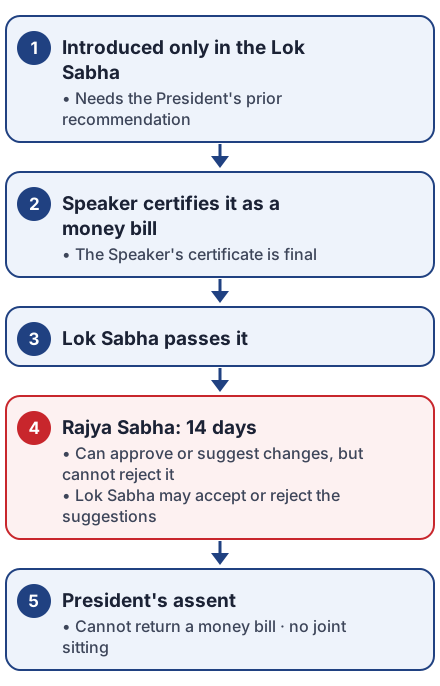
What will follow if a Money Bill is substantially amended by the Rajya Sabha?
- The Lok Sabha may still proceed with the Bill, accepting or not accepting the recommendations of the Rajya Sabha
- The Lok Sabha cannot consider the Bill further
- The Lok Sabha may send the Bill to the Rajya Sabha for reconsideration
- The President may call a joint sitting for passing the Bill
Show answer
Answer: (a) · UPSC official key
| Financial bills (Art 117) | Rules |
|---|---|
| Category I: Art 117(1) | Has money-bill matters plus other matters. Lok Sabha only, with the President’s recommendation; otherwise an ordinary bill: the Rajya Sabha can amend or reject, and a joint sitting is possible |
| Category II: Art 117(3) | Involves spending from the Consolidated Fund but no Art 110 matter. Either House; the President’s recommendation is needed before it is considered |
The 2023 question tested the difference. When the Lok Sabha sends a financial bill, the Rajya Sabha can amend or reject it; when it sends a money bill, the Rajya Sabha cannot amend or reject the Bill, it can only make recommendations. A joint sitting is possible for a financial bill but never necessary, and impossible for a money bill. Two statements are correct.
With reference to Finance Bill and Money Bill in the Indian Parliament, consider the following statements : 1. When the Lok Sabha transmits Finance Bill to the Rajya Sabha, it can amend or reject the Bill. 2. When the Lok Sabha transmits Money Bill to the Rajya Sabha, it cannot amend or reject the Bill, it can only make recommendations. 3. In the case of disagreement between the Lok Sabha and the Rajya Sabha, there is no joint sitting for Money Bill, but a joint sitting becomes necessary for Finance Bill. How many of the above statements are correct?
- Only one
- Only two
- All three
- None
Show answer
Answer: (b) · UPSC official key
Justice K.S. Puttaswamy v Union of India (Aadhaar) 2018
Held: Upheld the Aadhaar Act as a money bill; Justice Chandrachud dissented, calling its
passage as a money bill a fraud on the Constitution. WHY IT MATTERS The live debate on using the money-bill route to bypass the Rajya Sabha.
In Rojer Mathew v South Indian Bank (2019) a five-judge bench doubted the Aadhaar reasoning on money bills and referred the question to a larger bench.
The budget and Parliament’s control over money
The Constitution calls the budget the Annual Financial Statement (Art 112). The President causes it to be laid before both Houses; the Finance Minister presents it. Since 2017 it is presented on 1 February, and the Railway budget has been merged with it.
The Rajya Sabha has no power either to reject or to amend a Money Bill, and it cannot vote on the Demands for Grants: voting is for the Lok Sabha alone (Art 113). It can, however, discuss the budget. No demand for a grant can be made except on the President’s recommendation.
Consider the following statements : 1. The Rajya Sabha has no power either to reject or to amend a Money Bill. 2. The Rajya Sabha cannot vote on the Demands for Grants. 3. The Rajya Sabha cannot discuss the Annual Financial Statement. Which of the statements given above is/are correct?
- 1 only
- 1 and 2 only
- 2 and 3 only
- 1, 2 and 3
Show answer
Answer: (b) · UPSC official key
No money leaves the Consolidated Fund without an Appropriation Act (Art 114, 266), so the authorization for the withdrawal of funds from the Consolidated Fund of India must come from Parliament (2011). Charged expenditure, such as the President’s emoluments, judges’ salaries and the CAG’s salary, is discussed but not voted.
The authorization for the withdrawal of funds from the Consolidated Fund of India must come from
- The President of India
- The Parliament of India
- The Prime Minister of India
- The Union Finance Minister
Show answer
Answer: (b) · UPSC official key
Parliament’s methods of control over public finance: the Annual Financial Statement, withdrawal only after the Appropriation Bill, supplementary grants and vote-on-account (Art 116), and the Finance Bill. India has no Parliamentary Budget Office, so statement 4 of the 2012 question is out.
Which of the following are the methods of Parliamentary control over public finance in India? 1. Placing Annual Financial Statement before the Parliament 2. Withdrawal of moneys from Consolidated Fund of India only after passing the Appropriation Bill 3. Provisions of supplementary grants and vote-on-account 4. A periodic or at least a mid-year review of programme of the Government against macroeconomic forecasts and expenditure by a Parliamentary Budget Office 5. Introducing Finance Bill in the Parliament Select the correct answer using the codes given below :
- 1, 2, 3 and 5 only
- 1, 2 and 4 only
- 3, 4 and 5 only
- 1, 2, 3, 4 and 5
Show answer
Answer: (a) · UPSC official key
Rejection of the budget in the Lok Sabha means the government has lost the confidence of the House. When the annual Union Budget is not passed by the Lok Sabha, the Prime Minister submits the resignation of the Council of Ministers (2011).
When the annual Union Budget is not passed by the Lok Sabha,
- the Budget is modified and presented again
- the Budget is referred to the Rajya Sabha for suggestions
- the Union Finance Minister is asked to resign
- the Prime Minister submits the resignation of Council of Ministers
Show answer
Answer: (d) · UPSC official key
| Term | Meaning |
|---|---|
| Vote on account | Advance grant for part of the year until the budget is passed (Art 116) |
| Guillotine | On the last day for demands, all remaining demands are put to vote without discussion |
| Contingency Fund | At the President’s disposal for unforeseen spending, repaid after Parliament approves (Art 267) |
| Public Account | Money the government holds for others (provident funds, deposits); no appropriation needed |
Parliamentary committees
Most scrutiny happens in committees. The three financial committees: the Public Accounts Committee (22 members: 15 Lok Sabha, 7 Rajya Sabha; examines the CAG’s audit reports; chaired by an opposition member by convention since 1967), the Estimates Committee (30 members, all from the Lok Sabha; suggests economies; the largest committee) and the Committee on Public Undertakings (22 members). The largest Committee of the Parliament is the Estimates Committee (2014, option b).
Which one of the following is the largest Committee of the Parliament?
- The Committee on Public Accounts
- The Committee on Estimates
- The Committee on Public Undertakings
- The Committee on Petitions
Show answer
Answer: (b) · UPSC official key
The Committee on Subordinate Legislation checks whether the powers to make regulations, rules, sub-rules, by-laws delegated by Parliament are being properly used by the executive (2018, option b).
With reference to the Parliament of India, which of the following Parliamentary Committees scrutinizes and reports to the House whether the powers to make regulations, rules, sub-rules, by-laws, etc. conferred by the Constitution or delegated by the Parliament are being properly exercised by the Executive within the scope of such delegation?
- Committee on Government Assurances
- Committee on Subordinate Legislation
- Rules Committee
- Business Advisory Committee
Show answer
Answer: (b) · UPSC official key
The Lok Sabha’s Ethics Committee: initially it was an ad-hoc Committee (from 2000), and it became permanent in 2015. Any person can complain through a member, so a complaint is not limited to members, and the committee cannot take up a matter that is sub judice.
Which of the following statements about the Ethics Committee in the Lok Sabha are correct ? 1. Initially it was an ad-hoc Committee. 2. Only a Member of the Lok Sabha can make a complaint relating to unethical conduct of a member of the Lok Sabha. 3. This Committee cannot take up any matter which is sub-judice. Select the answer using the code given below :
- 1 and 2 only
- 2 and 3 only
- 1 and 3 only
- 1, 2 and 3
Show answer
Answer: (c) · UPSC official key
Department-related Facts Standing Committees
Number
Members 31 each: 21 Lok Sabha, 10 Rajya Sabha Department-related Facts Standing Committees Work Examine demands for grants, bills referred to them, annual reports and long-term policy of ministries Limit Recommendations are advisory; ministers cannot be members
Mains keeps coming back here. 2023: explain the structure of the Parliamentary Committee system and how far the financial committees have helped Parliament. 2021: do Department-related Parliamentary Standing Committees keep the administration on its toes? 2018: the role of the Estimates Committee. 2017: the role of the Public Accounts Committee. Use the data: PRS Legislative Research found that only 16% of bills in the 17th Lok Sabha (2019–24) were referred to committees, lower than in the previous three Lok Sabhas.
Explain the structure of the Parliamentary Committee system. How far have the financial committees helped in the institutionalisation of Indian Parliament?
Do Department-related Parliamentary Standing Committees keep the administration on its toes and inspire reverence for parliamentary control? Evaluate the working of such committees with suitable examples.
Why do you think the committees are considered to be useful for parliamentary work? Discuss, in this context, the role of the Estimates Committee.
Discuss the role of Public Accounts Committee in establishing accountability of the government to the people.
→ Constitutional Bodies The CAG, whose reports the PAC examines.
Mains box: analysis and answer points
- Any person can complain through a member, so a complaint is not limited to members, and the committee cannot take up a matter that is sub judice.
- A money bill (Art 110) contains only provisions on taxes, government borrowing and guarantees, the custody of the Consolidated Fund or the Contingency Fund, payment into or appropriation of money out of the Consolidated Fund, and charged expenditure.
- Article 109 mentions special procedure in respect of Money Bills.
- Likely next angle: Category I vs II financial bills; the pending larger-bench reference
- Asked: Mains 2023 (GS Paper II, 15 marks): Explain the structure of the Parliamentary Committee system. How far have the financial committees helped in the institutionalisation of Indian Parliament?
Practice
Practice MCQs (8)
A Money Bill passed by the Lok Sabha is returned by the Rajya Sabha with recommendations. If the Lok Sabha does not accept any of these recommendations, the bill
Answer (a) & explanation
Under Article 109(4), if the Lok Sabha does not accept any of the recommendations of the Rajya Sabha, the Money Bill is deemed to have been passed by both Houses in the form in which the Lok Sabha passed it, without any of the recommended changes. A joint sitting is not available for Money Bills, because the Lok Sabha's will prevails anyway. The President also has no role in choosing between the Houses' versions. The Rajya Sabha must return a Money Bill within fourteen days, and if it does not, the bill is deemed passed by both Houses in the Lok Sabha's form (Article 109(5)). The Lok Sabha may accept all, some or none of the Rajya Sabha's recommendations. The design reflects the principle that money matters belong to the directly elected House.
Which Article of the Constitution of India defines a 'Money Bill'?
Answer (d) & explanation
Article 110 defines a Money Bill: a bill is a Money Bill if it contains only provisions on the matters listed in clause (1), such as taxes, government borrowing, the custody of the Consolidated and Contingency Funds and appropriation from the Consolidated Fund. Clause (3) makes the Speaker's decision on whether a bill is a Money Bill final, and clause (4) requires his certificate to be endorsed on it. Article 109 lays down the special procedure for passing Money Bills. Article 112 deals with the Annual Financial Statement, that is, the Budget, and Article 117 deals with Financial Bills. Article 109(1) adds that a Money Bill can be introduced only in the Lok Sabha. Article 199 is the matching definition for State Money Bills.
Consider the following statements regarding a Money Bill:
1. The Speaker's certificate that it is a Money Bill is endorsed on the bill when it is transmitted to the Rajya Sabha and when it is presented to the President for assent.
2. Every Money Bill is treated as a government bill and can be introduced only by a minister.
Which of the statements given above is/are correct?
Answer (c) & explanation
Both statements are correct. Article 110(4) requires the Speaker's certificate that the bill is a Money Bill to be endorsed on it when it is transmitted to the Rajya Sabha and when it is presented to the President. The certificate tells both the Rajya Sabha and the President that the special procedure applies. A Money Bill needs the President's recommendation for introduction and can be introduced only in the Lok Sabha, and every such bill is a government bill introduced only by a minister. Because the certificate is endorsed, the President cannot return a Money Bill for reconsideration.
Consider the following statements:
1. Every Money Bill is a Financial Bill, but every Financial Bill is not a Money Bill.
2. A bill that contains provisions on taxation together with other matters not covered by Article 110(1) is a Money Bill.
Which of the statements given above is/are correct?
Answer (a) & explanation
Statement 1 is correct: Financial Bills are all bills dealing with fiscal matters, and the Money Bill under Article 110 is one narrow category among them. Statement 2 is incorrect: Article 110(1) says a bill is a Money Bill if it contains only provisions dealing with the listed matters. A bill that mixes taxation with other subjects is a Financial Bill (I) under Article 117(1), which the Rajya Sabha can amend or reject. Whether some laws were properly passed as Money Bills has been disputed. For example, the Finance Act, 2017 changed the rules for tribunals, and this was challenged in Rojer Mathew (2019).
Under Article 110(2) of the Constitution of India, a bill shall NOT be deemed to be a Money Bill by reason only that it provides for
Answer (d) & explanation
Article 110(1) lists the matters that make a bill a Money Bill when it contains only those matters: taxes, government borrowing, custody of the Consolidated and Contingency Funds, appropriation from the Consolidated Fund, charged expenditure, and so on. Article 110(2) then excludes three things: fines or other pecuniary penalties, fees for licences or services, and taxes imposed by a local authority for local purposes. A bill does not become a Money Bill just because it contains one of these. The word 'only' in Article 110(1) is the key: a bill that mixes Money Bill matters with anything else is not a Money Bill. The Speaker's decision under Article 110(3) is final. Whether that decision can be reviewed by courts was referred to a larger bench in Rojer Mathew (2019). Article 199 gives the same definition for State Money Bills.
A bill that contains provisions involving expenditure from the Consolidated Fund of India, but does not contain any of the matters specified in Article 110, is a Financial Bill of the type covered by Article 117(3). Which one of the following is correct about such a bill?
Answer (d) & explanation
A Financial Bill (II) under Article 117(3) involves expenditure from the Consolidated Fund but contains none of the Article 110 matters. It is treated as an ordinary bill: it can be introduced in either House, the President's recommendation is not needed for introduction, and the Rajya Sabha can reject or amend it. But neither House can pass it unless the President has recommended to that House the consideration of the bill. A deadlock is resolved by a joint sitting. An Article 117(3) bill is thus closer to an ordinary bill than to a Money Bill; only the recommendation for consideration sets it apart.
Consider the following statements:
1. A bill providing for the imposition or regulation of a tax by a municipal corporation for local purposes is a Money Bill under Article 110.
2. A bill dealing only with the audit of the accounts of the Union or of a State can be a Money Bill.
Which of the statements given above is/are correct?
Answer (b) & explanation
Statement 1 is incorrect: Article 110(2) says a bill is not a Money Bill merely because it provides for the imposition, abolition, remission, alteration or regulation of any tax by a local authority or body for local purposes. Statement 2 is correct: Article 110(1)(f) includes the receipt of money on account of the Consolidated Fund or the Public Account, the custody or issue of such money, and the audit of the accounts of the Union or of a State. A bill containing only such provisions is a Money Bill. Taxes of municipalities are dealt with by State law under Article 243X, which is why they are kept out of the Union's Money Bill definition.
In Justice K.S. Puttaswamy (Retd.) v. Union of India (2018), concerning the Aadhaar (Targeted Delivery of Financial and Other Subsidies, Benefits and Services) Act, 2016, the majority of the Supreme Court
Answer (a) & explanation
The Aadhaar Act, 2016 was passed as a Money Bill, so the Rajya Sabha could only make recommendations. In the 2018 Aadhaar judgment, the majority held that the Act was validly passed as a Money Bill, because its main provision, Section 7, linked Aadhaar to subsidies and benefits paid from the Consolidated Fund. Justice D.Y. Chandrachud dissented, holding that its passage as a Money Bill was a fraud on the Constitution. The Rajya Sabha's recommendations on a Money Bill are never binding, and no special majority applies. The judgment was delivered on 26 September 2018. The majority also struck down Section 57, which had allowed private entities to use Aadhaar.
0 / 0 correct
Prelims PYQs on this topic (8)
Which of the following statements are correct in respect of a Money Bill in the Parliament ?
- 1. Article 109 mentions special procedure in respect of Money Bills.
- 2. A Money Bill shall not be introduced in the Council of States.
- 3. The Rajya Sabha can either approve the Bill or suggest changes but cannot reject it.
- 4. Amendments to a Money Bill suggested by the Rajya Sabha have to be accepted by the Lok Sabha.
Select the answer using the code given below :
Answer (c) & explanation
Statements 1, 2 and 3 are correct (c). Statement 1 is right: Article 109 sets the special procedure for Money Bills. Statement 2 is right: a Money Bill can be introduced only in the Lok Sabha, never in the Council of States, and only on the President's recommendation. Statement 3 is right: the Rajya Sabha must return it within 14 days, with or without recommendations, and cannot reject it. Statement 4 is wrong: the Lok Sabha is free to accept or reject those recommendations.
Notice that Article 110 defines a Money Bill, and the Speaker's certificate is final. The Supreme Court is examining the use of the Money Bill route for laws like Aadhaar. A joint sitting is not possible on a Money Bill.
"suggest" in statement 3 and "have to be accepted" in statement 4. The Rajya Sabha recommends; the Lok Sabha decides.
Answer as per the official UPSC answer key.
With reference to Finance Bill and Money Bill in the Indian Parliament, consider the following statements :
- 1. When the Lok Sabha transmits Finance Bill to the Rajya Sabha, it can amend or reject the Bill.
- 2. When the Lok Sabha transmits Money Bill to the Rajya Sabha, it cannot amend or reject the Bill, it can only make recommendations.
- 3. In the case of disagreement between the Lok Sabha and the Rajya Sabha, there is no joint sitting for Money Bill, but a joint sitting becomes necessary for Finance Bill.
How many of the above statements are correct?
Answer (b) & explanation
Two statements are correct (b). Statement 1 is right: a Finance Bill that is not a Money Bill (an Article 117 bill) goes through the Rajya Sabha like an ordinary Bill, so the Rajya Sabha can amend or reject it. Statement 2 is right: for a Money Bill (Article 110), the Rajya Sabha can only make recommendations within 14 days, which the Lok Sabha may ignore. Statement 3 is wrong: there is indeed no joint sitting for a Money Bill, but for a Finance Bill a joint sitting is possible, not "necessary".
Notice that only the Speaker certifies a Bill as a Money Bill. The use of this route for laws like Aadhaar (2016) was challenged, and a larger bench of the Supreme Court is examining it.
"necessary" in statement 3. A joint sitting is an option the President may use, never automatic.
Answer as per the official UPSC answer key.
Consider the following statements about the Committee on the Welfare of Scheduled Castes and Scheduled Tribes of the Parliament of India :
- 1. Although members of this Committee are elected from both Houses of Parliament, the Chairperson of this Committee is appointed by the Chairman of the Rajya Sabha.
- 2. Twenty members are elected by the Rajya Sabha and ten members by the Lok Sabha.
- 3. No Minister, except for the Union Minister of Social Justice and Empowerment, is eligible to be a member of this Committee.
- 4. Members are elected for a fixed term of two years from the date they enter their office.
Which one of the following conclusions based on the above statements is correct ?
Answer (d) & explanation
No statement is correct (d). The Committee on the Welfare of SCs and STs has 30 members. Statement 1 is wrong: the Speaker appoints its Chairperson from among the Lok Sabha members. Statement 2 is wrong: 20 members come from the Lok Sabha and 10 from the Rajya Sabha, the reverse of the statement. Statement 3 is wrong: no Minister at all can be a member. Statement 4 is wrong: the term is one year, not two. So options (a), (b) and (c) fail.
Notice the pattern: like the Estimates and Public Accounts committees, it is a financial-style committee where Ministers are barred. Its job is to examine the work of the National Commissions for SCs and STs and the implementation of safeguards.
four confident details, all slightly off. When every line has a number or an office, check each one.
Answer as per the official UPSC answer key.
With reference to Union Budget, consider the following statements :
- 1. The Union Finance Minister on behalf of the Prime Minister lays the Annual Financial Statement before both the Houses of Parliament.
- 2. At the Union level, no demand for a grant can be made except on the recommendation of the President of India.
Which of the statements given above is/are correct ?
Answer (c) & explanation
Both statements are treated as correct (c). Statement 1: Article 112 makes the President cause the Annual Financial Statement (the Budget) to be laid before both Houses. In practice the Finance Minister presents it for the Council of Ministers, which the Prime Minister heads; UPSC read statement 1 in that sense. Statement 2 is right: Article 113(3) says no demand for a grant can be made except on the President's recommendation. So options (a), (b) and (d) fail under UPSC's key.
Notice that the word "Budget" is not used in the Constitution. Since 2017, the Budget is presented on 1 February, and the Railway Budget is merged into it. Article 114 covers the Appropriation Bill.
a statement that sounds loose can still be accepted. Read it the way a working government reads it, not word by word.
Answer as per the official UPSC answer key.
Consider the following statements :
- 1. Pursuant to the report of H.N. Sanyal Committee, the Contempt of Courts Act, 1971 was passed.
- 2. The Constitution of India empowers the Supreme Court and the High Courts to punish for contempt of themselves.
- 3. The Constitution of India defines Civil Contempt and Criminal Contempt.
- 4. In India, the Parliament is vested with the powers to make laws on Contempt of Court.
Which of the statements given above is/are correct?
Answer (b) & explanation
Statements 1, 2 and 4 are correct (b). Statement 1 is right: the H.N. Sanyal Committee (1963) led to the Contempt of Courts Act, 1971. Statement 2 is right: Article 129 and Article 215 make the Supreme Court and the High Courts courts of record, with power to punish contempt of themselves. Statement 4 is right: Parliament can make laws on contempt, under Entry 77 of the Union List and Entry 14 of the Concurrent List. Statement 3 is wrong: civil and criminal contempt are defined in the 1971 Act, not in the Constitution.
Notice the 2006 amendment, which made truth a defence if in the public interest. Contempt of court is also a ground for restricting free speech under Article 19(2).
statement 3. The Constitution gives the power; the Act gives the definitions.
Answer as per the official UPSC answer key.
Along with the Budget, the Finance Minister also places other documents before the Parliament which include 'The Macro Economic Framework Statement'. The aforesaid document is presented because this is mandated by
Answer (d) & explanation
The FRBM Act, 2003 requires it (d). Under Section 3 of the Fiscal Responsibility and Budget Management Act, the government must lay certain statements before Parliament with the Budget. These are the Macro-economic Framework Statement, which assesses growth, the fiscal balance and the external sector, and the Medium-term Fiscal Policy cum Fiscal Policy Strategy Statement. The Medium-term Expenditure Framework Statement is laid in the session after the Budget. It is not just a convention (a). Article 112 (b) requires the Annual Financial Statement, and Article 110 defines Money Bills. Article 113 (c) deals with demands for grants.
Notice the targets: the government set a 4.4% fiscal deficit target for 2025–26, and is shifting to a debt-to-GDP anchor of about 50% by 2031.
Answer as per the official UPSC answer key.
Mains PYQs on this topic (5)
- UPSC Mains 2023 · GS Paper II · Q16Explain the structure of the Parliamentary Committee system. How far have the financial committees helped in the institutionalisation of Indian Parliament?How to approach: Intro: committees as 'mini-Parliaments'. Body: (1) Structure: standing vs ad hoc; financial committees, 24 Departmentally Related Standing Committees (since 199…
- UPSC Mains 2026 · GS Paper II · Q2“Women as a class neither belong to a minority group nor are they regarded as forming a backward class.” In the light of this statement, discuss the evolution of women's reservation from local bodies to Parliament.How to approach: Intro: women are neither a minority nor a backward class, so their quotas rest on Article 15(3) and specific amendments. Body: (1) Local bodies: 73rd and 74th A…
- UPSC Mains 2025 · GS Paper II · Q12Indian Constitution has conferred the amending power on the ordinary legislative institutions with a few procedural hurdles. In view of this statement, examine the procedural and substantive limitations on the amending p…How to approach: Intro: flexible yet rigid. Body: (1) Procedural limitations; (2) Substantive limitations; (3) Assessment. Conclusion: The balance lets Parliament adapt the Cons…
- UPSC Mains 2024 · GS Paper II · Q3“The growth of cabinet system has practically resulted in the marginalisation of the parliamentary supremacy.” Elucidate.How to approach: Intro: In theory the Cabinet is responsible to the Lok Sabha (Art. 75(3)). Body: (1) Signs of marginalisation; (2) Reasons; (3) Checks remain. Conclusion: Parli…
- UPSC Mains 2023 · GS Paper II · Q4Compare and contrast the British and Indian approaches to Parliamentary sovereignty.How to approach: Intro: Dicey's idea of parliamentary sovereignty. Body: (1) Britain: unwritten constitution, no judicial review of Acts, unitary state, any law by simple majori…
Write an answer
In 150 words, explain the significance of Parliament with one recent example.
Flashcards (4)
Is appropriation from the Contingency Fund
a money-bill matter? No. It is not in Art 110.
Within how many days must the Rajya
Sabha return a money bill? 14 days.
Which is the largest parliamentary
committee? The Estimates Committee (30, all Lok Sabha).
Which committee checks delegated
legislation? The Committee on Subordinate Legislation.
Read more: related explainers
In the news
- 25 Oct 2026Census 2027: can private teachers be made enumerators? The Census Rules amendment and Article 23
- 24 Oct 2026Legislative Council polls in four States: why only six States have a second chamber
- 13 Aug 2026Monsoon Session ends: 19 sittings, 12 Bills passed by both Houses
- 13 Aug 2026MEA Parliament replies (13 Aug 2026): IORA chair
 Next topic · 13.4 →Parliament: Privileges and the anti-defection law
Syllabus: GS-II · Parliament and State legislatures—structure, functioning, conduct of business, p…