
Chapter 6 · Topic 6.3 · Prelims + Mains3 of 3
Space Technology: Sun, observatories and the solar system
Key points
- Aditya-L1: PSLV-C57, halo orbit at L1 on 6 January 2024. Seven payloads.
- AstroSat: 28 Sep 2015, 1,515 kg, 650 km. India's first astronomy satellite.
- JWST: launched 25 Dec 2021, at L2, infrared.
- RTGs: heat from plutonium-238 decay, not fission.
- LISA: three craft, six lasers, launch 2035 (target).
- DART hit Dimorphos on 26 Sep 2022. Goldilocks zone = habitable zone.
1 PYQ 2005–2014
Prelims box: facts and traps
| Mission | Target |
|---|---|
| MESSENGER | Mercury |
| Cassini | Saturn |
| Voyager 1 and 2 | Outer planets |
| LISA | Gravitational waves |
- Trap (Prelims 2023): Cepheids and nebulae were swapped. Only the neutron star description matches pulsars.
- Trap (Prelims 2011): comets are not found between Venus and Mercury.
On this page (3 sections)
Aditya-L1 and space observatories
Aditya-L1 is the first space-based Indian mission to study the Sun. Launched on PSLV-C57, it was placed in a halo orbit around Lagrange point L1 on 6 January 2024. L1 is a balance point about 1.5 million km from the Earth where the pulls of the Sun and Earth even out, so a spacecraft can park there. From L1 it has a continuous view of the Sun, never blocked by Earth. It studies the photosphere (visible surface), chromosphere and corona (outer atmosphere). Four payloads view the Sun directly and three measure particles and fields on the spot (ISRO, Aditya-L1 page).
Watching the Sun helps forecast space weather, much like a weather office warns of storms. On NOAA’s scale, an extreme geomagnetic storm can cause grid blackouts and transformer damage, degrade satellite navigation and disturb spacecraft (NOAA Space Weather Prediction Center). If a major solar storm (solar flare) reaches the Earth, GPS and power grids can fail, intense auroras appear, satellite orbits are disturbed and shortwave radio over the poles is cut. There are no tsunamis or forest fires (Prelims 2022: answer (c), 1, 3, 4, 6 and 7 only).
If a major solar storm (solar flare) reaches the Earth, which of the following are the possible effects on the Earth ? 1. GPS and navigation systems could fail. 2. Tsunamis could occur at equatorial regions. 3. Power grids could be damaged. 4. Intense auroras could occur over much of the Earth. 5. Forest fires could take place over much of the planet. 6. Orbits of the satellites could be disturbed. 7. Shortwave radio communication of the aircraft flying over polar regions could be interrupted. Select the correct answer using the code given below :
- 1, 2, 4 and 5 only
- 2, 3, 5, 6 and 7 only
- 1, 3, 4, 6 and 7 only
- 1, 2, 3, 4, 5, 6 and 7
Show answer
Answer: (c) · UPSC official key
AstroSat, launched on PSLV-C30 on 28 September 2015, is India’s first dedicated astronomy mission. It observes in X-ray, optical and ultraviolet bands. It weighs 1,515 kg and orbits at 650 km, inclined at 6 degrees (ISRO, AstroSat page). So the claim of a 2000 kg satellite at 1650 km is wrong. UPSC’s key also rejects the claim that only the USA and Russia had launched a similar observatory before (Prelims 2016: answer (d), Neither 1 nor 2).
With reference to ‘Astrosat’, the astronomical observatory launched by India, which of the following statements is/are correct? 1. Other than USA and Russia, India is the only country to have launched a similar observatory into space. 2. Astrosat is a 2000 kg satellite placed in an orbit at 1650 km above the surface of the Earth. Select the correct answer using the code given below.
- 1 only
- 2 only
- Both 1 and 2
- Neither 1 nor 2
Show answer
Answer: (d) · UPSC official key
The James Webb Space Telescope (JWST), launched on 25 December 2021, orbits the Sun at Lagrange point L2, 1.5 million km from Earth, behind a five-layer sunshield the size of a tennis court. Hubble, by contrast, orbits Earth at about 560 km (NASA/ESA Webb). Mains 2022 asked what makes JWST better than earlier space telescopes. Points:
- a much bigger mirror,
- infrared vision to see the earliest galaxies and inside dust clouds, much like night-vision goggles,
- a cold, stable position at L2,
- goals of studying the first stars, galaxy formation and exoplanet atmospheres.
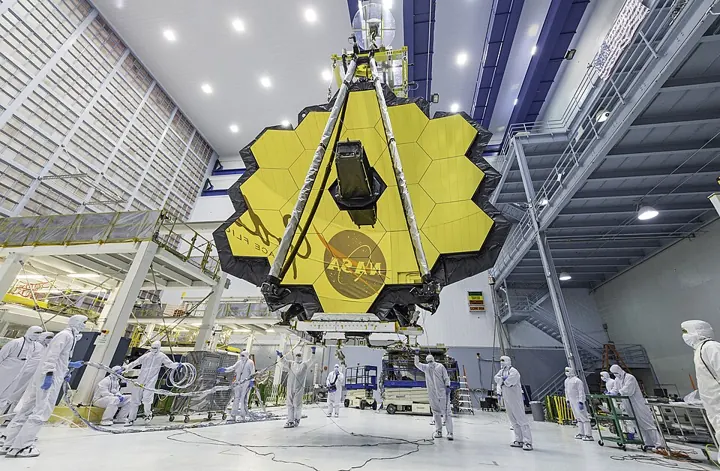
Launched on 25th December, 2021, James Webb Space Telescope has been much in the news since then. What are its unique features which make it superior to its predecessor Space Telescopes? What are the key goals of this mission? What potential benefits does it hold for the human race?
Planetary missions, RTGs and gravitational waves
Some key planetary missions (NASA):
- MESSENGER was the first spacecraft to orbit Mercury.
- Cassini studied the Saturn system, not Venus, and ended with its grand finale on 15 September 2017.
- Voyager 1 and 2, launched in 1977, toured the outer planets and reached the interstellar boundary, the edge of the Sun’s bubble, in 2012 (Voyager 1) and 2018 (Voyager 2).
So Messenger was for mapping and investigating Mercury, and Voyager explored the outer solar system (Prelims 2014: answer (b), 2 and 3 only).
Which of the following pairs is/are correctly matched? Spacecraft Purpose 1. Cassini-Huygens Orbiting the Venus and transmitting data to the Earth 2. Messenger Mapping and investigating the Mercury 3. Voyager 1 and 2 Exploring the outer solar system Select the correct answer using the code given below.
- 1 only
- 2 and 3 only
- 1 and 3 only
- 1, 2 and 3
Show answer
Answer: (b) · UPSC official key
Far from the Sun, solar panels give too little power. NASA’s radioisotope power systems (RTGs) turn heat from the natural decay of plutonium-238 into electricity (NASA). Think of a hot water bottle that stays warm for decades. They are not fission reactors, so statement 1 is false. They power the onboard systems of spacecraft and use plutonium-238 (Prelims 2024: answer (b), 2 and 3 only).
With reference to radioisotope thermoelectric generators (RTGs), consider the following statements : 1. RTGs are miniature fission reactors. 2. RTGs are used for powering the onboard systems of spacecrafts. 3. RTGs can use Plutonium-238, which is a by-product of weapons development. Which of the statements given above are correct ?
- 1 and 2 only
- 2 and 3 only
- 1 and 3 only
- 1, 2 and 3
Show answer
Answer: (b) · UPSC official key
LISA (Laser Interferometer Space Antenna), led by ESA, will be the first space-based gravitational wave observatory. It will use three spacecraft linked by six laser beams, with launch planned for 2035 (ESA, a target). Its earlier name was evolved LISA (eLISA). So its purpose is to detect gravitational waves (Prelims 2017: answer (b)), and a trio of spacecraft flying in formation with lasers between them is Evolved LISA (Prelims 2020: answer (d)).
What is the purpose of ‘evolved Laser Interferometer Space Antenna (eLISA)’ project ?
- To detect neutrinos
- To detect gravitational waves
- To detect the effectiveness of missile defence system
- To study the effect of solar flares on our communication systems
Show answer
Answer: (b) · UPSC official key
“The experiment will employ a trio of spacecraft flying in formation in the shape of an equilateral triangle that has sides one million kilometres long, with lasers shining between the craft.” The experiment in question refers to
- Voyager-2
- New Horizons
- LISA Pathfinder
- Evolved LISA
Show answer
Answer: (d) · UPSC official key
| Mission | Target | Fact |
|---|---|---|
| MESSENGER | Mercury | First to orbit Mercury |
| Cassini | Saturn | Grand finale 15 Sep 2017 |
| Voyager 1 and 2 | Outer planets | Launched 1977; interstellar 2012, 2018 |
| JWST | Universe (infrared) | At L2, launched 25 Dec 2021 |
| LISA | Gravitational waves | 3 craft, 6 lasers; launch 2035 (target) |
Source: NASA and ESA mission pages.
Asteroids, comets, exoplanets and stars
Asteroids are rocky leftovers from the formation of the solar system, mostly found between Mars and Jupiter (NASA). Comets are cosmic snowballs of frozen gases, rock and dust. Near the Sun they heat up into a glowing head with a tail. They come from the Kuiper Belt and the Oort Cloud, far beyond Neptune (NASA). So asteroids are small rocky planetoids and comets show a tail (true), but comets are not found between Venus and Mercury (Prelims 2011: answer (b), 1 and 3 only).
What is the difference between asteroids and comets ? 1. Asteroids are small rocky planetoids, while comets are formed of frozen gases held together by rocky and metallic material. 2. Asteroids are found mostly between the orbits of Jupiter and Mars, while comets are found mostly between Venus and Mercury. 3. Comets show a perceptible glowing tail, while asteroids do not. Which of the statements given above is/are correct ?
- 1 and 2 only
- 1 and 3 only
- 3 only
- 1, 2 and 3
Show answer
Answer: (b) · UPSC official key
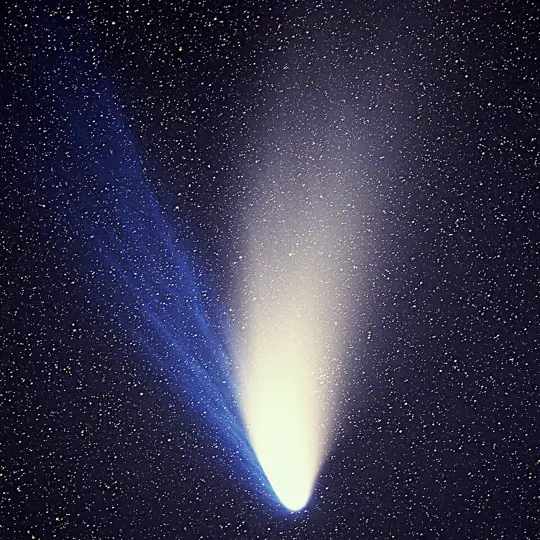
NASA’s DART was the first mission to show asteroid deflection by kinetic impact, which means pushing an asteroid off course by crashing into it, like nudging a ball with another ball. Launched on 24 November 2021, it hit Dimorphos, a 160 m moonlet of the asteroid Didymos, on 26 September 2022 (NASA). Mains 2024 asked what asteroids are and what strategies exist to prevent an impact catastrophe. Points: survey and track near-Earth objects, kinetic impactors like DART, and international planetary defence planning.
What are asteroids? How real is the threat of them causing extinction of life? What strategies have been developed to prevent such a catastrophe?
The habitable zone is the range of distances from a star where liquid water could exist on a planet’s surface. NASA notes these are also called Goldilocks zones: not too hot, not too cold, just right, as in the fairy tale (NASA). So the term relates to the search for Earth-like planets in outer space (Prelims 2015: answer (c)).
The term ‘Goldilocks Zone’ is often seen in the news in the context of
- the limits of habitable zone above the surface of the Earth
- regions inside the Earth where shale gas is available
- search for the Earth-like planets in outer space
- search for meteorites containing precious metals
Show answer
Answer: (c) · UPSC official key
Some star terms (NASA):
- Cepheid variables are stars whose brightness changes in a regular cycle, which astronomers use to measure distances.
- A nebula is a cloud of dust and gas.
- Neutron stars form when a massive star runs out of fuel and collapses.
- Pulsars are neutron stars whose beams sweep past us as pulses, like a lighthouse.
In the 2023 pairs, Cepheids and Nebulae were swapped. Only neutron stars formed when massive stars run out of fuel and collapse matches (Prelims 2023: answer (a), Only one).
Consider the following pairs : Objects in space Description 1. Cepheids Giant clouds of dust and gas in space 2. Nebulae Stars which brighten and dim periodically 3. Pulsars Neutron stars that are formed when massive stars run out of fuel and collapse How many of the above pairs are correctly matched?
- Only one
- Only two
- All three
- None
Show answer
Answer: (a) · UPSC official key
What UPSC asks: Prelims: Aditya at L1, Messenger to Mercury, asteroids between Mars and Jupiter. Mains: storms hit GPS and grids, AstroSat 1,515 kg, RTGs run on Pu-238 decay, LISA for gravity waves, Goldilocks means habitable, pulsars are neutron stars.
Mains box: analysis and answer points
- Solar watch: Aditya-L1 and space weather risks.
- Planetary defence: asteroids and DART.
- JWST: features and goals.
Practice
Practice MCQs (8)
With reference to the James Webb Space Telescope (JWST), consider the following statements:
1. It observes mainly in infrared light.
2. It operates in an orbit around the Sun–Earth L2 point, about 1.5 million km from the Earth.
3. Like the Hubble Space Telescope, it was designed to be repaired and upgraded by visiting astronauts.
Which of the statements given above is/are correct?
Answer (b) & explanation
Statements 1 and 2 are correct. JWST, a NASA–ESA–CSA project launched on an Ariane 5 on 25 December 2021, is an infrared observatory with a 6.5 m mirror of 18 gold- coated beryllium segments. It orbits the Sun–Earth L2 point, about 1.5 million km from Earth on the side away from the Sun, where a five-layer sunshield keeps its instruments extremely cold. Hubble orbits about 540 km up and was serviced five times by Space Shuttle crews; JWST is far beyond the reach of any crewed vehicle and was not designed for servicing.
The James Webb Space Telescope was built to observe mainly in infrared rather than visible light. Which one of the following is the best reason?
Answer (d) & explanation
As the Universe expands, light from very distant galaxies is stretched to longer wavelengths, the cosmological redshift. Ultraviolet and visible light emitted soon after the Big Bang now arrives as infrared, so an infrared telescope is needed to see the first galaxies. Infrared also passes through dust that hides star-forming regions and young planetary systems. All light travels at the same speed in a vacuum, and infrared telescopes must be kept very cold, which is why JWST has a large sunshield at L2.
Consider the following statements:
1. Most asteroids of the solar system lie in the main belt between the orbits of Mars and Jupiter.
2. The asteroid Apophis is predicted to pass the Earth on 13 April 2029 at a distance smaller than that of geostationary satellites.
3. NASA's Lucy mission is designed to visit Trojan asteroids, which share Jupiter's orbit around the Sun.
How many of the statements given above are correct?
Answer (c) & explanation
All three are correct. The main asteroid belt between Mars and Jupiter holds most known asteroids. Apophis, about 340 m wide, will pass within about 32,000 km of the Earth's surface on 13 April 2029, closer than geostationary satellites at about 35,786 km and visible to the naked eye from parts of the world; NASA has ruled out an impact for at least the next 100 years. NASA's Lucy, launched in October 2021, is on a 12-year journey to several Jupiter Trojans, which cluster around the L4 and L5 points of the Sun–Jupiter system.
Solar observatories such as SOHO and India's Aditya-L1 are placed near the Sun–Earth L1 point rather than in a low orbit around the Earth mainly because, from L1, a spacecraft
Answer (b) & explanation
L1 lies between the Earth and the Sun, about 1.5 million km sunward of Earth. A craft there circles L1 in a halo orbit and keeps the Sun permanently in view, with no day–night cycle or eclipses like those a low Earth orbit suffers. Being upstream, it also meets the solar wind and coronal mass ejections before they reach Earth, giving advance warning for space weather. The halo orbit is chosen precisely to keep the craft out of the Earth's shadow; L1 is unstable, and it is still about 148 million km from the Sun, far beyond Mercury's orbit.
Consider the following statements about the search for exoplanets:
1. In the transit method, a planet is detected from the small, regular dip in its star's brightness as it passes in front of the star.
2. In the radial velocity method, a planet is detected from the periodic shift in the star's spectral lines as the star wobbles under the planet's pull.
3. The habitable zone around a cool red dwarf star lies farther from the star than the habitable zone around a Sun-like star.
Which of the statements given above is/are correct?
Answer (b) & explanation
Statements 1 and 2 are correct. The transit method, used by Kepler and TESS, has found most known exoplanets; the depth of the dip gives the planet's size. The radial velocity (Doppler) method measures the star's to-and-fro motion and gives the planet's mass; India's PARAS spectrograph at Mount Abu works this way. The habitable zone is the range of distances at which liquid water could exist on a planet's surface; a red dwarf is cooler and dimmer than the Sun, so its habitable zone lies much closer to it, as in the TRAPPIST-1 system.
Consider the following statements about gravitational waves:
1. They were first detected directly in September 2015 by the LIGO detectors in the USA, from the merger of two black holes.
2. They are ripples in the fabric of space-time that Einstein's general theory of relativity had predicted.
3. The Union Cabinet approved the LIGO-India observatory in April 2023, to be built in Hingoli district of Maharashtra.
Which of the statements given above is/are correct?
Answer (d) & explanation
All three are correct. On 14 September 2015 the twin LIGO detectors recorded GW150914, produced by two black holes of about 36 and 29 solar masses merging some 1.3 billion light years away; the result was announced in February 2016 and won the 2017 Nobel Prize in Physics. Gravitational waves are disturbances of space-time itself, predicted by Einstein in 1916. In April 2023 the Cabinet approved LIGO-India at Hingoli, Maharashtra, at about Rs 2,600 crore, to be built by the Department of Atomic Energy and the Department of Science and Technology with the US LIGO Laboratory.
The European Space Agency adopted the LISA mission in January 2024. Why is a gravitational- wave detector being placed in space when ground-based detectors such as LIGO already exist?
Answer (b) & explanation
LISA (Laser Interferometer Space Antenna) will use three spacecraft in a triangle with arms of about 2.5 million km, linked by lasers, trailing the Earth in its orbit round the Sun; it was adopted by ESA on 25 January 2024 for launch around 2035. Ground detectors have arms of a few km and are swamped by seismic noise at low frequencies, so they hear only the high- frequency signals of stellar-mass black holes and neutron stars. LISA will hear low-frequency waves from merging supermassive black holes and compact binaries in our galaxy. Gravitational waves pass through the atmosphere and the Earth itself.
With reference to the object 3I/ATLAS, consider the following statements:
1. It was discovered on 1 July 2025 by a NASA-funded ATLAS survey telescope in Chile.
2. It is only the third object from outside the solar system to be seen passing through it, after 'Oumuamua and Borisov.
3. It is bound to the Sun in a long elliptical orbit, like the long-period comets from the Oort cloud.
Which of the statements given above is/are correct?
Answer (b) & explanation
Statements 1 and 2 are correct. The ATLAS (Asteroid Terrestrial-impact Last Alert System) telescope at Río Hurtado, Chile, reported the comet on 1 July 2025. The '3I' stands for the third interstellar object, after 1I/'Oumuamua (2017) and 2I/Borisov (2019). Its very high speed gives it a hyperbolic (open) orbit: it is not bound to the Sun and will leave the solar system for good. NASA said it posed no threat to the Earth; its closest approach to the Sun was around 30 October 2025.
0 / 0 correct
Prelims PYQs on this topic (1)
Which of the following pairs is/are correctly matched?
| Spacecraft | Purpose
| 1. Cassini-Huygens | Orbiting the Venus and transmitting data to the Earth
| 2. Messenger | Mapping and investigating the Mercury
| 3. Voyager 1 and 2 | Exploring the outer solar system
Select the correct answer using the code given below.
Answer (b) & explanation
Pairs 2 and 3 are correct (b). Cassini–Huygens studied Saturn, not Venus, and its Huygens probe landed on the moon Titan in 2005, so pair 1 is wrong. NASA's MESSENGER orbited and mapped Mercury from 2011 to 2015. Voyager 1 and 2, launched in 1977, explored the outer planets and have since entered interstellar space.
Venus missions include Magellan, ESA's Venus Express and Japan's Akatsuki; India plans its Venus Orbiter Mission. Notice how UPSC likes pairing spacecraft with their targets: a short table of missions saves marks.
Answer as per the official UPSC answer key.
Write an answer
In 150 words, explain the significance of Space Technology with one recent example.
Flashcards (5)
Where is Aditya-L1?
Halo orbit around L1, about 1.5 million km away.
First spacecraft to orbit Mercury?
MESSENGER.
Fuel of NASA RTGs?
Plutonium-238.
What will LISA detect?
Gravitational waves.
Goldilocks zone means?
Habitable zone where liquid water could exist.
Read more: related explainers
- Weather Forecasting in India and Mission Mausam: IMD, Numerical Models, Doppler Radars, Bharat Forecast System, Supercomputers, Weather Modification and Early Warnings
- ISRO and India's Space Programme: History, Launch Vehicles, Major Missions from Aryabhata to Chandrayaan-3, Space Sector Reforms and the Road to 2040
- GM Crops in India: Technology, Bt Cotton, Bt Brinjal, GM Mustard, Regulation by GEAC and Genome-Edited Rice
In the news
- 24 Oct 2026NVS-03 launch on 30 October: can ISRO’s new satellite bring NavIC back to life?
- 22 Oct 2026eMudhra weak-key flaw: browsers block 8 certificates; what it means for India’s web trust
- 21 Oct 2026Japan’s MMX mission lifts off for Mars to bring back a sample of Phobos by 2031
- 21 Oct 2026Open-weight AI models: why Big Tech gives them away and what it means for India
 Next chapter · 7. Defence Technology →Defence Technology: Missiles and missile defence
Syllabus: GS-III · Awareness in the fields of IT, Space, Computers, robotics, nano-technology, bio-…