
Chapter 6 · Topic 6.2 · Prelims + Mains2 of 3
Space Technology: Earth observation, Moon, Mars and human spaceflight
Key points
- IRS satellites: crops, groundwater, minerals. Not telecom.
- NISAR: 30 July 2025, GSLV-F16, L-band + S-band, 747 km, 12-day revisit.
- Chandrayaan-3: launched 14 July 2023, landed 23 August 2023 near south pole.
- MOM: PSLV-C25, 5 Nov 2013. India 4th space agency at Mars.
- Chandrayaan-4: Rs 2,104.06 crore, sample return.
- Gaganyaan: 3 crew, 400 km, 3 days. SpaDeX docked 16 Jan 2025. BAS by 2035.
Prelims box: facts and traps
| Mission | Fact |
|---|---|
| Chandrayaan-3 cost | Rs 250 crore (excluding launcher) |
| Gaganyaan funding | Rs 20,193 crore |
| SpaDeX satellites | SDX01, SDX02 (about 220 kg each) |
- Ax-4 lifted off on 25 June 2025 on a Falcon 9 with a Crew Dragon from Kennedy Space Center, docked with the ISS the next day and splashed down off California on 15 July 2025.
- Trap (Prelims 2016): India was not the second country after the USA to orbit Mars.
On this page (3 sections)
Earth observation and NISAR
Remote sensing satellites look at the land, oceans and air from orbit, like a doctor’s scan of the whole country. UPSC’s key accepts that Indian Remote Sensing (IRS) satellites are used for assessing crop productivity, locating groundwater resources and mineral exploration, but not for telecommunications or traffic studies (Prelims 2015: answer (a), 1, 2 and 3 only). Telecommunication needs geostationary communication satellites instead (page 1).
In which of the following activities are Indian Remote Sensing (IRS) satellites used? 1. Assessment of crop productivity 2. Locating groundwater resources 3. Mineral exploration 4. Telecommunications 5. Traffic studies Select the correct answer using the code given below.
- 1, 2 and 3 only
- 4 and 5 only
- 1 and 2 only
- 1, 2, 3, 4 and 5
Show answer
Answer: (a) · UPSC official key
Satellite images and remote sensing data are used to estimate chlorophyll (the green pigment) in plants, greenhouse gas emissions from rice paddies, and land surface temperatures of a specific place (Prelims 2019: answer (d), 1, 2 and 3, per UPSC’s key, the same question appears in the geography chapter).
For the measurement/estimation of which of the following are satellite images/remote sensing data used? 1. Chlorophyll content in the vegetation of a specific location 2. Greenhouse gas emissions from rice paddies of a specific location 3. Land surface temperatures of a specific location Select the correct answer using the code given below.
- 1 only
- 2 and 3 only
- 3 only
- 1, 2 and 3
Show answer
Answer: (d) · UPSC official key
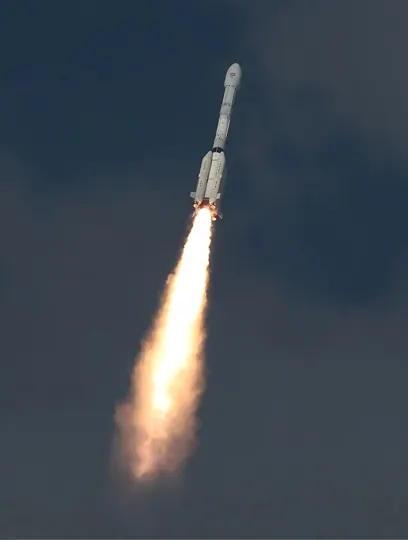
NISAR (NASA-ISRO Synthetic Aperture Radar) was launched on GSLV-F16 on 30 July 2025. It was the first time a GSLV placed a satellite in sun-synchronous polar orbit. A synthetic aperture radar sends its own microwave pulses and reads the echoes, so it can see through clouds and at night, unlike a normal camera. NISAR is the world’s first dual-frequency radar satellite of this kind, carrying NASA’s L-band and ISRO’s S-band radars. It weighs 2,393 kg, orbits at 747 km, revisits each spot every 12 days and has a 5-year mission life (PIB, 30 Jul 2025). ISRO gives a 242 km swath (the width of ground it sees), SweepSAR imaging and a 12 m reflector antenna (ISRO, NISAR page). Its cost is reported as over $1.5 billion, jointly funded (an estimate, not an audited figure).
| NISAR | Value | Source |
|---|---|---|
| Radars | L-band (NASA) + S-band (ISRO) | PIB |
| Mass | 2,393 kg (ISRO page: 2,392 kg) | PIB / ISRO |
| Orbit | 747 km SSO (ISRO: 743 km, 98.4°) | PIB / ISRO |
| Revisit | 12 days | PIB |
| Swath | 242 km | ISRO |
| Mission life | 5 years (design) | PIB |
Small differences between PIB and ISRO pages are shown as given.
Mains 2026 asked about the role of satellite technologies in climate-smart agriculture and food security in India. Points:
- remote sensing of crop area, crop health and soil moisture,
- radar (like NISAR) that sees through cloud during the monsoon,
- land surface temperature and drought monitoring,
- navigation for precision farming,
- ISRO’s open data access under the Space Policy 2023.
Analyze the role of satellite-based technologies in achieving climate-smart agriculture and food security in India.
Chandrayaan and Mangalyaan
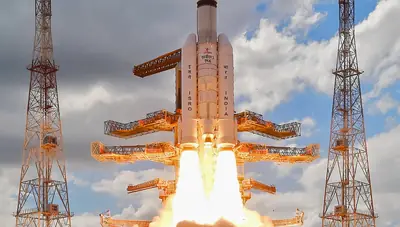
Chandrayaan-2’s lander lost contact during descent at about 2.1 km altitude and crashed (Parliament Library explainer, Chandrayaan-3). Chandrayaan-3, launched on LVM3 on 14 July 2023, had three aims: a safe and soft landing, a rover moving on the Moon, and experiments on the spot. A soft landing means touching down gently, not crashing. Its propulsion module, carrying the SHAPE payload, took the lander and rover to a 100 km lunar orbit (ISRO, Chandrayaan-3 page). The Vikram lander, carrying the Pragyan rover, touched down on 23 August 2023. The lander and rover were designed for one lunar day, about 14 Earth days (Parliament Library explainer).
India became the fourth country to soft-land on the Moon and the first to land near its south pole. The approved cost was Rs 250 crore, excluding the launch vehicle (PIB, 23 Aug 2023). Mains 2023 asked about the main task of India’s third moon mission that its earlier mission could not achieve. Answer: a soft landing and roving. Then describe the three modules (propulsion, lander, rover).
What is the main task of India’s third moon mission which could not be achieved in its earlier mission? List the countries that have achieved this task. Introduce the subsystems in the spacecraft launched and explain the role of the ‘Virtual Launch Control Centre’ at the Vikram Sarabhai Space Centre which contributed to the successful launch from Sriharikota.
The Mars Orbiter Mission (Mangalyaan) was launched on PSLV-C25 on 5 November 2013. ISRO became the fourth space agency to reach Mars orbit. The mission was designed for 6 months but completed 7 years in orbit on 24 September 2021 (ISRO, MOM page). So Mangalyaan is also called the Mars Orbiter Mission (true), but India was not the second country after the USA (false). UPSC’s key accepts it as the first success in a first attempt (Prelims 2016: answer (c), 1 and 3 only).
Consider the following statements : The Mangalyaan launched by ISRO 1. is also called the Mars Orbiter Mission 2. made India the second country to have a spacecraft orbit the Mars after USA 3. made India the only country to be successful in making its spacecraft orbit the Mars in its very first attempt Which of the statements given above is/are correct?
- 1 only
- 2 and 3 only
- 1 and 3 only
- 1, 2 and 3
Show answer
Answer: (c) · UPSC official key
Next, Chandrayaan-4, approved on 18 September 2024 at Rs 2,104.06 crore, will bring back lunar samples using two LVM3 launches. The government’s target is an Indian landing on the Moon by 2040 (PIB, 18 Sep 2024, target, not achieved).
| Mission | Launch | Key result or aim | Status |
|---|---|---|---|
| Mars Orbiter Mission | 5 Nov 2013, PSLV-C25 | Mars orbit; 7 years (design 6 months) | completed |
| Chandrayaan-3 | 14 Jul 2023, LVM3 | Soft landing near south pole, 23 Aug 2023 | achieved |
| Chandrayaan-4 | two LVM3 launches | Lunar sample return; Rs 2,104.06 crore | approved (target) |
| Indian on the Moon | — | Crewed landing by 2040 | target |
Sources: ISRO, PIB 23 Aug 2023 and 18 Sep 2024.
Gaganyaan, docking and the space station
The Gaganyaan project aims to show India can do human spaceflight. It will launch a crew of 3 to a 400 km orbit for a 3-day mission and bring them back safely, landing in Indian sea waters (ISRO, Gaganyaan page). The programme was approved in December 2018. In September 2024 the Cabinet widened it to build the first unit of the Bharatiya Antariksh Station (BAS-1), with eight missions to be completed by December 2028. Total funding was raised to Rs 20,193 crore. The targets are an operational BAS by 2035 and an Indian crewed lunar mission by 2040 (PIB, 18 Sep 2024).
Docking means joining two spacecraft in orbit, and it is needed to build a station piece by piece. SpaDeX (Space Docking Experiment) used two satellites of about 220 kg each, SDX01 (chaser) and SDX02 (target), launched on PSLV-C60 on 30 December 2024. They docked on 16 January 2025, making India the fourth country to do so (PIB, 16 Jan 2025).
In July 2025 Gaganyatri Shubhanshu Shukla, flying on the Axiom-4 mission to the International Space Station, completed all seven Indian microgravity experiments by 14 July 2025. Microgravity means near-weightless conditions. The experiments included tardigrades, muscle loss (myogenesis), sprouting of methi and moong seeds, cyanobacteria and microalgae (ISRO). Gaganyaan also plans microgravity experiments, while SpaDeX was a docking test. UPSC’s key: two of the three missions support microgravity research (Prelims 2025: answer (b), Only two).
Consider the following space missions : I. Axiom-4 II. SpaDeX III. Gaganyaan How many of the space missions given above encourage and support micro-gravity research?
- Only one
- Only two
- All the three
- None
Show answer
Answer: (b) · UPSC official key
| Human spaceflight goal | Date | Status |
|---|---|---|
| Gaganyaan approved | Dec 2018 | done |
| SpaDeX docking | 16 Jan 2025 | achieved |
| Axiom-4 experiments | 14 Jul 2025 | completed |
| BAS-1 and 8 missions | by Dec 2028 | target |
| Bharatiya Antariksh Station | by 2035 | target |
| Indian crewed lunar landing | by 2040 | target |
Source: PIB 18 Sep 2024, 16 Jan 2025, ISRO. Targets are plans, not results.
Mains 2019 asked about India’s plan for its own space station and how it will help the space programme. Points: BAS-1 by 2028 and BAS by 2035 (targets), docking proven by SpaDeX, long-duration microgravity research, and a base for lunar missions. Mains 2017 asked about the main obstacles to a manned space mission: a human-rated launcher, life support, crew escape, re-entry and recovery at sea, astronaut training, and cost.
What is India’s plan to have its own space station and how will it benefit our space programme?
India has achieved remarkable successes in unmanned space missions including the Chandrayaan and Mars Orbitter Mission, but has not ventured into manned space missions. What are the main obstacles to launching a manned space mission, both in terms of technology and logistics. Examine critically.
What UPSC asks: Prelims: IRS for crops, water and minerals, Chandrayaan-3 on 23 Aug 2023, Gaganyaan’s 3 crew at 400 km. Mains: NISAR’s L + S bands, 12-day revisit, MOM as 4th agency, Chandrayaan-4 samples, SpaDeX docking 2025, BAS by 2035 (target).
Mains box: analysis and answer points
- Satellites for farming: remote sensing, NISAR.
- Moon and Mars: Chandrayaan-3 lessons, low cost.
- Human spaceflight: obstacles and BAS plan.
Practice
Practice MCQs (8)
Astronauts on board the International Space Station, orbiting about 400 km above the Earth, float freely inside it because
Answer (d) & explanation
At about 400 km, the pull of gravity is still roughly 90% of that at the surface. The ISS moves sideways at about 7.7 km/s, so as it falls towards the Earth, the surface curves away beneath it: it is in permanent free fall. Astronauts and the station fall together, so nothing presses on anything and people feel weightless. This condition is called microgravity, not zero gravity, and it is what makes the station useful for experiments in biology, materials and fluids.
'Vyommitra', sometimes seen in the news in connection with the Gaganyaan programme, is
Answer (a) & explanation
Vyommitra ('space friend') is a female-looking half-humanoid robot developed by ISRO and first shown in January 2020. It is meant to fly on an uncrewed Gaganyaan flight, where it will monitor the crew-module systems, check life support and environmental conditions, and respond to commands, simulating some functions of a human crew before astronauts fly. ISRO's reusable winged vehicle is the RLV, and its deep space antennas are part of the Indian Deep Space Network at Byalalu near Bengaluru.
With reference to the Bharatiya Antariksh Station (BAS), consider the following statements:
1. In September 2024 the Union Cabinet widened the Gaganyaan programme to include building the first module, BAS-1, with the related missions to be completed by December 2028.
2. The government's stated vision is a fully operational Indian space station by 2035 and an Indian landing on the Moon by 2040.
3. BAS is planned as an Indian module to be attached to the International Space Station.
Which of the statements given above is/are correct?
Answer (c) & explanation
Statements 1 and 2 are correct. On 18 September 2024 the Cabinet revised Gaganyaan to include development of BAS-1 and precursor missions; the human spaceflight programme now comprises eight missions to be completed by December 2028 with the launch of BAS-1, at a total cost of Rs 20,193 crore. PIB describes the vision of an Indian space station by 2035 and an Indian landing on the Moon by 2040. BAS is an independent national station, not part of the ISS, which NASA plans to retire around 2030.
Which one of the following statements about the effects of long stays in space on the human body is not correct?
Answer (a) & explanation
Statement (a) is the incorrect one. Without gravity pressing the vertebrae together, the discs of the spine expand and astronauts grow up to about 3% taller, returning to normal height after landing. In microgravity, weight-bearing bones lose roughly 1% of their mass per month and muscles waste, which is why the crew exercise about two hours a day. Fluids that gravity normally pulls towards the legs move up (fluid shift). The Earth's magnetosphere deflects much charged-particle radiation in low Earth orbit; on Moon or Mars trips that protection is lost.
With reference to India's Gaganyaan programme, consider the following statements:
1. Its goal is to launch a crew of three to an orbit of about 400 km for a mission of about three days and bring them back safely.
2. The TV-D1 flight of October 2023 tested the crew escape system that would pull the crew module away from a failing rocket.
3. The crew module is designed to return by parachute onto land in the Thar desert.
Which of the statements given above is/are correct?
Answer (b) & explanation
Statements 1 and 2 are correct. ISRO states the Gaganyaan aim as launching a crew of three to a 400 km orbit for a three-day mission and returning them safely by landing in Indian sea waters, on the human-rated LVM3 (HLVM3). On 21 October 2023 the Test Vehicle– Demonstration 1 flight carried a crew-module mock-up to about Mach 1.2, fired the crew escape system, separated the module and brought it down by parachute into the Bay of Bengal for recovery. A sea splashdown, not a land touchdown, is the planned recovery mode.
Consider the following statements about Axiom Mission 4 (Ax-4):
1. It was launched in June 2025 on a SpaceX Falcon 9 rocket from the Kennedy Space Center.
2. Shubhanshu Shukla of ISRO flew as the mission's pilot.
3. Shubhanshu Shukla became the first Indian astronaut to visit the International Space Station.
4. Shubhanshu Shukla became the first Indian citizen to travel to space.
How many of the statements given above are correct?
Answer (c) & explanation
Three are correct. Ax-4 lifted off on 25 June 2025 on a Falcon 9 with a Crew Dragon from Kennedy Space Center, docked with the ISS the next day and splashed down off California on 15 July 2025. The crew was commander Peggy Whitson, pilot Shubhanshu Shukla, Sławosz Uznański-Wiśniewski of Poland and Tibor Kapu of Hungary, and they carried out about 60 experiments in microgravity, including Indian ones. Shukla was the first Indian on the ISS but the second Indian in space: Rakesh Sharma flew on Soyuz T-11 to the Salyut-7 station in April 1984.
With reference to ISRO's Space Docking Experiment (SpaDeX), consider the following statements:
1. It used two satellites of about 220 kg each, launched together by PSLV-C60 at the end of December 2024.
2. The two satellites docked in January 2025, making India the fourth country to achieve docking in space.
3. One of the satellites was docked with the International Space Station to test India's docking mechanism.
Which of the statements given above is/are correct?
Answer (a) & explanation
Statements 1 and 2 are correct. PSLV-C60 launched SDX01 (Chaser) and SDX02 (Target), each about 220 kg, on 30 December 2024. They docked with each other on 16 January 2025, after the USA, Russia and China, and were undocked on 13 March 2025; a second, fully autonomous docking with power transfer followed in April 2025. The two satellites docked only with each other, in a low Earth orbit. Docking is needed for Chandrayaan-4 sample return and the Bharatiya Antariksh Station; the PSLV's spent fourth stage (POEM-4) also carried experiments.
Sunita Williams and Butch Wilmore, who flew to the International Space Station in June 2024 on the first crewed test flight of Boeing's Starliner, returned to Earth in March 2025 aboard
Answer (c) & explanation
Starliner's Crew Flight Test launched on 5 June 2024 for what was planned as a roughly eight-day stay. Because of thruster problems and helium leaks, NASA decided to bring Starliner back uncrewed, and it landed in New Mexico on 7 September 2024. Williams and Wilmore joined the station crew and returned with the Crew-9 mission on a SpaceX Crew Dragon, splashing down off Florida on 18 March 2025 after about nine months in space. Orion is meant for Artemis Moon missions, not ISS crew rotation.
0 / 0 correct
Write an answer
In 150 words, explain the significance of Space Technology with one recent example.
Flashcards (8)
NISAR radars?
L-band (NASA) and S-band (ISRO).
NISAR revisit time?
12 days.
Chandrayaan-3 landing date?
23 August 2023.
MOM launch vehicle and date?
PSLV-C25, 5 Nov 2013.
Chandrayaan-4 aim?
Lunar sample return.
Gaganyaan crew and orbit?
3 crew, 400 km, 3 days.
SpaDeX docking date?
16 January 2025.
Target year for Bharatiya Antariksh Station?
2035 (target).
Read more: related explainers
- Gaganyaan: India's Human Spaceflight Programme, HLVM3, Crew Module, Astronaut-Designates, Test Flights and the Bharatiya Antariksh Station
- One Health Approach: Why Human, Animal and Environmental Health Are Linked, Zoonotic Diseases, the Global Quadripartite and India's National One Health Mission
- ISRO and India's Space Programme: History, Launch Vehicles, Major Missions from Aryabhata to Chandrayaan-3, Space Sector Reforms and the Road to 2040
In the news
- 24 Oct 2026NVS-03 launch on 30 October: can ISRO’s new satellite bring NavIC back to life?
- 22 Oct 2026eMudhra weak-key flaw: browsers block 8 certificates; what it means for India’s web trust
- 21 Oct 2026Japan’s MMX mission lifts off for Mars to bring back a sample of Phobos by 2031
- 21 Oct 2026Open-weight AI models: why Big Tech gives them away and what it means for India
 Next topic · 6.3 →Space Technology: Sun, observatories and the solar system
Syllabus: GS-III · Awareness in the fields of IT, Space, Computers, robotics, nano-technology, bio-…