
Chapter 2 · Topic 2.3 · Prelims + Mains3 of 3
Physics: Waves, lasers and modern physics
Key points
- Communication with light; lasers.
- Modern physics and semiconductors.
6 PYQs 2013–2026
Prelims box: facts and traps
| Wave | Wavelength |
|---|---|
| Radio | > 0.1 m |
| Microwave | 0.1 m to 1 mm |
| Infrared | 1 mm to 700 nm |
| Visible light | 700 nm to 400 nm |
| Ultraviolet | 400 nm to 1 nm |
| X-rays | 1 nm to 10⁻³ nm |
| Gamma rays | < 10⁻³ nm. |
- VLC uses electromagnetic spectrum wavelengths 375 to 780 nm, can carry large amounts of data faster than Bluetooth and has no electromagnetic interference, but it is short-range, not long-range (Prelims 2020: 1, 3 and 4).
- Electric current is the flow of charge; a current produces a magnetic field around it, as Hans Christian Oersted found in 1820 when a wire deflected a compass needle (NCERT Physics, Class 12, Chapter 4).
- On 16 May 1960 Theodore Maiman at Hughes Research Laboratories operated the first laser using a flash- lamp-pumped ruby crystal (chromium-doped aluminium oxide), emitting red light at 694.3 nm.
- Trap (UPSC Prelims 2011): “Thickness of BD is 2.4 mm while that of DVD is 1.2 mm” is incorrect.
- Trap (UPSC Prelims 2016, ‘LiFi’): all the statements are correct.
On this page (3 sections)
Electricity, magnetism and electromagnetic waves
Electric current is the flow of charge; a current produces a magnetic field around it, as Hans Christian Oersted found in 1820 when a wire deflected a compass needle (NCERT Physics, Class 12, Chapter 4). A changing magnetic field in turn produces a current, the basis of generators and transformers.
| Wave | Wavelength | Uses |
|---|---|---|
| Radio | > 0.1 m | broadcasting, mobile phones |
| Microwave | 0.1 m to 1 mm | radar, microwave ovens |
| Infrared | 1 mm to 700 nm | remote controls, night vision, heat lamps |
| Visible light | 700 nm to 400 nm | sight |
| Ultraviolet | 400 nm to 1 nm | sterilising; mostly absorbed by the ozone layer |
| X-rays | 1 nm to 10⁻³ nm | medical imaging |
| Gamma rays | < 10⁻³ nm | cancer treatment; from radioactive decay |
Source: NCERT Physics, Class 12, Chapter 8, Table 8.1 and section 8.4. All travel at the speed of light in vacuum.
Microwave ovens use a frequency matched to water molecules, so food containing water heats up. Microwaves suit radar because of their short wavelength (NCERT Physics, Class 12, Chapter 8).
Stealth objects have a very small radar cross-section and are coated with Radar Absorbing Material, so little radar energy returns to the receiver; they can still be detected using specific frequencies. Coatings are meant to reduce, not increase, the scattering of radar back to its source (Prelims 2026: 1 and 2; answer key provisional).
Which of the following statements with regard to stealth technology is/are correct ? 1. Stealth objects have a very small radar cross-section and are coated with Radar Absorbing Material. 2. Stealth objects can be detected using specific frequencies. 3. Stealth objects are coated with metamaterials to increase the scattering of electromagnetic radiation. Select the answer using the code given below :
- 1 only
- 2 and 3 only
- 1 and 2 only
- 1, 2 and 3
Show answer
Answer: (c) · UPSC provisional key (final key awaited)
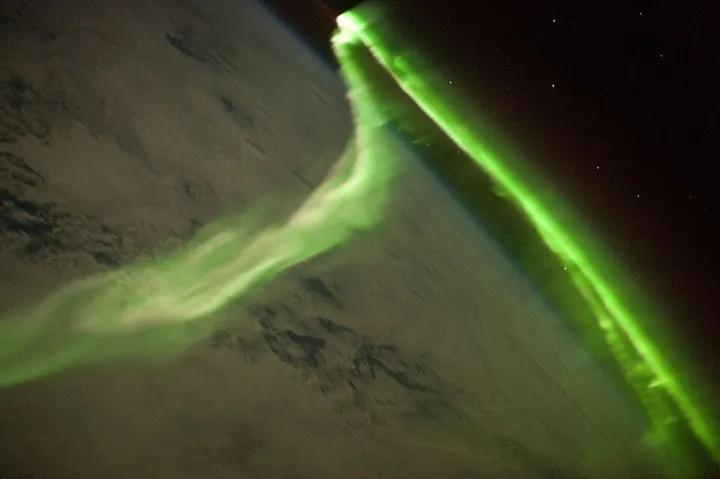
Solar storms send charged particles and radiation toward Earth. On NOAA’s scale, an extreme (G5) geomagnetic storm can cause grid blackouts and transformer damage, degrade satellite navigation for days and disturb spacecraft (NOAA Space Weather Prediction Center). If a major solar storm (solar flare) reaches the Earth, GPS and power grids can fail, intense auroras appear, satellite orbits are disturbed and shortwave radio over the poles is cut; it causes no tsunamis or forest fires (Prelims 2022: 1, 3, 4, 6 and 7).
If a major solar storm (solar flare) reaches the Earth, which of the following are the possible effects on the Earth ? 1. GPS and navigation systems could fail. 2. Tsunamis could occur at equatorial regions. 3. Power grids could be damaged. 4. Intense auroras could occur over much of the Earth. 5. Forest fires could take place over much of the planet. 6. Orbits of the satellites could be disturbed. 7. Shortwave radio communication of the aircraft flying over polar regions could be interrupted. Select the correct answer using the code given below :
- 1, 2, 4 and 5 only
- 2, 3, 5, 6 and 7 only
- 1, 3, 4, 6 and 7 only
- 1, 2, 3, 4, 5, 6 and 7
Show answer
Answer: (c) · UPSC official key
Communication with light, and lasers
Visible Light Communication (VLC) sends data by switching LEDs on and off faster than the eye can see. VLC uses electromagnetic spectrum wavelengths 375 to 780 nm, can carry large amounts of data faster than Bluetooth and has no electromagnetic interference, but it is short-range, not long-range (Prelims 2020: 1, 3 and 4).
With reference to Visible Light Communication (VLC) technology, which of the following statements are correct ? 1. VLC uses electromagnetic spectrum wavelengths 375 to 780 nm. 2. VLC is known as long-range optical wireless communication. 3. VLC can transmit large amounts of data faster than Bluetooth. 4. VLC has no electromagnetic interference. Select the correct answer using the code given below :
- 1, 2 and 3 only
- 1, 2 and 4 only
- 1, 3 and 4 only
- 2, 3 and 4 only
Show answer
Answer: (c) · UPSC official key
LiFi is a form of VLC: it uses light as the medium for high-speed data transmission, and it is a wireless technology that can be several times faster than WiFi; light does not pass through walls, which limits range but helps security (Prelims 2016: both statements correct).
With reference to ‘LiFi’, recently in the news, which of the following statements is/are correct? 1. It uses light as the medium for high-speed data transmission. 2. It is a wireless technology and is several times faster than ‘WiFi’. Select the correct answer using the code given below.
- 1 only
- 2 only
- Both 1 and 2
- Neither 1 nor 2
Show answer
Answer: (c) · UPSC official key
LASER stands for Light Amplification by Stimulated Emission of Radiation. Laser light is of one colour, travels in a narrow beam and its waves are in step. The 1964 Physics Nobel went to Townes, Basov and Prokhorov for fundamental work in quantum electronics that led to the maser and laser; the 2018 prize to Arthur Ashkin for optical tweezers, and to Gérard Mourou and Donna Strickland for high-intensity, ultra-short laser pulses (nobelprize.org).
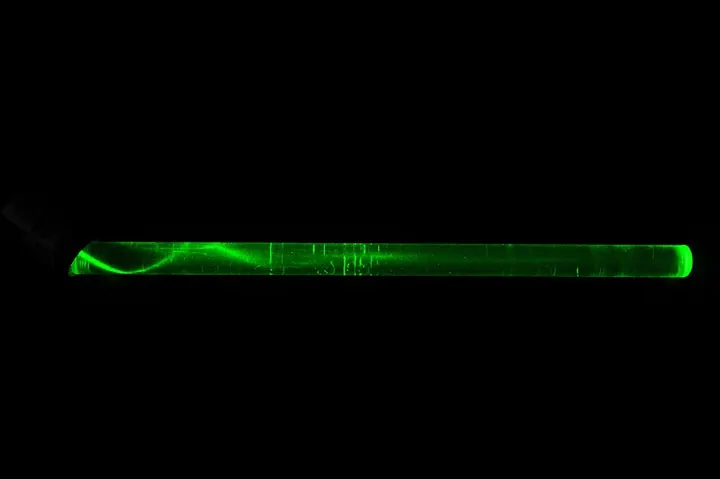
Optical fibres carry light by total internal reflection along a glass core; Charles Kao won half the 2009 Physics Nobel for showing how light could be sent far through fibres for communication, and the other half went for the CCD image sensor (nobelprize.org).
Optical discs are read by a laser. A Blu-ray Disc uses a shorter-wavelength (blue-violet) laser than a DVD, so it packs data more tightly: DVD supports Standard Definition video while BD supports High Definition, and BD stores several times more; both discs are the same thickness (Prelims 2011: 1 and 2 only).
A new optical disc format known as the Blu-ray Disc (BD) is becoming popular. In what way is it different from the traditional DVD ? 1. DVD supports Standard Definition video while BD supports High Definition video. 2. Compared to a DVD, the BD format has several times more storage capacity. 3. Thickness of BD is 2.4 mm while that of DVD is 1.2 mm. Which of the statements given above is/are correct ?
- 1 only
- 1 and 2 only
- 2 and 3 only
- 1, 2 and 3
Show answer
Answer: (b) · UPSC official key
Light and laser Nobels.
Modern physics and semiconductors
Light can behave as a stream of particles called photons. In the photoelectric effect, light above a certain frequency knocks electrons out of a metal; the minimum energy needed is the metal’s work function. Einstein’s explanation won the 1921 Physics Nobel “for his discovery of the law of the photoelectric effect” (NCERT Physics, Class 12, Chapter 11; nobelprize.org). This principle runs solar cells, camera sensors and automatic doors.
In a solid, electrons sit in energy bands. Conductors have overlapping bands; insulators have a wide energy gap; semiconductors such as silicon have a small gap, so heat, light or added impurities (doping) let them conduct. Adding impurities gives n-type (extra electrons) or p-type (extra holes) material, and joining them makes a p-n junction diode (NCERT Physics, Class 12, Chapter 14).
The transistor, a semiconductor switch and amplifier, replaced vacuum tubes; Shockley, Bardeen and Brattain won the 1956 Physics Nobel for researches on semiconductors and the transistor effect (nobelprize.org). LEDs, solar cells and computer chips are all built from p-n junctions.
Other modern ideas: radioactivity and nuclear fission (see Nuclear Technology), superconductors that carry current with zero resistance below a critical temperature, and quantum effects used in quantum computing (see Emerging Technologies).
Mains box: analysis and answer points
- Microwaves suit radar because of their short wavelength (NCERT Physics, Class 12, Chapter 8).
- A changing magnetic field in turn produces a current, the basis of generators and transformers.
- Likely next angle: G5 storm effects
Practice
Practice MCQs (8)
In semiconductor physics, a 'hole' is best described as
Answer (d) & explanation
When an electron leaves a covalent bond, the empty place in the valence band is a hole. A neighbouring bound electron can jump into it, so the vacancy moves the other way and behaves like a carrier of positive charge equal in size to the electron's. It is not a particle like a positron and not a missing atom; a missing atom is a lattice vacancy, a crystal defect.
As the temperature of a piece of pure (intrinsic) silicon is raised from room temperature, its electrical resistivity
Answer (b) & explanation
In an intrinsic semiconductor, heat breaks more covalent bonds and lifts more electrons across the gap, creating electron-hole pairs. The rise in the number of charge carriers outweighs the slight fall in their mobility, so the conductivity rises and the resistivity falls: a semiconductor has a negative temperature coefficient of resistance. In metals the carrier number is fixed and stronger lattice vibration raises resistivity.
Consider the following statements about free-electron lasers (FELs):
1. They do not use atoms or molecules as the gain medium; the light is produced by a beam of fast electrons passing through an array of alternating magnets.
2. Their wavelength can be tuned by changing the energy of the electron beam or the strength of the magnetic field.
3. They can work only at radio frequencies and cannot produce X-rays.
How many of the statements given above are correct?
Answer (b) & explanation
Two statements are correct. In a free-electron laser, electrons from a particle accelerator, moving at nearly the speed of light, pass through an undulator, a row of magnets with alternating poles, which makes them wiggle and emit radiation. Under the right conditions the electrons bunch up and emit coherently, amplifying the light. Because the electrons are not bound to atoms, the wavelength is set by the electron energy and the undulator's period and field, and can be tuned from terahertz and infrared to hard X-rays. Statement 3 is wrong: X-ray FELs such as LCLS in the USA and the European XFEL in Germany produce ultra-bright femtosecond X-ray pulses that image molecules and materials at atomic scale. RRCAT, Indore, is developing FELs in the terahertz and infrared regions.
Consider the following statements about laser light compared with the light of an ordinary bulb:
1. It is coherent, that is, its waves keep a fixed phase relationship.
2. It has a very narrow range of wavelengths.
3. It always lies in the visible part of the spectrum.
How many of the statements given above are correct?
Answer (b) & explanation
Two statements are correct. Laser light is coherent (waves in step in time and space), nearly monochromatic (a very narrow spectral width) and highly directional, which is why it can be focused to a tiny spot. Statement 3 is wrong: lasers exist from the ultraviolet to the far infrared. A CO2 laser emits at about 10.6 micrometres (infrared), an Nd:YAG laser at 1,064 nm (infrared), fibre-optic lasers near 1,550 nm (infrared) and an ArF excimer laser at 193 nm (ultraviolet). Many of the most powerful lasers are invisible, which makes them more dangerous to the eye.
Consider the following statements regarding extrinsic semiconductors:
1. Adding a small amount of phosphorus to pure silicon produces an n-type semiconductor.
2. An n-type semiconductor carries a net negative charge because it has excess free electrons.
3. In a p-type semiconductor, holes are the majority charge carriers.
Which of the statements given above is/are correct?
Answer (c) & explanation
Statements 1 and 3 are correct. Phosphorus is pentavalent: four of its electrons bond with silicon and the fifth becomes a free electron, so it is a donor and the material is n- type. Boron, aluminium or indium (trivalent) create holes and give p-type material, where holes are the majority carriers. Statement 2 is wrong: every free electron comes from a neutral donor atom that is left as a fixed positive ion, so the doped crystal stays electrically neutral.
Consider the following statements about how lasers are 'pumped':
1. In a helium-neon laser, energy is supplied by an electrical discharge through the gas mixture.
2. In a semiconductor laser diode, the gain is produced by passing a current across a p-n junction.
3. 'Optical pumping' means heating the gain medium in a furnace until its atoms reach the excited state.
Which of the statements given above is/are correct?
Answer (a) & explanation
Statements 1 and 2 are correct. In a helium-neon laser an electric discharge excites helium atoms, which pass their energy to neon atoms by collision; neon then lases. In a laser diode, current injects electrons and holes into the junction region, where they recombine and emit photons. Statement 3 is wrong: optical pumping means supplying energy as light, from a flash lamp, another laser or laser diodes, as in ruby, Nd:YAG and fibre lasers. Heating cannot produce inversion, because in thermal equilibrium the lower level is always more populated.
A laboratory has a doped semiconductor sample and wants to find out whether its majority charge carriers are electrons or holes. Which one of the following measurements directly reveals this?
Answer (c) & explanation
In the Hall effect, a magnetic field perpendicular to the current pushes the moving carriers to one side of the sample. Electrons and holes moving in the same current direction are pushed to the same side, so the sign of the Hall voltage shows whether the side collects negative or positive charge, that is, whether the sample is n-type or p-type. The size of the voltage also gives the carrier density. Band gap and temperature behaviour are similar for both types.
Consider the following statements about the history of lasers:
1. The maser, which amplifies microwaves by stimulated emission, was demonstrated before the first laser.
2. The first working laser, built by Theodore Maiman in 1960, used a ruby crystal.
3. The Nobel Prize in Physics, 1964, was shared by Charles Townes, Nikolay Basov and Aleksandr Prokhorov for work in quantum electronics that led to masers and lasers.
Which of the statements given above is/are correct?
Answer (d) & explanation
All three statements are correct. Charles Townes and colleagues built the ammonia maser (Microwave Amplification by Stimulated Emission of Radiation) in 1953–54. Townes and Arthur Schawlow then proposed extending the idea to light (1958). On 16 May 1960 Theodore Maiman at Hughes Research Laboratories operated the first laser using a flash- lamp-pumped ruby crystal (chromium-doped aluminium oxide), emitting red light at 694.3 nm. The 1964 Nobel Prize in Physics went to Townes (half) and jointly to Basov and Prokhorov (half) 'for fundamental work in the field of quantum electronics, which has led to the construction of oscillators and amplifiers based on the maser-laser principle'.
0 / 0 correct
Prelims PYQs on this topic (6)
Which of the following statements with regard to the National Quantum Mission (NQM) is/are correct ?
- 1. It aims at developing intermediate-scale quantum computers with 50-1000 physical qubits.
- 2. Its implementation includes setting up of four Thematic Hubs (T-Hubs) in academic and national R&D institutes across India.
Select the answer using the code given below :
Answer (c) & explanation
Both statements are correct (c). Statement 1 is right: the National Quantum Mission (2023, under the DST) aims at quantum computers of 50–1,000 physical qubits within eight years. Statement 2 is right: it has four T-Hubs: computing at IISc Bengaluru, communication at IIT Madras, sensing and metrology at IIT Bombay, and materials and devices at IIT Delhi. So options (a), (b) and (d) fail.
Notice the budget: about ₹6,000 crore from 2023-24 to 2030-31. The mission also aims at secure quantum communication over 2,000 km between cities, and satellite-based quantum links. India joined a handful of nations, like the USA, China and France, with such a dedicated mission.
Answer as per the official UPSC answer key.
In the context of digital technologies for entertainment, consider the following statements :
- 1. In Augmented Reality (AR), a simulated environment is created and the physical world is completely shut out.
- 2. In Virtual Reality (VR), images generated from a computer are projected onto real-life objects or surroundings.
- 3. AR allows individuals to be present in the world and improves the experience using the camera of smart-phone or PC.
- 4. VR closes the world, and transposes an individual, providing complete immersion experience.
Which of the statements given above is/are correct?
Answer (b) & explanation
Statements 3 and 4 are correct (b). Statements 1 and 2 swap the definitions. Augmented Reality (AR) keeps you in the real world and adds digital images on top of it, usually through a phone camera or smart glasses (3). Examples are Pokémon Go, Snapchat filters, and apps that show furniture in your room. Virtual Reality (VR) shuts out the real world and places you in a fully simulated one, usually through a headset, giving complete immersion (4).
Mixed reality combines both, letting digital objects interact with the real world, as in Apple Vision Pro. Notice the uses beyond games: training surgeons and pilots, virtual tours of heritage sites, and India's AVGC-XR policy for animation, gaming and extended reality.
Answer as per the official UPSC answer key.
Consider the following pairs :
| Terms sometimes seen in news | Context/Topic
| 1. Belle II experiment | Artificial Intelligence
| 2. Blockchain technology | Digital/Cryptocurrency
| 3. CRISPR-Cas9 | Particle Physics
Which of the pairs given above is/are correctly matched ?
Answer (b) & explanation
Only pair 2 is correct (b). Pair 1 is wrong because Belle II is a particle physics experiment at Japan's SuperKEKB collider (KEK). It studies B-mesons to look for new physics and the matter–antimatter imbalance, and Indian institutions take part. Pair 2 is right because blockchain, a shared, tamper-proof digital ledger, underlies cryptocurrencies such as Bitcoin. Pair 3 is wrong because CRISPR-Cas9 is a gene-editing tool that cuts DNA at a chosen spot, not particle physics.
Notice the news links: Doudna and Charpentier won the Chemistry Nobel (2020) for CRISPR. India released genome-edited rice varieties (2025). The RBI's e-rupee (CBDC) draws on similar ledger ideas, while India taxes crypto gains at 30%.
Answer as per the official UPSC answer key.
Regarding ‘DigiLocker’, sometimes seen in the news, which of the following statements is/are correct?
- 1. It is a digital locker system offered by the Government under Digital India Programme.
- 2. It allows you to access your e-documents irrespective of your physical location.
Select the correct answer using the code given below.
Answer (c) & explanation
Both statements are correct (c). DigiLocker, launched by MeitY in 2015 under the Digital India programme (1), is a cloud-based document wallet linked to Aadhaar. Agencies such as transport departments, CBSE, universities and UIDAI issue documents into it directly, and users can open them from anywhere (2). Under the IT Rules (2016 amendment), documents in DigiLocker are legally valid like physical originals. Police can accept a digital driving licence and registration certificate under the Motor Vehicles rules.
Today it has hundreds of millions of users and links to ABHA health records and the Academic Bank of Credits. Notice that it is part of India's Digital Public Infrastructure stack, alongside Aadhaar, UPI and e-Sign.
Answer as per the official UPSC answer key.
Rainbow is produced when sunlight falls on drops of rain. Which of the following physical phenomena are responsible for this?
- 1. Dispersion
- 2. Refraction
- 3. Internal reflection
Select the correct answer using the codes given below.
Answer (d) & explanation
All three are correct (d). Sunlight is refracted, or bent, as it enters a raindrop (2), and split into its colours because each wavelength bends differently: dispersion (1). The light is then reflected internally at the back of the drop (3) and refracted again as it leaves. Together, these make a rainbow at about 42° from the point opposite the sun. So options (a), (b) and (c) leave out real processes.
Notice the related facts: a rainbow is seen only with the sun behind you; a secondary rainbow, from two internal reflections, has reversed colours and lies outside the main bow. Red is on the outside of the primary rainbow. Newton used a prism to show dispersion. Trap: internal reflection is often forgotten.
Answer as per the official UPSC answer key.
The efforts to detect the existence of Higgs boson particle have become frequent news in the recent past. What is/are the importance/importances of discovering this particle?
- 1. It will enable us to understand as to why elementary particles have mass.
- 2. It will enable us in the near future to develop the technology of transferring matter from one point to another without traversing the physical space between them.
- 3. It will enable us to create better fuels for nuclear fission.
Select the correct answer using the codes given below.
Answer (a) & explanation
Statement 1 only is correct (a). The Higgs boson, discovered at CERN's Large Hadron Collider in July 2012, confirmed the Higgs field, which explains why elementary particles have mass (1). Statement 2 is wrong: it has no link to teleporting matter. Statement 3 is wrong: it does not help make nuclear fuels. So (b), (c) and (d) fail.
Notice the Indian link: the particle is a boson, a class named after Satyendra Nath Bose. Peter Higgs and François Englert won the 2013 Nobel Prize in Physics. India became an associate member of CERN in 2017. The popular name 'God particle' comes from a book title, not from physics. Trap: dramatic applications are attached to basic science.
Answer as per the official UPSC answer key.
Write an answer
In 150 words, explain the significance of Physics with one recent example.
Flashcards (5)
What does a G5 geomagnetic storm do?
Grid blackouts, satellite and navigation trouble, HF radio loss.
Is VLC long-range?
No, it is short-range.
LASER stands for?
Light Amplification by Stimulated Emission of Radiation.
Einstein's Nobel was for?
The law of the photoelectric effect (1921).
Who won the 1956 Physics Nobel?
Shockley, Bardeen, Brattain (transistor).
In the news
- 24 Oct 2026Panel to review pharma marketing code: UCPMP 2024 and why a voluntary code is not enough
- 24 Oct 2026NVS-03 launch on 30 October: can ISRO’s new satellite bring NavIC back to life?
- 23 Oct 2026Nasha Mukt Bharat Abhiyaan reaches 35 crore people: demand reduction and the 2029 drug-free goal
- 23 Oct 2026Carbon capture: how India can make its ₹20,000 crore CCUS push count, in three phases
 Next chapter · 3. Chemistry →Chemistry: Matter, acids and batteries