
Geometry and mensuration: previous-year questions
21 real UPSC Prelims questions (2011–2026) with the official answer and a clear explanation. 4 of them came in the last five papers.
How often UPSC asks this
Questions per year, counted from the official papers.
Attempt the questions
Newest papers first. Tap an option; the answer and the reason appear instantly.
There are three types of rectangular tiles : 3' × 3', 3' × 7' and 3' × 11'. An area of rectangular shape of dimensions 3' × 100' is to be covered using these tiles without breaking them. If x and y are the maximum and minimum numbers of tiles of various sizes, respectively, that can be used to cover the area exactly, then x – y is
Answer (a) & explanation
x − y is 20 (a). Step 1: every tile is 3' wide, like the strip, so only lengths matter: 3a + 7b + 11c = 100, where a, b, c are the numbers of each tile. Step 2: maximum tiles: use as many short 3' tiles as possible. 100 is not a multiple of 3, but 31 × 3 + 7 = 100. So x = 32 tiles. Step 3: minimum tiles: use as many long 11' tiles as possible. 9 × 11 = 99 leaves 1 (impossible); trying downwards, 8 × 11 + 4 × 3 = 88 + 12 = 100 works with 12 tiles, and no combination with 11 or fewer tiles works. So y = 12. x − y = 20.
Tip: for maximum count, use the smallest pieces; for minimum, the largest. Then adjust to hit the exact total.
Answer as per the official UPSC answer key.
Consider the following :
- 1. 1000 litres = 1 m3
- 2. 1 metric ton = 1000 kg
- 3. 1 hectare = 10000 m2
Which of the above are correct?
Answer (d) & explanation
All three statements are correct (d). Step 1: a cube 1 m on each side holds 1000 litres. So 1 m³ = 1000 L (1 is right). Step 2: a metric ton, also called a tonne, is 1000 kg (2 is right). Step 3: a hectare is a square field 100 m × 100 m, so 1 hectare = 10,000 m² (3 is right). So options (a), (b) and (c), which leave one out, are wrong.
Tip: learn these everyday conversions: 1 litre = 1000 cm³; 1 hectare is about 2.47 acres; 1 km² = 100 hectares. Land records and farm questions use hectares often.
Answer as per the official UPSC answer key.
A rectangular floor measures 4 m in length and 2·2 m in breadth. Tiles of size 140 cm by 60 cm have to be laid such that the tiles do not overlap. A tile can be placed in any orientation so long as its edges are parallel to the edges of the floor. What is the maximum number of tiles that can be accommodated on the floor ?
Answer (d) & explanation
1. Floor = 400 cm × 220 cm. One tile = 140 cm × 60 cm.
2. Neat rows (all tiles the same way) fit only 8 tiles.
3. Mixing the two directions in a staggered (pinwheel) pattern, as in the figure, fits 9 tiles.
4. 10 cannot fit: across the 220 cm width the tiles can fill at most 200 cm (140 + 60), so a strip of floor is always left empty and there is room for only 9.
don't stop at the neat grid answer 8. "Any orientation" is a hint to mix them.
Answer as per the official UPSC answer key.
Consider the following statements in respect of a rectangular sheet of length 20 cm and breadth 8 cm :
- 1. It is possible to cut the sheet exactly into 4 square sheets.
- 2. It is possible to cut the sheet into 10 triangular sheets of equal area.
Which of the above statements is/are correct?
Answer (c) & explanation
Both statements are correct (c). Step 1: the squares need not be equal. Cut two 8 × 8 squares from the 20 × 8 sheet. The leftover 4 × 8 strip makes two 4 × 4 squares. That is exactly 4 squares (1 is true). Step 2: cut the sheet into five 4 × 8 rectangles. Cut each along a diagonal to get two equal triangles. That gives 10 triangles of equal area (2 is true). Step 3: so options (a), (b) and (d) fail.
Tip: read "exactly 4 square sheets" carefully: it does not say equal squares. Don't add conditions the question does not state.
nothing says the four squares must be equal.
Answer as per the official UPSC answer key.
There are three points P, Q and R on a straight line such that PQ : QR = 3 : 5. If n is the number of possible values of PQ : PR, then what is n equal to ?
Answer (b) & explanation
There are 2 possible values of PQ : PR (b). Step 1: take PQ = 3 and QR = 5. Draw the possible orders. Step 2: if Q lies between P and R, then PR = 3 + 5 = 8, giving 3 : 8. If P lies between Q and R, then PR = 5 − 3 = 2, giving 3 : 2. Step 3: R cannot lie between P and Q, because QR (5) is longer than PQ (3). So n = 2. Options (a), (c) and (d) miscount the cases.
Tip: for points on a line, list every possible order and test each one. A case is possible only if the lengths fit.
Answer as per the official UPSC answer key.
A cubical vessel of side 1 m is filled completely with water. How many millilitres of water is contained in it (neglect thickness of the vessel) ?
Answer (d) & explanation
The vessel holds 10,00,000 ml (d). Step 1: the vessel is a cube of side 1 m, so its volume is 1 m³. Step 2: 1 m³ = 1000 litres. Step 3: 1 litre = 1000 ml. So 1000 × 1000 = 10,00,000 ml (one million). Option (a), 1000, is the number of litres, not millilitres. Options (b) and (c) drop zeroes.
Tip: remember 1 m³ = 1000 litres and 1 cm³ = 1 ml. So 1 m³ = 100 × 100 × 100 cm³ = 10,00,000 ml.
1000 is the answer in litres. The question asks for millilitres.
Answer as per the official UPSC answer key.
Let x, y be the volumes; m, n be the masses of two metallic cubes P and Q respectively. Each side of Q is two times that of P and mass of Q is two times that of P. Let u = m/x and v = n/y. Which one of the following is correct?
Answer (a) & explanation
u = 4v (a). Step 1: Q's sides are twice P's. Volume grows by the cube: 2 × 2 × 2 = 8. So y = 8x. Step 2: Q's mass is only twice P's: n = 2m. Step 3: v = n ÷ y = 2m ÷ 8x = ¼ × (m ÷ x) = ¼u. So u = 4v. P is four times as dense as Q. Option (b), u = 2v, wrongly doubles the volume instead of multiplying by 8. Options (c) and (d) fail.
Tip: doubling the side multiplies area by 4 and volume by 8. Here u and v are densities (mass ÷ volume). Remember the square and cube rules for scaling.
Doubling the side does not double the volume; it makes it 8 times.
Answer as per the official UPSC answer key.
Consider the following statements :
- 1. The minimum number of points of intersection of a square and a circle is 2.
- 2. The maximum number of points of intersection of a square and a circle is 8.
Which of the above statements is/are correct?
Answer (b) & explanation
Only statement 2 is correct (b). Step 1: statement 1 says the minimum number of meeting points is 2. But a circle can lie completely away from the square, or fully inside without touching it. Then there are 0 points. So 1 is false. Step 2: statement 2: a circle can cut each of the 4 sides twice, when it is a bit larger than the inscribed circle. That gives 8 points. So 2 is true. Step 3: so options (a), (c) and (d) fail.
Tip: a straight line can meet a circle at most twice. Multiply by the number of sides to get the maximum for any polygon: a triangle gives 6, a square 8.
Answer as per the official UPSC answer key.
If 1 litre of water weighs 1 kg, then how many cubic millimetres of water will weigh 0·1 gm?
Answer (c) & explanation
100 cubic millimetres of water weigh 0·1 gm (c). Step 1: 1 litre weighs 1 kg, so 1 ml weighs 1 g. And 1 ml = 1 cm³. Step 2: 1 cm = 10 mm, so 1 cm³ = 10 × 10 × 10 = 1000 mm³. So 1 g of water = 1000 mm³. Step 3: 0·1 g = 0·1 × 1000 = 100 mm³. Option (d), 1000, is the volume for 1 g. Options (a) and (b) fail.
Tip: water facts to remember: 1 ml = 1 cm³ = 1 g; 1 litre = 1000 cm³ = 1 kg. When converting cubic units, cube the length factor: (10)³ = 1000.
Answer as per the official UPSC answer key.
There are 24 equally spaced points lying on the circumference of a circle. What is the maximum number of equilateral triangles that can be drawn by taking sets of three points as the vertices?
Answer (c) & explanation
The maximum is 8 equilateral triangles (c). Step 1: in a circle, the corners of an equilateral triangle are 120° apart. The 24 points are 360 ÷ 24 = 15° apart, so 120° is every 8th point. Step 2: start at point 1: the triangle is 1, 9, 17. Start at point 2: 2, 10, 18. And so on. Step 3: starting at point 9 gives the same triangle as starting at point 1. So only starts 1 to 8 give new triangles: 24 ÷ 3 = 8. Option (a), 4, and option (b), 6, are too few. Option (d), 12, counts each triangle more than once.
Tip: for n equally spaced points (n divisible by 3), the number of equilateral triangles is n ÷ 3.
Answer as per the official UPSC answer key.
Twelve equal squares are placed to fit in a rectangle of diagonal 5 cm. There are three rows containing four squares each. No gaps are left between adjacent squares. What is the area of each square?
Answer (c) & explanation
Each square has an area of 1 sq cm (c). Step 1: let each square have side s. Four squares across and three down make a rectangle 4s long and 3s wide. Step 2: the diagonal forms a right triangle with sides 3s and 4s. By Pythagoras, diagonal = √(9s² + 16s²) = √25s² = 5s. This is the famous 3-4-5 triangle. Step 3: the diagonal is 5 cm, so 5s = 5 and s = 1. Area = 1 × 1 = 1 sq cm. Option (d), 25/12, wrongly treats 25 (diagonal squared) as the rectangle's area. Options (a) and (b) fail.
Tip: spot Pythagorean triples like 3-4-5 and 5-12-13 at once; they save time in CSAT geometry.
Answer as per the official UPSC answer key.
How many diagonals can be drawn by joining the vertices of an octagon?
Answer (a) & explanation
An octagon has 20 diagonals (a). Step 1: an octagon has 8 corners. From each corner, you can draw a diagonal to every other corner except itself and its 2 neighbours. That is 8 − 3 = 5 diagonals. Step 2: 8 corners × 5 = 40. But each diagonal joins two corners, so it is counted twice. Step 3: 40 ÷ 2 = 20. Option (d), 64, is 8 × 8. Option (c), 28, counts all lines between corners, including the 8 sides. Option (b), 24, does not fit.
Tip: the formula for diagonals of an n-sided shape is n(n − 3) ÷ 2. For a hexagon it is 6 × 3 ÷ 2 = 9.
Answer as per the official UPSC answer key.
Two walls and a ceiling of a room meet at right angles at a point P. A fly is in the air 1 m from one wall, 8 m from the other wall and 9 m from the point P. How many meters is the fly from the ceiling?
Answer (a) & explanation
The fly is 4 m from the ceiling (a). Step 1: put point P at the corner where the two walls and the ceiling meet. The fly's distances from the two walls and the ceiling act like three coordinates: 1, 8 and h. Step 2: the straight distance from P is found by a 3-D Pythagoras rule: 1² + 8² + h² = 9². Step 3: 1 + 64 + h² = 81, so h² = 16 and h = 4 m. Option (b), 6, and options (c) and (d) do not fit the equation.
Tip: in a box-shaped corner, distance from the corner = √(x² + y² + z²). It is just Pythagoras used twice. This idea also gives the diagonal of a room.
Answer as per the official UPSC answer key.
A piece of tin is in the form of a rectangle having length 12 cm and width 8 cm. This is used to construct a closed cube. The side of the cube is :
Answer (c) & explanation
The side of the cube is 4 cm (c). Step 1: the tin sheet's area is 12 × 8 = 96 cm². Step 2: a closed cube has 6 equal square faces. So each face = 96 ÷ 6 = 16 cm². Step 3: 16 = 4 × 4, so each side is 4 cm. Option (a), 2 cm, gives only 24 cm² of surface. Option (b), 3 cm, gives 54 cm². Option (d), 6 cm, would need 216 cm², more than the sheet.
Tip: the surface area of a cube is 6 × side × side. When a sheet is "used to make" a solid, set the sheet's area equal to the solid's surface area, not its volume.
Answer as per the official UPSC answer key.
An agricultural field is in the form of a rectangle having length X1 meters and breadth X2 meters (X1 and X2 are variable). If X1 + X2 = 40 meters, then the area of the agricultural field will not exceed which one of the following values?
Answer (a) & explanation
The area cannot exceed 400 sq m (a). Step 1: length + breadth = 40 m. Step 2: for a fixed sum, the product is largest when the two parts are equal. So the best is 20 × 20. Step 3: maximum area = 400 sq m. Try others: 30 × 10 = 300 and 35 × 5 = 175, both smaller. So options (b) 300, (c) 200 and (d) 80 are possible areas, but the question asks for the value it will not exceed.
Tip: among rectangles with the same perimeter, the square has the largest area. This idea comes up often in CSAT.
Answer as per the official UPSC answer key.
AB is a vertical trunk of a huge tree with A being the point where the base of the trunk touches the ground. Due to a cyclone, the trunk has been broken at C which is at a height of 12 meters, broken part is partially attached to the vertical portion of the trunk at C. If the end of the broken part B touches the ground at D which is at a distance of 5 meters from A, then the original height of the trunk is :
Answer (b) & explanation
The original height was 25 m (b). Step 1: the trunk breaks at C, 12 m high, and the top touches the ground 5 m from the base. The standing part (12 m), the ground distance (5 m) and the broken part form a right-angled triangle. Step 2: broken part = √(12 × 12 + 5 × 5) = √169 = 13 m. This is the 5-12-13 set. Step 3: original height = standing part + broken part = 12 + 13 = 25 m. Option (a), 20 m, and options (c) and (d) do not fit.
Tip: in broken-tree problems, the broken piece is the long side of the triangle. Add it back to the standing part to get the full height.
Answer as per the official UPSC answer key.
A cylindrical overhead tank of radius 2 m and height 7 m is to be filled from an underground tank of size 5·5 m × 4 m × 6 m. How much portion of the underground tank is still filled with water after filling the overhead tank completely?
Answer (a) & explanation
One-third of the underground tank is still full (a). Step 1: the overhead tank is a cylinder. Volume = πr²h = 22/7 × 2 × 2 × 7 = 88 m³. Step 2: the underground tank is a cuboid. Volume = 5.5 × 4 × 6 = 132 m³. Step 3: water left = 132 − 88 = 44 m³. As a fraction: 44 ÷ 132 = 1/3. Option (b), 1/2, and options (c) and (d) do not fit. Here π = 22/7 cancels neatly with the 7 m height.
Tip: when the height is 7 or a multiple of 7, use 22/7 for π. It makes the numbers come out whole.
88/132 = 2/3 is what was taken out. The question asks what is left.
Answer as per the official UPSC answer key.
In a plane, line X is perpendicular to line Y and parallel to line Z; line U is perpendicular to both lines V and W; line X is perpendicular to line V. Which one of the following statements is correct?
Answer (d) & explanation
Y, V and W are parallel (d). Step 1: use one rule: in a flat plane, two lines perpendicular to the same line are parallel. Step 2: Y and V are both perpendicular to X, so Y ∥ V. Step 3: U is perpendicular to V, and X is also perpendicular to V, so U ∥ X. Step 4: W is perpendicular to U. U is parallel to X, so W is perpendicular to X too. Like Y and V, W is perpendicular to X, so W ∥ V ∥ Y. Options (a), (b) and (c) mix up parallel and perpendicular lines.
Tip: sort the lines into two families: lines like X (here X, Z, U) and lines at right angles to them (Y, V, W). Lines within a family are parallel.
Answer as per the official UPSC answer key.
A gardener increased the area of his rectangular garden by increasing its length by 40% and decreasing its width by 20%. The area of the new garden
Answer (b) & explanation
The area increases by 12% (b). Step 1: take the old garden as length 10 and width 10, so area = 100. Step 2: the length goes up 40%, to 14. The width goes down 20%, to 8. Step 3: new area = 14 × 8 = 112. That is 12 more than 100, a 12% increase. Option (a) is the trap: simply doing 40 − 20 = 20% ignores how the two changes multiply. Options (c) and (d) are also wrong.
Tip: quick formula for two percentage changes: a + b + (a × b ÷ 100). Here 40 + (−20) + (40 × −20 ÷ 100) = 40 − 20 − 8 = 12%.
40 – 20 = 20% adds percentages that should be multiplied.
Answer as per the official UPSC answer key.
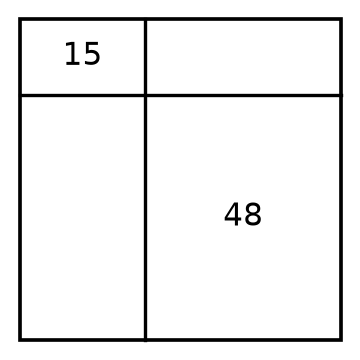
Consider the following figure and answer the item that follows:
A square is divided into four rectangles as shown above. The lengths of the sides of rectangles are natural numbers. The areas of two rectangles are indicated in the figure. What is the length of each side of the square?
Answer (b) & explanation
1. Call the side of the square s. The '15' box is a wide by b tall; the '48' box is then (s − a) wide by (s − b) tall.
2. Whole-number sides for 15: 1 × 15 or 3 × 5.
3. Try 3 and 5 with s = 11: the other box is (11 − 5) × (11 − 3) = 6 × 8 = 48. It fits.
4. Check the other options: s = 10 gives 5 × 7 = 35, not 48; s = 15 gives 10 × 12 = 120 (or 0 if 1 × 15 is used). Neither fits.
5. So each side is 11.
Answer as per the official UPSC answer key.