
UPSC Prelims PYQs with explanations
Real questions from official papers, mapped to syllabus topics. Attempt each one; the answer and the reason appear instantly.
Consider the following statements :
In India, a Metropolitan Planning Committee
- 1. is constituted under the provisions of the Constitution of India.
- 2. prepares the draft development plans for metropolitan area.
- 3. has the sole responsibility for implementing Government sponsored schemes in the metropolitan area.
Which of the statements given above is/are correct ?
Answer (a) & explanation
Statements 1 and 2 are correct (a). Article 243ZE, added by the 74th Amendment (1992), provides a Metropolitan Planning Committee for every metropolitan area, defined as a population of 10 lakh or more (1). The MPC prepares the draft development plan for the whole metropolitan area (2). Statement 3 is wrong: the MPC is a planning body; schemes are carried out by state agencies, development authorities and municipalities, so it has no sole responsibility. So (b), (c) and (d) fail.
Notice the related body: District Planning Committees (Article 243ZD) consolidate rural and urban plans. In practice, many states have not set up working MPCs; Kolkata's is often cited as the active one. Trap: 'sole' makes statement 3 an overreach.
Answer as per the official UPSC answer key.
Read the passage
For achieving inclusive growth there is a critical need to rethink the role of the State. The early debate among economists about the size of the Government can be misleading. The need of the hour is to have an enabling Government. India is too large and complex a nation for the State to be able to deliver all that is needed. Asking the Government to produce all the essential goods, create all the necessary jobs, and keep a curb on the prices of all goods is to lead to a large cumbersome bureaucracy and widespread corruption.
The aim must be to stay with the objective of inclusive growth that was laid down by the founding fathers of the nation and also to take a more modern view of what the State can realistically deliver.
This is what leads to the idea of an enabling State, that is, a Government that does not try to directly deliver to the citizens everything that they need. Instead, it (1) creates an enabling ethos for the market so that individual enterprise can flourish and citizens can, for the most part, provide for the needs of one another, and (2) steps in to help those who do not manage to do well for themselves, for there will always be individuals, no matter what the system, who need support and help. Hence we need a Government that, when it comes to the market, sets effective, incentive-compatible rules and remains on the sidelines with minimal interference, and, at the same time, plays an important role in directly helping the poor by ensuring that they get basic education and health services and receive adequate nutrition and food.
According to the passage :
- 1. The objective of inclusive growth was laid down by the founding fathers of the nation.
- 2. Need of the hour is to have an enabling Government.
- 3. The Government should engage in maximum interference in market processes.
- 4. There is a need to change the size of the Government.
Which of the statements given above are correct ?
Answer (a) & explanation
Statements 1 and 2 are correct (a). Step 1: the passage says we must 'stay with the objective of inclusive growth that was laid down by the founding fathers of the nation'. So statement 1 is stated. Step 2: it says 'the need of the hour is to have an enabling Government'. So statement 2 is stated word for word. Step 3: check the others. Statement 3 is the opposite: the Government should remain 'on the sidelines with minimal interference'. Statement 4 is wrong: the passage says the debate about the size of Government 'can be misleading'. So options (b), (c) and (d) fail.
Tip: when a statement uses a strong word like 'maximum', look for the passage's own word. Here 'minimal' kills it at once.
Answer as per the official UPSC answer key.
(Same passage and graph as the question above.)
Which region of the curve indicates that the treatment yielded effective relief?
Answer (c) & explanation
E is correct (c). Step 1: effective relief means the bacteria count is falling and the person is getting better. Step 2: on the graph, the curve goes down only in region E, after he started treatment. Step 3: in C and D the count is still high or near its peak, so the person is still ill; treatment had not yet worked there. (d) is wrong because the falling part of the curve clearly shows the effect of treatment. So (a), (b) and (d) fail.
Tip: improvement on a germ-count graph always means a falling line. Look for the only part of the curve that heads down.
Answer as per the official UPSC answer key.
Read the passage
He walked several miles that day but could not get anything to eat or drink except some dry bread and some water, which he got from cottagers and farmers. As night fell, he slept under a haystack lying in a meadow. He felt frightened at first, for the wind blew awfully over the empty fields. He felt cold and hungry, and was feeling more lonely than he had ever felt before. He, however, soon fell asleep, being much tired with his long walk. When he got up next day, he was feeling terribly hungry so he purchased a loaf of bread with a few coins that he had.
He soon fell asleep because
Answer (a) & explanation
He was exhausted is correct (a). Step 1: the passage says 'He, however, soon fell asleep, being much tired with his long walk'. Being much tired means exhausted: (a). Step 2: (b) and (d) are wrong: being alone and frightened were what he felt at first, and these feelings would have kept him awake, not made him sleep. The word 'however' shows the contrast. Step 3: (c) is wrong: the passage never says he had not slept for days.
Tip: look for 'because', 'being' or 'as' near the event. Here 'being much tired' gives the direct reason.
Answer as per the official UPSC answer key.
A “closed economy” is an economy in which
Answer (d) & explanation
The answer is (d). A closed economy has no trade with the rest of the world: neither exports nor imports, and usually no international capital flows. It is mostly a theoretical model used in economics to study an economy on its own. Option (a), full control of money supply, describes monetary policy, not openness. Option (b), deficit financing, is a fiscal method. Option (c), only exports, is still trade, so it is not a closed economy.
Notice the contrast: an open economy trades goods, services and capital with other countries. In macroeconomics, a closed economy's output is C + I + G, while an open economy adds net exports (X − M). India was relatively closed before the 1991 reforms (LPG: liberalisation, privatisation, globalisation), which opened it to trade and investment. Trap: 'only exports' is still an open economy.
Answer as per the official UPSC answer key.
The surface of a lake is frozen in severe winter, but the water at its bottom is still liquid. What is the reason ?
Answer (c) & explanation
Density of water is maximum at 4°C is correct (c). As a lake cools in winter, surface water reaches 4°C, becomes densest and sinks. Colder water then stays on top and freezes, and ice floats because it is lighter than water. So the bottom stays liquid at about 4°C, and fish survive. (a) is a helping factor, since ice is a poor conductor and insulates the water below, but it is not the basic reason. (b) is wrong: heat is lost from the surface, which is why it freezes. (d) fails because (c) is correct.
Notice the wider idea: this anomalous expansion of water between 0°C and 4°C is unusual among liquids. It also makes water pipes burst in frost and helps break rocks (frost weathering).
Answer as per the official UPSC answer key.
Why is the Government of India disinvesting its equity in the Central Public Sector Enterprises (CPSEs) ?
- 1. The Government intends to use the revenue earned from the disinvestment mainly to pay back the external debt.
- 2. The Government no longer intends to retain the management control of the CPSEs.
Which of the statements given above is/are correct ?
Answer (d) & explanation
Neither statement is correct (d). Statement 1 is wrong: in 2011, disinvestment money went into the National Investment Fund (2005) and was used for social-sector schemes and capital spending, not to repay external debt, which is small and long-term for India. Statement 2 is wrong: the policy then was to sell minority stakes while keeping at least 51% and management control. So (a), (b) and (c) fail.
Notice the later shift: the New PSE Policy (2021) keeps a minimal presence in four strategic sectors and allows strategic sale with transfer of control elsewhere, as with Air India to Tata (2022). The Department of Disinvestment became DIPAM in 2016. Trap: statement 2 describes today's strategic sales, not the 2011 policy.
Answer as per the official UPSC answer key.
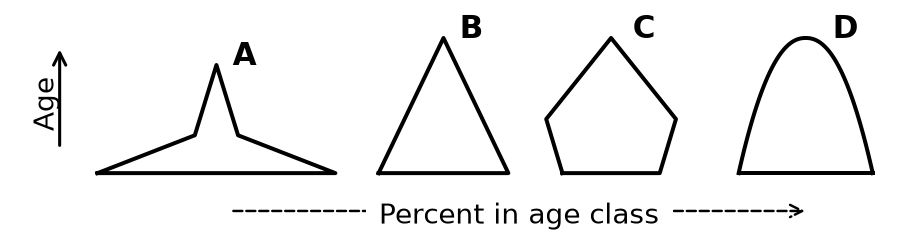
Consider the four age pyramids given below namely A, B, C and D representing four different countries.
Which one of them indicates the declining population?
Answer (c) & explanation
C is correct (c). Step 1: in an age pyramid, the bottom bars show children and the top bars show old people. Step 2: a wide bottom means many children are being born, so the population will grow. Pyramids A, B and D have this shape. Step 3: in C, the bottom is narrower than the middle: fewer children are being born than there are adults now. Fewer children today means fewer parents tomorrow, so the population will decline. So (a), (b) and (d) fail.
Tip: read a pyramid from the bottom up. A narrowing base is the sign of an ageing, shrinking population, as in Japan or Italy today.
Answer as per the official UPSC answer key.
Read the passage
A species that exerts an influence out of proportion to its abundance in an ecosystem is called a keystone species. The keystone species may influence both the species richness of communities and the flow of energy and materials through ecosystems. The sea star Pisaster ochraceus, which lives in rocky intertidal ecosystems on the Pacific coast of North America, is also an example of a keystone species. Its preferred prey is the mussel Mytilus californianus. In the absence of sea stars, these mussels crowd out other competitors in a broad belt of the intertidal zone. By consuming mussels, sea star creates bare spaces that are taken over by a variety of other species.
A study at the University of Washington demonstrated the influence of Pisaster on species richness by removing sea stars from selected parts of the intertidal zone repeatedly over a period of five years. Two major changes occurred in the areas from which sea stars were removed. First, the lower edge of the mussel bed extended farther down into the intertidal zone, showing that sea stars are able to eliminate mussels completely where they are covered with water most of the time. Second, and more dramatically, 28 species of animals and algae disappeared from the sea star removal zone. Eventually only Mytilus, the dominant competitor, occupied the entire substratum. Through its effect on competitive relationships, predation by Pisaster largely determines which species live in these rocky intertidal ecosystems.
What is the crux of the passage ?
Answer (c) & explanation
Keystone species ensures species diversity is correct (c). Step 1: the passage says a keystone species influences 'species richness'. Step 2: when sea stars were removed, 28 species of animals and algae disappeared, and only the mussel took over. So the keystone predator keeps many species alive: (c). Step 3: (a) is a detail, the sea star's preferred prey. (b) reverses the relation. (d) is wrong: the passage says the sea star is 'also an example', so it is not the only one. So (a), (b) and (d) fail.
Tip: the crux is the general idea that the example proves. Here the sea star story proves the keystone idea.
Answer as per the official UPSC answer key.
You are an officer in-charge for providing basic medical facilities to the survivors of an earthquake affected area. Despite your best possible effort, people put allegations against you for making money out of the funds given for relief. You would
Answer (a) & explanation
UPSC's key lists (a) and (c), with no negative marking; (a) is the best response. Step 1: you are working hard on earthquake relief, but people allege you are misusing funds. Step 2: (a) letting an enquiry be set up shows transparency and clears your name through a fair process. (c) not being distracted lets the relief work continue for survivors. Step 3: (b) asking to be replaced and (d) stopping work both hurt the survivors who need help now.
Tip: for these interpersonal items, pick the response that is lawful, honest and keeps the public work going. Avoid options that give in to pressure, pass the buck or abandon duty.
Answer as per the official UPSC answer key.
Both Foreign Direct Investment (FDI) and Foreign Institutional Investor (FII) are related to investment in a country. Which one of the following statements best represents an important difference between the two ?
Answer (b) & explanation
Option (b) best states the difference. FII (now called Foreign Portfolio Investment) buys shares and bonds across the market, so it adds to capital in general, but it can leave quickly, which is why it is called 'hot money'. FDI goes into a particular firm or sector, usually with a lasting stake (10% or more), and brings technology and management. (a) is reversed: FDI, not FII, brings skills. (c) is wrong: FIIs mostly trade in the secondary market, and FDI is not limited to it. (d) is reversed: FDI is the more stable flow.
Notice the policy angle: India prefers FDI for long-term growth and watches FPI flows for currency volatility. Trap: options (a) and (d) swap the two terms.
Answer as per the official UPSC answer key.
Aspartame is an artificial sweetener sold in the market. It consists of amino acids and provides calories like other amino acids. Yet, it is used as a low-calorie sweetening agent in food items. What is the basis of this use ?
Answer (d) & explanation
Option (d) is correct. Aspartame, made of two amino acids, gives about 4 kcal per gram, the same as sugar, but it is about 200 times sweeter. So only a tiny amount is needed, and the food ends up with very few calories. (a) is wrong: it is not as sweet as sugar, and the body does digest and oxidise it. (b) is wrong: processing does not make it resistant to oxidation; in fact it breaks down with heat. (c) is wrong: its metabolites do yield calories.
Notice the debate: the WHO's cancer agency (IARC) classed aspartame as 'possibly carcinogenic' in 2023, but JECFA kept the safe daily intake at 40 mg/kg body weight. People with phenylketonuria must avoid it.
Answer as per the official UPSC answer key.
Consider the following statements :
- 1. Biodiversity is normally greater in the lower latitudes as compared to the higher latitudes.
- 2. Along the mountain gradients, biodiversity is normally greater in the lower altitudes as compared to the higher altitudes.
Which of the statements given above is/are correct ?
Answer (c) & explanation
Both statements are correct (c). Species are richest in the tropics and fall towards the poles (1). Reasons include more warmth and sunlight, high productivity, and a long, stable history without glaciation, giving more time for species to evolve. Climbing a mountain is like moving towards the poles: it gets colder and harsher, so diversity generally falls with altitude (2). So (a), (b) and (d) fail.
Notice the examples: the Amazon holds the most species of any region, and India's Western Ghats and Eastern Himalaya are biodiversity hotspots. Some groups peak at mid-elevations in mountains, but the general rule holds. Trap: both are textbook gradients, so do not look for an exception.
Answer as per the official UPSC answer key.
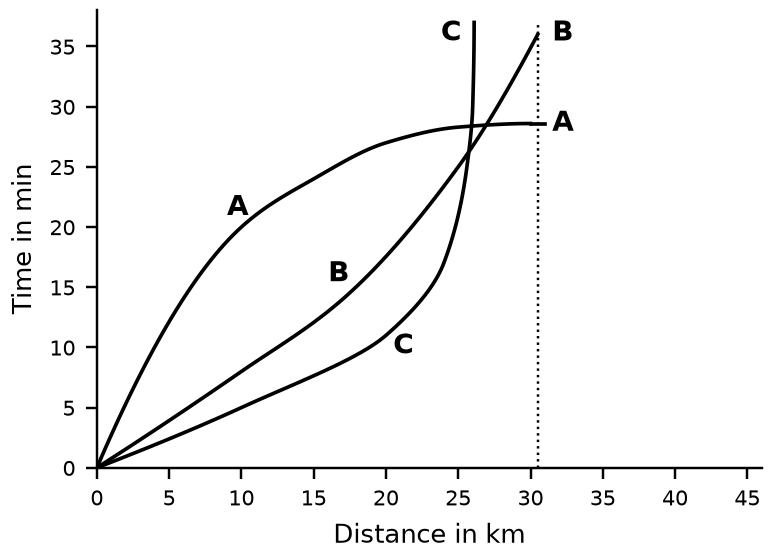
Consider the following distance-time graph. The graph shows three athletes A, B, and C running side by side for a 30 km race.
With reference to the above graph, consider the following statements:
- 1. The race was won by A.
- 2. B was ahead of A up to 25 km mark.
- 3. C ran very slowly from the beginning.
Which of the statements given above is/are correct?
Answer (b) & explanation
1. Here time is on the up-down axis, so a lower line means less time taken for the same distance (faster).
2. At 30 km, A's line is lowest (about 28 min); B takes about 35 min and C never reaches 30 km. A wins: 1 is correct.
3. Up to about 25 km, B's line is below A's, so B reached each mark sooner: 2 is correct.
4. At the start C's line is the lowest of all, so C was the fastest early on: 3 is wrong.
5. Answer: 1 and 2 only.
Answer as per the official UPSC answer key.
Read the passage
Now India’s children have a right to receive at least eight years of education, the gnawing question is whether it will remain on paper or become a reality. One hardly needs a reminder that this right is different from the others enshrined in the Constitution, that the beneficiary – a six year old child cannot demand it, nor can she or he fight a legal battle when the right is denied or violated. In all cases, it is the adult society which must act on behalf of the child. In another peculiarity, where a child’s right to education is denied, no compensation offered later can be adequate or relevant. This is so because childhood does not last. If a legal battle fought on behalf of a child is eventually won, it may be of little use to the boy or girl because the opportunity missed at school during childhood cannot serve the same purpose later in life. This may be painfully true for girls because our society permits them only a short childhood, if at all. The Right to Education (RTE) has become law at a point in India’s history when the ghastly practice of female infanticide has resurfaced in the form of foeticide. This is “symptomatic of a deeper turmoil” in society which is compounding the traditional obstacles to the education of girls. Tenacious prejudice against the intellectual potential of girls runs across our cultural diversity and the system of education has not been able to address it.
Which one of the following statements conveys the key message of the passage ?
Answer (c) & explanation
Option (c) is the key message. Step 1: the passage says a child cannot demand the right or fight for it, so adults must act. Step 2: it says a lost childhood cannot be compensated later, and that this is 'painfully true for girls', who face foeticide and prejudice. Step 3: all of this adds up to one message: the right to education, especially for girls, must be safeguarded: (c). (a) is only background. (b) is not stated; the passage says adults must act, not that they are unwilling. (d) is vague and misses the girl-child focus.
Tip: the key message ties together all the main points. Here: children cannot defend the right, loss cannot be undone, girls suffer most.
Answer as per the official UPSC answer key.
Microbial fuel cells are considered a source of sustainable energy. Why ?
- 1. They use living organisms as catalysts to generate electricity from certain substrates.
- 2. They use a variety of inorganic materials as substrates.
- 3. They can be installed in waste water treatment plants to cleanse water and produce electricity.
Which of the statements given above is/are correct ?
Answer (c) & explanation
Statements 1 and 3 are correct (c). A microbial fuel cell uses living bacteria as catalysts to break down substrates and release electrons, which flow through a circuit as electric current (1). It can be fitted in wastewater treatment plants, where bacteria feed on organic matter in sewage, cleaning the water while generating electricity (3). Statement 2 is wrong: the substrates are mainly organic materials such as glucose, acetate and sewage waste, not a variety of inorganic materials. So options (a), (b) and (d) fail.
Notice why it is called sustainable: it turns waste into power, works at normal temperatures, and does not burn fuel. Related ideas include biogas from anaerobic digestion and bio-electrochemical systems. India's SATAT and GOBARdhan schemes also aim at waste-to-energy. Trap: 'living organisms' in statement 1 is correct, since bacteria are the catalysts, not an error.
Answer as per the official UPSC answer key.
Southeast Asia has captivated the attention of global community over space and time as a geostrategically significant region. Which among the following is the most convincing explanation for this global perspective ?
Answer (d) & explanation
Option (d) is the most convincing (d). Southeast Asia lies between the Pacific and Indian Oceans, and sea lanes such as the Strait of Malacca, Sunda and Lombok carry a large share of world trade and energy. This lasting maritime character explains its importance 'over space and time'. (a) and (c) are wrong because they describe single periods, the Second World War and the Cold War. (b) is wrong because its position between China and India is only one, narrower angle, not the deepest reason.
Notice the present: the South China Sea disputes, ASEAN centrality and India's Act East and Indo-Pacific policies all flow from this maritime geography. Trap: options tied to one era cannot explain 'over space and time'.
(a) and (c) are true but belong to one period each; the question asks for a reason that holds "over space and time".
Answer as per the official UPSC answer key.
What is the difference between “vote-on-account” and “interim budget” ?
- 1. The provision of a “vote-on-account” is used by a regular Government, while an “interim budget” is a provision used by a caretaker Government.
- 2. A “vote-on-account” only deals with the expenditure in Government’s budget, while an “interim budget” includes both expenditure and receipts.
Which of the statements given above is/are correct ?
Answer (b) & explanation
Statement 2 only is correct (b). A vote on account (Article 116) lets the Lok Sabha grant money for expenditure only, usually for a few months, until the full budget is passed. An interim budget is a full statement of both expenditure and receipts, presented when a government cannot present a full budget, typically in an election year (2). Statement 1 is wrong: any government, regular or outgoing, can use either device; neither is reserved for a caretaker government. So (a), (c) and (d) fail.
Notice the practice: in election years such as 2019 and 2024, the outgoing government presented an interim budget with a vote on account, and the new government presented the full budget later. Trap: the government types in statement 1 are invented.
Answer as per the official UPSC answer key.
Read the passage
For achieving inclusive growth there is a critical need to rethink the role of the State. The early debate among economists about the size of the Government can be misleading. The need of the hour is to have an enabling Government. India is too large and complex a nation for the State to be able to deliver all that is needed. Asking the Government to produce all the essential goods, create all the necessary jobs, and keep a curb on the prices of all goods is to lead to a large cumbersome bureaucracy and widespread corruption.
The aim must be to stay with the objective of inclusive growth that was laid down by the founding fathers of the nation and also to take a more modern view of what the State can realistically deliver.
This is what leads to the idea of an enabling State, that is, a Government that does not try to directly deliver to the citizens everything that they need. Instead, it (1) creates an enabling ethos for the market so that individual enterprise can flourish and citizens can, for the most part, provide for the needs of one another, and (2) steps in to help those who do not manage to do well for themselves, for there will always be individuals, no matter what the system, who need support and help. Hence we need a Government that, when it comes to the market, sets effective, incentive-compatible rules and remains on the sidelines with minimal interference, and, at the same time, plays an important role in directly helping the poor by ensuring that they get basic education and health services and receive adequate nutrition and food.
According to the passage, the strategy of inclusive growth can be effected by focussing on
Answer (d) & explanation
Delivery of basic services to the deprived is correct (d). Step 1: find what the State should do for the poor. The passage says it should play 'an important role in directly helping the poor' by ensuring basic education and health services and adequate nutrition and food. That is option (d). Step 2: check (a). The passage says India is too large for the State to 'deliver all that is needed', so 'all the needs of every citizen' is wrong. Step 3: check (b) and (c). More regulation and controlling distribution are what the passage rejects; it wants minimal interference in markets. So (a), (b) and (c) fail.
Tip: options that sound generous ('all needs') are often the trap. Match the option to the passage's exact list of services.
Answer as per the official UPSC answer key.
There are four routes to travel from city A to city B and six routes from city B to city C. How many routes are possible to travel from the city A to city C?
Answer (a) & explanation
24 routes is correct (a). Step 1: there are 4 routes from A to B. Step 2: for each of those, there are 6 routes from B to C. Step 3: so the total number of A-to-C routes is 4 × 6 = 24. Adding them (4 + 6 = 10) would be wrong, because every first route pairs with every second route. So (b), (c) and (d) fail.
Tip: this is the multiplication rule of counting. When one choice is followed by another, multiply the number of ways. Add only when you choose one path or another, not one then another.
Answer as per the official UPSC answer key.