
UPSC Prelims PYQs with explanations
Real questions from official papers, mapped to syllabus topics. Attempt each one; the answer and the reason appear instantly.
Read the passage
He walked several miles that day but could not get anything to eat or drink except some dry bread and some water, which he got from cottagers and farmers. As night fell, he slept under a haystack lying in a meadow. He felt frightened at first, for the wind blew awfully over the empty fields. He felt cold and hungry, and was feeling more lonely than he had ever felt before. He, however, soon fell asleep, being much tired with his long walk. When he got up next day, he was feeling terribly hungry so he purchased a loaf of bread with a few coins that he had.
With reference to the passage, consider the following statements :
- 1. He was walking through the countryside.
- 2. The cottagers and farmers gave him enough food so that he could sleep at night without feeling hungry.
Which of the statements given above is/are correct ?
Answer (a) & explanation
Statement 1 only is correct (a). Step 1: the passage mentions cottagers, farmers, a haystack, a meadow and empty fields. These place him in the countryside: statement 1. Step 2: statement 2 is wrong: he got only 'dry bread and some water', and at night he 'felt cold and hungry'. So he did not get enough food to sleep without hunger. Step 3: options (b), (c) and (d) fail.
Tip: test each statement against a specific line. Statement 2 is directly contradicted by 'felt cold and hungry'.
Answer as per the official UPSC answer key.
When the bark of a tree is removed in a circular fashion all around near its base, it gradually dries up and dies because
Answer (b) & explanation
The answer is (b). Removing a ring of bark all round the trunk is called girdling or ringing. The bark contains the phloem, which carries sugars made in the leaves down to the roots. Once the phloem is cut, the roots no longer get food, so they gradually starve of energy, stop absorbing water and minerals, and the tree dries up and dies. Option (a) is wrong because water rises through the xylem in the inner wood, which girdling leaves intact, so the leaves stay green for some time. Options (c) and (d) are not the main reason.
Notice the classic experiment: in girdling, the bark just above the ring swells, because food carried down by the phloem piles up there. This proves the phloem carries food downwards. Xylem carries water up, mainly pulled by transpiration. Trap: water still reaches the leaves; it is the roots that starve.
Answer as per the official UPSC answer key.
A sandy and saline area is the natural habitat of an Indian animal species. The animal has no predators in that area but its existence is threatened due to the destruction of its habitat. Which one of the following could be that animal ?
Answer (b) & explanation
Indian wild ass is correct (b). The khur lives only in the Little Rann of Kutch, Gujarat, a flat, saline and sandy desert, protected in the Wild Ass Sanctuary (1972). Adults have almost no natural predators there, but salt pans, livestock grazing and the invasive Prosopis juliflora shrub eat into its habitat. (a) is wrong: the wild buffalo lives in wet grasslands of Assam and Chhattisgarh. (c) is wrong: the wild boar is widespread and has many predators. (d) is wrong: the chinkara (Indian gazelle) lives in Thar scrub and is hunted by wolves and dogs.
Notice the trend: the 2024 census counted about 7,670 wild asses, up from a few hundred in the 1960s. Trap: 'saline' points straight to the Rann.
Answer as per the official UPSC answer key.
What is the difference between asteroids and comets ?
- 1. Asteroids are small rocky planetoids, while comets are formed of frozen gases held together by rocky and metallic material.
- 2. Asteroids are found mostly between the orbits of Jupiter and Mars, while comets are found mostly between Venus and Mercury.
- 3. Comets show a perceptible glowing tail, while asteroids do not.
Which of the statements given above is/are correct ?
Answer (b) & explanation
Statements 1 and 3 are correct (b). Asteroids are small rocky or metallic bodies, while comets are 'dirty snowballs' of frozen gases, ice and dust held with rock (1). Near the Sun, a comet's ice vaporises and forms a glowing coma and tail pointing away from the Sun, while asteroids show no tail (3). Statement 2 is wrong: asteroids are mostly in the belt between Mars and Jupiter, but comets come from the distant Kuiper Belt and Oort Cloud, not between Venus and Mercury. So (a), (c) and (d) fail.
Notice the missions: NASA's DART (2022) changed an asteroid's orbit, OSIRIS-REx returned Bennu samples (2023), and the interstellar comet 3I/ATLAS was seen in 2025. Trap: statement 2 puts comets in the inner solar system.
Answer as per the official UPSC answer key.
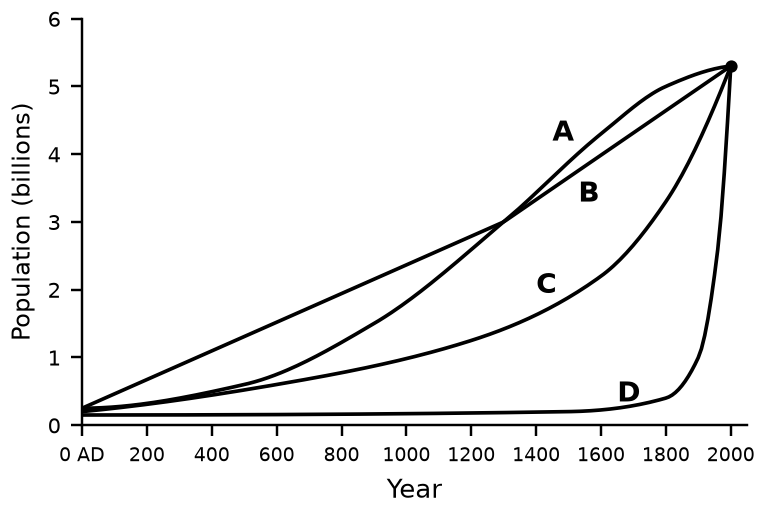
The following figure has four curves namely A, B, C and D. Study the figure and answer the item that follows.
Which curve indicates the exponential growth?
Answer (c) & explanation
C is correct (c). Step 1: exponential growth means the quantity grows by the same percentage each period, so the curve rises slowly at first and then faster and faster. Step 2: check the curves. B is a straight line, which shows steady (linear) growth. A rises but bends over and flattens at the top, which shows growth slowing to a limit. Step 3: C keeps bending upward, getting steeper each period. That is the exponential shape. So (a), (b) and (d) fail.
Tip: straight line = constant addition; upward curve = constant multiplication; S-shaped or flattening curve = growth hitting a limit.
Many readers pick D because it looks like the sharp J-shaped curve; the official answer is (c), as printed.
Answer as per the official UPSC answer key.
Read the passage
A species that exerts an influence out of proportion to its abundance in an ecosystem is called a keystone species. The keystone species may influence both the species richness of communities and the flow of energy and materials through ecosystems. The sea star Pisaster ochraceus, which lives in rocky intertidal ecosystems on the Pacific coast of North America, is also an example of a keystone species. Its preferred prey is the mussel Mytilus californianus. In the absence of sea stars, these mussels crowd out other competitors in a broad belt of the intertidal zone. By consuming mussels, sea star creates bare spaces that are taken over by a variety of other species.
A study at the University of Washington demonstrated the influence of Pisaster on species richness by removing sea stars from selected parts of the intertidal zone repeatedly over a period of five years. Two major changes occurred in the areas from which sea stars were removed. First, the lower edge of the mussel bed extended farther down into the intertidal zone, showing that sea stars are able to eliminate mussels completely where they are covered with water most of the time. Second, and more dramatically, 28 species of animals and algae disappeared from the sea star removal zone. Eventually only Mytilus, the dominant competitor, occupied the entire substratum. Through its effect on competitive relationships, predation by Pisaster largely determines which species live in these rocky intertidal ecosystems.
With reference to the passage, consider the following statements :
- 1. Mussels are generally the dominant species in intertidal ecosystems.
- 2. The survival of sea stars is generally determined by the abundance of mussels.
Which of the statements given above is/are correct ?
Answer (d) & explanation
Neither statement is correct (d). Step 1: statement 1 says mussels are generally dominant. The passage says they crowd out others only 'in the absence of sea stars'. So they are not generally dominant: 1 is wrong. Step 2: statement 2 says sea-star survival depends on mussels. The passage shows the reverse: sea stars control mussels, not mussels controlling sea stars. So 2 is wrong. Step 3: options (a), (b) and (c) fail.
Tip: watch for conditions. 'In the absence of X' cannot become 'generally'. Also check the direction of cause and effect.
Answer as per the official UPSC answer key.
You have been made responsible to hire boats at a short notice to be used for an area under flood. On seeing the price mentioned by the boat owners you found that the lowest price was approximately three times more than the approved rate of the Government. You would
Answer (b) & explanation
UPSC's key lists (b) and (d), with no negative marking. Step 1: a flood is an emergency, and boats are needed now, but the lowest price is about three times the approved rate. Step 2: (b) accepting the lowest price saves lives without delay; emergency rules allow this with proper recording. (d) warning owners that exploiting a disaster may cost them their licence can bring the price down quickly. Step 3: (a) a fresh call for prices and (c) waiting for Government approval both lose precious time while people are stranded.
Tip: for these interpersonal items, pick the response that is lawful, honest and keeps the public work going. Avoid options that give in to pressure, pass the buck or abandon duty.
Answer as per the official UPSC answer key.
A genetically engineered form of brinjal, known as the Bt-brinjal, has been developed. The objective of this is
Answer (a) & explanation
To make it pest-resistant is correct (a). Bt brinjal carries the cry1Ac gene from the soil bacterium Bacillus thuringiensis. The gene makes a protein toxic to the fruit and shoot borer, the main pest of brinjal, so farmers need fewer insecticide sprays. (b) is wrong: the change does not target taste or nutrition. (c) is wrong: drought tolerance needs other genes. (d) is wrong: longer shelf life was the aim of the 'Flavr Savr' tomato, not Bt brinjal.
Notice the policy story: GEAC cleared Bt brinjal in 2009, but the environment ministry imposed a moratorium in February 2010, which still holds; Bangladesh grows it. Bt cotton (2002) remains India's only commercial GM crop, while GM mustard DMH-11 awaits final clearance.
Answer as per the official UPSC answer key.
What was the purpose with which Sir William Wedderburn and W. S. Caine had set up the Indian Parliamentary Committee in 1893 ?
Answer (a) & explanation
To agitate for political reforms in the House of Commons is correct (a). Sir William Wedderburn, a Congress president (1889) and Liberal MP, and W.S. Caine, also an MP, formed the Indian Parliamentary Committee in 1893 to raise Indian grievances and press for reforms in the British Parliament. (b) is wrong: entry into the imperial judiciary was not its aim. (c) is wrong: independence was not on anyone's agenda in 1893. (d) is wrong: getting Indians elected was not its aim, though Dadabhai Naoroji had entered the Commons in 1892.
Notice the related bodies: the British Committee of the INC (1889) and its journal 'India' also lobbied in London. Trap: 'independence' is an anachronism for the 1890s.
Answer as per the official UPSC answer key.
The Brahmaputra, Irrawady and Mekong rivers originate in Tibet and flow through narrow and parallel mountain ranges in their upper reaches. Of these rivers, Brahmaputra makes a “U” turn in its course to flow into India. This “U” turn is due to
Answer (b) & explanation
Syntaxial bending of the young Himalaya is correct (b). At the eastern end of the Himalaya, near Namcha Barwa (7,782 m), the mountain chain bends sharply south in a hairpin called the eastern syntaxis, caused by the pressure of the Indian plate. The Tsangpo follows this bend, cuts the world's deepest gorge, and turns back as the Siang/Dihang, becoming the Brahmaputra in Assam. (a) and (c) are general statements that do not explain the specific U-turn. (d) fails because (a) is not the reason.
Notice the western twin: the Nanga Parbat syntaxis, where the Indus turns sharply. China began building a mega-dam on the Yarlung Tsangpo at Medog near this bend in July 2025, raising concerns in India. Trap: 'uplift' is too general.
Answer as per the official UPSC answer key.
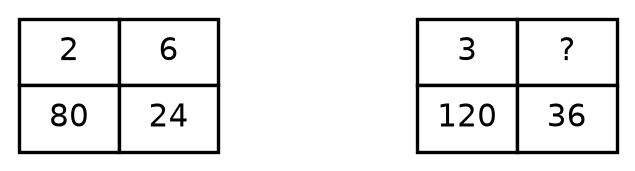
Consider the following figures:
What is the missing number?
Answer (c) & explanation
9 is correct (c). Step 1: look at the first figure. The top numbers are 2 and 6. The bottom-left number 80 = (2 + 6) × 10. The bottom-right number 24 = 6 × 4. Step 2: apply the same rule to the second figure. The bottom-right is 36, and it equals the missing number × 4. So the missing number = 36 ÷ 4 = 9. Step 3: check the bottom-left: (3 + 9) × 10 = 120, which matches the figure. So (a), (b) and (d) fail.
Tip: find the rule in the complete figure first, then test it on every number in the second figure. If one number fits and another does not, the rule is wrong.
Answer as per the official UPSC answer key.
Read the passage
Now India’s children have a right to receive at least eight years of education, the gnawing question is whether it will remain on paper or become a reality. One hardly needs a reminder that this right is different from the others enshrined in the Constitution, that the beneficiary – a six year old child cannot demand it, nor can she or he fight a legal battle when the right is denied or violated. In all cases, it is the adult society which must act on behalf of the child. In another peculiarity, where a child’s right to education is denied, no compensation offered later can be adequate or relevant. This is so because childhood does not last. If a legal battle fought on behalf of a child is eventually won, it may be of little use to the boy or girl because the opportunity missed at school during childhood cannot serve the same purpose later in life. This may be painfully true for girls because our society permits them only a short childhood, if at all. The Right to Education (RTE) has become law at a point in India’s history when the ghastly practice of female infanticide has resurfaced in the form of foeticide. This is “symptomatic of a deeper turmoil” in society which is compounding the traditional obstacles to the education of girls. Tenacious prejudice against the intellectual potential of girls runs across our cultural diversity and the system of education has not been able to address it.
Which one of the following statements conveys the inference of the passage ?
Answer (d) & explanation
There is no substitute for childhood education is correct (d). Step 1: an inference is something that follows from the passage but is not said word for word. Step 2: the passage says 'no compensation offered later can be adequate', and the missed opportunity 'cannot serve the same purpose later in life'. From this we infer that nothing can replace education missed in childhood: (d). Step 3: (a) is stated directly, so it is not an inference. (b) and (c) go beyond the passage; it never says adults are unreliable or that legal fights are prohibitive. So (a), (b) and (c) fail.
Tip: in inference questions, a statement copied from the passage is usually not the answer. Look for the idea the passage clearly implies.
Answer as per the official UPSC answer key.
Which one of the following statements appropriately describes the “fiscal stimulus” ?
Answer (b) & explanation
The answer is (b). A fiscal stimulus is an intense, deliberate action by the government to boost economic activity, mainly by increasing public spending and/or cutting taxes, so that demand, output and jobs rise during a slowdown. India used it after the 2008 global financial crisis through excise duty cuts and higher spending, and again in 2020 with the Atmanirbhar Bharat packages during COVID-19. Option (a) is too narrow, limiting it to manufacturing, and links it to a demand surge, when stimulus is used in a slowdown. Option (c) describes farm credit, and (d) financial inclusion, which are separate policies.
Notice the difference: fiscal policy uses government spending and taxes, managed by the Finance Ministry; monetary policy uses interest rates and money supply, managed by the RBI. A stimulus raises the fiscal deficit in the short run, which the FRBM Act tries to keep in check.
Answer as per the official UPSC answer key.
A company marketing food products advertises that its items do not contain trans-fats. What does this campaign signify to the customers ?
- 1. The food products are not made out of hydrogenated oils.
- 2. The food products are not made out of animal fats/oils.
- 3. The oils used are not likely to damage the cardiovascular health of the consumers.
Which of the statements given above is/are correct ?
Answer (c) & explanation
Statements 1 and 3 are correct (c). Trans fats form mainly when vegetable oil is partially hydrogenated, as in vanaspati, so 'no trans fat' signals no such oils (1). Trans fats raise 'bad' LDL cholesterol and lower 'good' HDL, so avoiding them protects the heart (3). Statement 2 is wrong: the claim says nothing about animal fats; ghee and butter may still be used, and they carry a little natural trans fat. So (a), (b) and (d) fail.
Notice the policy: FSSAI capped industrial trans fat at 2% of total fat in oils and foods from January 2022, in line with the WHO's 'REPLACE' goal. Trap: 'no trans fat' is not the same as 'no saturated or animal fat'.
Answer as per the official UPSC answer key.
Regarding the International Monetary Fund, which one of the following statements is correct ?
Answer (c) & explanation
It grants loans to only member countries is correct (c). The IMF (1944, Bretton Woods) lends only to its 190 member countries, mainly to fix balance-of-payments problems, often with conditions. Each member pays a quota that sets its voting power and how much it can borrow. (a) is wrong: non-members cannot borrow. (b) is wrong: most IMF loans now go to developing and emerging economies. (d) is wrong: loans go to member governments, usually routed through their central banks or treasuries, not to any central bank on its own.
Notice the wider frame: the IMF's reserve asset is the SDR, valued against five currencies, including the yuan since 2016. Kristalina Georgieva began her second term as Managing Director in October 2024. India borrowed from the IMF in 1991.
Answer as per the official UPSC answer key.
Read the passage
For achieving inclusive growth there is a critical need to rethink the role of the State. The early debate among economists about the size of the Government can be misleading. The need of the hour is to have an enabling Government. India is too large and complex a nation for the State to be able to deliver all that is needed. Asking the Government to produce all the essential goods, create all the necessary jobs, and keep a curb on the prices of all goods is to lead to a large cumbersome bureaucracy and widespread corruption.
The aim must be to stay with the objective of inclusive growth that was laid down by the founding fathers of the nation and also to take a more modern view of what the State can realistically deliver.
This is what leads to the idea of an enabling State, that is, a Government that does not try to directly deliver to the citizens everything that they need. Instead, it (1) creates an enabling ethos for the market so that individual enterprise can flourish and citizens can, for the most part, provide for the needs of one another, and (2) steps in to help those who do not manage to do well for themselves, for there will always be individuals, no matter what the system, who need support and help. Hence we need a Government that, when it comes to the market, sets effective, incentive-compatible rules and remains on the sidelines with minimal interference, and, at the same time, plays an important role in directly helping the poor by ensuring that they get basic education and health services and receive adequate nutrition and food.
What constitutes an enabling Government ?
- 1. A large bureaucracy.
- 2. Implementation of welfare programmes through representatives.
- 3. Creating an ethos that helps individual enterprise.
- 4. Providing resources to those who are underprivileged.
- 5. Offering direct help to the poor regarding basic services.
Select the correct answer from the codes given below :
Answer (c) & explanation
Items 3, 4 and 5 are correct (c). Step 1: the passage says an enabling State 'creates an enabling ethos for the market so that individual enterprise can flourish'. That is item 3. Step 2: it 'steps in to help those who do not manage to do well' and directly helps the poor with basic services. Those are items 4 and 5. Step 3: check the rest. Item 1 is wrong: a large bureaucracy is named as a problem leading to corruption. Item 2 is wrong: the passage never mentions working through representatives. So (a), (b) and (d) fail.
Tip: anything the passage criticises cannot be part of its ideal. Spot the warnings first, then strike those items.
Answer as per the official UPSC answer key.
A contract on construction job specifies a penalty for delay in completion of the work beyond a certain date is as follows: Rs. 200 for the first day, Rs. 250 for the second day, Rs. 300 for the third day etc., the penalty for each succeeding day being Rs. 50 more than that of the preceding day. How much penalty should the contractor pay if he delays the work by 10 days?
Answer (b) & explanation
Rs. 4,250 is correct (b). Step 1: the penalties form a series rising by Rs. 50 each day: 200, 250, 300 and so on. The 10th day's penalty = 200 + 9 × 50 = Rs. 650. Step 2: the total of an evenly rising series = number of days × (first + last) ÷ 2 = 10 × (200 + 650) ÷ 2 = 10 × 425 = Rs. 4,250. Step 3: (d) Rs. 650 is only the last day's penalty, a trap. (a) and (c) come from wrong sums. So (a), (c) and (d) fail.
Tip: for any steady increase, the average of the first and last term, times the number of terms, gives the total. No need to add ten numbers.
Rs. 650 is only the 10th day, not the total.
Answer as per the official UPSC answer key.
Read the passage
I opened the bag and packed the boots in; and then, just as I was going to close it, a horrible idea occurred to me. Had I packed my toothbrush ? I don’t know how it is, but I never do know whether I’ve packed my toothbrush.
My toothbrush is a thing that haunts me when I’m travelling, and makes my life a misery. I dream that I haven’t packed it, and wake up in a cold perspiration, and get out of bed and hunt for it. And, in the morning, I pack it before I have used it, and it is always the last thing I turn out of the bag; and then I repack and forget it, and have to rush upstairs for it at the last moment and carry it to the railway station, wrapped up in my pocket-handkerchief.
When he was going to close the bag, the idea that occurred to him was
Answer (a) & explanation
Unpleasant is correct (a). Step 1: the passage says 'a horrible idea occurred to me': that he might not have packed his toothbrush. Step 2: 'horrible' means very bad or disturbing, which is closest to unpleasant: (a). Step 3: (b) sad is the wrong kind of feeling; he was worried, not sorrowful. (c) fantastic is wrong. (d) amusing is how the reader may find it, since the passage is comic, but the narrator himself did not find it funny.
Tip: answer from the character's point of view, not yours as a reader. The narrator calls it 'horrible', so pick the matching feeling.
Answer as per the official UPSC answer key.
The “New START” treaty was in the news. What is this treaty ?
Answer (a) & explanation
The answer is (a). New START (New Strategic Arms Reduction Treaty) was signed in Prague in April 2010 by US President Obama and Russian President Medvedev, and came into force in 2011. It is a bilateral treaty between the USA and Russia that capped each side at 1,550 deployed strategic nuclear warheads and 700 deployed missiles and bombers, with on-site inspections. Options (b), (c) and (d) describe energy or trade arrangements among other groups, which are unrelated.
Notice its fate: the treaty was extended in 2021 for five years. Russia suspended its participation in 2023. The treaty expired in February 2026 without a replacement, leaving no binding limits on the two largest nuclear arsenals for the first time in decades. Earlier treaties include START I (1991) and the INF Treaty (1987, ended 2019). India is not party to these, and follows no first use.
"Multilateral" in (b), (c) and (d) is the giveaway: START has always been a two-party treaty, first USA–USSR, then USA–Russia.
Fell for this one? Most aspirants do. The PYQ Book puts every UPSC trap side by side, so the pattern finally clicks. Try the free sample
Answer as per the official UPSC answer key.
La Nina is suspected to have caused recent floods in Australia. How is La Nina different from El Nino ?
- 1. La Nina is characterised by unusually cold ocean temperature in equatorial Indian Ocean whereas El Nino is characterised by unusually warm ocean temperature in the equatorial Pacific Ocean.
- 2. El Nino has adverse effect on south-west monsoon of India, but La Nina has no effect on monsoon climate.
Which of the statements given above is/are correct ?
Answer (d) & explanation
Neither statement is correct (d). Statement 1 is wrong: both El Niño (unusual warming) and La Niña (unusual cooling) refer to the equatorial Pacific Ocean, not the Indian Ocean. Statement 2 is wrong: El Niño does tend to weaken India's south-west monsoon, but La Niña usually strengthens it, so it is not without effect. So (a), (b) and (c) fail.
Notice the wider frame: both are phases of ENSO (El Niño–Southern Oscillation). The Indian Ocean has its own see-saw, the Indian Ocean Dipole (IOD); a positive IOD can offset a bad El Niño year, as in 1997. La Niña brings floods to eastern Australia, as in 2010–11. Trap: the ocean is swapped in statement 1.
Answer as per the official UPSC answer key.