
UPSC Prelims PYQs with explanations
Real questions from official papers, mapped to syllabus topics. Attempt each one; the answer and the reason appear instantly.
Consider the following factors :
- 1. Rotation of the Earth
- 2. Air pressure and wind
- 3. Density of ocean water
- 4. Revolution of the Earth
Which of the above factors influence the ocean currents?
Answer (b) & explanation
Factors 1, 2 and 3 are correct (b). The Earth's rotation creates the Coriolis force, which deflects currents to the right in the north and left in the south, shaping gyres (1). Air pressure and winds, such as the trade winds and westerlies, drag surface water along (2). Differences in density, caused by temperature and salinity, drive deep thermohaline circulation (3). Item 4 is wrong: the Earth's revolution round the Sun gives seasons but does not move currents. So (a), (c) and (d) fail.
Notice the related ideas: the global 'conveyor belt', the AMOC, which scientists warn is weakening, and the Indian Ocean's monsoon-driven reversal of currents. Coastline shape and the sea floor also steer currents. Trap: revolution and rotation are easily confused.
Answer as per the official UPSC answer key.
Consider the following :
- 1. Assessment of land revenue on the basis of nature of the soil and the quality of crops
- 2. Use of mobile cannons in warfare
- 3. Cultivation of tobacco and red chillies
Which of the above was/were introduced into India by the English?
Answer (d) & explanation
None was introduced by the English (d). Item 1: assessment of land revenue by soil type and crop quality goes back to Sher Shah Suri and Akbar's minister Todar Mal (zabt system). Item 2: mobile field artillery was used by Babur at the First Battle of Panipat (1526). Item 3: tobacco and red chillies came from the Americas through the Portuguese in the 16th–17th centuries. So (a), (b) and (c) fail.
Notice the other Portuguese introductions: potato, tomato, pineapple, papaya, cashew and maize. Jahangir tried to ban tobacco smoking. Babur's gunners Ustad Ali and Mustafa used the 'Rumi' (Ottoman) method. Trap: things linked with colonial times are not all British.
Answer as per the official UPSC answer key.
Read the passage
Chemical pesticides lose their role in sustainable agriculture if the pests evolve resistance. The evolution of pesticide resistance is simply natural selection in action. It is almost certain to occur when vast numbers of a genetically variable population are killed. One or a few individuals may be unusually resistant (perhaps because they possess an enzyme that can detoxify the pesticide). If the pesticide is applied repeatedly, each successive generation of the pest will contain a larger proportion of resistant individuals. Pests typically have a high intrinsic rate of reproduction, and so a few individuals in one generation may give rise to hundreds or thousands in the next, and resistance spreads very rapidly in a population.
This problem was often ignored in the past, even though the first case of DDT (dichlorodiphenyltrichloroethane) resistance was reported as early as 1946. There is exponential increase in the numbers of invertebrates that have evolved resistance and in the number of pesticides against which resistance has evolved. Resistance has been recorded in every family of arthropod pests (including dipterans such as mosquitoes and house flies, as well as beetles, moths, wasps, fleas, lice and mites) as well as in weeds and plant pathogens. Take the Alabama leafworm, a moth pest of cotton, as an example. It has developed resistance in one or more regions of the world to aldrin, DDT, dieldrin, endrin, lindane and toxaphene.
If chemical pesticides brought nothing but problems, — if their use was intrinsically and acutely unsustainable — then they would already have fallen out of widespread use. This has not happened. Instead, their rate of production has increased rapidly. The ratio of cost to benefit for the individual agricultural producer has remained in favour of pesticide use. In the USA, insecticides have been estimated to benefit the agricultural products to the tune of around $5 for every $1 spent.
Moreover, in many poorer countries, the prospect of imminent mass starvation, or of an epidemic disease, are so frightening that the social and health costs of using pesticides have to be ignored. In general the use of pesticides is justified by objective measures such as ‘lives saved’, ‘economic efficiency of food production’ and ‘total food produced’. In these very fundamental senses, their use may be described as sustainable. In practice, sustainability depends on continually developing new pesticides that keep at least one step ahead of the pests — pesticides that are less persistent, biodegradable and more accurately targeted at the pests.
Though the problems associated with the use of chemical pesticides is known for a long time, their widespread use has not waned. Why ?
Answer (d) & explanation
None of these is correct (d). Step 1: the passage gives the real reason pesticide use has not fallen: the cost-to-benefit ratio 'has remained in favour of pesticide use' (about $5 of benefit for $1 spent in the USA). None of the options says this. Step 2: (a) the passage never says alternatives do not exist at all. (b) is false: it speaks of 'continually developing new pesticides'. Step 3: (c) is wrong because the passage only hopes for future pesticides that are 'biodegradable'; it does not say present ones are. So (a), (b) and (c) fail.
Tip: when the true reason is missing from the options, 'none of the above' is a real choice. Check each option against the text before ruling it out.
Answer as per the official UPSC answer key.
Read the passage
The need for Competition Law becomes more evident when foreign direct investment (FDI) is liberalised. The impact of FDI is not always pro-competitive. Very often FDI takes the form of a foreign corporation acquiring a domestic enterprise or establishing a joint venture with one. By making such an acquisition the foreign investor may substantially lessen competition and gain a dominant position in the relevant market, thus charging higher prices. Another scenario is where the affiliates of two separate multinational companies (MNCs) have been established in competition with one another in a particular developing economy, following the liberalisation of FDI. Subsequently, the parent companies overseas merge. With the affiliates no longer remaining independent, competition in the host country may be virtually eliminated and the prices of the products may be artificially inflated. Most of these adverse consequences of mergers and acquisitions by MNCs can be avoided if an effective competition law is in place. Also, an economy that has implemented an effective competition law is in a better position to attract FDI than one that has not. This is not just because most MNCs are expected to be accustomed to the operation of such a law in their home countries and know how to deal with such concerns but also that MNCs expect competition authorities to ensure a level playing field between domestic and foreign firms.
What is the inference from this passage ?
Answer (c) & explanation
(c) is correct. Step 1: the passage says most harms of MNC mergers 'can be avoided if an effective competition law is in place', and that MNCs expect competition authorities to 'ensure a level playing field between domestic and foreign firms'. Step 2: (a) is wrong because of 'always': the passage only describes situations where foreign firms may dominate. Step 3: (b) is wrong: the passage does not oppose mergers as such; it wants them checked by competition law. (d) is wrong: whether FDI is essential for growth is never discussed. So (a), (b) and (d) fail.
Tip: the best inference usually echoes the passage's conclusion (here, the value of competition law). Options with 'always' or new topics are traps.
Answer as per the official UPSC answer key.
Read the passage
We started pitching the highest camp that has ever been made. Everything took five times as long as it would have taken in a place where there was enough air to breathe; but at last we got the tent up, and when we crawled in, it was not too bad. There was only a light wind, and inside it was not too cold for us to take off our gloves. At night most climbers take off their boots; but I prefer to keep them on. Hillary, on the other hand, took his off and laid them next to his sleeping bag.
They took a long time to finish the work because
Answer (b) & explanation
(b) is correct. Step 1: the passage says everything 'took five times as long as it would have taken in a place where there was enough air to breathe'. So the thin air at that height slowed them down. Step 2: (a) is wrong: tiredness is not given as the reason. Step 3: (c) is wrong: the passage says inside 'it was not too cold'. (d) is wrong: darkness is never mentioned. So (a), (c) and (d) fail.
Tip: in 'because' questions, find the sentence that gives the cause directly. Here the comparison with 'a place where there was enough air' tells you the cause was lack of air. Remember: at great heights air is thin and every action takes longer.
Answer as per the official UPSC answer key.
The Nagara, the Dravida and the Vesara are the
Answer (c) & explanation
Three styles of temple architecture is correct (c). Nagara is the north Indian style, with a curved shikhara over the sanctum, as at Khajuraho. Dravida is the south Indian style, with a pyramid-shaped vimana and tall gopurams, as at Thanjavur's Brihadeeswara. Vesara is the mixed Deccan style of the later Chalukyas and Hoysalas, as at Belur and Halebidu. (a), (b) and (d) are wrong: these are not racial, linguistic or musical terms.
Notice the texts and sub-styles: the Shilpa Shastras name these styles; Nagara has Odisha (rekha deul) and Rajasthan sub-styles. The Hoysala temples became a World Heritage Site in 2023. Trap: 'Dravida' also names a language family, but here it is architecture.
Answer as per the official UPSC answer key.
According to the Constitution of India, it is the duty of the President of India to cause to be laid before the Parliament which of the following?
- 1. The Recommendations of the Union Finance Commission
- 2. The Report of the Public Accounts Committee
- 3. The Report of the Comptroller and Auditor General
- 4. The Report of the National Commission for Scheduled Castes
Select the correct answer using the codes given below :
Answer (c) & explanation
Items 1, 3 and 4 are correct (c). The Constitution makes the President lay before Parliament the Finance Commission's recommendations with an explanatory memorandum (Article 281) (1), the CAG's reports on Union accounts (Article 151) (3), and the National Commission for Scheduled Castes' reports (Article 338) (4). Item 2 is wrong: the Public Accounts Committee is Parliament's own committee and reports directly to the Lok Sabha, not through the President. So (a), (b) and (d) fail.
Notice the similar duties: reports of the UPSC (Article 323), the National Commission for STs (338A), the NCBC (338B) and the Special Officer for Linguistic Minorities (350B) are also laid by the President. Trap: the PAC uses CAG reports, but it is not a constitutional reporting body to the President.
Answer as per the official UPSC answer key.
Which one of the following groups of animals belongs to the category of endangered species?
Answer (a) & explanation
Option (a) is correct per UPSC's key. Option (a) lists only threatened animals: the Great Indian Bustard (Critically Endangered), musk deer and red panda (Endangered), and the Asiatic wild ass, treated as endangered in India; the Indian subspecies, the khur, is in Schedule I (the IUCN now lists the species as a whole as Near Threatened, so the grouping is loose). Each other option includes a common animal: cheetal and blue bull (nilgai) in (b) and (d), rhesus monkey in (c), and Hanuman langur in (d). So (b), (c) and (d) fail.
Notice the bustard's plight: fewer than 150 remain, mainly in Rajasthan; the Supreme Court has ordered undergrounding of power lines in its habitat. Trap: one common animal sinks an option.
Answer as per the official UPSC answer key.
Examine the following statements:
- 1. Either A and B are of the same age or A is older than B.
- 2. Either C and D are of the same age or D is older than C.
- 3. B is older than C.
Which one of the following conclusions can be drawn from the above statements?
Answer (d) & explanation
'A is older than C' is correct (d). Step 1: statement 1 means A is the same age as B or older: A ≥ B. Statement 2 means D ≥ C. Statement 3 says B > C. Step 2: join them: A ≥ B > C, so A is definitely older than C (d). Step 3: (a) fails because A and B may be the same age. (b) fails because nothing links B and D. (c) fails because C and D may be the same age. So only (d) is certain.
Tip: turn 'either the same age or older' into the sign ≥. Then chain the signs. A conclusion is certain only if every link holds; one 'may be equal' breaks a strict 'older than'.
Answer as per the official UPSC answer key.
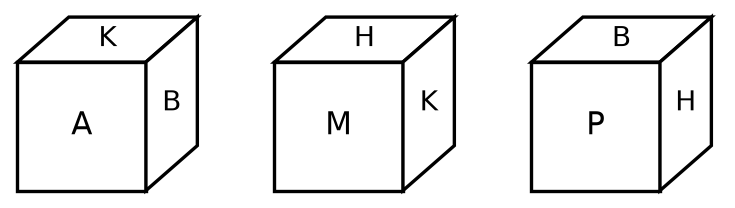
Three views of a cube following a particular motion are given below:
What is the letter opposite to A?
Answer (a) & explanation
H is correct (a). Step 1: letters seen together in one view are neighbours, so they cannot be opposite each other. Step 2: view 2 shows H with M and K. View 3 shows H with B and P. So H touches K, M, B and P. Step 3: a face touches four faces and is opposite just one. The only letter H never touches is A, so H is opposite A. B, P and M all touch H's group of neighbours, so (b), (c) and (d) fail.
Tip: list each letter's neighbours from all the views. A cube face has exactly four neighbours; the one letter left over is the opposite face.
Answer as per the official UPSC answer key.
In the areas covered under the Panchayat (Extension to the Scheduled Areas) Act, 1996, what is the role/power of Gram Sabha?
- 1. Gram Sabha has the power to prevent alienation of land in the Scheduled Areas.
- 2. Gram Sabha has the ownership of minor forest produce.
- 3. Recommendation of Gram Sabha is required for granting prospecting licence or mining lease for any mineral in the Scheduled Areas.
Which of the statements given above is/are correct?
Answer (b) & explanation
Statements 1 and 2 are correct per UPSC's key (b), but this key is doubtful. Under PESA (1996), the Gram Sabha has power to prevent alienation of land in Scheduled Areas and to restore land unlawfully taken (1), and holds ownership of minor forest produce (2). Statement 3 is the doubt: PESA requires the recommendation of the Gram Sabha or the panchayat at the appropriate level before prospecting licences or mining leases are granted, so the role is not exclusively the Gram Sabha's, and UPSC left it out; many books mark (d). (a) and (c) fail on any reading.
Notice the related rulings: the Samatha (1997) and Niyamgiri (2013) judgements upheld tribal consent over mining. Several states, lately Jharkhand (January 2026), have framed PESA rules.
Answer as per the official UPSC answer key.
Which of the following are the methods of Parliamentary control over public finance in India?
- 1. Placing Annual Financial Statement before the Parliament
- 2. Withdrawal of moneys from Consolidated Fund of India only after passing the Appropriation Bill
- 3. Provisions of supplementary grants and vote-on-account
- 4. A periodic or at least a mid-year review of programme of the Government against macroeconomic forecasts and expenditure by a Parliamentary Budget Office
- 5. Introducing Finance Bill in the Parliament
Select the correct answer using the codes given below :
Answer (a) & explanation
Items 1, 2, 3 and 5 are correct (a). Parliament controls public finance through the Annual Financial Statement (Article 112) (1), the Appropriation Bill, without which no money leaves the Consolidated Fund (Article 114) (2), supplementary grants and vote on account (Articles 115–116) (3), and the Finance Bill for taxes (5). Item 4 is wrong: India has no Parliamentary Budget Office; it has only been proposed. So (b), (c) and (d) fail.
Notice the other tools: the Public Accounts Committee, Estimates Committee and Committee on Public Undertakings, plus CAG audits. The US has a Congressional Budget Office, and the UK an Office for Budget Responsibility. Trap: item 4 describes a good idea that India has not adopted.
Answer as per the official UPSC answer key.
How do you distinguish between Kuchipudi and Bharatanatyam dances?
- 1. Dancers occasionally speaking dialogues is found in Kuchipudi dance but not in Bharatanatyam.
- 2. Dancing on the brass plate by keeping the feet on its edges is a feature of Bharatanatyam but Kuchipudi dance does not have such a form of movements.
Which of the statements given above is/are correct?
Answer (a) & explanation
Statement 1 only is correct (a). Kuchipudi, from Andhra Pradesh, grew from dance-drama (yakshagana-style), so dancers occasionally speak or sing dialogue, which is not found in Bharatanatyam (1). Statement 2 is reversed: the Tarangam, dancing on the rim of a brass plate with a water pot on the head, is a Kuchipudi feature, not Bharatanatyam. So (b), (c) and (d) fail.
Notice the other features: Kuchipudi was once performed by Brahmin men of Kuchipudi village, and Siddhendra Yogi shaped it; Bharatanatyam, from Tamil Nadu, was codified by the Thanjavur Quartet and revived by Rukmini Devi Arundale. India recognises eight classical dances (Sangeet Natak Akademi), and the Ministry of Culture counts Chhau too. Trap: the brass plate feature is swapped.
Answer as per the official UPSC answer key.
Lord Buddha’s image is sometimes shown with the hand gesture called ‘Bhumisparsha Mudra’. It symbolizes
Answer (b) & explanation
Calling the Earth to witness his purity is correct (b). In the Bhumisparsha ('earth-touching') mudra, the Buddha's right hand reaches down to touch the ground. Just before his enlightenment at Bodh Gaya, Mara challenged his right to enlightenment; the Buddha called the Earth to witness his merit and resolve, and the Earth goddess affirmed it. (a) is wrong: the Earth was not asked to guard against Mara. (c) is wrong: it is not a lesson about life dissolving into earth. (d) fails because (a) is wrong.
Notice the other mudras: Dharmachakra (turning the wheel, first sermon at Sarnath), Abhaya (fearlessness), Dhyana (meditation) and Varada (giving). The Bodh Gaya Mahabodhi image shows Bhumisparsha. Trap: (a) uses the same characters with a different story.
Answer as per the official UPSC answer key.
Read the passage
Invasions of exotic species into new geographic areas sometimes occur naturally and without human agency. However, human actions have increased this trickle to a flood. Human-caused introductions may occur either accidentally as a consequence of human transport, or intentionally but illegally to serve some private purpose or legitimately to procure some hoped-for public benefit by bringing a pest under control, producing new agricultural products or providing novel recreational opportunities. Many introduced species are assimilated into communities without much obvious effect. However, some have been responsible for dramatic changes to native species and natural communities. For example, the accidental introduction of the brown tree snake Boiga irregularis into Guam, an island in the Pacific, has through nest predation reduced 10 endemic forest bird species to the point of extinction.
One of the major reasons for the world’s great biodiversity is the occurrence of centers of endemism so that similar habitats in different parts of the world are occupied by different groups of species that happen to have evolved there. If every species naturally had access to everywhere on the globe, we might expect a relatively small number of successful species to become dominant in each biome. The extent to which this homogenization can happen naturally is restricted by the limited powers of dispersal of most species in the face of the physical barriers that exist to dispersal. By virtue of the transport opportunities offered by humans, these barriers have been breached by an ever-increasing number of exotic species. The effects of introductions have been to convert a hugely diverse range of local community compositions into something much more homogeneous.
It would be wrong, however, to conclude that introducing species to a region will inevitably cause a decline in species richness there. For example, there are numerous species of plants, invertebrates and vertebrates found in continental Europe but absent from the British Isles (many because they have so far failed to recolonize after the last glaciations). Their introduction would be likely to augment British biodiversity. The significant detrimental effect noted above arises where aggressive species provide a novel challenge to endemic biotas ill-equipped to deal with them.
With reference to the passage, which of the following statements is correct ?
Answer (d) & explanation
None of the statements is correct (d). Step 1: (a) says introductions always reduce biodiversity. The passage says this is 'wrong' and that bringing continental species to Britain would 'augment British biodiversity'. Step 2: (b) says introduced species have always greatly changed native systems. The passage says 'many introduced species are assimilated without much obvious effect'. Step 3: (c) says man is the only cause of homogenization. The passage says invasions also 'occur naturally', even if humans turned the trickle into a flood. So (a), (b) and (c) all fail.
Tip: words like 'always' and 'only' in options are warning signs. One counter-example in the passage is enough to reject them.
Answer as per the official UPSC answer key.
(Same information as the question above.)
Which lecture is scheduled on Wednesday?
Answer (c) & explanation
English is correct (c). Step 1: History is on Tuesday (only day the faculty is free). Step 2: the block English → Economics → Mathematics needs three days in a row; only Wed–Thu–Fri are free in a row, and this also keeps Economics off Tuesday. Step 3: so English is on Wednesday, Economics Thursday, Mathematics Friday, and Statistics Monday. Statistics is Monday, Economics Thursday and History Tuesday, so (a), (b) and (d) fail.
Tip: check your schedule against every clue once before answering. Here: Economics not on Tuesday (✓ Thursday), History Tuesday (✓), English just before Economics (✓), Mathematics just after Economics (✓). One check protects all five linked answers.
Answer as per the official UPSC answer key.
What is the role of ultraviolet (UV) radiation in the water purification systems?
- 1. It inactivates/kills the harmful microorganisms in water.
- 2. It removes all the undesirable odours from the water.
- 3. It quickens the sedimentation of solid particles, removes turbidity and improves the clarity of water.
Which of the statements given above is/are correct?
Answer (a) & explanation
Statement 1 only is correct (a). Ultraviolet light, especially at about 254 nm, damages the DNA of bacteria and viruses, so they cannot multiply; this inactivates harmful microbes (1). Statement 2 is wrong: UV adds no chemicals and does not remove odours; activated carbon filters do that. Statement 3 is wrong: UV does not settle particles or remove turbidity; in fact, cloudy water shields microbes from UV, so water must be filtered first. So (b), (c) and (d) fail.
Notice the related methods: chlorination leaves a residual disinfectant, reverse osmosis removes dissolved salts, and ozonation also disinfects. UV does not remove arsenic or fluoride. Trap: UV is a disinfection step only.
Answer as per the official UPSC answer key.
With reference to the wetlands of India, consider the following statements :
- 1. The country’s total geographical area under the category of wetlands is recorded more in Gujarat as compared to other States.
- 2. In India, the total geographical area of coastal wetlands is larger than that of inland wetlands.
Which of the statements given above is/are correct?
Answer (a) & explanation
Statement 1 only is correct (a). The National Wetland Atlas (ISRO's Space Applications Centre, 2011) found that Gujarat has the largest wetland area of any state, about a fifth of India's total, thanks to the Rann of Kutch, the Gulf of Khambhat and other coastal flats (1). Statement 2 is wrong: for India as a whole, inland wetlands (about 69%) are larger than coastal wetlands (about 27%). So (b), (c) and (d) fail.
Notice the Ramsar count: India has about 90+ Ramsar sites, the most in Asia, with Tamil Nadu having the most sites; the largest single site is the Sundarbans. The Wetlands (Conservation and Management) Rules, 2017 govern them, and Amrit Dharohar (2023) promotes them. Trap: Gujarat's coastal wetlands are huge, but nationally inland wetlands lead.
Gujarat sounds like a dry State, so statement 1 looks wrong; the Rann of Kutch and the Gulf of Khambhat make it the top wetland State.
Answer as per the official UPSC answer key.
With reference to the guilds (Shreni) of ancient India that played a very important role in the country’s economy, which of the following statements is/are correct?
- 1. Every guild was registered with the central authority of the State and the king was the chief administrative authority on them.
- 2. The wages, rules of work, standards and prices were fixed by the guild.
- 3. The guild had judicial powers over its own members.
Select the correct answer using the codes given below :
Answer (c) & explanation
Statements 2 and 3 are correct (c). Shrenis, guilds of artisans and merchants, were self-governing. They fixed wages, work rules, quality standards and prices for their members (2), and had judicial powers to settle disputes and punish members (3). The Dharmashastras told kings to respect guild customs. Statement 1 is wrong: guilds were not registered with a central state authority, nor did the king run them. So (a), (b) and (d) fail.
Notice the evidence: inscriptions at Sanchi and Nasik record guild donations; guilds acted as banks, taking deposits and paying interest; the Mandasor inscription (436 CE) records a silk-weavers' guild building a sun temple. The Arthashastra mentions guild-based soldiers. Trap: guilds were autonomous, not state departments.
Answer as per the official UPSC answer key.
Read the passage
Chemical pesticides lose their role in sustainable agriculture if the pests evolve resistance. The evolution of pesticide resistance is simply natural selection in action. It is almost certain to occur when vast numbers of a genetically variable population are killed. One or a few individuals may be unusually resistant (perhaps because they possess an enzyme that can detoxify the pesticide). If the pesticide is applied repeatedly, each successive generation of the pest will contain a larger proportion of resistant individuals. Pests typically have a high intrinsic rate of reproduction, and so a few individuals in one generation may give rise to hundreds or thousands in the next, and resistance spreads very rapidly in a population.
This problem was often ignored in the past, even though the first case of DDT (dichlorodiphenyltrichloroethane) resistance was reported as early as 1946. There is exponential increase in the numbers of invertebrates that have evolved resistance and in the number of pesticides against which resistance has evolved. Resistance has been recorded in every family of arthropod pests (including dipterans such as mosquitoes and house flies, as well as beetles, moths, wasps, fleas, lice and mites) as well as in weeds and plant pathogens. Take the Alabama leafworm, a moth pest of cotton, as an example. It has developed resistance in one or more regions of the world to aldrin, DDT, dieldrin, endrin, lindane and toxaphene.
If chemical pesticides brought nothing but problems, — if their use was intrinsically and acutely unsustainable — then they would already have fallen out of widespread use. This has not happened. Instead, their rate of production has increased rapidly. The ratio of cost to benefit for the individual agricultural producer has remained in favour of pesticide use. In the USA, insecticides have been estimated to benefit the agricultural products to the tune of around $5 for every $1 spent.
Moreover, in many poorer countries, the prospect of imminent mass starvation, or of an epidemic disease, are so frightening that the social and health costs of using pesticides have to be ignored. In general the use of pesticides is justified by objective measures such as ‘lives saved’, ‘economic efficiency of food production’ and ‘total food produced’. In these very fundamental senses, their use may be described as sustainable. In practice, sustainability depends on continually developing new pesticides that keep at least one step ahead of the pests — pesticides that are less persistent, biodegradable and more accurately targeted at the pests.
How do pesticides act as agents for the selection of resistant individuals in any pest population ?
- 1. It is possible that in a pest population the individuals will behave differently due to their genetic makeup.
- 2. Pests do possess the ability to detoxify the pesticides.
- 3. Evolution of pesticide resistance is equally distributed in pest population.
Which of the statements given above is/are correct ?
Answer (b) & explanation
Statements 1 and 2 are correct (b). Step 1: the passage speaks of a 'genetically variable population', so individuals respond differently because of their genes: 1 is right. Step 2: it says a few may be resistant 'perhaps because they possess an enzyme that can detoxify the pesticide': 2 is right. Step 3: statement 3 says resistance is equally distributed. The passage says it begins in 'one or a few individuals' and spreads over generations, so it is unequal at first. So 3 is wrong, and (a), (c) and (d) fail.
Tip: selection works only because individuals differ. Any statement saying everyone is the same ('equally distributed') goes against the whole idea of selection.
Answer as per the official UPSC answer key.