
UPSC Prelims PYQs with explanations
Real questions from official papers, mapped to syllabus topics. Attempt each one; the answer and the reason appear instantly.
Examine the following statements:
- 1. I watch TV only if I am bored.
- 2. I am never bored when I have my brother's company.
- 3. Whenever I go to the theatre, I take my brother along.
Which one of the following conclusions is valid in the context of the above statements?
Answer (d) & explanation
(d) is correct. Step 1: 'I watch TV only if I am bored' means: if I watch TV, I am bored. Its valid flip (contrapositive) is: if I am not bored, I do not watch TV. That is (d). Step 2: (a) reverses the rule; being bored does not force me to watch TV. Step 3: (b) is wrong: the statements say I am never bored with my brother, not that boredom makes me seek him. (c) is wrong: being without my brother does not prove I am bored, and even boredom does not force TV. So (a), (b) and (c) fail.
Tip: 'A only if B' means 'if A then B'. The safe conclusion is 'if not B then not A'; never reverse it to 'if B then A'.
'only if' puts the condition after the arrow: P only if Q means P → Q.
Answer as per the official UPSC answer key.
Read the passage
We started pitching the highest camp that has ever been made. Everything took five times as long as it would have taken in a place where there was enough air to breathe; but at last we got the tent up, and when we crawled in, it was not too bad. There was only a light wind, and inside it was not too cold for us to take off our gloves. At night most climbers take off their boots; but I prefer to keep them on. Hillary, on the other hand, took his off and laid them next to his sleeping bag.
When they crawled into the tent
Answer (a) & explanation
(a) is correct. Step 1: the passage says 'inside it was not too cold for us to take off our gloves'. So they took their gloves off because it was not very cold. Step 2: (b) and (c) are wrong: both say it was very cold, the opposite of the text. Step 3: (d) is wrong: it says they did not take off their gloves, which reverses the action. So (b), (c) and (d) fail.
Tip: the phrase 'not too cold to do X' means it was warm enough to do X. Options here change one or two small parts (the temperature or the action). Check both parts against the sentence before choosing.
Answer as per the official UPSC answer key.
The Congress ministries resigned in the seven provinces in 1939, because
Answer (d) & explanation
None of the statements is correct (d). In October 1939 the Congress ministries resigned in protest because the Viceroy, Lord Linlithgow, had declared India a party to the Second World War without consulting Indian leaders, and the British would not promise independence after the war. (a) is wrong: the Congress had ministries in 8 of 11 provinces and its resignation was not about the others. (b) is wrong: the left wing did not cause it. (c) is wrong: communal riots were not the reason.
Notice what followed: the Muslim League celebrated 22 December 1939 as 'Day of Deliverance', the August Offer (1940) and Individual Satyagraha (Vinoba Bhave first) came next. Trap: 'seven provinces' in the question is UPSC's wording; the usual count is eight.
Answer as per the official UPSC answer key.
A deadlock between the Lok Sabha and the Rajya Sabha calls for a joint sitting of the Parliament during the passage of
- 1. Ordinary Legislation
- 2. Money Bill
- 3. Constitution Amendment Bill
Select the correct answer using the codes given below :
Answer (a) & explanation
Ordinary legislation only is correct (a). A joint sitting under Article 108, called by the President and presided over by the Speaker, is possible only for ordinary bills when the Houses disagree (1). Item 2 is wrong: on a Money Bill, the Rajya Sabha can only make recommendations within 14 days, and the Lok Sabha prevails, so no deadlock arises. Item 3 is wrong: a Constitution Amendment Bill under Article 368 must pass each House separately by a special majority; there is no joint sitting. So (b), (c) and (d) fail.
Notice the record: joint sittings have been held only three times: the Dowry Prohibition Bill (1961), the Banking Service Commission (Repeal) Bill (1978) and the Prevention of Terrorism Bill (2002). Trap: joint sittings are rare and narrow.
Answer as per the official UPSC answer key.
Consider the following statements :
If there were no phenomenon of capillarity
- 1. it would be difficult to use a kerosene lamp
- 2. one would not be able to use a straw to consume a soft drink
- 3. the blotting paper would fail to function
- 4. the big trees that we see around would not have grown on the Earth
Which of the statements given above are correct?
Answer (b) & explanation
Statements 1, 3 and 4 are correct (b). Capillarity draws liquid up narrow spaces because of adhesion and surface tension. It lifts kerosene up a lamp wick (1), soaks ink into blotting paper (3), and helps raise water up the narrow xylem vessels of trees, along with transpiration pull and cohesion (4). Statement 2 is wrong: drinking through a straw works by air pressure; sucking lowers the pressure inside, and atmospheric pressure pushes the drink up. So (a), (c) and (d) fail.
Notice the related examples: water rising in soil and in a towel, and the meniscus in thin tubes. Mercury shows capillary fall, not rise, because cohesion exceeds adhesion. Trap: the straw is about pressure, not capillarity.
Answer as per the official UPSC answer key.
Examine the following statements:
- 1. Only those who have a pair of binoculars can become the members of the birdwatcher's club.
- 2. Some members of the birdwatcher's club have cameras.
- 3. Those members who have cameras can take part in photo-contests.
Which of the following conclusions can be drawn from the above statements?
Answer (b) & explanation
'All members have binoculars' is correct (b). Step 1: 'Only those who have binoculars can become members' means every member must have binoculars. So (b) follows directly. Step 2: (a) reverses it: having binoculars does not make you a member; it only makes you eligible. Step 3: (c) fails: statement 3 says members with cameras can take part in photo-contests, but it never says only members take part; outsiders may join too. Since (b) follows, (d) also fails.
Tip: 'Only X can be Y' means 'every Y is X', not 'every X is Y'. Turning the sentence round is the most common trap in these questions.
Answer as per the official UPSC answer key.
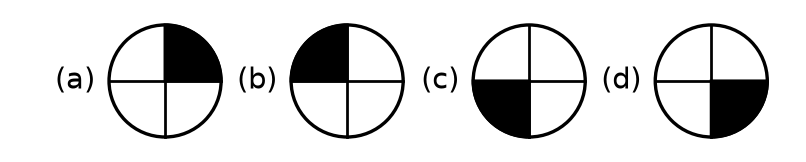
Which one of the figures shown below occupies the blank space (?) in the matrix given above?
Answer (d) & explanation
Figure (d) is correct. Step 1: in each row the first and last circles are the same. Step 2: the middle circle has its black quarter in the opposite corner. Row 1: the ends have top-right black, the middle has bottom-left black. Row 3: the ends have bottom-right black, the middle has top-left black. Step 3: row 2's ends have the top-left quarter black, so the middle must have the bottom-right quarter black. That is (d). So (a), (b) and (c) fail.
Tip: in matrix figures, check rows first, then columns. Look for 'same at both ends' and 'opposite in the middle' patterns; they are very common in UPSC CSAT.
Answer as per the official UPSC answer key.
In the Parliament of India, the purpose of an adjournment motion is
Answer (a) & explanation
To discuss a definite matter of urgent public importance is correct (a). An adjournment motion sets aside the normal business of the Lok Sabha to discuss a definite, factual matter of urgent public importance. It needs the support of 50 members, and because it interrupts business, it carries an element of censure of the government. The Rajya Sabha does not use it. (b) is wrong: members get information through Question Hour. (c) is wrong: reducing a demand for grant is a cut motion. (d) is wrong: the Speaker handles disorder by adjourning the House or suspending members, not through this motion.
Notice the related devices: the calling attention motion (Indian innovation, no censure), the short-duration discussion (Rule 193) and the no-confidence motion (Rule 198). Trap: 'adjournment' sounds like stopping the House for disorder.
Answer as per the official UPSC answer key.
Mahatma Gandhi undertook fast unto death in 1932, mainly because
Answer (c) & explanation
The Communal Award is correct (c). In August 1932, British Prime Minister Ramsay MacDonald announced the Communal Award, giving separate electorates to the Depressed Classes. Gandhi saw this as splitting Hindu society and began a fast unto death in Yerwada jail on 20 September 1932. It ended with the Poona Pact (24 September 1932) between Gandhi and Ambedkar: separate electorates were dropped, and reserved seats within joint electorates rose from 71 to 148. (a) and (b) were not the trigger. (d) fails because (c) is correct.
Notice the follow-up: Gandhi founded the Harijan Sevak Sangh (1932) and the weekly 'Harijan' (1933). Trap: the Round Table failure was real but did not cause the fast.
Answer as per the official UPSC answer key.
With reference to the religious history of medieval India, the Sufi mystics were known to pursue which of the following practices?
- 1. Meditation and control of breath
- 2. Severe ascetic exercises in a lonely place
- 3. Recitation of holy songs to arouse a state of ecstasy in their audience
Select the correct answer using the codes given below :
Answer (d) & explanation
All three are correct (d). Sufi mystics practised zikr, repeating God's name, often with breath control and meditation (1). They undertook chilla, forty days of severe ascetic exercises in seclusion (2). They held sama, gatherings of devotional music such as qawwali, to arouse a state of spiritual ecstasy (3). So options (a), (b) and (c) leave out real practices.
Notice the orders: the Chishti order (Khwaja Moinuddin Chishti at Ajmer, Nizamuddin Auliya in Delhi) embraced sama, while the Naqshbandi order frowned on music. The Suhrawardi order was strong in Multan and Sindh. Amir Khusrau, Nizamuddin's disciple, is linked with qawwali. Trap: different orders differed, but all three practices existed.
Answer as per the official UPSC answer key.
Which of the following is/are among the Fundamental Duties of citizens laid down in the Indian Constitution?
- 1. To preserve the rich heritage of our composite culture
- 2. To protect the weaker sections from social injustice
- 3. To develop the scientific temper and spirit of inquiry
- 4. To strive towards excellence in all spheres of individual and collective activity
Select the correct answer using the codes given below :
Answer (c) & explanation
Items 1, 3 and 4 are correct (c). Article 51A includes valuing and preserving the rich heritage of our composite culture (1), developing scientific temper, humanism and the spirit of inquiry (3), and striving towards excellence in all spheres of individual and collective activity (4). Item 2 is wrong: protecting the weaker sections from social injustice and exploitation is a Directive Principle under Article 46, addressed to the State, not a citizen's duty. So (a), (b) and (d) fail.
Notice the list: there are 11 Fundamental Duties; ten came with the 42nd Amendment (1976) and the eleventh, on parents educating children aged 6 to 14, with the 86th Amendment (2002). Constitution Day (26 November) is used to promote them. Trap: item 2 reads like a duty but is a state directive.
Answer as per the official UPSC answer key.
Read the passage
Invasions of exotic species into new geographic areas sometimes occur naturally and without human agency. However, human actions have increased this trickle to a flood. Human-caused introductions may occur either accidentally as a consequence of human transport, or intentionally but illegally to serve some private purpose or legitimately to procure some hoped-for public benefit by bringing a pest under control, producing new agricultural products or providing novel recreational opportunities. Many introduced species are assimilated into communities without much obvious effect. However, some have been responsible for dramatic changes to native species and natural communities. For example, the accidental introduction of the brown tree snake Boiga irregularis into Guam, an island in the Pacific, has through nest predation reduced 10 endemic forest bird species to the point of extinction.
One of the major reasons for the world’s great biodiversity is the occurrence of centers of endemism so that similar habitats in different parts of the world are occupied by different groups of species that happen to have evolved there. If every species naturally had access to everywhere on the globe, we might expect a relatively small number of successful species to become dominant in each biome. The extent to which this homogenization can happen naturally is restricted by the limited powers of dispersal of most species in the face of the physical barriers that exist to dispersal. By virtue of the transport opportunities offered by humans, these barriers have been breached by an ever-increasing number of exotic species. The effects of introductions have been to convert a hugely diverse range of local community compositions into something much more homogeneous.
It would be wrong, however, to conclude that introducing species to a region will inevitably cause a decline in species richness there. For example, there are numerous species of plants, invertebrates and vertebrates found in continental Europe but absent from the British Isles (many because they have so far failed to recolonize after the last glaciations). Their introduction would be likely to augment British biodiversity. The significant detrimental effect noted above arises where aggressive species provide a novel challenge to endemic biotas ill-equipped to deal with them.
Why does man introduce exotic species into new geographical areas ?
- 1. To breed exotic species with local varieties.
- 2. To increase agricultural productivity.
- 3. For beautification and landscaping.
Which of the above statements is/are correct ?
Answer (d) & explanation
All three is the official key (d). Step 1: the passage lists reasons for deliberate introductions: controlling pests, 'producing new agricultural products' and 'providing novel recreational opportunities'. Step 2: new agricultural products fit raising farm productivity (2). Recreational uses are read broadly to cover beautification and landscaping (3). Step 3: UPSC also reads 'new agricultural products' as covering breeding with local varieties (1). Note: statement 1 is DOUBTFUL — breeding is never mentioned, so (b) '2 and 3 only' is arguable. UPSC's key, however, is (d).
Tip: when the passage gives a general reason ('new products'), UPSC sometimes accepts specific examples of it. Choose the key, but note where the text is thin.
Answer as per the official UPSC answer key.
(Same information as the question above.)
Which lecture is scheduled before the Mathematics lecture?
Answer (a) & explanation
Economics is correct (a). Step 1: the clue itself says Mathematics is scheduled 'immediately after the day of Economics'. Step 2: in the full week (Mon Statistics, Tue History, Wed English, Thu Economics, Fri Mathematics), Economics on Thursday comes just before Mathematics on Friday. Step 3: History (Tuesday), Statistics (Monday) and English (Wednesday) also come before Mathematics in the week, but not just before it. The question means the lecture immediately before, so (b), (c) and (d) fail.
Tip: some answers can be read straight from a clue. Before working the whole puzzle, check whether one clue already answers the question.
Answer as per the official UPSC answer key.
Graphene is frequently in news recently. What is its importance?
- 1. It is a two-dimensional material and has good electrical conductivity.
- 2. It is one of the thinnest but strongest materials tested so far.
- 3. It is entirely made of silicon and has high optical transparency.
- 4. It can be used as ‘conducting electrodes’ required for touch screens, LCDs and organic LEDs.
Which of the statements given above are correct?
Answer (c) & explanation
Statements 1, 2 and 4 are correct (c). Graphene is a single layer of carbon atoms arranged in a honeycomb, so it is two-dimensional and conducts electricity very well (1). It is one atom thick yet about 200 times stronger than steel (2). Being nearly transparent and conductive, it suits conducting electrodes in touch screens, LCDs and OLEDs (4). Statement 3 is wrong: it is made of carbon, not silicon. So (a), (b) and (d) fail.
Notice the history: Andre Geim and Konstantin Novoselov won the 2010 Nobel Prize in Physics for isolating it with sticky tape. India set up the India Graphene Engineering and Innovation Centre in Kerala. Trap: 'silicon' comes from the link with electronics.
Answer as per the official UPSC answer key.
Consider the following crops of India :
- 1. Groundnut
- 2. Sesamum
- 3. Pearl millet
Which of the above is/are predominantly rainfed crop/crops?
Answer (d) & explanation
All three are correct (d). Groundnut, sesamum (til) and pearl millet (bajra) are hardy dryland crops grown mostly in the kharif season on monsoon rain, with little irrigation, in Gujarat, Rajasthan, Maharashtra and the Deccan. Bajra tolerates heat and poor sandy soils; groundnut and sesame are oilseeds suited to light, well-drained soils. So options (a), (b) and (c) leave out real rainfed crops.
Notice the wider pattern: about half of India's net sown area is still rainfed, growing most pulses, oilseeds and coarse cereals. Rajasthan leads in bajra, Gujarat in groundnut. Millets were promoted as 'Shree Anna' during the International Year of Millets 2023. Trap: groundnut is sometimes irrigated in rabi, but it is predominantly rainfed.
Answer as per the official UPSC answer key.
The distribution of powers between the Centre and the States in the Indian Constitution is based on the scheme provided in the
Answer (c) & explanation
The Government of India Act, 1935 is correct (c). The 1935 Act created a three-fold division of powers: Federal, Provincial and Concurrent Lists, and gave the provinces autonomy. The Constitution's Union, State and Concurrent Lists in the Seventh Schedule follow this scheme closely. (a) is wrong: Morley–Minto (1909) added separate electorates but did not divide powers. (b) is wrong: Montagu–Chelmsford (1919) separated central and provincial subjects and brought dyarchy, but not the three-list scheme. (d) is wrong: the 1947 Act ended British rule and created two dominions.
Notice the other borrowings from 1935: the office of Governor, emergency provisions, Public Service Commissions and the Federal Court. About 250 Articles drew on it. Trap: 1919 divided subjects, but 1935 gave the list scheme.
Answer as per the official UPSC answer key.
Read the passage
Chemical pesticides lose their role in sustainable agriculture if the pests evolve resistance. The evolution of pesticide resistance is simply natural selection in action. It is almost certain to occur when vast numbers of a genetically variable population are killed. One or a few individuals may be unusually resistant (perhaps because they possess an enzyme that can detoxify the pesticide). If the pesticide is applied repeatedly, each successive generation of the pest will contain a larger proportion of resistant individuals. Pests typically have a high intrinsic rate of reproduction, and so a few individuals in one generation may give rise to hundreds or thousands in the next, and resistance spreads very rapidly in a population.
This problem was often ignored in the past, even though the first case of DDT (dichlorodiphenyltrichloroethane) resistance was reported as early as 1946. There is exponential increase in the numbers of invertebrates that have evolved resistance and in the number of pesticides against which resistance has evolved. Resistance has been recorded in every family of arthropod pests (including dipterans such as mosquitoes and house flies, as well as beetles, moths, wasps, fleas, lice and mites) as well as in weeds and plant pathogens. Take the Alabama leafworm, a moth pest of cotton, as an example. It has developed resistance in one or more regions of the world to aldrin, DDT, dieldrin, endrin, lindane and toxaphene.
If chemical pesticides brought nothing but problems, — if their use was intrinsically and acutely unsustainable — then they would already have fallen out of widespread use. This has not happened. Instead, their rate of production has increased rapidly. The ratio of cost to benefit for the individual agricultural producer has remained in favour of pesticide use. In the USA, insecticides have been estimated to benefit the agricultural products to the tune of around $5 for every $1 spent.
Moreover, in many poorer countries, the prospect of imminent mass starvation, or of an epidemic disease, are so frightening that the social and health costs of using pesticides have to be ignored. In general the use of pesticides is justified by objective measures such as ‘lives saved’, ‘economic efficiency of food production’ and ‘total food produced’. In these very fundamental senses, their use may be described as sustainable. In practice, sustainability depends on continually developing new pesticides that keep at least one step ahead of the pests — pesticides that are less persistent, biodegradable and more accurately targeted at the pests.
Why is the use of chemical pesticides generally justified by giving the examples of poor and developing countries ?
- 1. Developed countries can afford to do away with use of pesticides by adapting to organic farming, but it is imperative for poor and developing countries to use chemical pesticides.
- 2. In poor and developing countries, the pesticide addresses the problem of epidemic diseases of crops and eases the food problem.
- 3. The social and health costs of pesticide use are generally ignored in poor and developing countries.
Which of the statements given above is/are correct ?
Answer (c) & explanation
Only statement 2 is correct (c). Step 1: the passage says in poorer countries 'the prospect of imminent mass starvation, or of an epidemic disease' is so frightening that pesticides are used. That is the justification: they ease food problems and disease: 2 is right. Step 2: statement 1 talks about organic farming in developed countries, which the passage never mentions. Step 3: statement 3 is a result of that fear (the costs 'have to be ignored'), not the reason for using pesticides. The question asks why use is justified, so 3 fails. Hence (a), (b) and (d) are wrong.
Tip: separate the reason from the consequence. A true fact from the passage can still be the wrong answer to a 'why' question.
Answer as per the official UPSC answer key.
Only six roads A, B, C, P, Q and R connect a military camp to the rest of the country. Only one out of A, P and R is open at any one time. If B is closed so is Q. Only one of A and B is open during storms. P is closed during floods. In the context, which one of the following statements is correct?
Answer (b) & explanation
'During storms at least one road is open' is correct (b). Step 1: the rule says 'only one of A and B is open during storms'. So in a storm exactly one of these two roads is open, which means at least one road is open. Step 2: (a) and (c) state exact numbers of open roads (three). The rules never fix these numbers; for example, during floods P is closed, but the others depend on unknown choices. Step 3: (d) says all roads close during calamities, but the storm rule already keeps one road open. So (a), (c) and (d) fail.
Tip: in rule puzzles, prefer options that come straight from a rule. Exact counts usually need information the question does not give.
Answer as per the official UPSC answer key.
Read the passage
A local man, staying on the top floor of an old wooden house, was awakened at midnight by a fire. Losing his way in a smoke-filled passage, he missed the stairway and went into another room. He picked up a bundle to protect his face from the fire and immediately fell through the floor below where he managed to escape through a clear doorway. The “bundle” proved to be the baby of the Mayor’s wife. The “hero” was congratulated by all.
The man went into another room because
Answer (b) & explanation
(b) is correct. Step 1: the passage says 'Losing his way in a smoke-filled passage, he missed the stairway'. The smoke made him lose his way, so he went into the wrong room. Step 2: (a) is wrong: he lived in the house, so he knew where the stairway was; he just could not see it in the smoke. Step 3: (c) is wrong: nervousness is not mentioned. (d) is wrong: he picked up the bundle after going into the room, so it was not the cause. So (a), (c) and (d) fail.
Tip: check the order of events. An action that happens later can never be the cause of an earlier one.
Answer as per the official UPSC answer key.
With reference to National Rural Health Mission, which of the following are the jobs of ‘ASHA’, a trained community health worker?
- 1. Accompanying women to the health facility for antenatal care checkup
- 2. Using pregnancy test kits for early detection of pregnancy
- 3. Providing information on nutrition and immunization
- 4. Conducting the delivery of baby
Select the correct answer using the codes given below :
Answer (a) & explanation
Statements 1, 2 and 3 are correct (a). An ASHA (Accredited Social Health Activist), created under the National Rural Health Mission (2005), is a trained village woman who links families to the health system. She accompanies women for antenatal check-ups and institutional delivery (1), uses pregnancy test kits for early detection (2), and gives advice on nutrition and immunisation (3). Statement 4 is wrong: she does not conduct deliveries; she encourages delivery at a health facility, where trained staff attend. So (b), (c) and (d) fail.
Notice the scale: India has about 10 lakh ASHAs, paid through task-based incentives. They were recognised with the WHO Global Health Leaders Award in 2022. ASHAs work with ANMs and Anganwadi workers. Trap: helping with delivery is not conducting it.
Answer as per the official UPSC answer key.