
UPSC Prelims PYQs with explanations
Real questions from official papers, mapped to syllabus topics. Attempt each one; the answer and the reason appear instantly.
Who of the following organized a march on the Tanjore coast to break the Salt Law in April 1930?
Answer (b) & explanation
C. Rajagopalachari led a salt march from Trichinopoly to Vedaranyam on the Tanjore coast in April 1930, the southern counterpart of Gandhi's Dandi March (b). V. O. Chidambaram Pillai (a) founded the Swadeshi Steam Navigation Company in 1906 and was jailed long before 1930. K. Kamaraj (c) was a younger Congress leader at the time, and Annie Besant (d) led the Home Rule League, not this march.
Other salt marches were led by K. Kelappan in Malabar and Gopabandhu Choudhury in Odisha. Notice how salt, used by everyone, made civil disobedience truly all-India.
Answer as per the official UPSC answer key.
In India, in which one of the following types of forests is teak a dominant tree species?
Answer (a) & explanation
Teak and sal are the dominant trees of tropical moist deciduous forests, which get roughly 100–200 cm of rain (a). These forests grow along the Western Ghats, in central India and the Shiwalik foothills, and shed their leaves in the dry season. Tropical rain forests (b) are evergreen, with species such as rosewood and mahogany. Thorn scrub (c) has acacia and cactus-like plants, and temperate forests (d) have oak, deodar and conifers.
Teak also grows in the drier deciduous belt. Notice how teak's strength made it prized for shipbuilding, which led the British to set up India's first forest department.
Answer as per the official UPSC answer key.
Twelve people form a club. By picking lots, one of them will host a dinner for all once in a month. The number of dinners a particular member has to host in one year is
Answer (d) & explanation
It cannot be predicted (d). Step 1: understand the rule. Every month, a lot is drawn from all twelve members to choose the host. Step 2: lots are drawn fresh each month, so the same person can be picked again, and someone may never be picked. Step 3: in one year (12 draws), a member might host zero, one, two or more dinners. No single number is certain. Option (a) is the trap: "one" would be true only if each member took a turn, which the question does not say. Options (b) and (c) are also only possibilities.
Tip: "picking lots" means chance. With chance, an exact count cannot be fixed; only an average could be estimated (here one a year on average).
12 dinners for 12 people does not mean one each. Lots are drawn at random every time.
Answer as per the official UPSC answer key.
Read the passage
Climate change is already making many people hungry all over the world, by disrupting crop yields and pushing up prices. And it is not just food but nutrients that are becoming scarcer as the climate changes. It is the poorest communities that will suffer the worst effects of climate change, including increased hunger and malnutrition as crop production and livelihoods are threatened. On the other hand, poverty is a driver of climate change, as desperate communities resort to unsustainable use of resources to meet current needs.
Which among the following is the most logical corollary to the above passage ?
Answer (b) & explanation
Poverty and climate impacts reinforce each other, so food systems must change (b). Step 1: find both directions. Climate change makes the poor hungrier by hitting crops and prices. And "poverty is a driver of climate change", as desperate people overuse resources. Each worsens the other: a two-way loop. Step 2: breaking the loop needs a new approach to food systems. Step 3: test the others. Option (a) is wrong: more subsidies address only one side. Option (c) is wrong: it ignores climate. Option (d) is wrong: "immediately" is too strong, and food prices are only part of the story.
Tip: a "corollary" follows naturally from the whole passage. When a passage shows two things causing each other, the answer usually mentions both.
Answer as per the official UPSC answer key.
(Same information as the question above.)
What is the number of logically possible orders of all six cousins in terms of increasing age ?
Answer (b) & explanation
There are 2 possible orders (b). Step 1: from the question above, E = 22, A = 21, C = 20 and F = 18. Step 2: B and D take the ages 17 and 19, with F in between. Either B is 17 and D is 19, or D is 17 and B is 19. Both fit all the clues: A is older than B, and C is older than D, in both cases. Step 3: so there are 2 orders. Options (a), (c) and (d) do not match.
Tip: in follow-up questions, reuse the fixed results and look only at the people who are still free to move. Count their possible arrangements.
Answer as per the official UPSC answer key.
Which one of the following is the national aquatic animal of India?
Answer (c) & explanation
The Gangetic river dolphin was declared India's National Aquatic Animal in 2009 (c). It is nearly blind, finds its way and prey by echolocation, and is listed as Endangered. The saltwater crocodile (a), olive ridley turtle (b) and gharial (d) are important protected species but not the national aquatic animal.
The Vikramshila Gangetic Dolphin Sanctuary in Bihar protects it, and Project Dolphin was announced in 2020. The first nationwide count, released in 2025, found about 6,300 of them. Notice how the dolphin acts as an indicator of a healthy river, like the tiger for forests.
Answer as per the official UPSC answer key.
India is a member of which among the following?
- 1. Asia-Pacific Economic Cooperation
- 2. Association of South-East Asian Nations
- 3. East Asia Summit
Select the correct answer using the code given below.
Answer (b) & explanation
Only statement 3 is correct (b). India has been a member of the East Asia Summit since it began in 2005. India is a dialogue partner of ASEAN, not a member, and the relationship was raised to a Comprehensive Strategic Partnership in 2022. India has long sought to join APEC, but the group has not admitted it.
The EAS has 18 members: the ten ASEAN states plus India, China, Japan, South Korea, Australia, New Zealand, the USA and Russia. Notice how India's Act East Policy works through these forums, linking trade, connectivity and security in the Indo-Pacific.
Answer as per the official UPSC answer key.
There is a Parliamentary System of Government in India because the
Answer (d) & explanation
A system is parliamentary when the executive answers to the legislature. Article 75(3) makes the Council of Ministers collectively responsible to the Lok Sabha, which is the defining feature (d). Direct election of the Lok Sabha (a) and Parliament's power to amend the Constitution (b) can exist in presidential systems too. The Rajya Sabha being a permanent body (c) is a feature of bicameralism, not of parliamentary government.
India borrowed this model from Britain's Westminster system. Notice how the President is the nominal head while real power lies with the PM and Cabinet, who stay in office only with the Lok Sabha's confidence.
Answer as per the official UPSC answer key.
All good athletes want to win and all athletes who want to win eat a well-balanced diet; therefore all athletes who do not eat a well-balanced diet are bad athletes.
The best conclusion from this statement is that
Answer (b) & explanation
No athlete who skips a balanced diet is a good athlete (b). Step 1: write the chain. Good athlete → wants to win → eats a balanced diet. Step 2: if something always leads to a result, then no result means no cause. So an athlete who does not eat a balanced diet cannot be a good athlete. That is option (b). Step 3: test the others. Option (a) is not supported: bad athletes might also want to win. Option (c) reverses the chain: eating well does not prove someone is good. Option (d) also reverses it: wanting to win does not prove someone is good.
Tip: "If A then B" also means "if not B then not A". It does not mean "if B then A". Reversing the arrow is the most common logic trap.
Answer as per the official UPSC answer key.
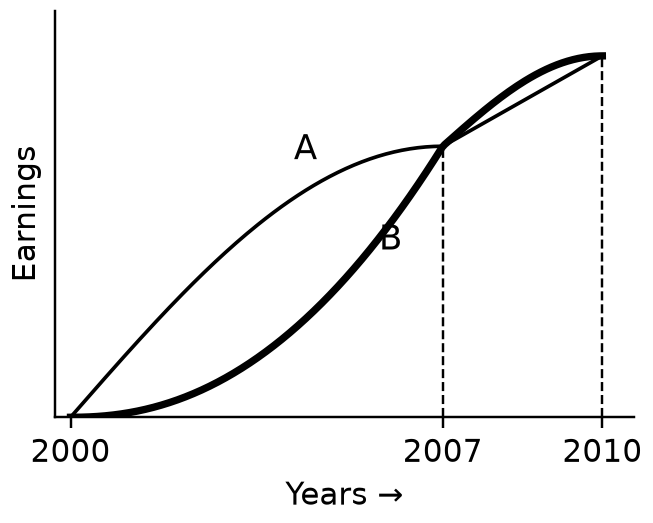
The graph below depicts the earnings of A and B over the period 2000 to 2010 :
From the graph, which one of the following can be concluded ?
Answer (a) & explanation
On average, A earned more than B (a). Step 1: read the graph from 2000 to 2007. A's curve stays well above B's, for seven years. Step 2: the two curves meet at 2007. From 2007 to 2010, B is only a little above A, for three years. Step 3: A's big lead over a long period outweighs B's small lead over a short period. So on average A earned more. Option (b) is wrong for the same reason. Option (c) is wrong: they were equal only at one point. Option (d) is wrong: A earned less only in the last few years.
Tip: "on average" over a period depends on both how big the gap is and how long it lasts. Compare the area between the curves on each side of the crossing point.
Do not judge by the end point alone; look at the whole period.
Answer as per the official UPSC answer key.
A decrease in tax to GDP ratio of a country indicates which of the following?
- 1. Slowing economic growth rate
- 2. Less equitable distribution of national income
Select the correct answer using the code given below.
Answer (a) & explanation
Tax collections are buoyant: they rise faster than GDP in good years and fall faster in slow years. So a falling tax-to-GDP ratio usually signals slowing growth (1 correct). Statement 2 is wrong because the ratio says nothing about how income is shared among people; that needs measures such as the Gini coefficient. The answer is (a).
India's combined tax-GDP ratio is around 17–18%, low compared with many developed economies, partly because of a large informal sector. Notice how GST and better compliance aim to widen the tax base without raising rates.
Answer as per the official UPSC answer key.
Consider the following rivers :
- 1. Vamsadhara
- 2. Indravati
- 3. Pranahita
- 4. Pennar
Which of the above are tributaries of Godavari?
Answer (d) & explanation
The Indravati, rising in Odisha and flowing through Bastar, and the Pranahita, formed by the Wardha and Wainganga, are left-bank tributaries of the Godavari (d). The Vamsadhara and the Pennar are separate east-flowing rivers that reach the Bay of Bengal on their own, so options with 1 or 4 fail.
The Godavari is the largest river of peninsular India, often called the Dakshin Ganga. Other tributaries include the Manjira and the Sabari. The Vamsadhara has been the subject of an Andhra–Odisha water dispute. Notice how tributary questions reward learning rivers in their basins.
Answer as per the official UPSC answer key.
Which one of the following movements has contributed to a split in the Indian National Congress resulting in the emergence of ‘moderates’ and ‘extremists’?
Answer (a) & explanation
The Swadeshi Movement (1905–08) split the Congress into Moderates and Extremists (a). The Extremists, led by Tilak, Lala Lajpat Rai and Bipin Chandra Pal, wanted to take boycott and passive resistance across India, while the Moderates wanted to limit it to Bengal and continue petitioning. The quarrel ended in the Surat split of 1907. Non-Cooperation (c), Civil Disobedience (d) and Quit India (b) came much later.
The two wings reunited at the Lucknow session of 1916. Notice how the Swadeshi era also gave India national education and swadeshi industries.
Answer as per the official UPSC answer key.
Kalamkari painting refers to
Answer (a) & explanation
Kalamkari ("pen-work") is a hand-painted or block-printed cotton textile of South India (a), mainly Andhra Pradesh. The Srikalahasti style is drawn freehand with a bamboo kalam and shows scenes from the epics and temple themes. The Machilipatnam style uses carved wooden blocks. Both use natural dyes and have GI tags. It is not a North-East bamboo craft (b), a Himalayan woollen cloth (c) or a silk cloth of the North-West (d).
Notice how Kalamkari links art, trade and history: Machilipatnam's printed cloth was a major export when European companies traded on the Coromandel coast.
Answer as per the official UPSC answer key.
In a town, 45% population read magazine A, 55% read magazine B, 40% read magazine C, 30% read magazines A and B, 15% read magazines B and C, 25% read magazines A and C; and 10% read all the three magazines. What percentage do not read any magazine ?
Answer (c) & explanation
20% read no magazine (c). Step 1: use the three-set rule. Readers of at least one magazine = (A + B + C) − (each pair) + (all three). Step 2: A + B + C = 45 + 55 + 40 = 140. Pairs: 30 + 15 + 25 = 70. All three: 10. Step 3: at least one = 140 − 70 + 10 = 80%. Step 4: none = 100 − 80 = 20%. Options (a), (b) and (d) miss a step.
Tip: why add the "all three" back? When we subtract the pairs, people who read all three are taken away three times, after being added three times, so they vanish. Adding them once restores them. Draw a three-circle Venn diagram if unsure.
Answer as per the official UPSC answer key.
Read the passage
The conflict between man and State is as old as State history. Although attempts have been made for centuries to bring about a proper adjustment between the competing claims of State and the individual, the solution seems to be still far off. This is primarily because of the dynamic nature of human society where old values and ideas constantly yield place to new ones. It is obvious that if individuals are allowed to have absolute freedom of speech and action, the result would be chaos, ruin and anarchy.
The author’s viewpoint can be best summed up in which of the following statements ?
Answer (a) & explanation
The State-individual conflict remains unresolved (a). Step 1: find the author's view. Attempts have been made "for centuries" to balance State and individual, but "the solution seems to be still far off". That is option (a). Step 2: test the others. Option (b) is wrong: anarchy follows absolute freedom, not democratic traditions. Option (c) is wrong: the passage says old values "constantly yield place to new ones", the opposite of persisting. Option (d) is wrong: the author warns against absolute freedom of speech, not against a constitutional guarantee.
Tip: the author's viewpoint is often stated plainly in a short line, here "still far off". Options that twist a detail, like "absolute freedom" into "democracy", are traps.
Answer as per the official UPSC answer key.
Consider the following pairs :
| Place of Pilgrimage | Location
| 1. Srisailam | Nallamala Hills
| 2. Omkareshwar | Satmala Hills
| 3. Pushkar | Mahadeo Hills
Which of the above pairs is/are correctly matched?
Answer (a) & explanation
Only pair 1 is correct (a). The Srisailam jyotirlinga stands in the Nallamala Hills of the Eastern Ghats, beside the Krishna, in Andhra Pradesh. Omkareshwar is on an island in the Narmada, between the Vindhya and Satpura ranges in Madhya Pradesh, not in the Satmala Hills, which are in Maharashtra. Pushkar, with its lake and Brahma temple, lies in the Aravalli hills near Ajmer, not in the Mahadeo Hills (Pachmarhi).
The Nallamala forests also hold the Nagarjunasagar–Srisailam Tiger Reserve, India's largest. Notice how pilgrimage sites follow rivers and hills, linking culture with physical geography.
Answer as per the official UPSC answer key.
Who of the following founded a new city on the south bank of a tributary to river Krishna and undertook to rule his new kingdom as the agent of a deity to whom all the land south of the river Krishna was supposed to belong?
Answer (c) & explanation
Harihara I, with his brother Bukka, founded Vijayanagara in 1336 on the south bank of the Tungabhadra, a tributary of the Krishna (c). The kings ruled as agents of Virupaksha, the deity of Hampi, and signed grants as "Sri Virupaksha". Amoghavarsha I (a) was a Rashtrakuta king, Ballala II (b) a Hoysala ruler, and Prataparudra II (d) the last Kakatiya king of Warangal.
The sage Vidyaranya is linked with the founding. Notice how Hampi, now a World Heritage Site, shows the empire's wealth in its temples and bazaars.
Answer as per the official UPSC answer key.
‘Beijing Declaration and Platform for Action’, often seen in the news, is
Answer (c) & explanation
The Beijing Declaration and Platform for Action is an agenda for women's empowerment, adopted at the UN's Fourth World Conference on Women in 1995 (c). It covers 12 critical areas, from poverty and education to violence and decision-making, and countries report on it every five years. It is not an SCO counter-terror strategy (a), an APEC growth plan (b) or an East Asia Summit wildlife declaration (d).
Its 30th anniversary review, Beijing+30, took place in 2025. Notice how its goals feed into SDG 5 on gender equality and India's own steps like the women's reservation law of 2023.
Answer as per the official UPSC answer key.
An automobile owner reduced his monthly petrol consumption when the prices went up. The price-consumption relationship is as follows :
| Price (in ₹ per litre) | 40 | 50 | 60 | 75 |
|---|---|---|---|---|
| Monthly consumption (in litres) | 60 | 48 | 40 | 32 |
If the price goes up to ₹ 80 per litre, his expected consumption (in litres) will be
Answer (a) & explanation
He will use 30 litres at ₹80 (a). Step 1: look at the table. Multiply price by consumption in each column: in every case the answer is 2,400. So he always spends ₹2,400 a month on petrol, whatever the price. Step 2: at ₹80 a litre: 2,400 ÷ 80 = 30 litres. Options (b), (c) and (d) would mean a different monthly spend.
Tip: in price-quantity tables, check whether price × quantity stays the same. If it does, the person has a fixed budget, and the new quantity is simply budget ÷ new price. This is quicker than looking for a pattern in the differences.
the drops (12, 8, 8) do not follow a steady pattern. Look for the constant product.
Answer as per the official UPSC answer key.