
UPSC Prelims PYQs with explanations
Real questions from official papers, mapped to syllabus topics. Attempt each one; the answer and the reason appear instantly.
Read the passage
The Global Financial Stability Report finds that the share of portfolio investments from advanced economies in the total debt and equity investments in emerging economies has doubled in the past decade to 12 percent. The phenomenon has implications for Indian policy makers as foreign portfolio investments in the debt and equity markets have been on the rise. The phenomenon is also flagged as a threat that could compromise global financial stability in a chain reaction, in the event of United States Federal Reserve’s imminent reversal of its “Quantitative Easing” policy.
Which among the following is the most rational and critical inference that can be made from the above passage ?
Answer (d) & explanation
Emerging economies face a risk of shock from advanced economies (d). Step 1: find the warning. Portfolio money from advanced economies into emerging markets has doubled to 12%. This is "flagged as a threat" that could start "a chain reaction" if the US Federal Reserve reverses Quantitative Easing. So emerging economies are at risk of shock. Step 2: test the others. Option (a) is wrong: the passage flags a risk, not that such investment is bad. Option (b) is wrong: it does not say advanced economies undermine stability on purpose. Option (c) is wrong: it never suggests India should stop accepting such investment.
Tip: a passage that flags a risk does not recommend a ban. Choose the option that matches the strength of the passage.
Answer as per the official UPSC answer key.
In a society it is customary for friends of the same sex to hug and for friends of opposite sex to shake hands when they meet. A group of friends met in a party and there were 24 handshakes.
Which one among the following numbers indicates the possible number of hugs ?
Answer (c) & explanation
1. Handshakes happen only between a man and a woman, so men × women = 24.
2. Hugs happen between each pair of the same sex. Among 4 people there are 3 + 2 + 1 = 6 pairs; among 6 people there are 5 + 4 + 3 + 2 + 1 = 15 pairs.
3. 4 men and 6 women (4 × 6 = 24 handshakes) give 6 + 15 = 21 hugs.
4. The other splits (3 and 8, 2 and 12, 1 and 24) give 31, 67 and 276 hugs, which are not options.
Answer as per the official UPSC answer key.
With reference to Congress Socialist Party, consider the following statements :
- 1. It advocated the boycott of British goods and evasion of taxes.
- 2. It wanted to establish the dictatorship of proletariat.
- 3. It advocated separate electorate for minorities and oppressed classes.
Which of the statements given above is/are correct?
Answer (d) & explanation
None of the statements is correct (d). The Congress Socialist Party (1934) of Jayaprakash Narayan, Acharya Narendra Dev and Minoo Masani worked inside the Congress to push it towards socialism: land to the tiller, rights for workers and peasants, and nationalisation of key industries. It did not seek a dictatorship of the proletariat, the communist goal (2), or separate electorates for minorities (3), which nationalists opposed. Boycott and tax evasion (1) were not its distinct programme.
Notice how the CSP gave the Congress a left wing, and how JP later led the 1974 movement against the Emergency-era government.
Answer as per the official UPSC answer key.
In India, the steel production industry requires the import of
Answer (c) & explanation
Indian coal has a high ash content, so steel plants import most of their coking (metallurgical) coal, mainly from Australia, and also from the USA, Russia and others (c). Saltpetre (a) is used for explosives and fertilisers, and rock phosphate (b) for phosphatic fertilisers; neither is needed for steel, so (d) also fails.
India is the world's second-largest steel producer and aims for 300 million tonnes of capacity by 2030 under the National Steel Policy 2017. Notice how this import dependence links steel, trade and energy security, which is why coal washeries and Mission Coking Coal matter.
Answer as per the official UPSC answer key.
H1N1 virus is sometimes mentioned in the news with reference to which one of the following diseases?
Answer (d) & explanation
H1N1 is the influenza A strain behind the 2009 swine flu pandemic (d), and it has returned in seasonal waves in India. H and N stand for the surface proteins haemagglutinin and neuraminidase. AIDS (a) is caused by HIV, dengue (c) by the dengue virus spread by the Aedes mosquito, and bird flu (b) is usually caused by H5N1.
The 2009 virus mixed genes from pig, bird and human flu viruses, which is why it was called swine flu. Notice how the One Health approach links human, animal and environmental health to prevent such outbreaks.
Answer as per the official UPSC answer key.
Read the passage
The richer States have a responsibility to cut down carbon emissions and promote clean energy investments. These are the States that got electricity, grew faster and now have high per capita income, making them capable of sharing India’s burden of becoming eco-friendly. Delhi, for example, can help by generating its own clean electricity using solar rooftop panels or even help poor States finance their clean energy projects. It is no secret that State Electricity Boards, which control 95% of the distribution network, are neck-deep in losses. These losses further discourage State utilities from adopting renewable energy as it is more expensive than fossil fuels.
Which among the following is the most logical and rational assumption that can be made from the above passage ?
Answer (a) & explanation
The richer States must lead in renewable energy (a). Step 1: find the main point. The richer States "have a responsibility" to cut emissions and promote clean energy; they grew faster and have high incomes, making them capable of sharing the burden. Delhi can make its own solar power or help finance poor States. So rich States should lead. Step 2: test the others. Option (b) is wrong: "always" is too strong. Option (c) is wrong: renewables are "more expensive", so they would worsen, not improve, Board finances. Option (d) is wrong: disparity is not said to cause emissions.
Tip: an assumption must fit the passage's direction. Option (c) uses passage words but flips the logic.
Answer as per the official UPSC answer key.
Two pipes A and B can independently fill a tank completely in 20 and 30 minutes respectively. If both the pipes are opened simultaneously, how much time will they take to fill the tank completely?
Answer (b) & explanation
Together they fill the tank in 12 minutes (b). Step 1: pick a tank size that both times divide into: the LCM of 20 and 30 is 60 units. Step 2: pipe A fills 60 ÷ 20 = 3 units a minute. Pipe B fills 60 ÷ 30 = 2 units a minute. Step 3: together they fill 3 + 2 = 5 units a minute. Time = 60 ÷ 5 = 12 minutes. Options (a) and (c) do not fit the rates. Option (d), 25 minutes, is the trap: the plain average of 20 and 30.
Tip: when two pipes work together, the time is always less than the faster pipe alone (here less than 20). That alone rules out (d).
25 minutes is the average of 20 and 30. Two pipes must be faster than either alone.
Answer as per the official UPSC answer key.
In the South Atlantic and South-Eastern Pacific regions in tropical latitudes, cyclone does not originate. What is the reason?
Answer (b) & explanation
Tropical cyclones grow out of disturbances along the ITCZ. Over the South Atlantic and south-east Pacific, the ITCZ rarely moves south of the equator, so the seed disturbances seldom form. UPSC's key gives this as the reason (b). Option (a) is partly true, as cold currents cool the sea, but the key does not accept it. Option (c) is wrong because the Coriolis force at these latitudes is strong enough. Option (d) is wrong: cyclones need open ocean, so an absence of land would help, not hinder.
The cold Benguela and Humboldt currents and strong wind shear also help keep these seas cyclone-free.
Cool water there is real, but the official key picks the ITCZ. Learn the keyed reason.
Answer as per the official UPSC answer key.
When a bill is referred to a joint sitting of both the Houses of the Parliament, it has to be passed by
Answer (a) & explanation
Under Article 108(4), a Bill at a joint sitting is passed by a simple majority of the total members of both Houses present and voting (a). Three-fourths (b), two-thirds (c) and absolute majorities (d) are not required.
A joint sitting is called by the President to resolve a deadlock on an ordinary or financial Bill, but not on a Money Bill or a Constitution Amendment Bill. The Speaker presides. Since the Lok Sabha is larger, it usually prevails. Only three joint sittings have been held: on the Dowry Prohibition Bill (1961), the Banking Service Commission Repeal Bill (1978) and POTA (2002).
Answer as per the official UPSC answer key.
In a particular region in India, the local people train the roots of living trees into robust bridges across the streams. As the time passes, these bridges become stronger. These unique ‘living root bridges’ are found in
Answer (a) & explanation
Living root bridges are found in Meghalaya (a). The Khasi and Jaintia people guide the aerial roots of the rubber fig (Ficus elastica) across streams, and over years the roots grow into strong bridges, such as the famous double-decker bridge at Nongriat. Himachal Pradesh (b), Jharkhand (c) and Tamil Nadu (d) do not have this tradition.
The bridges grow stronger with age and can last for centuries. The "Jingkieng Jri" root bridge landscapes were placed on UNESCO's tentative list in 2022. Notice how this shows indigenous engineering working with nature: a model of sustainable infrastructure.
Answer as per the official UPSC answer key.
The ideal of 'Welfare State' in the Indian Constitution is enshrined in its
Answer (b) & explanation
The ideal of a Welfare State is enshrined in the Directive Principles of State Policy (b). Article 38 asks the State to promote the welfare of the people by securing social, economic and political justice, and other articles cover livelihood, fair wages, health and education. The Preamble (a) states the goal of justice but does not lay out welfare duties. Fundamental Rights (c) are limits on the State, and the Seventh Schedule (d) divides subjects.
UPSC repeated this question almost word for word in 2020. Notice how welfare laws like the Food Security Act give life to these principles.
Answer as per the official UPSC answer key.
Examine the following statements :
- 1. Lady's finger is tastier than cabbage.
- 2. Cauliflower is tastier than lady's finger.
- 3. Cabbage is not tastier than peas.
The conclusion that can be drawn from these statements is that
Answer (d) & explanation
Cauliflower is tastier than cabbage (d). Step 1: put the clear comparisons in a line. Cauliflower > lady's finger (statement 2). Lady's finger > cabbage (statement 1). So cauliflower > lady's finger > cabbage. That gives option (d) directly. Step 2: what about peas? Statement 3 says cabbage is not tastier than peas, so peas are at least as tasty as cabbage. We do not know where peas stand against lady's finger or cauliflower. Step 3: so (a) and (b) are not certain, and (c) is not certain either, because peas might be equal to cabbage.
Tip: "not tastier than" means "less than or equal to". It does not fix an exact position.
Answer as per the official UPSC answer key.
Read the passage
Climate change is a complex policy issue with major implications in terms of finance. All actions to address climate change ultimately involve costs. Funding is vital for countries like India to design and implement adaptation and mitigation plans and projects. Lack of funding is a large impediment to implementing adaptation plans. The scale and magnitude of the financial support required by developing countries to enhance their domestic mitigation and adaptation actions are a matter of intense debate in the multilateral negotiations under the United Nations Framework Convention on Climate Change (UNFCCC). The Convention squarely puts the responsibility for provision of financial support on the developed countries, taking into account their contribution to the stock of greenhouse gases (GHGs) in the atmosphere. Given the magnitude of the task and the funds required, domestic finances are likely to fall short of the current and projected needs of the developing countries. Global funding through the multilateral mechanism of the Convention will enhance their domestic capacity to finance the mitigation efforts.
According to the passage, which of the following is/are a matter of intense debate in the multilateral negotiations under UNFCCC regarding the role of developing countries in climate change ?
- 1. The scale and size of required financial support.
- 2. The crop loss due to climate change in the developing countries.
- 3. To enhance the mitigation and adaptation actions in the developing countries.
Select the correct answer using the code given below :
Answer (c) & explanation
Financial support and mitigation-adaptation actions are debated (c). Step 1: find the line. "The scale and magnitude of the financial support required by developing countries to enhance their domestic mitigation and adaptation actions are a matter of intense debate" under the UNFCCC. That gives items 1 and 3. Step 2: test item 2. Crop loss due to climate change is never mentioned. So options (b) and (d) fail. Option (a) misses item 3.
Tip: break the sentence into parts. The debate is about the size of finance (1), and the purpose, enhancing mitigation and adaptation (3). Then tick each item that is actually in that sentence.
Answer as per the official UPSC answer key.
With reference to Rowlatt Satyagraha, which of the following statements is/are correct?
- 1. The Rowlatt Act was based on the recommendations of the ‘Sedition Committee’.
- 2. In Rowlatt Satyagraha, Gandhiji tried to utilize the Home Rule League.
- 3. Demonstrations against the arrival of Simon Commission coincided with Rowlatt Satyagraha.
Select the correct answer using the code given below.
Answer (b) & explanation
Statements 1 and 2 are correct (b). The Rowlatt Act (March 1919) came from Justice Rowlatt's Sedition Committee and allowed detention without trial. Gandhi formed a Satyagraha Sabha and drew on the Home Rule Leagues for an all-India hartal in April 1919. Statement 3 is wrong: the Simon Commission arrived in 1928, nine years later.
The Rowlatt Satyagraha was Gandhi's first all-India movement. Its sad climax was the Jallianwala Bagh massacre of 13 April 1919 in Amritsar. Notice how the anger it created paved the way for the Non-Cooperation Movement in 1920.
Answer as per the official UPSC answer key.
Consider the following statements :
- 1. The first woman President of the Indian National Congress was Sarojini Naidu.
- 2. The first Muslim President of the Indian National Congress was Badruddin Tyabji.
Which of the statements given above is/are correct?
Answer (b) & explanation
Only statement 2 is correct (b). Badruddin Tyabji presided at Madras (1887) as the first Muslim president of the Congress. Statement 1 is wrong: Annie Besant presided at Calcutta (1917) and was the first woman president. Sarojini Naidu, at Kanpur (1925), was the first Indian woman president.
Other firsts worth knowing: W. C. Bonnerjee presided over the first session (Bombay, 1885), and Dadabhai Naoroji was president three times. Nellie Sengupta presided in 1933. Notice how UPSC loves "first" questions, where one word like "Indian" changes the answer.
Sarojini Naidu was the first Indian woman to preside, not the first woman.
Answer as per the official UPSC answer key.
“Each day is more or less the same, the morning is clear and bright with a sea breeze; as the Sun climbs high in the sky, heat mounts up, dark clouds form, then rain comes with thunder and lightning. But rain is soon over.” Which of the following regions is described in the above passage?
Answer (b) & explanation
The passage describes the equatorial climate (b). Strong heating every day drives convection: cumulonimbus clouds build up by afternoon and bring a short thunderstorm at about the same time each day, often called "four o'clock rain". There is hardly any seasonal change, so "each day is more or less the same". The savannah (a) and monsoon (c) climates have distinct wet and dry seasons, and the Mediterranean (d) has dry summers and wet winters.
Such climate supports dense tropical rainforests, as in the Amazon and Congo basins. Notice how daily weather can reveal the climate type.
Answer as per the official UPSC answer key.
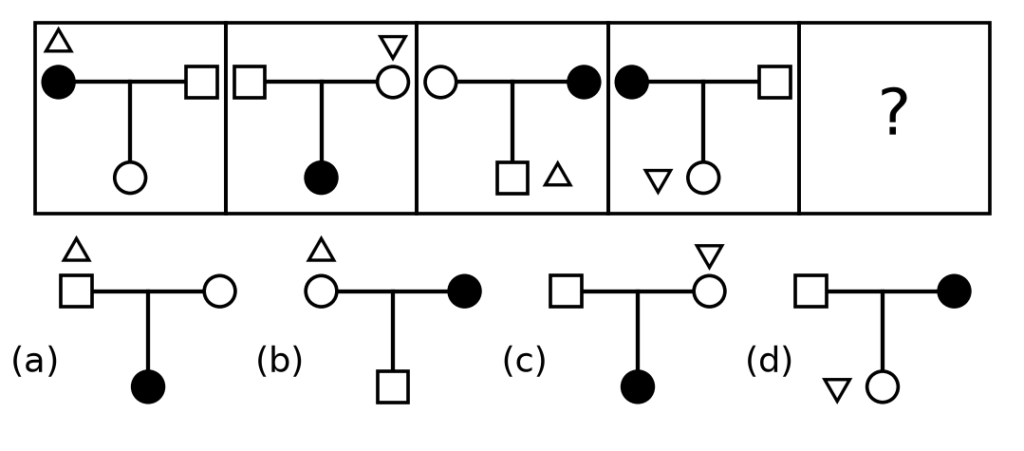
Consider the figures given below :
To fit the question mark, the correct answer is
Answer (a) & explanation
1. Look at the three end symbols (left, right, bottom). Figure 4 has the same ones as Figure 1, so they repeat every 3 figures. Figure 5 must match Figure 2: square left, open circle right, black circle at the bottom.
2. The small triangle moves round the corners: top-left, top-right, bottom-right, bottom-left, so next it is back at top-left. It points up, down, up, down, so next it points up.
3. Only (a) has both: the Figure 2 symbols and an upward triangle at the top-left.
(c) copies Figure 2 completely, but forgets that the triangle has moved on.
Answer as per the official UPSC answer key.
Read the passage
Open defecation is disastrous when practised in very densely populated areas, where it is impossible to keep away human faeces from crops, wells, food and children’s hands. Groundwater is also contaminated by open defecation. Many ingested germs and worms spread diseases. They prevent the body from absorbing calories and nutrients. Nearly one-half of India’s children remain malnourished. Lakhs of them die from preventable conditions. Diarrhoea leaves Indians’ bodies smaller on average than those of people in some poorer countries where people eat fewer calories. Underweight mothers produce stunted babies prone to sickness who may fail to develop their full cognitive potential. The germs released into environment harm rich and poor alike, even those who use latrines.
Which among the following is the most critical inference that can be made from the above passage ?
Answer (c) & explanation
Open defecation reduces the human capital of India's workforce (c). Step 1: follow the chain. Open defecation spreads germs, which stop the body absorbing nutrients. Children stay malnourished, bodies stay smaller, and underweight mothers have stunted babies who may not reach their full cognitive potential. Weaker, less healthy people mean lower human capital. Step 2: test the others. Option (a) is wrong: the cost of latrines is not discussed. Option (b) is wrong: "most important" problem is too strong. Option (d) is wrong: "all developing countries" is not stated.
Tip: "human capital" means the health, skills and abilities of people. When a passage links a problem to poor health and lower brain development, it is about human capital.
Answer as per the official UPSC answer key.
Two men, Anil and David, and two women, Shabnam and Rekha are in a sales group. Only two speak Tamil. The other two speak Marathi. Only one man and one woman can drive a car. Shabnam speaks Marathi. Anil speaks Tamil. Both Rekha and David can drive.
Which of the following statements is true ?
Answer (d) & explanation
One of the drivers speaks Tamil (d). Step 1: list what we know. Anil speaks Tamil. Shabnam speaks Marathi. Rekha and David are the drivers (one man, one woman). Step 2: exactly two speak Tamil and two speak Marathi. Anil has one Tamil and Shabnam one Marathi, so Rekha and David share the other Tamil and the other Marathi between them. Step 3: so one driver speaks Tamil and one speaks Marathi. That is option (d). Options (a), (b) and (c) need both drivers to speak the same language, which is impossible here.
Tip: in grouping puzzles, place the known people first. Then the remaining slots must be split among the unknown people.
Answer as per the official UPSC answer key.
Consider the following statements :
- 1. The Rajya Sabha has no power either to reject or to amend a Money Bill.
- 2. The Rajya Sabha cannot vote on the Demands for Grants.
- 3. The Rajya Sabha cannot discuss the Annual Financial Statement.
Which of the statements given above is/are correct?
Answer (b) & explanation
Statements 1 and 2 are correct (b). On a Money Bill the Rajya Sabha can neither reject nor amend; it can only make recommendations within 14 days (Article 109). Demands for Grants are voted only in the Lok Sabha (Article 113). Statement 3 is wrong: the Annual Financial Statement is laid before both Houses (Article 112), and the Rajya Sabha does discuss it.
The Speaker's certificate decides whether a Bill is a Money Bill (Article 110). Notice how control over money rests with the directly elected House, reflecting the principle of "no taxation without representation".
"cannot discuss". The Rajya Sabha cannot vote on grants, but it can discuss the Budget.
Answer as per the official UPSC answer key.