
UPSC Prelims PYQs with explanations
Real questions from official papers, mapped to syllabus topics. Attempt each one; the answer and the reason appear instantly.
Consider the following States :
- 1. Arunachal Pradesh
- 2. Himachal Pradesh
- 3. Mizoram
In which of the above States do ‘Tropical Wet Evergreen Forests’ occur?
Answer (c) & explanation
Tropical wet evergreen forests need more than 250 cm of rain and a short dry season. They are found in the Western Ghats, the North-East, including Arunachal Pradesh and Mizoram, and the Andaman and Nicobar Islands. So 1 and 3 are correct (c). Himachal Pradesh has subtropical pine and temperate forests instead, so options with 2 fail.
These forests are dense, multi-layered and tall, with trees such as rosewood, mahogany and ebony, and they never shed leaves all at once. Notice how rainfall and temperature decide forest type, so a rainfall map of India is a forest map too.
Answer as per the official UPSC answer key.
Read the passage
Many people in India feel that if we cut our defence expenditure on weapon-building, we can create a climate of peace with our neighbours, subsequently reducing the conflict or creating a no-war situation. People who proclaim such ideas are either the victims of war or the propagators of false argument.
With reference to the above passage, which of the following is the most valid assumption ?
Answer (b) & explanation
The author assumes that more weapon spending lessens the chance of conflict (b). Step 1: find the author's view. Many people feel that cutting defence spending will create peace. The author says such people are "victims of war or the propagators of false argument". So he rejects the idea. Step 2: if cutting spending does not bring peace, he must believe that spending deters war. That is option (b). Step 3: test the others. Option (a) is wrong: it says our weapons cause war, the opposite of his view. Option (c) is close but goes beyond the passage, which talks about conflict with neighbours, not state-of-the-art systems. Option (d) is wrong: it restates the view he rejects, not his assumption.
Tip: an assumption is the unstated belief behind the author's conclusion.
Answer as per the official UPSC answer key.
Two equal glasses of same type are respectively 1/3 and 1/4 full of milk. They are then filled up with water and the contents are mixed in a pot. What is the ratio of milk and water in the pot?
Answer (a) & explanation
The milk to water ratio is 7 : 17 (a). Step 1: pick a glass size that both fractions divide into easily. 12 units works for 1/3 and 1/4. Step 2: glass 1 is 1/3 milk: 4 units of milk, 8 of water. Glass 2 is 1/4 milk: 3 units of milk, 9 of water. Step 3: in the pot: milk = 4 + 3 = 7, water = 8 + 9 = 17. Total 24. Ratio 7 : 17. Options (b), (c) and (d) do not match.
Tip: choose a size equal to the LCM of the denominators (here 3 and 4 give 12). This turns fractions into whole numbers and makes mixing easy.
Answer as per the official UPSC answer key.
Read the passage
Climate change is a complex policy issue with major implications in terms of finance. All actions to address climate change ultimately involve costs. Funding is vital for countries like India to design and implement adaptation and mitigation plans and projects. Lack of funding is a large impediment to implementing adaptation plans. The scale and magnitude of the financial support required by developing countries to enhance their domestic mitigation and adaptation actions are a matter of intense debate in the multilateral negotiations under the United Nations Framework Convention on Climate Change (UNFCCC). The Convention squarely puts the responsibility for provision of financial support on the developed countries, taking into account their contribution to the stock of greenhouse gases (GHGs) in the atmosphere. Given the magnitude of the task and the funds required, domestic finances are likely to fall short of the current and projected needs of the developing countries. Global funding through the multilateral mechanism of the Convention will enhance their domestic capacity to finance the mitigation efforts.
Which one of the following is essentially discussed in the passage ?
Answer (a) & explanation
The passage discusses the conflict over support for mitigation (a). Step 1: find the centre of the passage. It explains that climate action costs money, that funding is "a matter of intense debate" between countries, and that the Convention puts the duty on developed countries. So the core topic is the disagreement between developed and developing countries over financial support. Step 2: test the others. Option (b) is wrong: the causes of climate change are not discussed. Option (c) is wrong: political will is not mentioned. Option (d) is wrong: governance problems are not discussed.
Tip: "essentially discussed" means the main topic. Check which option runs through most sentences of the passage.
Answer as per the official UPSC answer key.
With reference to ‘dugong’, a mammal found in India, which of the following statements is/are correct?
- 1. It is a herbivorous marine animal.
- 2. It is found along the entire coast of India.
- 3. It is given legal protection under Schedule I of the Wildlife (Protection) Act, 1972.
Select the correct answer using the code given below.
Answer (c) & explanation
Statements 1 and 3 are correct (c). The dugong or "sea cow" is a herbivorous marine mammal that grazes on seagrass (1). It is protected under Schedule I of the Wildlife (Protection) Act (3). Statement 2 is wrong: in India it survives only in the Gulf of Mannar–Palk Bay, the Gulf of Kutch and the Andaman and Nicobar islands, not along the entire coast.
Tamil Nadu notified India's first Dugong Conservation Reserve in Palk Bay in 2022. It is listed as Vulnerable globally. Notice how protecting seagrass meadows protects the dugong, and also stores carbon.
Answer as per the official UPSC answer key.
With reference to the Cabinet Mission, which of the following statements is/are correct?
- 1. It recommended a federal government.
- 2. It enlarged the powers of the Indian courts.
- 3. It provided for more Indians in the ICS.
Select the correct answer using the code given below.
Answer (a) & explanation
Only statement 1 is correct (a). The Cabinet Mission (1946), of Pethick-Lawrence, Stafford Cripps and A. V. Alexander, proposed a loose federal Union of provinces and princely states. The Centre would hold only defence, foreign affairs and communications; the provinces would be grouped into sections A, B and C; and a Constituent Assembly and an interim government would be formed. It said nothing about enlarging court powers (2) or adding Indians to the ICS (3).
The Muslim League's rejection and its Direct Action Day (August 1946) followed. Notice how the Mission's failure made Partition almost certain.
Answer as per the official UPSC answer key.
Which one of the following is the best description of the term ‘ecosystem’?
Answer (c) & explanation
An ecosystem is a community of organisms together with the non-living environment in which they live, such as soil, water, air and light, all working as one unit (c). Option (a) describes only a community, without the physical environment. Option (b) describes the biosphere, and option (d) describes the flora and fauna of an area.
The term was coined by A. G. Tansley in 1935. An ecosystem has producers, consumers and decomposers, with energy flowing through it and nutrients cycling within it. Notice how a pond, a forest or even an aquarium can be studied as an ecosystem.
Answer as per the official UPSC answer key.
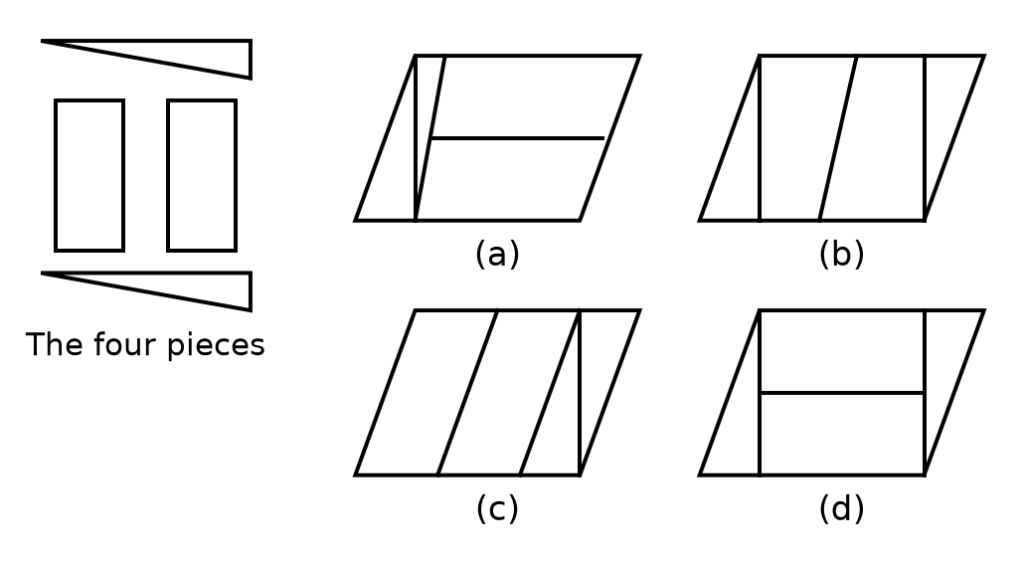
Four cardboard pieces of specific shapes are shown in the following figure :
Which one of the following figures given can be formed by joining these pieces together ?
Answer (d) & explanation
The pieces form figure (d) (d). Step 1: look at the four pieces. There are two equal rectangles and two equal right-angled triangles. Step 2: place the two rectangles flat, one on top of the other, to make a bigger rectangle (a box). Step 3: stand one triangle at each end of this box. The result is a slanted four-sided figure, like a parallelogram. Step 4: that matches figure (d), with two rectangles in the middle and one triangle on each side. Options (a), (b) and (c) need pieces of other shapes or sizes.
Tip: in shape-joining questions, first name and count the pieces, then try the simplest arrangement. Check that the total area of the answer matches the pieces.
Pieces may be turned around; only their shape and size must stay the same.
Answer as per the official UPSC answer key.
Read the passage
The existence/establishment of formal financial institutions that offer safe, reliable, and alternative financial instruments is fundamental in mobilising savings. To save, individuals need access to safe and reliable financial institutions, such as banks, and to appropriate financial instruments and reasonable financial incentives. Such access is not always available to all people in developing countries like India and more so, in rural areas. Savings help poor households manage volatility in cash flow, smoothen consumption, and build working capital. Poor households without access to a formal savings mechanism encourage immediate spending temptations.
What is the crucial message conveyed in the passage ?
Answer (d) & explanation
The crucial message is to promote financial inclusion (d). Step 1: find the theme. Savings need access to "safe and reliable financial institutions" and "appropriate financial instruments". Such access is not always available, especially in rural areas, and lack of it pushes the poor to spend. Bringing everyone into formal finance is financial inclusion. Step 2: test the others. Option (a) is wrong: more banks is only one narrow means. Option (b) is wrong: GDP is not discussed. Option (c) is wrong: interest rates are not discussed; incentives are mentioned only in passing.
Tip: the "crucial message" names the big idea that covers the whole passage, not a single tool.
Answer as per the official UPSC answer key.
A society consists of only two types of people — fighters and cowards. Two cowards are always friends. A fighter and a coward are always enemies. Fighters are indifferent to one another. If A and B are enemies, C and D are friends, E and F are indifferent to each other, A and E are not enemies, while B and F are enemies.
Which of the following statements is correct ?
Answer (b) & explanation
A, E and F are fighters (b). Step 1: use the rules. Two cowards are always friends. A fighter and a coward are always enemies. Fighters are indifferent to each other. Step 2: E and F are indifferent, so both are fighters. Step 3: B and F are enemies, and F is a fighter, so B is a coward. Step 4: A and B are enemies, and B is a coward, so A is a fighter. Check: A and E are both fighters, so they are not enemies. That fits. Options (a), (c) and (d) contradict these steps.
Tip: start with the relationship that fixes both people at once. Here "indifferent" can only mean two fighters.
Answer as per the official UPSC answer key.
In the context of modern scientific research, consider the following statements about ‘IceCube’, a particle detector located at South Pole, which was recently in the news :
- 1. It is the world’s largest neutrino detector, encompassing a cubic kilometre of ice.
- 2. It is a powerful telescope to search for dark matter.
- 3. It is buried deep in the ice.
Which of the statements given above is/are correct?
Answer (d) & explanation
All three are correct (d). IceCube, at the Amundsen–Scott South Pole station, has thousands of light sensors spread through a cubic kilometre of ice, making it the world's largest neutrino detector (1). It also searches for dark matter particles (2). Its sensors are buried 1.5–2.5 km deep in the ice (3), where the ice is very clear and shielded from other radiation.
Neutrinos are nearly massless particles that pass through matter almost untouched, so they carry information from distant cosmic events. India's proposed India-based Neutrino Observatory planned to study them under a mountain in Tamil Nadu.
Answer as per the official UPSC answer key.
Consider the following statements :
- 1. The Accelerated Irrigation Benefits Programme was launched during 1996-97 to provide loan assistance to poor farmers.
- 2. The Command Area Development Programme was launched in 1974-75 for the development of water-use efficiency.
Which of the statements given above is/are correct?
Answer (b) & explanation
Only statement 2 is correct (b). The Accelerated Irrigation Benefits Programme (1996-97) gave Central loan assistance to States, not poor farmers, to complete large irrigation projects stuck for lack of funds, so statement 1 is wrong. The Command Area Development Programme (1974-75) aimed to close the gap between irrigation capacity created and actually used by improving water-use efficiency through field channels and land levelling.
Both now form part of PMKSY (2015), whose motto is "Har Khet Ko Pani" and "More Crop Per Drop". Notice how building dams is only half the job; water must reach the field.
Answer as per the official UPSC answer key.
Which one of the following best describes the main objective of 'Seed Village Concept'?
Answer (b) & explanation
The Seed Village concept involves training farmers in quality seed production so that good seed is available to others nearby, on time and at an affordable cost (b). Option (a) is wrong: it does not discourage buying seed but improves farm-saved seed quality. Option (c) is wrong: villages are not set aside only for certified seed. Option (d) is wrong: it does not set up seed companies.
Farmers get foundation seed at subsidised rates and training in raising, storing and processing seed. This raises the seed replacement rate. Notice how one village's skill helps a whole area grow better crops.
Answer as per the official UPSC answer key.
Read the passage
Flamingos in large flocks in the wild are social and extremely loyal. They perform group mating dances. Parents are very fond of their chicks, gathering them into crèches for protection while both males and females fly off to search for food.
Which among the following is the most logical corollary to the above passage ?
Answer (c) & explanation
Social behaviour in some birds improves survival (c). Step 1: find the example. Flamingos are social and loyal, and parents gather chicks "into crèches for protection" while both go for food. This shows that social behaviour helps chicks survive. Step 2: the passage is about one species, so the safe corollary is about "some species". Step 3: test the others. Option (a) is wrong: "all species" and "complete survival" are too strong. Option (b) is wrong: "only birds" is not supported. Option (d) is wrong: "all species" set up crèches, and crèches are for protection, not to teach loyalty.
Tip: one example can support "some", never "all" or "only".
Answer as per the official UPSC answer key.
If ABC × DEED = ABCABC; where A, B, C, D and E are different digits, what are the values of D and E?
Answer (c) & explanation
D = 1 and E = 0 (c). Step 1: look at ABCABC. It is the number ABC written twice. Writing a three-digit number twice is the same as multiplying it by 1001. For example, 123 × 1001 = 123123. Step 2: so ABC × DEED = ABC × 1001, and DEED = 1001. Step 3: reading 1001 as D E E D gives D = 1 and E = 0. Options (a), (b) and (d) give 2002, 0110 and 1221, which do not work.
Tip: remember the 1001 trick: abc × 1001 = abcabc. Similarly, ab × 101 = abab. These patterns come up in CSAT digit puzzles.
Answer as per the official UPSC answer key.
Which of the following National Parks is unique in being a swamp with floating vegetation that supports a rich biodiversity?
Answer (b) & explanation
Keibul Lamjao on Loktak Lake, Manipur, is the world's only floating national park (b). It rests on phumdis, thick mats of vegetation, soil and organic matter, and is the last natural home of the sangai or brow-antlered deer, Manipur's state animal. Bhitarkanika (a) is a mangrove park in Odisha known for saltwater crocodiles. Keoladeo (c) and Sultanpur (d) are bird habitats in Rajasthan and Haryana, not floating swamps.
Loktak is a Ramsar site on the Montreux Record, threatened by the Ithai barrage and pollution. Notice how one lake links species, people and hydropower.
Answer as per the official UPSC answer key.
Consider the following :
The arrival of Babur into India led to the
- 1. introduction of gunpowder in the subcontinent
- 2. introduction of the arch and dome in the region’s architecture
- 3. establishment of Timurid dynasty in the region
Select the correct answer using the code given below.
Answer (b) & explanation
Only statement 3 is correct (b). Babur, descended from Timur on his father's side, founded the Timurid (Mughal) dynasty in India after the First Battle of Panipat in 1526. Statement 1 is wrong: gunpowder was known in India before him, though Babur used field artillery to great effect. Statement 2 is wrong: the true arch and dome came with the Delhi Sultanate in the 13th century, as in Balban's tomb and the Alai Darwaza.
Babur wrote his memoirs, the Baburnama, in Turkish. Notice how architecture and military technology questions often test the exact period of arrival.
Answer as per the official UPSC answer key.
The term ‘IndARC’, sometimes seen in the news, is the name of
Answer (d) & explanation
IndARC (2014) is India's first underwater moored observatory in the Arctic (d), placed in Kongsfjorden near the Himadri research station in Svalbard, Norway. It records ocean data such as temperature and salinity, linked to Arctic climate change and its possible effect on the Indian monsoon. It is not a radar (a), a satellite (b) or an Antarctic base (c).
India's Antarctic stations are Maitri and Bharati, after the first, Dakshin Gangotri. India released its Arctic Policy in 2022. Notice how polar research helps India understand its own monsoon and sea-level rise.
Answer as per the official UPSC answer key.
Read the passage
India accounts for nearly a fifth of the world’s child deaths. In terms of numbers, it is the highest in the world — nearly 16 lakhs every year. Of these, more than half die in the first month of life. Officials believe that the reason for this is the absence of steps to propagate basic health practices relating to breast feeding and immunisation. Also the large reproductive population of 2·6 crore remains bereft of care during the critical phases of pregnancy and post-delivery. Added to this is the prevalence of child marriages, anaemia among young women and lack of focus on adolescent sanitation, all of which impact child death rates.
Which is the critical inference that can be made from the above passage ?
Answer (c) & explanation
Joint maternal and child health services can address the problem (c). Step 1: list the causes of child deaths in the passage. Some concern infants: poor practices on breast feeding and immunisation. Others concern mothers: no care during pregnancy and after delivery, child marriages, anaemia among young women. Step 2: since causes lie with both mother and child, universal and integrated maternal and child services fit best. Step 3: test the others. Option (a) is wrong: illiteracy is not mentioned. Option (b) is wrong: the passage does not say the government cannot manage. Option (d) is wrong: it contradicts the passage, which links anaemia among young women to child deaths.
Tip: a "critical inference" often joins several causes into one solution.
Answer as per the official UPSC answer key.
Out of 130 students appearing in an examination, 62 failed in English, 52 failed in Mathematics, whereas 24 failed in both English and Mathematics. The number of students who passed finally is
Answer (a) & explanation
40 students passed (a). Step 1: students who failed in at least one subject = English fails + Maths fails − both. That is 62 + 52 − 24 = 90. We subtract 24 because those students were counted in both 62 and 52. Step 2: students who passed both = 130 − 90 = 40. Options (b), (c) and (d) miss the overlap.
Tip: "passed finally" means passed both subjects. In two-set questions, always remove the double count: total in either = A + B − both. A two-circle diagram makes this clear.
Answer as per the official UPSC answer key.