
UPSC Prelims PYQs with explanations
Real questions from official papers, mapped to syllabus topics. Attempt each one; the answer and the reason appear instantly.
Between 6 PM and 7 PM the minute hand of a clock will be ahead of the hour hand by 3 minutes at
Answer (c) & explanation
1. Between 6 and 7, the hour hand starts at the 30-minute mark and moves 1 minute-mark every 12 minutes.
2. Check (c) 6:36. The hour hand has moved 36 ÷ 12 = 3 marks, so it is at 33. The minute hand is at 36. It is 3 ahead. Works.
3. Quick check of the others: at 6:48 the hour hand is at 34 and the minute hand at 48 (14 ahead), so (d) fails; at 6:15 and 6:18 the minute hand is still behind.
4. Answer: 6:36 PM.
Answer as per the official UPSC answer key.
Who of the following was/were economic critic/critics of colonialism in India?
- 1. Dadabhai Naoroji
- 2. G. Subramania Iyer
- 3. R. C. Dutt
Select the correct answer using the code given below.
Answer (d) & explanation
All three were economic critics of colonialism (d). Dadabhai Naoroji put forward the drain theory in Poverty and Un-British Rule in India. R. C. Dutt wrote The Economic History of India, tracing the ruin of Indian industry and heavy land revenue. G. Subramania Iyer, a founder of The Hindu, wrote Some Economic Aspects of British Rule in India.
These economic nationalists showed that British rule drained India's wealth, which gave the freedom struggle a strong intellectual base. Notice how their ideas later shaped the Swadeshi movement and India's planned economy after independence.
Answer as per the official UPSC answer key.
Which one of the following National Parks has a climate that varies from tropical to subtropical, temperate and arctic?
Answer (d) & explanation
Namdapha in Arunachal Pradesh rises from about 200 m to over 4,500 m at Dapha Bum. This range takes its climate from tropical rainforest through subtropical and temperate forest to snowy, near-arctic peaks (d). Khangchendzonga (a) and Nanda Devi (b) are high-altitude parks without lowland tropical forest, and Neora Valley (c) in West Bengal covers a narrower range.
Namdapha is unusual in having four big cats: tiger, leopard, clouded leopard and snow leopard, and it is home to the hoolock gibbon. Notice how altitude packs many climate zones into one park, like a journey from equator to pole.
Answer as per the official UPSC answer key.
The fundamental object of Panchayati Raj system is to ensure which among the following?
- 1. People's participation in development
- 2. Political accountability
- 3. Democratic decentralization
- 4. Financial mobilization
Select the correct answer using the code given below.
Answer (c) & explanation
Panchayati Raj exists to bring decisions closer to people (democratic decentralisation) and to involve them in planning and development (people's participation). So 1 and 3 are its fundamental objects (c). Political accountability (2) and financial mobilisation (4) may follow, but UPSC's key does not count them as the basic purpose.
The 73rd Amendment (1992) gave panchayats constitutional status, with a three-tier structure, reserved seats for women and SCs/STs, State Election Commissions and State Finance Commissions. The idea was first recommended by the Balwant Rai Mehta Committee (1957). Notice how it reflects Gandhi's vision of gram swaraj.
Answer as per the official UPSC answer key.
In a test, a candidate attempted only 8 questions and secured 50% marks in each of the questions. If he obtained a total of 40% in the test and all questions in the test carried equal marks, how many questions were there in the test?
Answer (b) & explanation
There were 10 questions (b). Step 1: he got half marks on each of 8 questions. That equals the full marks of 4 questions. Step 2: those marks are 40% of the total. So 4 questions = 40% of all questions. Step 3: all questions = 4 ÷ 0.4 = 10. Check: 50% of 8 questions = 4 questions' marks; 4 out of 10 = 40%. Options (a), (c) and (d) fail the check.
Tip: turn percentages into "question-equivalents". Half marks on 8 questions is the same as full marks on 4. This avoids having to know the marks per question.
Answer as per the official UPSC answer key.
Read the passage
Governments may have to take steps which would otherwise be an infringement on the Fundamental Rights of individuals, such as acquiring a person’s land against his will, or refusing permission for putting up a building, but the larger public interest for which these are done must be authorized by the people (Parliament). Discretionary powers to the administration can be done away with. It is becoming more and more difficult to keep this power within limits as the government has many number of tasks to perform. Where discretion has to be used, there must be rules and safeguards to prevent misuse of that power. Systems have to be devised which minimise, if not prevent, the abuse of discretionary power. Government work must be conducted within a framework of recognised rules and principles, and decisions should be similar and predictable.
Which among the following is the most logical assumption that can be made from the above passage ?
Answer (b) & explanation
Rules and safeguards should prevail over unchecked discretion (b). Step 1: find the main idea. Where discretion is used, "there must be rules and safeguards to prevent misuse". Government work "must be conducted within a framework of recognised rules and principles", and decisions should be predictable. So rules should rule, not personal discretion. Step 2: test the others. Option (a) is wrong: "always... wide discretionary power" reverses the passage. Option (c) is wrong: it also reverses it, linking democracy to more discretion. Option (d) is wrong because (b) fits.
Tip: this is the idea of the Rule of Law, associated with A.V. Dicey: government by fixed rules, not by the whims of officials.
Answer as per the official UPSC answer key.
In a box of marbles, there are three less white marbles than the red ones and five more white marbles than the green ones. If there are a total of 10 white marbles, how many marbles are there in the box?
Answer (b) & explanation
There are 28 marbles (b). Step 1: there are 10 white marbles. Step 2: white is 3 less than red, so red = 10 + 3 = 13. Step 3: white is 5 more than green, so green = 10 − 5 = 5. Step 4: total = 10 + 13 + 5 = 28. Options (a), (c) and (d) come from adding or subtracting the wrong way.
Tip: read "three less white marbles than the red ones" carefully: white = red − 3, so red = white + 3. Write each sentence as a simple equation before working it out to avoid flipping the direction.
Answer as per the official UPSC answer key.
The terms 'Agreement on Agriculture', 'Agreement on the Application of Sanitary and Phytosanitary Measures' and 'Peace Clause' appear in the news frequently in the context of the affairs of the
Answer (c) & explanation
All three terms belong to the WTO (c). The Agreement on Agriculture limits trade-distorting farm subsidies. The SPS Agreement governs food safety and animal and plant health rules. The Peace Clause (Bali, 2013) protects developing countries from legal challenge if their public stockholding for food security breaches subsidy limits. The FAO (a), UNFCCC (b) and UNEP (d) do not use these terms.
India secured the Peace Clause to protect MSP procurement and the PDS, and has invoked it for rice. Notice how domestic food security links directly to global trade rules.
Answer as per the official UPSC answer key.
The Genetic Engineering Appraisal Committee is constituted under the
Answer (c) & explanation
The Genetic Engineering Appraisal Committee works under the Rules, 1989 framed under the Environment (Protection) Act, 1986 (c). It sits in the Environment Ministry and approves the environmental release of GM organisms. The Food Safety Act (a), the GI Act (b) and the Wildlife Act (d) do not create it.
GEAC approved Bt cotton in 2002, India's only commercial GM crop so far, and conditionally approved GM mustard (DMH-11) for environmental release in 2022. It also cleared then put on hold Bt brinjal in 2009–10. Notice how biotech regulation balances innovation with biosafety.
Answer as per the official UPSC answer key.
There has been a persistent deficit budget year after year. Which of the following actions can be taken by the government to reduce the deficit?
- 1. Reducing revenue expenditure
- 2. Introducing new welfare schemes
- 3. Rationalizing subsidies
- 4. Expanding industries
Select the correct answer using the code given below.
Answer (a) & explanation
Reducing revenue expenditure (1) and rationalising subsidies (3) both cut spending, so they directly reduce the deficit (a). Introducing new welfare schemes (2) adds spending and widens the deficit. Expanding industries (4) may raise tax revenue over time, but it is not a direct budget action to cut the deficit.
India's FRBM Act (2003) set targets for fiscal discipline, and the government aims to bring the fiscal deficit down to about 4.4% of GDP in 2025-26 and then focus on reducing debt. Notice how better targeting of subsidies through DBT cuts leakages and deficits together.
UPSC repeated this question in 2016 Q3, with "reducing import duty" in place of statement 4.
Answer as per the official UPSC answer key.
Read the passage
Vast numbers of Indian citizens without bank accounts live in rural areas, are financially and functionally illiterate, and have little experience with technology. A research study was conducted in a particular area in which electronic wage payments in Mahatma Gandhi National Rural Employment Guarantee Scheme (MGNREGS) are meant to go directly to the poor. It was observed that recipients often assume that the village leader needs to mediate the process, as was the case under the previous paper-based system. Among households under this research study area who claimed to have at least one bank account, over a third reported still receiving MGNREGS wages in cash directly from a village leader.
What is the most logical, rational and crucial message that is implied in the above passage ?
Answer (d) & explanation
The crucial message is the need for financial literacy (d). Step 1: find the problem. Rural citizens are "financially and functionally illiterate". Even with electronic payments meant to go directly to them, they assume a village leader must mediate, and over a third of account holders still took wages in cash from a leader. The root problem is lack of awareness, so financial literacy is the answer. Step 2: test the others. Option (a) is wrong: limiting MGNREGS to account holders is never suggested. Option (b) is wrong: the passage does not praise the paper-based system. Option (c) reverses the goal: direct payment was meant to remove middlemen.
Tip: the "crucial message" is the fix for the root cause the passage describes.
Answer as per the official UPSC answer key.
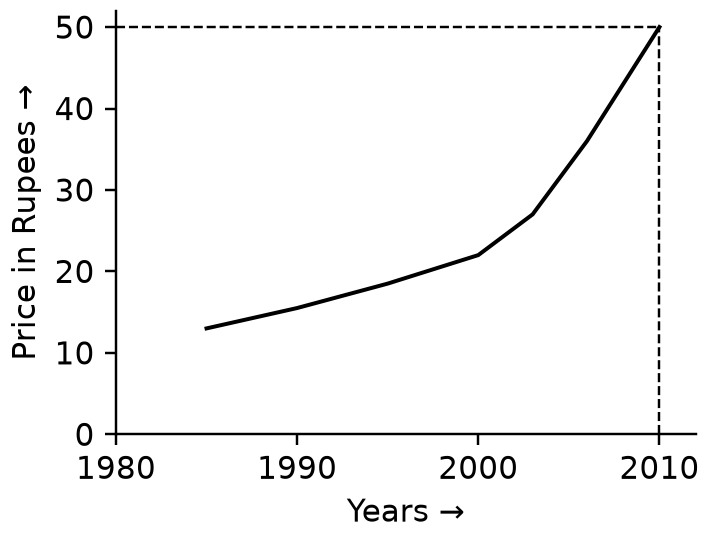
Year-wise variation of the price of a certain commodity is shown in the following graph :
The price of the commodity in the year 1990
Answer (c) & explanation
The 1990 price was somewhere between ₹10 and ₹20 (c). Step 1: look at 1990 on the graph. The line sits a little above the ₹10 mark and below the ₹20 mark. Step 2: the graph's scale is too rough to read an exact value, so options (a) and (b), which say "must have been" a precise number, are not safe. Step 3: the line rises all the time, so the 1990 price is lower than the 1991 price. Option (d) is wrong. Only a range can be stated with certainty.
Tip: when a graph does not give exact grid lines at a point, choose the answer that gives a safe range. "Must have been" an exact number needs exact data.
Answer as per the official UPSC answer key.
Which of the following statements is/are correct regarding National Innovation Foundation-India (NIF)?
- 1. NIF is an autonomous body of the Department of Science and Technology under the Central Government.
- 2. NIF is an initiative to strengthen the highly advanced scientific research in India’s premier scientific institutions in collaboration with highly advanced foreign scientific institutions.
Select the correct answer using the code given below.
Answer (a) & explanation
NIF-India (set up in 2000 in Gujarat) is an autonomous body of the Department of Science and Technology (1 correct). Inspired by Anil Gupta's Honey Bee Network, it scouts, documents and supports grassroots innovations and traditional knowledge of ordinary people. Statement 2 is wrong: it does not promote elite research tie-ups with advanced foreign institutions. The answer is (a).
NIF runs the biennial national grassroots innovation awards and helps innovators get patents and reach markets. Notice how it shows that innovation is not only the work of labs, but also of farmers and artisans solving local problems.
Answer as per the official UPSC answer key.
The Government of India has established NITI Aayog to replace the
Answer (d) & explanation
NITI Aayog was set up on 1 January 2015, by a Cabinet resolution, to replace the Planning Commission (1950) (d). Neither body is constitutional or statutory. The Finance Commission (b) is a constitutional body under Article 280 and continues. The Human Rights Commission (a) is statutory under the 1993 Act, and the Law Commission (c) is set up by the government for fixed terms; neither was replaced.
NITI Aayog works as a think tank and promotes cooperative federalism, with a Governing Council of the PM and all Chief Ministers. Notice how planning shifted from top-down plans to advice and indices.
Answer as per the official UPSC answer key.
With reference to ‘Forest Carbon Partnership Facility’, which of the following statements is/are correct?
- 1. It is a global partnership of governments, businesses, civil society and indigenous peoples.
- 2. It provides financial aid to universities, individual scientists and institutions involved in scientific forestry research to develop eco-friendly and climate adaptation technologies for sustainable forest management.
- 3. It assists the countries in their ‘REDD+ (Reducing Emissions from Deforestation and Forest Degradation+)’ efforts by providing them with financial and technical assistance.
Select the correct answer using the code given below.
Answer (c) & explanation
Statements 1 and 3 are correct (c). The Forest Carbon Partnership Facility (World Bank, 2008) brings together governments, businesses, civil society and indigenous peoples (1). Its Readiness Fund and Carbon Fund help countries prepare for REDD+ and pay them for verified emission cuts (3). Statement 2 is wrong: it does not give research grants to universities or individual scientists.
REDD+ pays developing countries to keep forests standing, also rewarding conservation and sustainable management. Notice how forests are treated as climate assets, linking this to the BioCarbon Fund in the previous question.
Answer as per the official UPSC answer key.
Read the passage
Foods travel more than the people who eat them. Grocery stores and supermarkets are loaded with preserved and processed foods. This, however, often leads to environmental threats, such as pollution generated by long distance food transportation and wastage of food during processing and transportation, destruction of rain forests, reduced nutritional content, increased demand for preservation and packaging. Food insecurity also increases as the produce comes from regions that are not feeding their own population properly.
With reference to the above passage, which of the following statements is/are true ?
- 1. Consuming regionally grown food and not depending on long travelled food is a part of eco-friendly behaviour.
- 2. Food processing industry puts a burden on our natural resources.
Select the correct answer using the code given below :
Answer (c) & explanation
Both statements are true (c). Step 1: test statement 1. The passage says food that travels long distances causes pollution, wastage and destruction of rain forests. So eating locally grown food, which does not travel far, is eco-friendly. Statement 1 holds. Step 2: test statement 2. Processed foods lead to "wastage of food during processing" and "increased demand for preservation and packaging". These use up natural resources. Statement 2 holds. So options (a), (b) and (d) fail.
Tip: a statement can be true even if the passage does not use the same words, as long as it follows directly. Here "regionally grown food" is the opposite of "long distance food", which the passage criticises.
Answer as per the official UPSC answer key.
In a group of persons travelling in a bus, 6 persons can speak Tamil, 15 can speak Hindi and 6 can speak Gujarati. In that group none can speak any other language. If 2 persons in the group can speak two languages only and one person can speak all the three languages, then how many persons are there in the group ?
Answer (c) & explanation
There are 23 persons (c). Step 1: add the language counts: 6 + 15 + 6 = 27. But this counts some people more than once. Step 2: each person who speaks two languages is counted twice, so is counted 1 extra time. There are 2 such persons: 2 extra counts. Step 3: the person who speaks all three is counted three times, so 2 extra counts. Step 4: people = 27 − 2 − 2 = 23. Options (a), (b) and (d) remove too much or too little.
Tip: think "extra counts". Someone in two groups adds one extra; someone in three groups adds two extra. Subtract all extras from the raw total.
Answer as per the official UPSC answer key.
There are 5 tasks and 5 persons. Task-1 cannot be assigned to either person-1 or person-2. Task-2 must be assigned to either person-3 or person-4. Every person is to be assigned one task. In how many ways can the assignment be done ?
Answer (c) & explanation
There are 24 ways (c). Step 1: Task-2 must go to person-3 or person-4: 2 ways. Step 2: Task-1 cannot go to person-1 or person-2, so it must go to one of persons 3, 4 or 5. One of 3 or 4 is already used by Task-2, so 2 choices are left. Step 3: the remaining 3 tasks go to the remaining 3 persons in 3 × 2 × 1 = 6 ways. Step 4: total = 2 × 2 × 6 = 24. Options (a), (b) and (d) miss or double a step.
Tip: in assignment problems, place the most restricted items first (here Task-2, then Task-1). Then the rest can be arranged freely: n items in n! ways.
Answer as per the official UPSC answer key.
Which one of the following issues the 'Global Economic Prospects' report periodically?
Answer (d) & explanation
The World Bank publishes Global Economic Prospects twice a year, in January and June (d). The Asian Development Bank (a) publishes the Asian Development Outlook. The EBRD (b) publishes its own Regional Economic Prospects for its region, and the US Federal Reserve (c) issues monetary policy statements, not this report.
Do not confuse it with the IMF's World Economic Outlook and Global Financial Stability Report. The World Bank also publishes the World Development Report. Notice how UPSC repeatedly tests which body publishes which report; a small table of reports and publishers is well worth keeping.
Answer as per the official UPSC answer key.
Amnesty International is
Answer (b) & explanation
Amnesty International (London, 1961) is a global human-rights movement of members and volunteers (b). It campaigns against torture, the death penalty and unjust imprisonment, and won the 1977 Nobel Peace Prize. It is not a UN refugee agency (a), which is the UNHCR; it is not a poverty relief NGO (c); and it is not an inter-governmental medical agency (d), a role closer to the ICRC or Médecins Sans Frontières, which is itself an NGO.
Amnesty shut its India operations in 2020 after its bank accounts were frozen. Notice how UPSC tests whether a body is UN, inter-governmental or non-governmental.
Answer as per the official UPSC answer key.