
UPSC Prelims PYQs with explanations
Real questions from official papers, mapped to syllabus topics. Attempt each one; the answer and the reason appear instantly.
With reference to Indian economy, consider the following :
- 1. Bank rate
- 2. Open market operations
- 3. Public debt
- 4. Public revenue
Which of the above is/are component/components of Monetary Policy?
Answer (c) & explanation
Monetary policy is run by the RBI through tools such as the bank rate, repo rate, CRR, SLR and open market operations. So 1 and 2 are correct (c). Public debt and public revenue concern government borrowing and taxes, which belong to fiscal policy, run by the government through the Budget.
Since 2016 a six-member Monetary Policy Committee sets the repo rate to keep CPI inflation at 4% within a 2–6% band. Notice how the two policies must work together: loose fiscal policy can push up inflation, forcing tighter monetary policy.
Answer as per the official UPSC answer key.
A father is nine times as old as his son and the mother is eight times as old as the son. The sum of the father's and the mother's age is 51 years. What is the age of the son?
Answer (d) & explanation
The son is 3 years old (d). Step 1: call the son's age s. The father is 9s and the mother is 8s. Step 2: father + mother = 9s + 8s = 17s = 51. Step 3: s = 51 ÷ 17 = 3. Check: father 27, mother 24, total 51. Options (a), (b) and (c) give totals of 119, 85 and 68.
Tip: when everyone's age is a multiple of one person's age, add the multiples first (9 + 8 = 17) and divide the total by that. You can also test options: 3 × 17 = 51 works straight away.
Answer as per the official UPSC answer key.
A selection is to be made for one post of Principal and two posts of Vice-Principal. Amongst the six candidates called for the interview, only two are eligible for the post of Principal while they all are eligible for the post of Vice-Principal. The number of possible combinations of selectees is
Answer (d) & explanation
The answer is 20, which is none of the given numbers (d). Step 1: choose the Principal. Only 2 candidates are eligible, so 2 ways. Step 2: choose two Vice-Principals from the remaining 5 people (everyone is eligible). Pairs from 5 = 5 × 4 ÷ 2 = 10 ways. We divide by 2 because the two posts are equal and order does not matter. Step 3: total = 2 × 10 = 20. 20 is not among (a), (b) or (c), so the answer is (d).
Tip: once a person is picked for one post, remove them before choosing the next. For choosing 2 from n without order, use n × (n − 1) ÷ 2.
Answer as per the official UPSC answer key.
Candidates in a competitive examination consisted of 60% men and 40% women. 70% men and 75% women cleared the qualifying test and entered the final test where 80% men and 70% women were successful. Which of the following statements is correct?
Answer (c) & explanation
More men cleared the exam than women (c). Step 1: take 100 candidates: 60 men and 40 women. Step 2: men who passed both tests: 60 × 0.7 × 0.8 = 33.6. Women: 40 × 0.75 × 0.7 = 21. So more men cleared (c). Step 3: test (a). Men's success rate = 33.6 ÷ 60 = 56%. Women's = 21 ÷ 40 = 52.5%. Women's rate is lower, so (a) is wrong. Step 4: test (b). Overall = 33.6 + 21 = 54.6%, above 50%, so (b) is wrong. Option (d) is wrong too.
Tip: for multi-stage pass rates, multiply the stages. Taking 100 as the total turns every answer into a percentage directly.
Answer as per the official UPSC answer key.
With reference to ‘Near Field Communication (NFC) Technology’, which of the following statements is/are correct?
- 1. It is a contactless communication technology that uses electromagnetic radio fields.
- 2. NFC is designed for use by devices which can be at a distance of even a metre from each other.
- 3. NFC can use encryption when sending sensitive information.
Select the correct answer using the code given below.
Answer (c) & explanation
Statements 1 and 3 are correct (c). NFC is a contactless technology using electromagnetic radio fields at 13.56 MHz (1). It supports encryption for sensitive data such as tap-to-pay transactions (3). Statement 2 is wrong: NFC works only within about 4 cm, which is part of its security. A one-metre range is closer to some RFID or Bluetooth uses.
NFC powers contactless cards, phone wallets, metro cards and FASTag-like systems, though FASTag itself uses RFID. Notice how short range is a design choice for safety: a device must be held close on purpose.
Answer as per the official UPSC answer key.
In the Mekong-Ganga Cooperation, an initiative of six countries, which of the following is/are not a participant/participants?
- 1. Bangladesh
- 2. Cambodia
- 3. China
- 4. Myanmar
- 5. Thailand
Select the correct answer using the code given below.
Answer (c) & explanation
Mekong–Ganga Cooperation (2000, Vientiane) joins India with five Mekong countries: Thailand, Myanmar, Cambodia, Laos and Vietnam. So Bangladesh and China are not participants (c). Options listing Cambodia, Myanmar or Thailand as non-participants are wrong.
MGC covers tourism, culture, education and transport, highlighting the civilisational links of the two great rivers. China leads its own Lancang–Mekong Cooperation, the Lancang being the Chinese name for the upper Mekong. Notice how MGC fits India's Act East Policy, along with BIMSTEC and the India–Myanmar–Thailand highway.
Answer as per the official UPSC answer key.
Which of the following has/have been accorded ‘Geographical Indication’ status?
- 1. Banaras Brocades and Sarees
- 2. Rajasthani Daal-Bati-Churma
- 3. Tirupathi Laddu
Select the correct answer using the code given below.
Answer (c) & explanation
Banaras brocades and saris received a GI tag in 2009, and the Tirupati laddu got one the same year, registered to the Tirumala Tirupati Devasthanams. So 1 and 3 are correct (c). Daal-bati-churma is a well-known Rajasthani dish but has no GI tag, so options with 2 fail.
The Geographical Indications of Goods Act was passed in 1999 and came into force in 2003; the first Indian GI was Darjeeling tea (2004). GIs protect products whose quality comes from their place of origin. Notice how GI tags support local artisans and farmers by preventing imitation.
Answer as per the official UPSC answer key.
Read the passage
Individuals, groups and leaders who promote human development operate under strong institutional, structural and political constraints that affect policy options. But experience suggests broad principles for shaping an appropriate agenda for human development. One important finding from several decades of human development experience is that focusing exclusively on economic growth is problematic. While we have good knowledge about how to advance health and education, the causes of growth are much less certain and growth is often elusive. Further, an unbalanced emphasis on growth is often associated with negative environmental consequences and adverse distributional effects. The experience of China, with its impressive growth record, reflects these broader concerns and underlines the importance of balanced approaches that emphasize investments in the non-income aspects of human development.
With reference to the above passage, consider the following statements :
- 1. In developing countries, a strong institutional framework is the only requirement for human development and policy options.
- 2. Human development and economic growth are not always positively inter-related.
- 3. Focusing only on human development should be the goal of economic growth.
Which of the above statements is/are correct ?
Answer (c) & explanation
Only statement 2 is correct (c). Step 1: test statement 2. The passage says focusing only on growth brings "adverse distributional effects" and environmental harm. So growth does not always improve human development; the two are not always positively linked. 2 holds. Step 2: test statement 1. It says a strong institutional framework is the "only" requirement. The passage never says this; it mentions constraints but not a single requirement. 1 fails. Step 3: test statement 3. It says growth should focus "only" on human development. The passage calls for "balanced approaches", not an exclusive focus. 3 fails. Options (a), (b) and (d) fail.
Tip: "only" in a statement usually clashes with a passage that asks for balance.
Answer as per the official UPSC answer key.
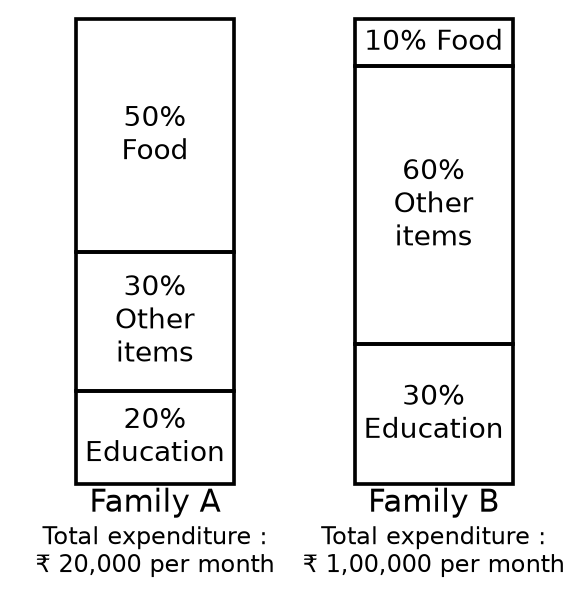
The proportion of expenditure on various items by two families A and B are represented in the following Bar Charts :
From these charts, we can conclude that
Answer (c) & explanation
Both families spent the same on food (c). Step 1: Family A's income is ₹20,000, and food is 50% of spending. 50% of 20,000 = ₹10,000. Step 2: Family B's income is ₹1,00,000, and food is 10%. 10% of 1,00,000 = ₹10,000. Step 3: both spent ₹10,000. Options (a) and (b) are wrong. Option (d) is wrong: the amounts can be compared because the totals are given.
Tip: percentages from different totals cannot be compared directly. Always convert each percentage into an actual amount first. Here a big share of a small income equals a small share of a big income.
A bigger percentage does not mean more money; multiply by the total first.
Answer as per the official UPSC answer key.
What can be the impact of excessive/inappropriate use of nitrogenous fertilizers in agriculture?
- 1. Proliferation of nitrogen-fixing microorganisms in soil can occur.
- 2. Increase in the acidity of soil can take place.
- 3. Leaching of nitrate to the groundwater can occur.
Select the correct answer using the code given below.
Answer (c) & explanation
Too much urea and ammonium fertiliser makes the soil acidic (2 correct), and unused nitrate washes down into groundwater (3 correct). Statement 1 is wrong: with plenty of nitrogen available, nitrogen-fixing microbes are suppressed, not boosted. The answer is (c).
High nitrate in drinking water can cause methaemoglobinaemia ("blue baby" syndrome), and runoff causes eutrophication of lakes. India's fertiliser use is skewed towards urea, partly because it is heavily subsidised. Notice how soil health cards, neem-coated urea and nano urea all aim to correct this imbalance.
Free nitrogen gives fixers no reason to work, so they decline.
Answer as per the official UPSC answer key.
What is Rio+20 Conference, often mentioned in the news?
Answer (a) & explanation
Rio+20 was the UN Conference on Sustainable Development, held in Rio de Janeiro in 2012, twenty years after the 1992 Earth Summit (a). It was not a WTO ministerial (b), an IPCC meeting (c) or a CBD Conference of Parties (d).
Its outcome document, "The Future We Want", started the process that led to the Sustainable Development Goals, adopted in 2015 with 17 goals and a 2030 deadline. It also highlighted the green economy. The 1992 summit had produced the UNFCCC, the CBD and Agenda 21. Notice how this chain of summits shapes today's development agenda.
Answer as per the official UPSC answer key.
Which one of the following was given classical language status recently?
Answer (a) & explanation
Odia became India's sixth classical language in 2014 (a), after Tamil (2004), Sanskrit (2005), Telugu and Kannada (2008) and Malayalam (2013). In 2015, Konkani (b), Bhojpuri (c) and Assamese (d) did not have the status.
Since then the list has grown: in October 2024, Marathi, Pali, Prakrit, Assamese and Bengali were added, making eleven in all. So today Assamese is also classical, though Konkani and Bhojpuri are not. Notice how such questions can change over time; always read them in their year and know the latest position too.
Assamese was not classical in 2015. It was added only in 2024, so the answer then was Odia.
Answer as per the official UPSC answer key.
Read the passage
I must say that, beyond occasionally exposing me to laughter, my constitutional shyness has been of no disadvantage whatever. In fact I can see that, on the contrary, it has been all to my advantage. My hesitancy in speech, which was once an annoyance, is now a pleasure. Its greatest benefit has been that it has taught me the economy of words. I have naturally formed the habit of restraining my thoughts. And I can now give myself the certificate that a thoughtless word hardly ever escapes my tongue or pen. I do not recollect ever having had to regret anything in my speech or writing. I have thus been spared many a mishap and waste of time. Experience has taught me that silence is part of the spiritual discipline of a votary of truth. Proneness to exaggerate, to suppress or modify the truth, wittingly or unwittingly, is a natural weakness of man, and silence is necessary in order to surmount it. A man of few words will rarely be thoughtless in his speech; he will measure every word. We find so many people impatient to talk. There is no chairman of a meeting who is not pestered with notes for permission to speak. And whenever the permission is given the speaker generally exceeds the time-limit, asks for more time, and keeps on talking without permission. All this talking can hardly be said to be of any benefit to the world. It is so much waste of time. My shyness has been in reality my shield and buckler. It has allowed me to grow. It has helped me in my discernment of truth.
The author says that a thoughtless word hardly ever escapes his tongue or pen. Which one of the following is not a valid reason for this ?
Answer (a) & explanation
Wanting to save time is not a valid reason (a). Step 1: find the reasons the author gives. His hesitancy in speech (d) "taught me the economy of words" (b). "I have naturally formed the habit of restraining my thoughts" (c). These lead to: "a thoughtless word hardly ever escapes my tongue or pen." Step 2: test option (a). The author says he has been spared "waste of time", but that is a result of speaking carefully, not the cause. He never says he speaks carefully because he wants to save time. So (a) is not a valid reason.
Tip: separate causes from results. Linking words like "taught me" show a cause; "thus been spared" shows a result. UPSC often offers a result dressed up as a reason.
Answer as per the official UPSC answer key.
In a parking area, the total number of wheels of all the cars (four-wheelers) and scooters/motorbikes (two-wheelers) is 100 more than twice the number of parked vehicles. The number of cars parked is
Answer (c) & explanation
There are 50 cars (c). Step 1: let c be cars and s be two-wheelers. Total wheels = 4c + 2s. Twice the number of vehicles = 2c + 2s. Step 2: the wheels are 100 more: 4c + 2s = 2c + 2s + 100. Step 3: the 2s appears on both sides, so it cancels. That leaves 2c = 100, so c = 50. The number of two-wheelers does not matter. Options (a), (b) and (d) do not fit.
Tip: a simple way to see it: give every vehicle 2 wheels first. That uses "twice the vehicles". The extra 100 wheels are the 2 more wheels each car has. 100 ÷ 2 = 50 cars.
Answer as per the official UPSC answer key.
The monthly incomes of Peter and Paul are in the ratio of 4 : 3. Their expenses are in the ratio of 3 : 2. If each saves ₹ 6,000 at the end of the month, their monthly incomes respectively are (in ₹)
Answer (a) & explanation
Their incomes are ₹24,000 and ₹18,000 (a). Step 1: every option keeps incomes in the ratio 4 : 3, so test each one using savings of ₹6,000. Step 2: option (a): expenses = 24,000 − 6,000 = 18,000 and 18,000 − 6,000 = 12,000. 18,000 : 12,000 = 3 : 2. This matches. Step 3: check option (b): expenses 22,000 and 15,000, which is not 3 : 2. Options (c) and (d) also fail.
Tip: when all options satisfy one condition, use the other condition to test them. Testing options is often faster than setting up two equations.
Answer as per the official UPSC answer key.
When the Reserve Bank of India reduces the Statutory Liquidity Ratio by 50 basis points, which of the following is likely to happen?
Answer (c) & explanation
The SLR is the share of deposits banks must keep in safe liquid assets such as government securities, gold or cash. A cut frees funds for lending, raising liquidity, so banks may cut lending rates (c). Option (a) is wrong: a 0.5-point cut cannot "drastically" raise GDP growth. Option (b) does not follow, since FII flows depend on wider returns and risk. Option (d) is the reverse: an SLR cut raises liquidity.
The SLR is set under the Banking Regulation Act and has fallen over the years to about 18%. Notice how SLR and CRR together shape how much money banks can lend.
"drastically" in options (a) and (d). A small cut has small, likely effects.
Answer as per the official UPSC answer key.
With reference to the art and archaeological history of India, which one among the following was made earliest?
Answer (b) & explanation
The Dhauli elephant, carved above Ashoka's rock edict near Bhubaneswar, dates to about the 3rd century BCE, making it the earliest (b). The Udayagiri Varaha (d) belongs to Chandragupta II's time, about 401 CE. Mahabalipuram's rock-cut monuments (c) are Pallava work of the 7th century, and the Lingaraja temple (a) dates to the 11th century.
Dhauli is believed to be near the site of the Kalinga war, after which Ashoka turned to dhamma. Notice how a quick timeline of dynasties (Mauryas, Guptas, Pallavas, Somavamshis and Gangas) solves "which came first" questions.
Answer as per the official UPSC answer key.
With reference to inflation in India, which of the following statements is correct?
Answer (c) & explanation
Inflation is often too much money chasing too few goods, so reduced money circulation helps control it (c). Option (a) is wrong: inflation control is shared, with the RBI in the lead. Option (b) is wrong for the same reason. Option (d) is the reverse of the truth.
Since 2016 the RBI has had a legal mandate under the amended RBI Act to keep CPI inflation at 4%, within a band of 2–6%, through its Monetary Policy Committee. The government helps through supply-side steps such as buffer stocks and import duty changes. Notice how monetary and supply measures work together against inflation.
Answer as per the official UPSC answer key.
Four persons A, B, C and D consisting of two married couples are in a group. Both the women are shorter than their respective husbands. A is the tallest among the four. C is taller than B. D is B's brother. In this context, which one of the following statements is not correct ?
Answer (c) & explanation
Statement (c) is not correct (c). Step 1: A is the tallest. Each wife is shorter than her husband, so the tallest person must be a husband: A is a man. D is B's brother, so D is also a man. Step 2: that leaves B and C as the two wives. Step 3: D cannot marry his own sister B, so the couples are A–B and D–C. Step 4: C is D's wife, so C is shorter than D. Option (c), "C is taller than D", is wrong. Check the others: (a) all are linked by family; (b) B is shorter than C, and C is shorter than her husband D and than A, so B is the shortest; (d) A is B's husband. These are correct.
Tip: in such puzzles, first fix who is a man and who is a woman, then pair the couples.
Answer as per the official UPSC answer key.
A student has to opt for 2 subjects out of 5 subjects for a course, namely, Commerce, Economics, Statistics, Mathematics I and Mathematics II. Mathematics II can be offered only if Mathematics I is also opted. The number of different combinations of two subjects which can be opted is
Answer (c) & explanation
There are 7 combinations (c). Step 1: count all possible pairs of 2 subjects from 5. That is 5 × 4 ÷ 2 = 10 pairs. Step 2: remove pairs that break the rule. Maths II can be taken only with Maths I. So pairs with Maths II but not Maths I are not allowed: Maths II with Commerce, with Economics, and with Statistics. That is 3 pairs. Step 3: allowed pairs = 10 − 3 = 7. Options (a), (b) and (d) do not match.
Tip: when there is a restriction, count everything first, then subtract the forbidden cases. This is often faster than counting the allowed cases one by one.
Answer as per the official UPSC answer key.