
Chapter 13 · Topic 13.1 · Prelims + Mains1 of 4
Parliament: The two Houses and the presiding
Key points
- Parliament = President + Rajya Sabha + Lok Sabha (Art 79). India: parliamentary system,
- Lok Sabha max 550, 25 years, 5-year term. Rajya Sabha max 250 (12 nominated), 30 years,
- Rajya Sabha only: Art 249, Art 312, VP removal begins there. Lok Sabha only: money bills,
- Speaker: stays in office till the new House meets; removal by majority of all members, 14 days'
13 PYQs 2013–2026
Prelims box: facts and traps
| Lok Sabha Maximum strength 550 (530 States + 20 UTs) since | Rajya Sabha 250 (238 elected + 12 nominated |
|---|---|
| the 104th Amendment ended | by the President) |
| Anglo-Indian nomination Present strength 543 elected Election Direct, first-past-the-post, by | 245 (233 elected + 12 nominated) Indirect: by elected MLAs, by; adult franchise Minimum age 25 years Term Five years; can be dissolved; → single transferable vote; seats per State in the Fourth Schedule 30 years Permanent body; one-third of |
| extendable one year at a time | members retire every second |
| during a national emergency Presiding officer Speaker (a member) | year; members serve six years Chairman: the Vice-President (not a member). |
- A Leader of the Opposition was recognised for the first time in 1969, and the post got statutory recognition in 1977.
- The Chairman is the Vice-President ex officio (Article 89(1)), while the Deputy Chairman is elected by the Rajya Sabha from among its own members (Article 89(2)).
- Trap (UPSC Prelims 2018): “In the first Lok Sabha, the single largest party in the opposition was the Swatantra Party” is incorrect. “In the Lok Sabha, if a party does not have a minimum of 75 members, its leader cannot be recognised as the Leader of the Opposition” is incorrect.
- Trap (UPSC Prelims 2022, Deputy Speaker of Lok Sabha): “There is a mandatory provision that the election of a candidate as Deputy Speaker of Lok Sabha shall be from either the principal opposition party or the ruling party” is incorrect. “The well established parliamentary practice regarding the appointment of Deputy Speaker is that the motion is moved by the Speaker and duly seconded by the Prime Minister” is incorrect.
On this page (3 sections)
Parliament in a parliamentary system
Parliament (Art 79) has three parts: the President, the Council of States (Rajya Sabha) and the House of the People (Lok Sabha). The President is not a member of either House, but no bill becomes law without the President’s assent, which is why the President is part of Parliament.
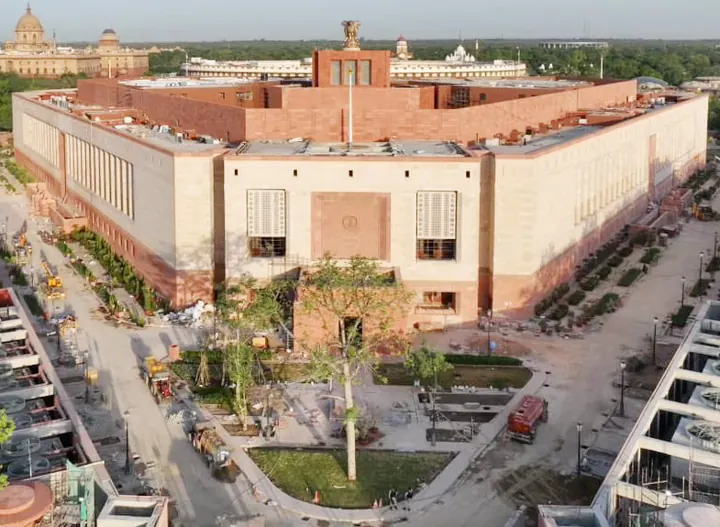
India took the British model of parliamentary democracy but not British parliamentary sovereignty. As regards legislation, the British Parliament is supreme or sovereign but in India, the power of the Parliament to legislate is limited: by the written Constitution, the division of powers with the States, Fundamental Rights and judicial review. Questions on whether an amendment is constitutional go to a Constitution Bench of at least five judges.
We adopted parliamentary democracy based on the British model, but how does our model differ from that model? 1. As regards legislation, the British Parliament is supreme or sovereign but in India, the power of the Parliament to legislate is limited. 2. In India, matters related to the constitutionality of the Amendment of an Act of the Parliament are referred to the Constitution Bench by the Supreme Court. Select the correct answer using the code given below.
- 1 only
- 2 only
- Both 1 and 2
- Neither 1 nor 2
Show answer
Answer: (c) · UPSC official key
Mains 2023 asked candidates to compare and contrast the British and Indian approaches to Parliamentary sovereignty. Frame: Britain has no written constitution and no judicial review of Acts; India has both, plus federalism and the basic structure limit on amendment (Kesavananda, 1973). Points of overlap: cabinet government, collective responsibility, and Parliament’s wide law-making power within its field.
Compare and contrast the British and Indian approaches to Parliamentary sovereignty.
→ India and Other Constitutions India’s Parliament compared with Westminster and the US Congress.
The two Houses: composition and powers
| Lok Sabha Maximum strength 550 (530 States + 20 UTs) since | Rajya Sabha 250 (238 elected + 12 nominated |
|---|---|
| the 104th Amendment ended | by the President) |
| Anglo-Indian nomination Present strength 543 elected Election Direct, first-past-the-post, by | 245 (233 elected + 12 nominated) Indirect: by elected MLAs, by |
| adult franchise Minimum age 25 years Term Five years; can be dissolved; | single transferable vote; seats per State in the Fourth Schedule 30 years Permanent body; one-third of |
| extendable one year at a time | members retire every second |
| during a national emergency Presiding officer Speaker (a member) | year; members serve six years Chairman: the Vice-President (not a member) |
Two things only the Rajya Sabha can do: pass a resolution empowering the Parliament to make laws in the State List in the national interest (Art 249) and to create one or more All India Services (Art 312), each by two-thirds of members present and voting. Proceedings to remove the Vice- President also begin only in the Rajya Sabha.
Which of the following special powers have been conferred on the Rajya Sabha by the Constitution of India?
- To change the existing territory of a State and to change the name of a State
- To pass a resolution empowering the Parliament to make laws in the State List and to create one or more All India Services
- To amend the election procedure of the President and to determine the pension of the President after his/her retirement
- To determine the functions of the Election Commission and to determine the number of Election Commissioners
Show answer
Answer: (b) · UPSC official key
Where the Houses are equal: ordinary bills (subject to a joint sitting), the election and impeachment of the President, approval of emergencies and ordinances, and amending the Constitution,
where each House must pass the bill separately by a special majority. That is the answer to the 2020 question. Creating All India Services is a Rajya Sabha power, and removing the government and making cut motions are Lok Sabha powers.
Rajya Sabha has equal powers with Lok Sabha in
- the matter of creating new All India Services
- amending the Constitution
- the removal of the government
- making cut motions
Show answer
Answer: (b) · UPSC official key
Exclusive to the Lok Sabha: money bills, voting on demands for grants, and to pass a motion of no-confidence against the Council of Ministers. Ratifying an emergency and impeaching the President need both Houses. So the 2022 answer is 2 only.
Which of the following is/are the exclusive power(s) of Lok Sabha? 1. To ratify the declaration of Emergency 2. To pass a motion of no-confidence against the Council of Ministers 3. To impeach the President of India Select the correct answer using the code given below :
- 1 and 2
- 2 only
- 1 and 3
- 3 only
Show answer
Answer: (b) · UPSC official key
Mains 2020 said the Rajya Sabha has been transformed from a ‘useless stepney tyre’ to the most useful supporting organ. Factors: coalition and minority governments without a Rajya Sabha majority, its committees, and its role in revising hasty bills; areas: scrutiny of bills, the federal voice of the States, and expertise from nominated members. Counterpoints: money-bill routing to bypass it, and debate on whether it still represents States after domicile rules were dropped (Kuldip Nayar, 2006).
Rajya Sabha has been transformed from a ‘useless stepney tyre’ to the most useful supporting organ in past few decades. Highlight the factors as well as the areas in which this transformation could be visible.
Speaker, Deputy Speaker and the Leader of the
Opposition The Speaker is elected by the Lok Sabha from among its members. The Speaker does not vacate office on dissolution until immediately before the first meeting of the new House. The Speaker can be removed by a resolution of the House passed by a majority of all the then members, after at least fourteen days’ notice (Art 94). The Constitution does not require a Speaker to leave the party; that statement made the 2025 answer I and III only.
Consider the following statements : I. On the dissolution of the House of the People, the Speaker shall not vacate his/her office until immediately before the first meeting of the House of the People after the dissolution. II. According to the provisions of the Constitution of India, a Member of the House of the People on being elected as Speaker shall resign from his/her political party immediately. III. The Speaker of the House of the People may be removed from his/her office by a resolution of the House of the People passed by a majority of all the then Members of the House, provided that no resolution shall be moved unless at least fourteen days’ notice has been given of the intention to move the resolution. Which of the statements given above are correct?
- I and II only
- II and III only
- I and III only
- I, II and III
Show answer
Answer: (c) · UPSC official key
While any resolution for the removal of the Speaker is under consideration, the Speaker shall not preside. The Speaker can still speak and take part, and can vote in the first instance, though not in a tie (Art 96). Only statement 1 of the 2024 question is right.
With reference to the Speaker of the Lok Sabha, consider the following statements : While any resolution for the removal of the Speaker of the Lok Sabha is under consideration 1. He/She shall not preside. 2. He/She shall not have the right to speak. 3. He/She shall not be entitled to vote on the resolution in the first instance. Which of the statements given above is/are correct ?
- 1 only
- 1 and 2 only
- 2 and 3 only
- 1, 2 and 3
Show answer
Answer: (a) · UPSC official key
The Speaker does not hold office at the pleasure of the President, and must already be a member when elected. A resignation letter is addressed to the Deputy Speaker. So the 2012 answer is 3 only.
Regarding the office of the Lok Sabha Speaker, consider the following statements : 1. He/She holds the office during the pleasure of the President. 2. He/She need not be a member of the House at the time of his/her election but has to become a member of the House within six months from the date of his/her election. 3. If he/she intends to resign, the letter of his/her resignation has to be addressed to the Deputy Speaker. Which of the statements given above is/are correct?
- 1 and 2 only
- 3 only
- 1, 2 and 3
- None
Show answer
Answer: (b) · UPSC official key
Deputy Speaker (Art 93). Under the Lok Sabha rules, the election of Deputy Speaker shall be held on such date as the Speaker may fix. There is no mandatory rule that the post goes to the opposition; that is only a convention. When presiding, the Deputy Speaker has the same powers as the Speaker and no appeal lies against the rulings.
With reference to Deputy Speaker of Lok Sabha, consider the following statements : 1. As per the Rules of Procedure and Conduct of Business in Lok Sabha, the election of Deputy Speaker shall be held on such date as the Speaker may fix. 2. There is a mandatory provision that the election of a candidate as Deputy Speaker of Lok Sabha shall be from either the principal opposition party or the ruling party. 3. The Deputy Speaker has the same power as of the Speaker when presiding over the sitting of the House and no appeal lies against his rulings. 4. The well established parliamentary practice regarding the appointment of Deputy Speaker is that the motion is moved by the Speaker and duly seconded by the Prime Minister. Which of the statements given above are correct?
- 1 and 3 only
- 1, 2 and 3
- 3 and 4 only
- 2 and 4 only
Show answer
Answer: (a) · UPSC official key
Leader of the Opposition. In the first Lok Sabha the largest opposition party was the CPI, not the Swatantra Party (founded only in 1959). A Leader of the Opposition was recognised for the first time in 1969, and the post got statutory recognition in 1977. The 10% rule (55 members) is a Speaker’s direction, not 75 members.
Consider the following statements : 1. In the first Lok Sabha, the single largest party in the opposition was the Swatantra Party. 2. In the Lok Sabha, a “Leader of the Opposition” was recognised for the first time in 1969. 3. In the Lok Sabha, if a party does not have a minimum of 75 members, its leader cannot be recognised as the Leader of the Opposition. Which of the statements given above is/are correct?
- 1 and 3 only
- 2 only
- 2 and 3 only
- 1, 2 and 3
Show answer
Answer: (b) · UPSC official key
| Speaker’s special powers | Detail |
|---|---|
| Money bills | Decides whether a bill is a money bill; the decision is final (Art 110(3)) |
| Joint sitting | Presides over a joint sitting of the two Houses |
| Anti-defection | Decides disqualification under the Tenth Schedule, subject to judicial review |
| Casting vote | Votes only to break a tie |
Mains box: analysis and answer points
- Frame: Britain has no written constitution and no judicial review of Acts; India has both, plus federalism and the basic structure limit on amendment (Kesavananda, 1973).
- Parliament (Art 79) has three parts: the President, the Council of States (Rajya Sabha) and the House of the People (Lok Sabha).
- India took the British model of parliamentary democracy but not British parliamentary sovereignty.
- Likely next angle: Constitution Bench referrals and the basic-structure limit on Parliament
- Asked: Mains 2023 (GS Paper II, 10 marks): Compare and contrast the British and Indian approaches to Parliamentary sovereignty.
Practice
Practice MCQs (8)
Consider the following statements:
1. Under the Rules of the Lok Sabha, the Speaker nominates from among the members a panel of not more than ten chairpersons, any of whom can preside over the House in the absence of the Speaker and the Deputy Speaker.
2. The Deputy Speaker, while presiding over the House, cannot exercise a casting vote.
Which of the statements given above is/are correct?
Answer (a) & explanation
Statement 1 is correct: the Speaker nominates a panel of not more than ten chairpersons, and any of them presides in the absence of both the Speaker and the Deputy Speaker; a member of the panel, however, cannot preside when the office of Speaker is vacant. Statement 2 is incorrect: when the Deputy Speaker presides, he has the same powers as the Speaker, including the casting vote in case of a tie (Article 100(1) applies to whoever is presiding). A member of the panel presiding over a sitting also exercises the casting vote.
When both the Chairman and the Deputy Chairman are absent from a sitting of the Rajya Sabha, the sitting is presided over by
Answer (c) & explanation
Article 91(2) provides that during the absence of the Chairman from a sitting, the Deputy Chairman presides, or, if he is also absent, such person as may be determined by the rules of procedure, or, failing that, by the House. Under the Rules, the Chairman nominates a panel of vice-chairpersons, and one of them presides in such a situation. The Speaker of the Lok Sabha has no role in the Rajya Sabha, and seniority or the post of Leader of the House gives no right to preside. The Chairman is the Vice-President ex officio (Article 89(1)), while the Deputy Chairman is elected by the Rajya Sabha from among its own members (Article 89(2)). Article 91 is the Rajya Sabha counterpart of Article 95 for the Lok Sabha. Like the Lok Sabha's panel of chairpersons, a vice-chairperson presides only during the temporary absence of both officers; when both offices are vacant, the President appoints a member to perform the Chairman's duties.
At a joint sitting of the two Houses of Parliament, if both the Speaker and the Deputy Speaker of the Lok Sabha are absent, the sitting is presided over by
Answer (a) & explanation
A joint sitting is presided over by the Speaker; in his absence by the Deputy Speaker; and if he too is absent, by the Deputy Chairman of the Rajya Sabha. If the Deputy Chairman is also absent, the members present decide who shall preside. The Chairman of the Rajya Sabha does not preside, because he is not a member of either House, while a joint sitting is a meeting of the members of both Houses. A joint sitting is called under Article 108 to resolve a deadlock on an ordinary bill; it is not available for Money Bills or Constitution Amendment Bills. Only three have been held: on the Dowry Prohibition Bill (1961), the Banking Service Commission (Repeal) Bill (1978) and the Prevention of Terrorism Bill (2002). The quorum is one- tenth of the total members of both Houses.
Consider the following statements regarding the period during which the Vice-President acts as President:
1. During this period, he does not perform the duties of the office of Chairman of the Rajya Sabha.
2. During this period, the duties of the Chairman are performed by the Deputy Chairman of the Rajya Sabha.
Which of the statements given above is/are correct?
Answer (c) & explanation
Both statements are correct. The proviso to Article 64 says that while the Vice- President acts as President or discharges the President's functions, he shall not perform the duties of Chairman of the Council of States and shall not be entitled to the Chairman's salary or allowances. Article 91(1) then provides that while the office of Chairman is vacant, or the Vice- President is acting as President, the duties of the office are performed by the Deputy Chairman. Under Article 65, the Vice-President acts as President when the office falls vacant, until a new President is elected within six months. V.V. Giri did so in 1969, and Chief Justice M. Hidayatullah acted after Giri resigned to contest the election.
Consider the role of the Speaker in the committee system and inter-parliamentary work of the Lok Sabha. Which one of the following is NOT correct?
Answer (d) & explanation
Options (a), (b) and (c) are correct. The Speaker is ex officio chairman of the Indian Parliamentary Group, which links Indian Parliament with other parliaments. He appoints the chairmen of all Lok Sabha committees and supervises their work. He himself chairs the Business Advisory Committee, the Rules Committee and the General Purposes Committee. Option (d) is not correct: the chairman of the Public Accounts Committee is appointed by the Speaker from among its members, and since 1967 it has been the convention to choose a member of the Opposition.
With reference to the Deputy Speaker of the Lok Sabha, consider the following statements:
1. The Deputy Speaker is not subordinate to the Speaker; he is directly responsible to the House.
2. Whenever the Deputy Speaker is appointed a member of a parliamentary committee, he automatically becomes its chairman.
3. The Constitution requires that the Deputy Speaker be elected from a party other than the party of the Speaker.
Which of the statements given above is/are correct?
Answer (b) & explanation
Statement 1 is correct: the Deputy Speaker is elected by the House and answers to it, not to the Speaker. Statement 2 is correct: the Deputy Speaker has a special privilege that whenever he is appointed to a parliamentary committee he automatically becomes its chairman. Statement 3 is incorrect: giving the post to the Opposition is only a convention, followed for long periods but not always; the Constitution says nothing about party affiliation. UPSC tested this in 2017 and 2022. Neither the Speaker nor the Deputy Speaker takes a separate oath for the office; each takes only the member's oath under Article 99. When presiding, the Deputy Speaker has the Speaker's powers, including the casting vote.
Which of the following powers of the Speaker of the Lok Sabha are conferred by the Constitution of India itself?
1. Deciding whether a bill is a Money Bill
2. Presiding over a joint sitting of the two Houses of Parliament
3. Recognising the leader of a party as the Leader of the Opposition
4. Deciding questions of disqualification of members on the ground of defection
Select the correct answer using the code given below:
Answer (d) & explanation
Three of these powers are written into the Constitution. Article 110(3) makes the Speaker's decision on whether a bill is a Money Bill final. Article 118(4) says the Speaker presides over a joint sitting. Paragraph 6 of the Tenth Schedule gives the presiding officer the power to decide defection cases. Recognition of the Leader of the Opposition is not a constitutional power: it rests on the Speaker's Directions and on the Salary and Allowances of Leaders of Opposition in Parliament Act, 1977. The Constitution does not mention the Leader of the Opposition at all.
Match List-I with List-II and select the correct answer using the code given below: List-I (Presiding officer) A. Speaker of the Lok Sabha B. Chairman of the Rajya Sabha C. Deputy Chairman of the Rajya Sabha D. Speaker pro tem List-II (Feature)
1. Appointed by the President for the first sitting of a newly elected House
2. Ceases to hold this office only when removed from another office
3. Elected by the House; resignation is addressed to the Chairman
4. Elected by the House; resignation is addressed to the Deputy Speaker
Answer (b) & explanation
A–4: the Speaker is elected by the Lok Sabha and resigns to the Deputy Speaker (Article 94). B–2: the Chairman of the Rajya Sabha is the Vice-President ex officio, so he can be removed as Chairman only by being removed as Vice-President (Article 67(b)). C–3: the Deputy Chairman is elected by the Rajya Sabha from its members and resigns to the Chairman (Article 90). D–1: the Speaker pro tem is appointed by the President, usually the senior-most member, to preside over the first sitting and administer the oath to new members.
0 / 0 correct
Prelims PYQs on this topic (8)
Consider the following statements :
- 1. The Chairman and the Deputy Chairman of the Rajya Sabha are not the members of that House.
- 2. While the nominated members of the two Houses of the Parliament have no voting right in the presidential election, they have the right to vote in the election of the Vice President.
Which of the statements given above is/are correct?
Answer (b) & explanation
Statement 2 only is correct (b). Statement 1 is wrong: the Chairman of the Rajya Sabha is the Vice-President, who is not a member of the House, but the Deputy Chairman is elected from among its members. Statement 2 is correct: nominated members of both Houses cannot vote in the presidential election (Article 54 counts only elected members), but they do vote in the Vice-Presidential election (Article 66), whose electoral college is all members of both Houses. So (a), (c) and (d) fail.
Notice the latest: C.P. Radhakrishnan became Vice-President in September 2025 after Jagdeep Dhankhar resigned in July 2025. State legislators vote for the President but not the Vice-President. Trap: one officer of the Rajya Sabha is a member and the other is not.
Answer as per the official UPSC answer key.
With reference to Deputy Speaker of Lok Sabha, consider the following statements :
- 1. As per the Rules of Procedure and Conduct of Business in Lok Sabha, the election of Deputy Speaker shall be held on such date as the Speaker may fix.
- 2. There is a mandatory provision that the election of a candidate as Deputy Speaker of Lok Sabha shall be from either the principal opposition party or the ruling party.
- 3. The Deputy Speaker has the same power as of the Speaker when presiding over the sitting of the House and no appeal lies against his rulings.
- 4. The well established parliamentary practice regarding the appointment of Deputy Speaker is that the motion is moved by the Speaker and duly seconded by the Prime Minister.
Which of the statements given above are correct?
Answer (a) & explanation
Statements 1 and 3 are correct (a). Statement 1 is right: under Rule 8 of the Lok Sabha's Rules of Procedure, the election of the Deputy Speaker is held on a date the Speaker fixes. Statement 2 is wrong: no rule ties the post to the opposition or the ruling party; giving it to the opposition is only a custom. Statement 3 is right: when presiding, the Deputy Speaker has the Speaker's full powers, and no appeal lies against his rulings. Statement 4 is wrong: the motion is moved by a member, not by the Speaker.
Notice that Article 93 says the Lok Sabha "shall" choose a Deputy Speaker, yet the post stayed vacant through the whole 17th Lok Sabha (2019–24). The Deputy Speaker sends any resignation to the Speaker.
"mandatory provision" for what is only a convention.
Answer as per the official UPSC answer key.
Which of the following statements with regard to the persons with disabilities in India is/are correct ?
- 1. The Rights of Persons with Disabilities Act, an Act passed by the Parliament of India in 2018, mandates reservation in education and employment, places a legal duty on Governments to ensure accessibility and non-discrimination.
- 2. The Sugamya Bharat Abhiyan focuses on achieving universal accessibility for Persons with Disabilities across three key domains — built infrastructure, transport systems and information and communication technology.
- 3. The National Divyangjan Finance and Development Corporation (NDFDC) is a public sector organisation set up by the Ministry of Corporate Affairs as a not-for-profit company to promote entrepreneurship among Persons with Disabilities (PwDs).
Select the answer using the code given below :
Answer (b) & explanation
Only statement 2 is correct (b). Statement 2 is right: the Sugamya Bharat (Accessible India) Abhiyan (2015) works on three areas: built environment, transport and ICT. Statement 1 is wrong: the RPwD Act was passed in 2016, not 2018, though it does mandate reservation and accessibility. Statement 3 is wrong: NDFDC works under the Ministry of Social Justice and Empowerment, not Corporate Affairs. So options (a), (c) and (d) fail.
Notice the RPwD Act's key features: it raised the disability types from 7 to 21, set 4% reservation in government jobs and 5% in higher education for persons with benchmark disabilities, and replaced the 1995 Act. It was passed to fulfil India's duties under the UN Convention (UNCRPD).
true content with one wrong detail (year, ministry). UPSC hides the error in the smallest word.
Answer as per the official UPSC answer key.
Consider the following statements in respect of questions asked by the Members in the Parliament of India :
- 1. Unstarred questions are those to which a Member desires an oral answer in the House.
- 2. Starred questions are those to which a Member desires a written answer.
- 3. No supplementary question can be asked on an unstarred question.
Which one of the following conclusions based on the above statements is correct ?
Answer (c) & explanation
Only one statement is correct (c). Statement 3 is right: an unstarred question gets a written answer, so no supplementary question can follow. Statement 1 is wrong: unstarred questions get written, not oral, answers. Statement 2 is wrong: a starred question, marked with an asterisk, gets an oral answer on the floor, and supplementaries may follow. Statements 1 and 2 swap the two types. So options (a), (b) and (d) fail.
Notice the third type: a short notice question is on a matter of urgent public importance, asked with less than ten days' notice and answered orally. Question Hour is usually the first hour of a sitting, followed by Zero Hour, an Indian innovation not found in the Rules of Procedure.
a clean swap of definitions. Remember: the star is for the spoken answer on the floor.
Answer as per the official UPSC answer key.
Consider the following statements about the Committee on the Welfare of Scheduled Castes and Scheduled Tribes of the Parliament of India :
- 1. Although members of this Committee are elected from both Houses of Parliament, the Chairperson of this Committee is appointed by the Chairman of the Rajya Sabha.
- 2. Twenty members are elected by the Rajya Sabha and ten members by the Lok Sabha.
- 3. No Minister, except for the Union Minister of Social Justice and Empowerment, is eligible to be a member of this Committee.
- 4. Members are elected for a fixed term of two years from the date they enter their office.
Which one of the following conclusions based on the above statements is correct ?
Answer (d) & explanation
No statement is correct (d). The Committee on the Welfare of SCs and STs has 30 members. Statement 1 is wrong: the Speaker appoints its Chairperson from among the Lok Sabha members. Statement 2 is wrong: 20 members come from the Lok Sabha and 10 from the Rajya Sabha, the reverse of the statement. Statement 3 is wrong: no Minister at all can be a member. Statement 4 is wrong: the term is one year, not two. So options (a), (b) and (c) fail.
Notice the pattern: like the Estimates and Public Accounts committees, it is a financial-style committee where Ministers are barred. Its job is to examine the work of the National Commissions for SCs and STs and the implementation of safeguards.
four confident details, all slightly off. When every line has a number or an office, check each one.
Answer as per the official UPSC answer key.
Consider the following statements about Lokpal :
- I. The power of Lokpal applies to public servants of India, but not to the Indian public servants posted outside India.
- II. The Chairperson or a Member shall not be a Member of the Parliament or a Member of the Legislature of any State or Union Territory, and only the Chief Justice of India, whether incumbent or retired, has to be its Chairperson.
- III. The Chairperson or a Member shall not be a person of less than forty-five years of age on the date of assuming office as the Chairperson or Member, as the case may be.
- IV. Lokpal cannot inquire into the allegations of corruption against a sitting Prime Minister of India.
Which of the statements given above is/are correct?
Answer (a) & explanation
Only statement III is correct (a). Statement III is right: the Chairperson or a Member must be at least 45 years old on taking office. Statement I is wrong: the Lokpal and Lokayuktas Act, 2013 covers public servants in India and abroad. Statement II is wrong: the Chairperson can be a former Chief Justice, a former Supreme Court judge, or an eminent person, so "only the CJI" is wrong. Statement IV is wrong: the Prime Minister is covered, with special safeguards, such as nothing on national security or foreign relations.
Notice the structure: a Chairperson and up to eight members, half of them judicial, and half from SC, ST, OBC, minorities and women. Justice Pinaki Chandra Ghose was the first Lokpal (2019).
"only" and "cannot". Absolute words in a Lokpal question are usually wrong.
One trap spotted is one mark saved. The PYQ Book lines up every trap UPSC has set, so you walk in prepared. Try the free sample
Answer as per the official UPSC answer key.
Mains PYQs on this topic (5)
- UPSC Mains 2026 · GS Paper II · Q2“Women as a class neither belong to a minority group nor are they regarded as forming a backward class.” In the light of this statement, discuss the evolution of women's reservation from local bodies to Parliament.How to approach: Intro: women are neither a minority nor a backward class, so their quotas rest on Article 15(3) and specific amendments. Body: (1) Local bodies: 73rd and 74th A…
- UPSC Mains 2025 · GS Paper II · Q12Indian Constitution has conferred the amending power on the ordinary legislative institutions with a few procedural hurdles. In view of this statement, examine the procedural and substantive limitations on the amending p…How to approach: Intro: flexible yet rigid. Body: (1) Procedural limitations; (2) Substantive limitations; (3) Assessment. Conclusion: The balance lets Parliament adapt the Cons…
- UPSC Mains 2024 · GS Paper II · Q3“The growth of cabinet system has practically resulted in the marginalisation of the parliamentary supremacy.” Elucidate.How to approach: Intro: In theory the Cabinet is responsible to the Lok Sabha (Art. 75(3)). Body: (1) Signs of marginalisation; (2) Reasons; (3) Checks remain. Conclusion: Parli…
- UPSC Mains 2023 · GS Paper II · Q4Compare and contrast the British and Indian approaches to Parliamentary sovereignty.How to approach: Intro: Dicey's idea of parliamentary sovereignty. Body: (1) Britain: unwritten constitution, no judicial review of Acts, unitary state, any law by simple majori…
- UPSC Mains 2023 · GS Paper II · Q16Explain the structure of the Parliamentary Committee system. How far have the financial committees helped in the institutionalisation of Indian Parliament?How to approach: Intro: committees as 'mini-Parliaments'. Body: (1) Structure: standing vs ad hoc; financial committees, 24 Departmentally Related Standing Committees (since 199…
Write an answer
In 150 words, explain the significance of Parliament with one recent example.
Flashcards (11)
What are the three parts of Parliament?
The President, the Rajya Sabha and the Lok Sabha (Art 79).
Maximum strength of the Rajya Sabha?
250 (238 elected + 12 nominated).
Which House alone can authorise
Parliament to legislate on a State List subject (Art 249)? The Rajya Sabha.
In what does the Rajya Sabha have equal
power with the Lok Sabha (2020)? Amending the Constitution.
Removal of the Speaker needs what
majority? A majority of all the then members, after 14 days' notice.
To whom does the Speaker address a
resignation? The Deputy Speaker.
Can the Speaker vote while a removal
resolution is under consideration? Yes, in the first instance, but not in a tie (Art 96).
When was a Leader of the Opposition first
recognised in the Lok Sabha? 1969.
Maximum gap allowed between two
sessions? Six months (Art 85).
Is there a joint sitting for a Constitution
amendment bill? No.
Can the Rajya Sabha vote on demands for
grants? No. Only the Lok Sabha votes.
Read more: related explainers
In the news
- 25 Oct 2026Census 2027: can private teachers be made enumerators? The Census Rules amendment and Article 23
- 24 Oct 2026Legislative Council polls in four States: why only six States have a second chamber
- 13 Aug 2026Monsoon Session ends: 19 sittings, 12 Bills passed by both Houses
- 13 Aug 2026MEA Parliament replies (13 Aug 2026): IORA chair
 Next topic · 13.2 →Parliament: Sessions, devices and law-making
Syllabus: GS-II · Parliament and State legislatures—structure, functioning, conduct of business, p…