
Directions, blood relations and Venn diagrams: previous-year questions
56 real UPSC Prelims questions (2011–2026) with the official answer and a clear explanation. 11 of them came in the last five papers.
How often UPSC asks this
Questions per year, counted from the official papers.
Attempt the questions
Newest papers first. Tap an option; the answer and the reason appear instantly.
There are 50 students admitted to a nursery class. Some students can speak only English and some can speak only Hindi. 10 students can speak both English and Hindi. If the number of students who can speak English is 21, then how many students can speak Hindi, how many can speak only Hindi and how many can speak only English ?
Answer (d) & explanation
The answer is 39, 29 and 11 (d). Step 1: 21 students speak English, and 10 of them also speak Hindi. So only English = 21 − 10 = 11. Step 2: everyone speaks at least one language. So all students except the "only English" ones speak Hindi: 50 − 11 = 39 Hindi speakers. Step 3: only Hindi = 39 − 10 = 29. Check: 11 + 10 + 29 = 50. Options (a), (b) and (c) fail this check.
Tip: draw two overlapping circles. Put the "both" number in the middle first, then fill the rest. The parts must add up to the total.
Answer as per the official UPSC answer key.
Out of a total of 120 musicians in a club, 5% can play all the three instruments, guitar, violin and flute. It so happens that the number of musicians who can play any two and only two of the above instruments is 30. The number of musicians who can play the guitar alone is 40. What is the total number of those who can play violin alone or flute alone ?
Answer (b) & explanation
44 play only the violin or only the flute (b). Step 1: work out each group. All three instruments: 5% of 120 = 6. Exactly two instruments: 30. Guitar alone: 40. Step 2: everyone else plays only one of the other two, violin alone or flute alone. So 120 − 6 − 30 − 40 = 44. This assumes every musician plays at least one of the three. Options (a), (c) and (d) do not match.
Tip: in such questions, split the total into non-overlapping groups: all three, exactly two, and each one alone. They must add up to the total, so the missing group is the total minus the rest.
Answer as per the official UPSC answer key.
Location of B is north of A and location of C is east of A. The distances AB and AC are 5 km and 12 km respectively. The shortest distance (in km) between the locations B and C is
Answer (b) & explanation
B and C are 13 km apart (b). Step 1: B is north of A and C is east of A. North and east are at a right angle, so A, B and C form a right-angled triangle with the corner at A. Step 2: use the right-angle rule (Pythagoras): square the two short sides and add. 5 × 5 + 12 × 12 = 25 + 144 = 169. Step 3: 13 × 13 = 169, so the straight distance BC = 13 km. Option (a) multiplies the sides. Option (c) adds them, which is the road distance through A. Option (d) subtracts them.
Tip: remember common triples: 3-4-5, 5-12-13, 8-15-17. They save time in CSAT direction questions.
Answer as per the official UPSC answer key.
A, B, C, D, E, F are members of a family. They are engineer, stenographer, doctor, draughtsman, lawyer and judge (not in order). A, the engineer is married to the lady stenographer. The judge is married to the lawyer. F, the draughtsman is the son of B and brother of E. C, the lawyer is the daughter-in-law of D. E is the unmarried doctor. D is the grandmother of F. There are two married couples in the family.
What is the profession of B ?
Answer (a) & explanation
B is the judge (a). Step 1: list known jobs. A is the engineer, C the lawyer, E the doctor and F the draughtsman. That leaves stenographer and judge for B and D. Step 2: the judge is married to the lawyer, C. C is the daughter-in-law of D, so D cannot be C's husband. So D is not the judge, and B is the judge. Step 3: D is then the lady stenographer, married to A. This fits: D is F's grandmother, and B, F's father, is D's son. Options (b), (c) and (d) fail.
Tip: in family puzzles, first fill in the direct clues, then use relationships like "daughter-in-law" to rule out who can be married to whom.
Answer as per the official UPSC answer key.
(Same information as the question above.)
Which of the following is/are a couple/couples ?
Answer (c) & explanation
Both AD and BC are couples (c). Step 1: from the earlier working, A, the engineer, is married to the lady stenographer, who is D. Step 2: the judge, B, is married to the lawyer, C. Step 3: so the two couples are A–D and B–C. This also matches the clue that there are exactly two married couples. Option (a) and (b) give only one couple. Option (d) is wrong: C is married to B, not A, and D is B's mother, not wife.
Tip: once the main puzzle is solved, related questions only need you to read off the answer. Check it against every clue, here "two married couples", to be sure.
Answer as per the official UPSC answer key.
(Same information as the question above.)
What is the profession of D ?
Answer (b) & explanation
D is the stenographer (b). Step 1: from the earlier working, B is the judge. The only jobs left for B and D were judge and stenographer. Step 2: so D is the stenographer. Step 3: check: A, the engineer, is married to the lady stenographer, and D is a lady, the grandmother of F. This fits. Option (a) is wrong: B is the judge. Option (c) is wrong: E is the doctor. Option (d) is wrong: the answer can be fixed.
Tip: in a set of linked questions, solve the puzzle once in a small table of names and jobs. Each question then takes seconds.
Answer as per the official UPSC answer key.
Consider the following statements :
There are six villages A, B, C, D, E and F.
F is 1 km to the west of D.
B is 1 km to the east of E.
A is 2 km to the north of E.
C is 1 km to the east of A.
D is 1 km to the south of A.
Which three villages are in a line ?
Answer (b) & explanation
A, D and E are in a line (b). Step 1: place the villages on a simple grid. Put E at (0, 0). B is 1 km east of E, so B is at (1, 0). A is 2 km north of E, so A is at (0, 2). C is 1 km east of A, so C is at (1, 2). D is 1 km south of A, so D is at (0, 1). F is 1 km west of D, so F is at (−1, 1). Step 2: A, D and E all have the same first number, 0, so they lie on one north–south line. Step 3: check the others. A, C, B form an L shape. C, B, F and E, B, D do not line up.
Tip: draw a quick sketch with one village at the centre. Direction puzzles become easy on paper.
Answer as per the official UPSC answer key.
Given that,
- 1. A is the brother of B.
- 2. C is the father of A.
- 3. D is the brother of E.
- 4. E is the daughter of B.
Then the uncle of D is
Answer (a) & explanation
A is correct (a). Step 1: E is the daughter of B, and D is the brother of E. So D is also a child of B. Step 2: A is the brother of B. So A is the brother of D's parent. Step 3: a parent's brother is an uncle, so A is D's uncle. B is D's parent, C is D's grandfather (C is the father of A, and so also of B, since A and B are brothers), and E is D's sister. So (b), (c) and (d) fail.
Tip: draw a small family tree. Put B in the middle, A beside B as a sibling, C above them and D and E below B. The uncle is then easy to see.
Answer as per the official UPSC answer key.
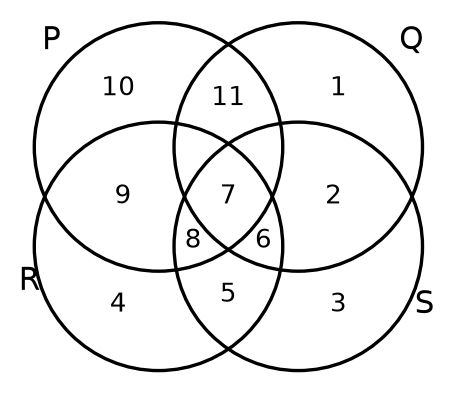
In the above figure, circle P represents hardworking people, circle Q represents intelligent people, circle R represents truthful people, and circle S represents honest people. Which region represents the people who are intelligent, honest and truthful but not hardworking?
Answer (a) & explanation
Region 6 is correct (a). Step 1: we need people who are intelligent (Q), truthful (R) and honest (S) but not hardworking (outside P). So the region must lie inside Q, R and S, and outside P. Step 2: region 7 is inside all four circles, so it includes hardworking people: wrong. Region 8 is inside P: wrong. Region 11 is only in P and Q: wrong. Step 3: region 6 is inside Q, R and S and outside P. So (b), (c) and (d) fail.
Tip: turn the description into 'inside' and 'outside' lists first. Then test each region number against both lists; one wrong circle rules it out.
Answer as per the official UPSC answer key.
The houses of A and B face each other on a road going north-south, A's being on the western side. A comes out of his house, turns left, travels 5 km, turns right, travels 5 km to the front of D's house. B does exactly the same and reaches the front of C's house. In this context, which one of the following statements is correct?
Answer (c) & explanation
Less than 20 km apart is correct (c). Step 1: A lives on the west side, so he faces east when he comes out. Turning left means going north 5 km; turning right then means going east 5 km. So D's house is 5 km north and 5 km east of A. Step 2: B lives on the east side and faces west. Left means south 5 km; right then means west 5 km. So C's house is 5 km south and 5 km west of B. Step 3: C and D are about 10 km apart north–south and roughly 10 km apart east–west, so the straight distance is about 14 km, well under 20 km. (a) and (b) cannot be fixed from the data. So (a), (b) and (d) fail.
Tip: draw it. Mark which way each person faces first; 'left' depends on that.
Answer as per the official UPSC answer key.
Read the following passage and answer the 3 (three) items that follow:
A, B, C, D and E are members of the same family. There are two fathers, two sons, two wives, three males and two females. The teacher was the wife of a lawyer who was the son of a doctor. E is not a male, neither also a wife of a professional. C is the youngest person in the family and D is the eldest. B is a male.
How is D related to E?
Answer (a) & explanation
1. Three generations: doctor → his son the lawyer → the lawyer's child. The eldest, D, is the doctor; the youngest, C, is the grandchild.
2. Two sons means the lawyer and C are both sons, so C is male. With B male, the males are D, the lawyer and C, so the lawyer is B.
3. The two females are then A and E. The teacher is the lawyer's wife, and E is not the wife of a professional, so the teacher is A (B's wife). The other wife, E, is D's wife.
4. So D is E's husband.
The wording "neither also a wife of a professional" is loose; the official answer is (a), as printed.
Answer as per the official UPSC answer key.
(Same information as the question above.)
Who are the females in the group?
Answer (c) & explanation
E and A is correct (c). Step 1: the family has three males and two females, with two fathers, two sons and two wives. Step 2: work out the males. B is male (given). The teacher is the wife of a lawyer, who is the son of a doctor, so there are two professional men, father and son. D is the eldest, so D is the grandfather-doctor; B is his son, the lawyer; and C, the youngest, is B's son. So the males are D, B and C. Step 3: that leaves E and A as the two females. The clue that E is 'not a male' confirms E is one of them. So (a), (b) and (d) fail.
Tip: once you know the males, the rest are females. Solve the clue chain (teacher → lawyer → doctor) first, then use 'eldest' and 'youngest' to place people.
Answer as per the official UPSC answer key.
(Same information as the question above.)
Whose wife is the teacher?
Answer (d) & explanation
B's wife is correct (d). Step 1: the clue says 'The teacher was the wife of a lawyer who was the son of a doctor'. Step 2: from the earlier solution, D is the eldest and the doctor, and B, a male, is his son and the lawyer. Step 3: so the teacher is the wife of B. (a) C is the youngest, a child, not the lawyer. (b) D is the doctor, not the lawyer. (c) A is a female. So (a), (b) and (c) fail.
Tip: in family puzzles, chain the relationship words: teacher → wife of lawyer → lawyer is son of doctor. Each link narrows the field.
Answer as per the official UPSC answer key.
In a survey regarding a proposed measure to be introduced, 2878 persons took part of which 1652 were males. 1226 persons voted against the proposal of which 796 were males. 1425 persons voted for the proposal. 196 females were undecided.
How many females voted for the proposal?
Answer (b) & explanation
600 is correct (b). Step 1: females in the survey = 2,878 − 1,652 = 1,226. Step 2: females who voted against = total against − males against = 1,226 − 796 = 430. Step 3: 196 females were undecided. So females who voted for = 1,226 − 430 − 196 = 600. So (a), (c) and (d) fail.
Tip: build a small table with rows Male/Female and columns For/Against/Undecided. Fill in what is given, and every missing cell comes from simple subtraction.
Answer as per the official UPSC answer key.
(Same information as the question above.)
How many males were undecided?
Answer (a) & explanation
31 is correct (a). Step 1: everyone who was undecided = total − against − for = 2,878 − 1,226 − 1,425 = 227. Step 2: 196 of the undecided were females. Step 3: so undecided males = 227 − 196 = 31. Check with the male row: males for = 1,425 − 600 = 825; 825 + 796 + 31 = 1,652. It matches. So (b), (c) and (d) fail.
Tip: always check your answer with a second route through the table. If the row and column totals agree, you are right.
Answer as per the official UPSC answer key.
(Same information as the question above.)
How many females were not in favour of the proposal?
Answer (a) & explanation
430 is correct (a). Step 1: 'not in favour' here means those who voted against, as UPSC's key takes it. Step 2: females against = total against − males against = 1,226 − 796 = 430. Step 3: if you also added the 196 undecided females, you would get 626, which is not an option, confirming the intended reading. (b), (c) and (d) do not match. So (b), (c) and (d) fail.
Tip: when a phrase is ambiguous ('not in favour' could include undecided), check which reading gives an option. The options often tell you the intended meaning.
Answer as per the official UPSC answer key.