
Urbanisation in India: Census Definitions, Trends, Causes, Problems, 74th Amendment, Urban Missions and Way Forward (UPSC Notes + PYQs)
UPSC has already asked about this. Read the story with these questions in mind.
How India defines “urban”
The Census uses two categories. Statutory towns have a municipal body (corporation, municipality, cantonment, notified area). Census towns are places without such a body that meet three tests: population of at least 5,000, density of at least 400 per sq km, and at least 75% of male main workers outside agriculture. In 2011 there were 4,041 statutory and 3,892 census towns. The jump in census towns (from 1,362 in 2001) shows “hidden” urbanisation that local government has not caught up with. Many experts, and the World Bank’s agglomeration index, suggest India is far more urban than official figures show.
- Has a municipal body
- Notified by State law
- Number in 2011: 4,041
- No municipal body; governed as a village
- Meets Census tests (5,000 people, 400/sq km, 75% non-farm male workers)
- Number in 2011: 3,892
Trends
| Census | Urban share | Urban population |
|---|---|---|
| 1951 | 17.3% | 6.2 crore |
| 1981 | 23.3% | 15.9 crore |
| 2001 | 27.8% | 28.6 crore |
| 2011 | 31.1% | 37.7 crore |
2011 was the first census in which the urban population grew by more people than the rural. There were 53 million-plus cities. Tamil Nadu, Kerala and Maharashtra are among the most urbanised large States; Himachal Pradesh and Bihar the least. Goa had the highest urban share among States (62%).
Causes
- Natural increase in towns: the largest single source of urban growth.
- Rural-urban migration: push (farm distress, small holdings) and pull (jobs, education, health).
- Reclassification: villages becoming census towns; city limits expanding.
- Growth of services and construction; industrial corridors.
Problems
- Slums: 6.5 crore people lived in slums in 2011, about one in six urban residents.
- Urban floods: Mumbai 2005, Chennai 2015, Bengaluru 2022, Delhi 2023, caused by building on wetlands and drains.
- Water and waste: unequal supply, untreated sewage, landfills like Ghazipur.
- Air pollution and heat islands.
- Transport: congestion, few buses per lakh people.
- Informal jobs and the exclusion of migrants, seen in the 2020 lockdown exodus.
- Weak municipal finances: own revenue of urban local bodies is well under 1% of GDP; property tax collection is low.
- Lakes and wetlands built over
- Choked and undersized drains
- Concrete surfaces stop absorption
- Heavier, short bursts of rain
- Encroached floodplains
The 74th Amendment
The 74th Amendment (1992) added Part IXA (Articles 243P to 243ZG) and the Twelfth Schedule with 18 functions, including urban planning, water supply, slum improvement and fire services. It provided for municipal corporations, municipal councils and nagar panchayats; ward committees for cities over three lakh; one-third seats for women; State Finance Commissions; and District Planning Committees (243ZD) and Metropolitan Planning Committees (243ZE). But States have devolved little: in most cities the mayor has a short term and limited power, and parastatals (development authorities, water boards) do the real work.
Urban missions
| Mission (year) | Focus |
|---|---|
| JNNURM (2005) | Infrastructure and services to the poor, tied to reforms |
| Smart Cities Mission (June 2015) | 100 cities; area-based development, Integrated Command and Control Centres |
| AMRUT (2015), AMRUT 2.0 (2021) | Water supply, sewerage; 2.0 aims at water-secure cities |
| PMAY-Urban (2015), PMAY-U 2.0 (2024) | Affordable housing |
| Swachh Bharat Mission-Urban (2014), SBM-U 2.0 (2021) | Sanitation, garbage-free cities |
| PM SVANidhi (2020) | Working capital loans for street vendors |
Way forward
Empower mayors and ward committees; give cities stable revenue through property tax reform, municipal bonds (Pune, Ahmedabad and others have issued them) and land value capture; plan for whole metropolitan regions; protect lakes, wetlands and floodplains; invest in buses and walking; provide rental housing for migrants (Affordable Rental Housing Complexes); and update the urban definition so that census towns get urban governance. The NITI Aayog report on urban planning capacity (2021) noted that 65% of the 7,933 towns had no master plan.
Census towns and hidden urbanisation
Census 2011 counted 3,894 census towns: settlements that meet the urban criteria (population of 5,000, density of 400 per sq km, 75% of male workers outside farming) but are still governed as villages by gram panchayats. They have urban densities without urban services such as sewerage, drainage or planning. Satellite studies and the European Commission’s degree of urbanisation method suggest that India may be over 50% urban if such places are counted. The World Bank called this “messy and hidden” urbanisation. Reclassifying them as statutory towns would bring urban funds, but also property taxes and building rules, which many residents resist.
Urban local body finances
Indian cities raise very little: municipal revenue is under 1% of GDP, against 4-6% in Brazil or South Africa. Property tax is under-assessed, and few cities have tried municipal bonds, which Pune, Indore and Lucknow used after 2017.
PYQ trend
Mains GS-I asks urbanisation nearly every year: segregation of the poor in metros (2023), why big cities attract more migrants (2024), smart cities and urban poverty (2025), caste in urban India (2026). GS-II asked about States’ reluctance to empower urban local bodies (2023); GS-III about urban floods (2024). Prelims asked UN-Habitat (2017).
Urbanisation: UPSC angle
For UPSC CSE
Mains GS-I: urbanisation, its problems and remedies (direct syllabus line). GS-II: urban local bodies. GS-III: infrastructure, urban floods.
Urbanisation UPSC PYQs (Prelims)
Questions UPSC has actually asked, from the official papers. Pick an option to check yourself.
With reference to the role of UN-Habitat in the United Nations programme working towards a better urban future, which of the statements is/are correct ?
– 1. UN-Habitat has been mandated by the United Nations General Assembly to promote socially and environmentally sustainable towns and cities to provide adequate shelter for all.
– 2. Its partners are either governments or local urban authorities only.
– 3. UN-Habitat contributes to the overall objective of the United Nations system to reduce poverty and to promote access to safe drinking water and basic sanitation.
Select the correct answer using the code given below :
UN-Habitat (Nairobi) has a General Assembly mandate for sustainable towns and cities and adequate shelter for all. It also supports the UN’s work on poverty, water and sanitation. Its partners include NGOs, academia, the private sector and community groups as well as governments. Answer as per the official UPSC key · Battle IAS PYQ bankAnswer (b) & why
Mains PYQs on this topic
Questions from the official UPSC Mains papers (2023-2026 in the Battle IAS Mains bank), newest first. Each links to a model answer.
- UPSC Mains 2026 · GS Paper I · Q18 · 15 marks
Is caste disappearing in urban India? Illustrate your answer with examples.
- UPSC Mains 2025 · GS Paper I · Q8 · 10 marks
How does smart city in India, address the issues of urban poverty and distributive justice?
- UPSC Mains 2024 · GS Paper I · Q5 · 10 marks
Why do large cities tend to attract more migrants than smaller towns? Discuss in the light of conditions in developing countries.
- UPSC Mains 2024 · GS Paper II · Q5 · 10 marks
Analyse the role of local bodies in providing good governance at local level and bring out the pros and cons merging the rural local bodies with the urban local bodies.
- UPSC Mains 2024 · GS Paper III · Q18 · 15 marks
Flooding in urban areas is an emerging climate-induced disaster. Discuss the causes of this disaster. Mention the features of two such major floods in the last two decades in India. Describe the policies and frameworks in India that aim at tackling such floods.
- UPSC Mains 2023 · GS Paper I · Q18 · 15 marks
Does urbanization lead to more segregation and/or marginalization of the poor in Indian metropolises?
- UPSC Mains 2023 · GS Paper II · Q3 · 10 marks
“The states in India seem reluctant to empower urban local bodies both functionally as well as financially.” Comment.
Quick quiz
A census town must have at least
Plus density and work tests.Answer (b)
The Twelfth Schedule contains
Added by the 74th Amendment.Answer (b)
Which article deals with Metropolitan Planning Committees?
243ZD is District Planning Committees.Answer (b)
FAQs
What share of India is urban?
31.1% as per Census 2011; estimates for today are higher, around 35-36%.
What is a census town?
A settlement without a municipal body that meets Census tests on population, density and non-farm work.
What is the biggest source of urban growth?
Natural increase, followed by reclassification and migration.
What does the 74th Amendment provide?
Constitutional status for urban local bodies, regular elections, reservation, ward committees and planning committees.
Why are municipal finances weak?
Low property tax collection, dependence on State grants and limited powers to tax.
What is the Smart Cities Mission?
A 2015 mission to develop 100 cities through area-based projects and technology-led services.
Spotted an error? Tell us. We correct within 48 hours.
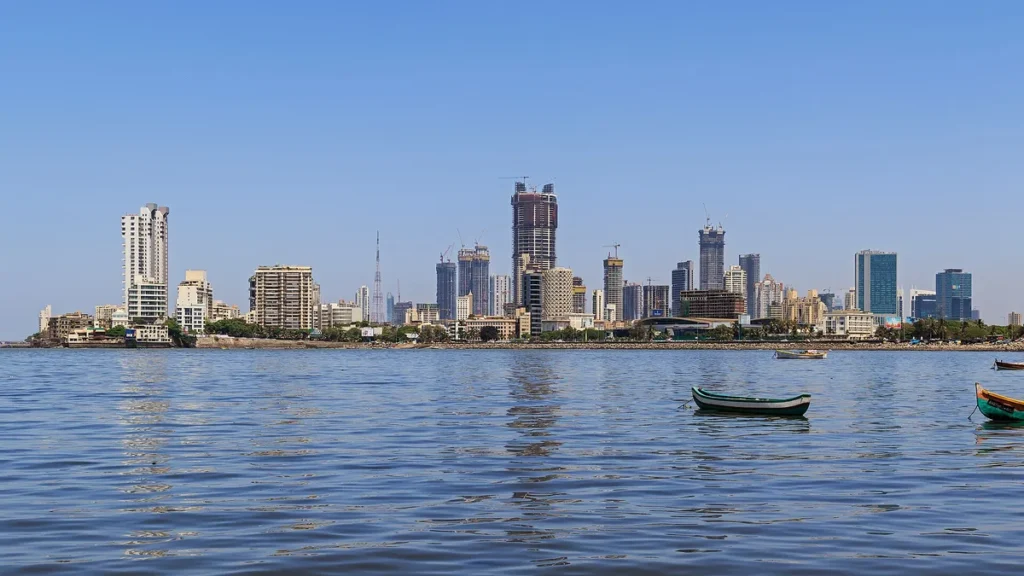
Image: A.Savin, Wikimedia Commons, FAL
How to use this in Mains
If asked: Discuss the major problems of urbanisation in India and suggest solutions. (GS-I)
Quote: “Urban floods: Mumbai 2005, Chennai 2015, Bengaluru 2022, Delhi 2023, caused by building on wetlands and drains.”
Use it: Ready examples for the problems section.
In the news

CAQM flying squads find 17 road-dust violations along Delhi’s Ring Road
On 3 October 2026 four CAQM flying squads inspected 25 stretches, about 35 km, of Delhi's Inner and Outer Ring Road managed by PWD. They found 17 violations of heavy visible road dust and construction and demolition waste. CAQM directed agencies to clean roads regularly to stop traffic from lifting dust back into the air.
4 Oct 2026
Domestic Tourism Expenditure Survey 2025-26: pilgrimage tops overnight trips
MoSPI released the Domestic Tourism Expenditure Survey, July 2025 to June 2026, on 23 September 2026. Pilgrimage and religious travel made up 48% of overnight trips over the last 365 days. Uttar Pradesh had the highest share of visitor-trips, 15.7%. Business trips had the highest average spend per trip, Rs. 5,949.
23 Sep 2026
Varuna Elevated Corridor: ₹10,998-crore, 43.2-km road project for Varanasi
The Varuna Elevated Corridor, approved by the Union Cabinet in July 2026, is a ₹10,998-crore, 43.218-km road along the Varuna river in Varanasi. It will link NH-31 with the Varanasi Ring Road. NHAI will build it, with a cable-stayed bridge. Travel time from NH-31 to Kashi Railway Station should fall from about 40 to 20 minutes.
15 Sep 2026
PM SVANidhi restructured: lending extended to 2030, 1.15 crore vendors targeted
PM SVANidhi, the collateral-free loan scheme for urban street vendors launched on 1 June 2020, completed one year of its restructured phase on 27 August 2026. Lending now runs till 31 March 2030 for 1.15 crore vendors. In the first year, 21.86 lakh loans worth ₹6,294 crore went to 10.56 lakh new beneficiaries.
27 Aug 2026