
Time, speed and distance; trains, boats and streams; races: previous-year questions
46 real UPSC Prelims questions (2011–2026) with the official answer and a clear explanation. 16 of them came in the last five papers.
How often UPSC asks this
Questions per year, counted from the official papers.
Attempt the questions
Newest papers first. Tap an option; the answer and the reason appear instantly.
A train travels at a certain average speed for a distance of 63 km and then travels a distance of 72 km at an average speed of 6 km/hr more than its original speed. If it takes 3 hours to complete the total journey, what is the original speed of the train in km/hr?
Answer (c) & explanation
42 km/hr is correct (c). Step 1: let the speed be v. Time for 63 km = 63/v; time for 72 km = 72/(v + 6). Total = 3 hours. Step 2: solving the quadratic is slow, so test the options. v = 42: 63/42 = 1.5 hours and 72/48 = 1.5 hours. Total = 3 hours. It fits. Step 3: v = 24 gives 2.6 + 2.4 = 5 hours; v = 33 gives about 1.9 + 1.85 = 3.75 hours; v = 66 gives about 0.95 + 1 = 1.95 hours. So (a), (b) and (d) fail.
Tip: in CSAT, plugging options back in is often quicker than algebra. Start with a number that divides evenly (63 and 42 share 21).
Answer as per the official UPSC answer key.
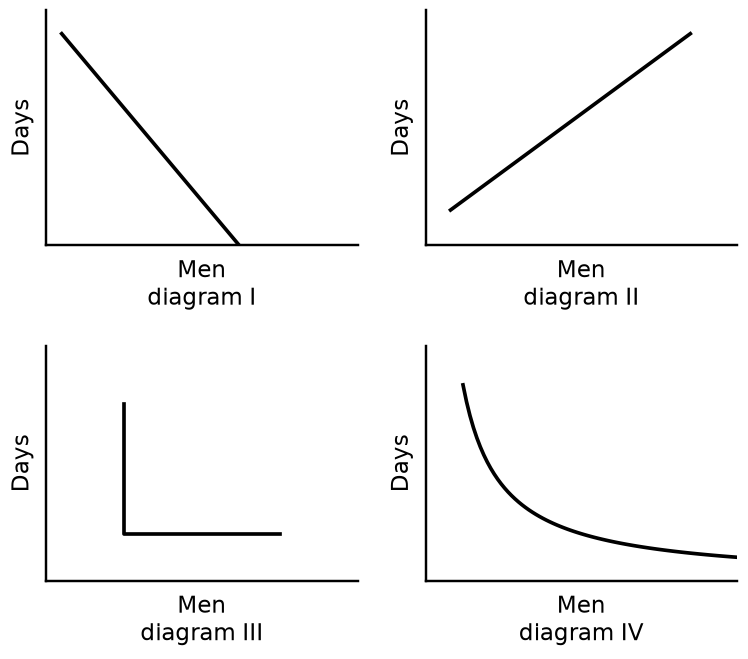
Consider the following diagrams:
x men, working at constant speed, do a certain job in y days. Which one of these diagrams shows the relation between x and y?
Answer (d) & explanation
Diagram IV is correct (d). Step 1: the job is fixed, so men × days = constant. More men finish the job in fewer days: double the men, half the days. This is inverse proportion. Step 2: on a graph, inverse proportion is a smooth curve that falls steeply at first and then more slowly, but never reaches zero. Step 3: diagram I hits zero days, which is impossible. Diagram II rises, which is the wrong direction. Diagram III has a sharp corner, which does not fit a steady rule. Diagram IV shows the smooth falling curve. So (a), (b) and (c) fail.
Tip: xy = constant always gives a smooth curve (a hyperbola) that approaches but never touches the axes.
Answer as per the official UPSC answer key.
In a garrison, there was food for 1000 soldiers for one month. After 10 days, 1000 more soldiers joined the garrison. How long would the soldiers be able to carry on with the remaining food?
Answer (d) & explanation
10 days is correct (d). Step 1: taking a month as 30 days, food is for 1,000 soldiers × 30 days. After 10 days, food is left for 1,000 soldiers for 20 days. Step 2: now 2,000 soldiers share it. Double the soldiers, half the time: 20 ÷ 2 = 10 days. Step 3: (b) 20 days ignores the new soldiers; (a) and (c) do not fit the numbers. So (a), (b) and (c) fail. Note: the answer assumes a 30-day month, the usual convention in such questions.
Tip: think in 'soldier-days': total food = soldiers × days. What is left (1,000 × 20 = 20,000 soldier-days) divided by the new number of soldiers (2,000) gives the days.
Answer as per the official UPSC answer key.
A person can walk a certain distance and drive back in six hours. He can also walk both ways in 10 hours. How much time will he take to drive both ways?
Answer (a) & explanation
2 hours is correct (a). Step 1: walking both ways takes 10 hours, so one walk takes 5 hours. Step 2: walking one way and driving back takes 6 hours, so one drive takes 6 − 5 = 1 hour. Step 3: driving both ways takes 1 + 1 = 2 hours. So (b), (c) and (d) fail.
Tip: break 'both ways' into one-way trips and use the information that has the same activity twice (walking both ways) to find one unit first. Then the mixed trip gives the other unit. A shortcut: drive both ways = 2 × (walk + drive) − (walk both ways) = 12 − 10 = 2 hours.
Answer as per the official UPSC answer key.
Mr. Kumar drives to work at an average speed of 48 km/h. The time taken to cover the first 60% of the distance is 10 minutes more than the time taken to cover the remaining distance. How far is his office?
Answer (b) & explanation
40 km is correct (b). Step 1: the speed is the same all the way, so time depends only on distance. The first part is 60% of the distance and the rest is 40%. The 10-minute gap comes from the extra 20% of the distance. Step 2: in 10 minutes at 48 km/h he covers 48 × 10/60 = 8 km. So 20% of the distance = 8 km. Step 3: the full distance = 8 × 5 = 40 km. Check: 24 km takes 30 min, 16 km takes 20 min, a 10-minute gap. So (a), (c) and (d) fail.
Tip: at a constant speed, a time difference equals a distance difference. Turn minutes into km first and the rest is simple percentage.
Answer as per the official UPSC answer key.
If a bus travels 160 km in 4 hours and a train travels 320 km in 5 hours at uniform speeds, then what is the ratio of the distances travelled by them in one hour?
Answer (b) & explanation
5 : 8 is correct (b). Step 1: the bus covers 160 km in 4 hours, so in one hour it covers 160 ÷ 4 = 40 km. Step 2: the train covers 320 km in 5 hours, so in one hour it covers 320 ÷ 5 = 64 km. Step 3: the ratio is 40 : 64. Divide both by 8: 5 : 8. (a) reverses the order, a common trap. So (a), (c) and (d) fail.
Tip: always keep the ratio in the order the question asks (bus first, train second). Reversed answers are always among the options.
Answer as per the official UPSC answer key.