
Time, speed and distance; trains, boats and streams; races: previous-year questions
46 real UPSC Prelims questions (2011–2026) with the official answer and a clear explanation. 16 of them came in the last five papers.
How often UPSC asks this
Questions per year, counted from the official papers.
Attempt the questions
Newest papers first. Tap an option; the answer and the reason appear instantly.
A man takes half time in rowing a certain distance downstream than upstream. What is the ratio of the speed in still water to the speed of current?
Answer (d) & explanation
The ratio of speed in still water to current is 3 : 1 (d). Step 1: the same distance takes half the time downstream, so the downstream speed is double the upstream speed. Step 2: let the boat's speed be b and the current c. Downstream = b + c; upstream = b − c. So b + c = 2(b − c). Step 3: this gives b + c = 2b − 2c, so b = 3c. Ratio = 3 : 1. Option (b), 2 : 1, is the ratio of the speeds, not of boat to current. Options (a) and (c) fail.
Tip: downstream adds the current, upstream subtracts it. Half the time means double the speed for the same distance.
Answer as per the official UPSC answer key.
A frog tries to come out of a dried well 4·5 m deep with slippery walls. Every time the frog jumps 30 cm, slides down 15 cm. What is the number of jumps required for the frog to come out of the well?
Answer (b) & explanation
The frog needs 29 jumps (b). Step 1: each jump gives a net gain of 30 − 15 = 15 cm. But on the last jump, the frog gets out and does not slide back. Step 2: so before its final jump, the frog must reach 450 − 30 = 420 cm. That takes 420 ÷ 15 = 28 jumps. Step 3: one more jump of 30 cm takes it out: 28 + 1 = 29. Option (c), 30, uses 450 ÷ 15 without the last-jump rule. Options (a) and (d) fail.
Tip: in climbing puzzles, subtract the final full jump from the height first. Then divide the rest by the net gain, and add 1.
450/15 = 30 ignores the last jump, after which it does not slide back.
One trap spotted is one mark saved. The PYQ Book lines up every trap UPSC has set, so you walk in prepared. Try the free sample
Answer as per the official UPSC answer key.
X, Y and Z are three contestants in a race of 1000 m. Assume that all run with different uniform speeds. X gives Y a start of 40 m and X gives Z a start of 64 m. If Y and Z were to compete in a race of 1000 m, how many metres start will Y give to Z?
Answer (b) & explanation
Y will give Z a start of 25 m (b). Step 1: X gives Y a 40 m start, so while X runs 1000 m, Y runs 960 m. X gives Z a 64 m start, so in the same time Z runs 936 m. Step 2: so Z : Y = 936 : 960 = 39 : 40. Step 3: when Y runs 1000 m, Z runs 1000 × 39/40 = 975 m. So Y can give Z a start of 1000 − 975 = 25 m. Options (a), (c) and (d) do not fit.
Tip: do not just subtract the two starts (64 − 40 = 24). Speeds are in ratio, so rescale to the new race length.
64 – 40 = 24 is close but wrong. The base is Y's 960 m, not 1000 m.
Answer as per the official UPSC answer key.
A train 200 metres long is moving at the rate of 40 kmph. In how many seconds will it cross a man standing near the railway line?
Answer (d) & explanation
The train takes 18 seconds (d). Step 1: change the speed to metres per second. 40 km/hr × 5/18 = 100/9 m/s, about 11.1 m/s. Step 2: to pass a man standing still, the train only needs to cover its own length, 200 m. Step 3: time = 200 ÷ (100/9) = 200 × 9/100 = 18 seconds. Option (a), 12, option (b), 15, and option (c), 16, come from errors in changing the units.
Tip: to change km/hr to m/s, multiply by 5/18. A person or a pole counts as having no length. For a platform or bridge, add its length to the train's length.
Answer as per the official UPSC answer key.
Two persons, A and B are running on a circular track. At the start, B is ahead of A and their positions make an angle of 30° at the centre of the circle. When A reaches the point diametrically opposite to his starting point, he meets B. What is the ratio of speeds of A and B, if they are running with uniform speeds?
Answer (a) & explanation
The ratio of speeds is 6 : 5 (a). Step 1: A runs to the point diametrically opposite his start. That is half the circle, 180°. Step 2: B started 30° ahead of A. To meet A at the same point, B covers only 180° − 30° = 150° in the same time. Step 3: in equal time, speeds are in the ratio of distances: 180 : 150 = 6 : 5. Option (c), 6 : 1, compares 180 with 30. Options (b) and (d) do not fit.
Tip: on circular tracks, angles can stand for distances. Compare the angles each runner covers in the same time to get their speed ratio.
180 : 30 = 6 : 1 compares A with the head start, not with B's run.
Answer as per the official UPSC answer key.
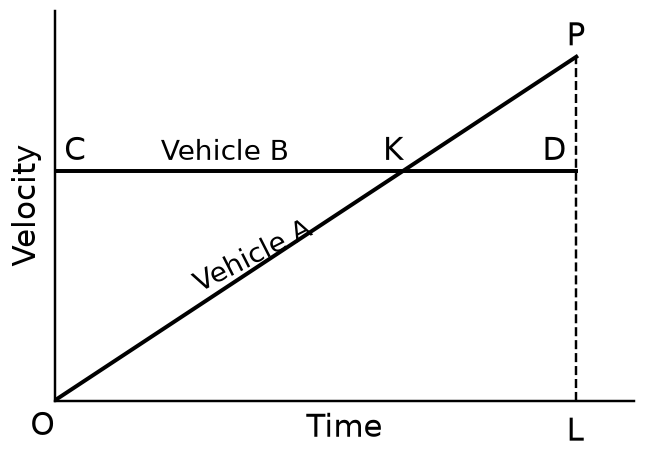
The figure drawn below gives the velocity graphs of two vehicles A and B. The straight line OKP represents the velocity of vehicle A at any instant, whereas the horizontal straight line CKD represents the velocity of vehicle B at any instant. In the figure, D is the point where perpendicular from P meets the horizontal line CKD such that PD = ½ LD :
What is the ratio between the distances covered by vehicles A and B in the time interval OL?
Answer (c) & explanation
The ratio of distances is 3 : 4 (c). Step 1: on a speed–time graph, distance = the area under the line. Let LD = 2 units, so PD = 1 and PL = 3. Let the time OL = 1 unit. Step 2: B moves at a steady speed of 2. Its area is a rectangle: 1 × 2 = 2. Step 3: A starts at 0 and speeds up evenly to 3. Its area is a triangle: ½ × 1 × 3 = 1.5. So A : B = 1.5 : 2 = 3 : 4. Option (d), 1 : 1, wrongly assumes equal distances because the lines cross at K. Options (a) and (b) do not fit.
Tip: on speed graphs, compare areas, not the heights of the lines.
Answer as per the official UPSC answer key.
There are three pillars X, Y and Z of different heights. Three spiders A, B and C start to climb on these pillars simultaneously. In one chance, A climbs on X by 6 cm but slips down 1 cm. B climbs on Y by 7 cm but slips down 3 cm. C climbs on Z by 6·5 cm but slips down 2 cm. If each of them requires 40 chances to reach the top of the pillars, what is the height of the shortest pillar?
Answer (b) & explanation
The shortest pillar is 163 cm (b). Step 1: in the last chance, each spider reaches the top and does not slip. So height = 39 × (net gain per chance) + one full climb. Step 2: A on X gains 6 − 1 = 5 per chance: 39 × 5 + 6 = 201 cm. B on Y gains 7 − 3 = 4: 39 × 4 + 7 = 163 cm. C on Z gains 6.5 − 2 = 4.5: 39 × 4.5 + 6.5 = 182 cm. Step 3: the shortest is 163 cm. Option (c), 182, is Z. Option (a), 161, and option (d), 210, are errors from counting slips in the 40th chance.
Tip: in climb-and-slip puzzles, the final climb has no slip. Count it separately.
40 × 4 = 160 forgets the last climb, which has no slip.
Answer as per the official UPSC answer key.
A freight train left Delhi for Mumbai at an average speed of 40 km/hr. Two hours later, an express train left Delhi for Mumbai, following the freight train on a parallel track at an average speed of 60 km/hr. How far from Delhi would the express train meet the freight train?
Answer (c) & explanation
The express meets the freight train 240 km from Delhi (c). Step 1: the freight train has a 2-hour start at 40 km/hr. Its lead = 2 × 40 = 80 km. Step 2: the express is faster by 60 − 40 = 20 km/hr. This is the relative speed. The gap closes in 80 ÷ 20 = 4 hours. Step 3: in 4 hours the express covers 4 × 60 = 240 km. Check: the freight train has run 6 hours × 40 = 240 km. Option (d), 120 km, is the express's distance in 2 hours. Options (a) and (b) do not fit.
Tip: when one vehicle chases another in the same direction, subtract the speeds. The chase time = lead ÷ difference in speed.
Answer as per the official UPSC answer key.
P works thrice as fast as Q, whereas P and Q together can work four times as fast as R. If P, Q and R together work on a job, in what ratio should they share the earnings?
Answer (a) & explanation
They should share in the ratio 3 : 1 : 1 (a). Step 1: P works three times as fast as Q. Take Q's rate as 1, so P's rate is 3. Step 2: P and Q together work four times as fast as R. P + Q = 3 + 1 = 4, so 4 = 4 × R, which gives R = 1. Step 3: earnings are shared by the amount of work done, which follows the rates. So P : Q : R = 3 : 1 : 1. Option (d), 3 : 1 : 4, treats R as 4. Options (b) and (c) do not fit.
Tip: when people work for the same time, share pay in the ratio of their speeds. Set the slowest person's speed as 1 to keep numbers simple.
Answer as per the official UPSC answer key.
A daily train is to be introduced between station A and station B starting from each end at 6 AM and the journey is to be completed in 42 hours. What is the number of trains needed in order to maintain the shuttle service ?
Answer (c) & explanation
1. Day 1, 6 AM: one train leaves A and one leaves B. That is 2 trains.
2. 42 hours = 1 day and 18 hours, so these trains arrive at midnight at the end of Day 2. On Day 2 at 6 AM they are still running, so 2 more trains are needed.
3. Day 3, 6 AM: the Day 1 trains have arrived and can go back. No new train is needed after this.
4. Total = 4 trains.
Answer as per the official UPSC answer key.
Ram and Shyam work on a job together for four days and complete 60% of it. Ram takes leave then and Shyam works for eight more days to complete the job. How long would Ram take to complete the entire job alone?
Answer (c) & explanation
Ram alone would take 10 days (c). Step 1: together, 60% in 4 days means 15% per day together. Step 2: Shyam alone finishes the last 40% in 8 days, so Shyam does 5% per day. Step 3: Ram's rate = 15% − 5% = 10% per day. The whole job takes Ram 100 ÷ 10 = 10 days. Option (a), 6 days, and option (b), 8 days, are too fast. Option (d), 11 days, is too slow.
Tip: turn work into "percent per day" or "units per day". Rates add when people work together, so you can subtract to find one person's rate. Check: Ram and Shyam do 10% + 5% = 15% a day, which matches.
Answer as per the official UPSC answer key.
A and B walk around a circular park. They start at 8 a.m. from the same point in the opposite directions. A and B walk at a speed of 2 rounds per hour and 3 rounds per hour respectively. How many times shall they cross each other after 8.00 a.m. and before 9.30 a.m.?
Answer (a) & explanation
They cross each other 7 times (a). Step 1: they walk in opposite directions, so their speeds add: 2 + 3 = 5 rounds per hour. Together they cover one full round every 60 ÷ 5 = 12 minutes. So they meet every 12 minutes. Step 2: from 8:00 to 9:30 is 90 minutes. They meet at 8:12, 8:24, 8:36, 8:48, 9:00, 9:12 and 9:24. Step 3: the next meeting is at 9:36, which is too late. So they cross 7 times. Option (b), 6, misses one. Option (c), 5, uses 1 hour. Option (d), 8, counts 9:36.
Tip: in circular tracks, opposite directions add speeds and the same direction subtracts them.
Answer as per the official UPSC answer key.
W can do 25% of a work in 30 days, X can do 1/4 of the work in 10 days, Y can do 40% of the work in 40 days and Z can do 1/3 of the work in 13 days. Who will complete the work first?
Answer (d) & explanation
Z will finish first (d). Step 1: work out each person's time for the whole job. W does 25% in 30 days, so the whole job takes 4 × 30 = 120 days. X does 1/4 in 10 days, so 40 days. Step 2: Y does 40% in 40 days, so 40 ÷ 0.4 = 100 days. Z does 1/3 in 13 days, so 3 × 13 = 39 days. Step 3: the shortest time is Z's 39 days. Option (b), X, is close at 40 days but slower. Options (a) W and (c) Y are much slower.
Tip: put everyone on the same base, the full job, before comparing. Close numbers like 39 and 40 are the setter's trap.
X looks fastest at a glance. Z's 1/3 in 13 days is just quicker.
Answer as per the official UPSC answer key.
In a race, a competitor has to collect 6 apples which are kept in a straight line on a track and a bucket is placed at the beginning of the track which is a starting point. The condition is that the competitor can pick only one apple at a time, run back with it and drop it in the bucket. If he has to drop all the apples in the bucket, how much total distance he has to run if the bucket is 5 meters from the first apple and all other apples are placed 3 meters apart?
Answer (d) & explanation
He runs 150 m in total (d). Step 1: the first apple is 5 m from the bucket, and each next one is 3 m further. So the apples are at 5, 8, 11, 14, 17 and 20 m. Step 2: add them: 5 + 8 + 11 + 14 + 17 + 20 = 75 m. Step 3: for each apple, he runs out and back, so each trip is doubled. Total = 2 × 75 = 150 m. Option (c), 75 m, is the trap: it counts only one way. Options (a) and (b) do not fit.
Tip: in "pick and return" problems, every trip is a round trip. For evenly spaced items, the sum = number × (first + last) ÷ 2 = 6 × 25 ÷ 2 = 75.
75 m counts only one way.
Answer as per the official UPSC answer key.
Two pipes A and B can independently fill a tank completely in 20 and 30 minutes respectively. If both the pipes are opened simultaneously, how much time will they take to fill the tank completely?
Answer (b) & explanation
Together they fill the tank in 12 minutes (b). Step 1: pick a tank size that both times divide into: the LCM of 20 and 30 is 60 units. Step 2: pipe A fills 60 ÷ 20 = 3 units a minute. Pipe B fills 60 ÷ 30 = 2 units a minute. Step 3: together they fill 3 + 2 = 5 units a minute. Time = 60 ÷ 5 = 12 minutes. Options (a) and (c) do not fit the rates. Option (d), 25 minutes, is the trap: the plain average of 20 and 30.
Tip: when two pipes work together, the time is always less than the faster pipe alone (here less than 20). That alone rules out (d).
25 minutes is the average of 20 and 30. Two pipes must be faster than either alone.
Answer as per the official UPSC answer key.
Two cities A and B are 360 km apart. A car goes from A to B with a speed of 40 km/hr and returns to A with a speed of 60 km/hr. What is the average speed of the car ?
Answer (b) & explanation
The average speed is 48 km/hr (b). Step 1: going from A to B at 40 km/hr takes 360 ÷ 40 = 9 hours. Step 2: coming back at 60 km/hr takes 360 ÷ 60 = 6 hours. Step 3: total distance = 360 + 360 = 720 km. Total time = 9 + 6 = 15 hours. Average speed = 720 ÷ 15 = 48 km/hr. Option (c), 50 km/hr, is the trap: the simple average of 40 and 60. Options (a) and (d) are wrong.
Tip: average speed = total distance ÷ total time, never the simple average of speeds. For equal distances, a shortcut is 2 × a × b ÷ (a + b) = 2 × 40 × 60 ÷ 100 = 48.
50 km/hr is the plain average of 40 and 60. The car spends more time at the slower speed, so the true average is lower.
Answer as per the official UPSC answer key.
In a 500 metres race, B starts 45 metres ahead of A, but A wins the race while B is still 35 metres behind. What is the ratio of the speeds of A to B assuming that both start at the same time?
Answer (a) & explanation
The speed ratio of A to B is 25 : 21 (a). Step 1: A runs the full 500 m. Step 2: B starts 45 m ahead, so B has only 455 m to run. When A finishes, B is still 35 m short. So B has run 455 − 35 = 420 m. Step 3: in the same time, A ran 500 m and B ran 420 m. Speed ratio = 500 : 420. Divide both by 20: 25 : 21. Options (b), (c) and (d) do not match.
Tip: when two runners run for the same time, their speeds are in the same ratio as their distances. Work out exactly how far each actually ran.
500 : 400 (= 25 : 20) forgets one of the two gaps.
Answer as per the official UPSC answer key.
A worker reaches his factory 3 minutes late if his speed from his house to the factory is 5 km/hr. If he walks at a speed of 6 km/hr, then he reaches the factory 7 minutes early. The distance of the factory from his house is
Answer (c) & explanation
The factory is 5 km away (c). Step 1: at 5 km/hr he is 3 minutes late; at 6 km/hr he is 7 minutes early. So the two journey times differ by 3 + 7 = 10 minutes, which is 1/6 hour. Step 2: time = distance ÷ speed. Distance ÷ 5 − distance ÷ 6 = 1/6. Step 3: distance ÷ 5 − distance ÷ 6 = distance ÷ 30. So distance ÷ 30 = 1/6, and distance = 5 km. Check: 5 km takes 60 minutes at 5 km/hr and 50 minutes at 6 km/hr, a 10-minute gap. Options (a), (b) and (d) fail the check.
Tip: "late" and "early" times add to give the gap between the two journeys.
the gap is 3 + 7, not 7 – 3. One trip is late and the other early.
Answer as per the official UPSC answer key.
Two cars start towards each other, from two places A and B which are at a distance of 160 km. They start at the same time 08 : 10 AM. If the speeds of the cars are 50 km and 30 km per hour respectively, they will meet each other at
Answer (a) & explanation
They meet at 10:10 AM (a). Step 1: the cars move towards each other, so their speeds add: 50 + 30 = 80 km/hr. This is how fast the gap between them closes. Step 2: time to close the 160 km gap = 160 ÷ 80 = 2 hours. Step 3: they start at 8:10 AM, so they meet at 8:10 + 2 hours = 10:10 AM. Options (b), (c) and (d) use the wrong speed or wrong start time.
Tip: moving towards each other: add speeds. Moving in the same direction: subtract speeds. Then time = distance ÷ that combined speed.
Answer as per the official UPSC answer key.
A thief running at 8 km/hr is chased by a policeman whose speed is 10 km/hr. If the thief is 100 m ahead of the policeman, then the time required for the policeman to catch the thief will be
Answer (b) & explanation
3 minutes is correct (b). Step 1: both are running the same way, so the policeman gains on the thief at the relative speed: 10 − 8 = 2 km/hr. Step 2: the gap is 100 m = 0.1 km. Step 3: time = 0.1 ÷ 2 = 1/20 hour = 60/20 = 3 minutes. So (a), (c) and (d) fail.
Tip: when two things move in the same direction, subtract their speeds; when they move towards each other, add them. Then convert units carefully: metres to km and hours to minutes. A quick check: at 2 km/hr, the policeman gains about 33 m per minute, so 100 m takes 3 minutes.
Answer as per the official UPSC answer key.