
Arrangements, ranking, ordering and puzzles: previous-year questions
141 real UPSC Prelims questions (2011–2026) with the official answer and a clear explanation. 35 of them came in the last five papers.
How often UPSC asks this
Questions per year, counted from the official papers.
Attempt the questions
Newest papers first. Tap an option; the answer and the reason appear instantly.
If A runs less fast than B, and B runs as fast but not faster than C; then, as compared to A, C runs
Answer (b) & explanation
C runs faster than A (b). Step 1: "A runs less fast than B" means A < B. Step 2: "B runs as fast but not faster than C" means B = C. Step 3: so A < B = C, which means A < C. C is faster than A. Option (a) is the reverse. Option (c) is wrong: A is slower than B, so it cannot equal C. Option (d) is wrong: the data are enough.
Tip: turn wordy comparisons into simple symbols (<, =, >). "As fast but not faster" is a roundabout way of saying "equal". Once written as A < B = C, the answer is immediate.
Answer as per the official UPSC answer key.
Consider that :
- 1. A is taller than B.
- 2. C is taller than A.
- 3. D is taller than C.
- 4. E is the tallest of all.
If they are made to sit in the above order of their height, who will occupy the mid position ?
Answer (c) & explanation
C sits in the middle (c). Step 1: write the order from the clues. A is taller than B, so A > B. C is taller than A, so C > A. D is taller than C, so D > C. E is the tallest of all. Step 2: full order from tallest to shortest: E, D, C, A, B. Step 3: five people means the middle seat is the 3rd. Counting from either end, the 3rd is C. Options (a), (b) and (d) are 4th, 5th and 2nd.
Tip: chain the comparisons into one line first. With an odd number of people, the middle is (n + 1) ÷ 2, here (5 + 1) ÷ 2 = 3.
Answer as per the official UPSC answer key.
Four children are sitting in a row. A is occupying the seat next to B but not next to C. If C is not sitting next to D, who is/are occupying seat/seats adjacent to D ?
Answer (b) & explanation
Only A sits next to D (b). Step 1: four children sit in a row. C is next to neither A nor D, so C can only sit next to B. That means C must be at an end, with B beside it. Step 2: A sits next to B but not C, so A comes next: C, B, A, D (or the reverse, D, A, B, C). Step 3: in both cases D is at the other end, and its only neighbour is A. Option (a) is wrong: B is two seats away from D. Option (c) is wrong: D has only one neighbour. Option (d) is wrong: the answer is fixed.
Tip: find the person with the most restrictions first. Here C can sit beside only one person, which forces the whole row.
Answer as per the official UPSC answer key.
Assume that
- 1. the hour and minute hands of a clock move without jerking.
- 2. the clock shows a time between 8 o'clock and 9 o'clock.
- 3. the two hands of the clock are one above the other.
After how many minutes (nearest integer) will the two hands be again lying one above the other ?
Answer (c) & explanation
The hands meet again after about 65 minutes (c). Step 1: the minute hand moves 6° a minute and the hour hand 0.5° a minute. So the minute hand gains 5.5° every minute. Step 2: once the hands are together, the minute hand must gain a full 360° to catch the hour hand again. Step 3: 360 ÷ 5.5 = 65 5/11 minutes, which is about 65 minutes. Options (a), (b) and (d) do not match. Option (a), 60 minutes, is the trap: after one hour the hour hand has also moved ahead.
Tip: the hands of a clock overlap 11 times in 12 hours, not 12 times, because each overlap comes about 65 5/11 minutes after the last one.
Answer as per the official UPSC answer key.
Six books are labelled A, B, C, D, E and F and are placed side by side. Books B, C, E and F have green covers while others have yellow covers. Books A, B and D are new while the rest are old volumes. Books A, B and C are law reports while the rest are medical extracts. Which two books are old medical extracts and have green covers ?
Answer (b) & explanation
E and F are old, medical and green (b). Step 1: make three lists. Green covers: B, C, E, F. Old books (not new): C, E, F. Medical extracts (not law reports): D, E, F. Step 2: find the books in all three lists. C is green and old but a law report. D is medical but yellow and new. Only E and F are in all three. Options (a), (c) and (d) include B or C, which are law reports.
Tip: when items have several features, write one short list per feature and look for the common members. This avoids mixing up "the rest" in each clue.
Answer as per the official UPSC answer key.
Six identical cards are placed on a table. Each card has number '1' marked on one side and number '2' marked on its other side. All the six cards are placed in such a manner that the number '1' is on the upper side. In one try, exactly four (neither more nor less) cards are turned upside down. In how many least number of tries can the cards be turned upside down such that all the six cards show number '2' on the upper side ?
Answer (a) & explanation
Three tries are enough (a). Step 1: each card starts on 1 and must end on 2, so each card must be turned an odd number of times. Step 2: can two tries work? In two tries a card is turned 0, 1 or 2 times. The only odd choice is exactly once, so all six cards would be turned once: 6 turns in total. But two tries always make exactly 4 + 4 = 8 turns. That is impossible. Step 3: three tries work. Turn cards 1, 4, 5, 6; then 2, 4, 5, 6; then 3, 4, 5, 6. Cards 1, 2, 3 turn once and cards 4, 5, 6 turn three times. All now show 2. Options (b), (c) and (d) are not the least number.
Tip: in flipping puzzles, think about odd and even counts; it rules out small answers quickly.
Answer as per the official UPSC answer key.
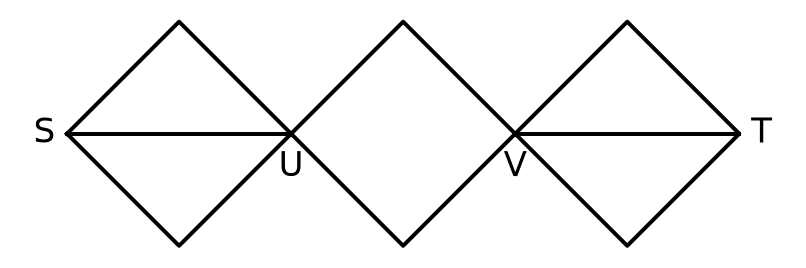
With reference to the figure given below, the number of different routes from S to T without retracing from U and/or V, is
Answer (d) & explanation
There are 18 routes (d). Step 1: break the journey into three parts. From S to U there are three paths: the top, the middle line and the bottom, so 3 ways. Step 2: from U to V there are two paths, top or bottom, so 2 ways. Step 3: from V to T there are again three paths, so 3 ways. Step 4: each choice can be combined with every other choice, so multiply: 3 × 2 × 3 = 18. Options (a), (b) and (c) add instead of multiplying or skip a part.
Tip: when a route passes through fixed points one after another, multiply the number of ways for each part. Add only when the routes are alternatives that do not combine.
Answer as per the official UPSC answer key.
In a group of six women there are four dancers, four vocal musicians, one actress and three violinists. Girija and Vanaja are among the violinists while Jalaja and Shailaja do not know how to play on the violin. Shailaja and Tanuja are among the dancers. Jalaja, Vanaja, Shailaja and Tanuja are all vocal musicians and two of them are also violinists. If Pooja is an actress, who among the following is certainly a dancer and a violinist ?
Answer (d) & explanation
Tanuja is certainly a dancer and a violinist (d). Step 1: the four vocal musicians are Jalaja, Vanaja, Shailaja and Tanuja, and two of them play the violin. Step 2: Jalaja and Shailaja do not play the violin. So the two violinists among them must be Vanaja and Tanuja. Step 3: Tanuja is also among the dancers. So she is certainly both. Option (a) is wrong: Jalaja does not play the violin. Option (b) is wrong: Pooja is the actress, with no sure link to violin. Option (c) is wrong: Shailaja is a dancer but not a violinist.
Tip: use the "two of them" clue with the "do not" clue. Removing who cannot be in a group often leaves exactly who must be.
Answer as per the official UPSC answer key.
Examine the following statements :
- 1. George attends Music classes on Monday.
- 2. He attends Mathematics classes on Wednesday.
- 3. His Literature classes are not on Friday.
- 4. He attends History classes on the day following the day of his Mathematics classes.
- 5. On Tuesday, he attends his Sports classes.
If he attends just one subject in a day and his Sunday is free, then he is also free on
Answer (d) & explanation
He is free on Friday (d). Step 1: fill in the week. Monday: Music. Tuesday: Sports. Wednesday: Mathematics. Thursday: History, the day after Mathematics. Sunday: free. Step 2: only Friday and Saturday are left for Literature. Literature is not on Friday, so it is on Saturday. Step 3: that leaves Friday free. Options (a), (b) and (c) are all filled days.
Tip: in scheduling puzzles, place the fixed clues first (named days), then the relative clues ("the day after"), and use the negative clue ("not on Friday") last to settle what is left.
Answer as per the official UPSC answer key.
In a row 'A' is in the 11th position from the left and 'B' is in the 10th position from the right. If 'A' and 'B' interchange, then 'A' becomes 18th from the left. How many persons are there in the row other than 'A' and 'B' ?
Answer (c) & explanation
There are 25 other people (c). Step 1: A is 11th from the left and B is 10th from the right. When they swap, A moves into B's old seat and becomes 18th from the left. Step 2: so B's old seat is 18th from the left and 10th from the right. Step 3: total people = 18 + 10 − 1 = 27. We subtract 1 because that seat was counted twice. Step 4: people other than A and B = 27 − 2 = 25. Options (a), (b) and (d) miss one of these steps.
Tip: total in a row = position from left + position from right − 1, for the same person or seat. Read the last line carefully: "other than A and B".
the question asks for people other than A and B.
Answer as per the official UPSC answer key.
There are seven persons up on a ladder, A, B, C, D, E, F and G (not in that order). A is further up than E but is lower than C. B is in the middle. G is between A and B. E is between B and F. If F is between E and D, the person on the bottom step of the ladder will be
Answer (c) & explanation
D is on the bottom step (c). Step 1: there are seven people, so the middle step is 4th. B is there. Step 2: E is between B and F, and F is between E and D. So below B the order runs B, E, F, D. That fills steps 4 to 7. Step 3: A is above E but below C, and G is between A and B. So above B the order runs C, A, G, B. Step 4: full order from top: C, A, G, B, E, F, D. The bottom step is D. Options (a), (b) and (d) are on steps 4, 6 and 5.
Tip: in ladder or row puzzles, start with the fixed position (here B in the middle), then attach the chains of "between" clues to it.
Answer as per the official UPSC answer key.
(Same information as the question above.)
If all the three males are selected, then how many combinations of four member teams are possible?
Answer (b) & explanation
2 teams is correct (b). Step 1: A, B and C are all selected, so we need exactly one woman to make four. Step 2: W cannot play with B, so W is out. Z cannot play with C, so Z is out. Step 3: X and Y have no problem with A, B or C (the W–Y rule does not apply, since only one woman is chosen). So the possible teams are A, B, C, X and A, B, C, Y: 2 combinations. So (a), (c) and (d) fail.
Tip: count only the free choices. Once three places are fixed, ask how many candidates can fill the last place without breaking any rule.
Answer as per the official UPSC answer key.
The music director of a film wants to select four persons to work on different aspects of the composition of a piece of music. Seven persons are available for this work; they are Rohit, Tanya, Shobha, Kaushal, Kunal, Mukesh and Jaswant.
Rohit and Tanya will not work together. Kunal and Shobha will not work together. Mukesh and Kunal want to work together.
Which of the following is the most acceptable group of people that can be selected by the music director?
Answer (c) & explanation
(c) is correct. Step 1: the rules are: Rohit and Tanya not together; Kunal and Shobha not together; Mukesh and Kunal together. Step 2: (a) has Kunal with Shobha: not allowed, and Kunal is without Mukesh. (b) has Rohit with Tanya: not allowed. (d) has Rohit with Tanya too, and Mukesh without Kunal. Step 3: (c) Tanya, Mukesh, Kunal and Jaswant breaks no rule and keeps Mukesh and Kunal together. So (a), (b) and (d) fail.
Tip: treat 'want to work together' as a pair that must come as a unit. Any option with only one of the pair fails, just like an option that joins two people who refuse to work together.
Answer as per the official UPSC answer key.
Five people A, B, C, D and E are seated about a round table. Every chair is spaced equidistant from adjacent chairs.
- (i) C is seated next to A.
- (ii) A is seated two seats from D.
- (iii) B is not seated next to A.
Which of the following must be true?
- 1. D is seated next to B.
- 2. E is seated next to A.
Select the correct answer from the codes given below:
Answer (c) & explanation
Both statements are correct (c). Step 1: B is not next to A (clue iii), and D is two seats from A (clue ii), so D is not next to A either. A's two neighbours must therefore be C and E. So E sits next to A: statement 2 is true. Step 2: at a table of five, the two seats not next to A are next to each other. B and D fill those two seats. Step 3: so D is seated next to B: statement 1 is true. Hence (a), (b) and (d) fail.
Tip: at a round table of five, each person has two neighbours and two 'far' seats, and the two far seats always touch each other.
Answer as per the official UPSC answer key.
Directions for the following 3 (three) items: Examine carefully the following statements and answer the three items that follow:
Out of four friends A, B, C and D,
A and B play football and cricket,
B and C play cricket and hockey,
A and D play basketball and football,
C and D play hockey and basketball.
Who does not play hockey?
Answer (d) & explanation
A is correct (d). Step 1: each pair plays two games, so build a list for each friend. A: football, cricket (with B), basketball, football (with D) = football, cricket, basketball. Step 2: B: football, cricket, hockey. C: cricket, hockey, basketball. D: basketball, football, hockey. Step 3: B, C and D all play hockey; only A does not. So (a), (b) and (c) fail.
Tip: turn pair statements into one list per person before answering. A small table of friends against games, with ticks, makes all three linked questions quick and avoids missing a game.
Answer as per the official UPSC answer key.
Four friends, A, B, C and D distribute some money among themselves in such a manner that A gets one less than B, C gets 5 more than D, D gets 3 more than B. Who gets the smallest amount?
Answer (a) & explanation
A is correct (a). Step 1: let B get x. A gets one less than B, so A = x − 1. D gets 3 more than B, so D = x + 3. C gets 5 more than D, so C = x + 8. Step 2: put them in order: C (x + 8) > D (x + 3) > B (x) > A (x − 1). Step 3: A gets the smallest amount. B is just above A, D is in the middle and C gets the most, so (b), (c) and (d) fail.
Tip: when everything is described relative to others, give one person the value x and write everyone else in terms of x. The order then becomes clear without knowing the actual money.
Answer as per the official UPSC answer key.
(Same information as the question above.)
Who plays football, basketball and hockey?
Answer (a) & explanation
D is correct (a). Step 1: from the pair statements, D plays basketball and football (with A) and hockey and basketball (with C). So D plays football, basketball and hockey. Step 2: C plays cricket, hockey and basketball, but not football. Step 3: B plays football, cricket and hockey, but not basketball. A plays football, cricket and basketball, but not hockey. So only D plays all three named games, and (b), (c) and (d) fail.
Tip: the friends' lists: A — football, cricket, basketball; B — football, cricket, hockey; C — cricket, hockey, basketball; D — football, basketball, hockey. Each friend misses exactly one game, which is a quick check that your table is right.
Answer as per the official UPSC answer key.
Directions for the following 4 (four) items: Read the following statements and answer the four items that follow:
Five cities P, Q, R, S and T are connected by different modes of transport as follows:
P and Q are connected by boat as well as rail.
S and R are connected by bus and boat.
Q and T are connected by air only.
P and R are connected by boat only.
T and R are connected by rail and bus.
Which mode of transport would help one to reach R starting from Q, but without changing the mode of transport?
Answer (a) & explanation
Boat is correct (a). Step 1: list the links. P–Q: boat, rail. S–R: bus, boat. Q–T: air. P–R: boat. T–R: rail, bus. Step 2: from Q, one route is Q → P → R. Q to P can be done by boat, and P to R is by boat only, so the whole trip works by boat. Step 3: the other route, Q → T → R, needs air to T and then rail or bus to R, so you must change. Rail (Q–P by rail) fails because P–R is boat only. Bus and air do not connect Q to R either. So (b), (c) and (d) fail.
Tip: write each link with its modes in a small list. Then follow one mode at a time from start to finish.
Answer as per the official UPSC answer key.
(Same information as the question above.)
Which game do B, C and D play?
Answer (b) & explanation
Hockey is correct (b). Step 1: from the lists, B plays football, cricket, hockey; C plays cricket, hockey, basketball; D plays football, basketball, hockey. Step 2: the only game all three share is hockey. Step 3: basketball is not played by B, cricket is not played by D, and football is not played by C. So (a), (c) and (d) fail.
Tip: to find a common game, write the three lists side by side and look for the item present in all of them. Here, A is the only one without hockey, so the other three must share it. Using the earlier answer ('A does not play hockey') gives this in seconds.
Answer as per the official UPSC answer key.
(Same information as the question above.)
If a person visits each of the places starting from P and gets back to P, which of the following places must he visit twice?
Answer (b) & explanation
R is correct (b). Step 1: from the links (P–Q, S–R, Q–T, P–R, T–R), S is linked only to R. So to visit S you must go R → S and then come back to R. Step 2: this means R is passed through twice in any round trip from P back to P. Example trip: P → Q → T → R → S → R → P. Step 3: Q, T and S can each be visited once on this route, so (a), (c) and (d) fail.
Tip: look for a 'dead end': a place with only one link. To leave it you must return the way you came, so its only neighbour gets visited twice. Draw the five cities as dots with lines to see this at once.
Answer as per the official UPSC answer key.