
Arrangements, ranking, ordering and puzzles: previous-year questions
141 real UPSC Prelims questions (2011–2026) with the official answer and a clear explanation. 35 of them came in the last five papers.
How often UPSC asks this
Questions per year, counted from the official papers.
Attempt the questions
Newest papers first. Tap an option; the answer and the reason appear instantly.
A, B, C, D and E belong to five different cities P, Q, R, S and T (not necessarily in that order). Each one of them comes from a different city. Further it is given that
- 1. B and C do not belong to Q.
- 2. B and E do not belong to P and R.
- 3. A and C do not belong to R, S and T.
- 4. D and E do not belong to Q and T.
Which one of the following statements is not correct?
Answer (d) & explanation
'B belongs to S' is not correct (d). Step 1: from clue 3, A and C are not in R, S or T, so they are in P or Q. Clue 1 says C is not in Q, so C = P and A = Q. Step 2: clue 4 says E is not in Q or T, and clue 2 says E is not in P or R, so E = S. Clue 4 says D is not in T, so D = R, and B = T. Step 3: so C belongs to P (true), D to R (true), A to Q (true), but B belongs to T, not S. So (a), (b) and (c) are correct statements and (d) is the incorrect one.
Tip: in 'not correct' questions, solve fully first, then pick the false statement. Start with people who have only two possible cities.
Answer as per the official UPSC answer key.
(Same information as the question above.)
Which one of the following pairs of cities is connected by any of the routes directly without going to any other city?
Answer (d) & explanation
None of these is correct (d). Step 1: the direct links given are P–Q, S–R, Q–T, P–R and T–R. No other pairs are joined directly. Step 2: (a) P and T: no direct link (you must go through Q or R). (b) T and S: no direct link (you must go through R). Step 3: (c) Q and R: no direct link (you must go through P or T). Since none of the three pairs is directly connected, (a), (b) and (c) fail and the answer is 'none of these'.
Tip: copy the list of direct links before answering. Then check each pair against it; anything not in the list needs a stop in another city, which the question rules out.
Answer as per the official UPSC answer key.
Seven men, A, B, C, D, E, F and G are standing in a queue in that order. Each one is wearing a cap of a different colour like violet, indigo, blue, green, yellow, orange and red. D is able to see in front of him green and blue, but not violet. E can see violet and yellow, but not red. G can see caps of all colours other than orange. If E is wearing an indigo coloured cap, then the colour of the cap worn by F is
Answer (c) & explanation
Red is correct (c). Step 1: G, last in the queue, sees everyone but cannot see orange, so G wears orange. Step 2: D sees green and blue in front (A, B, C) but not violet. E sees violet and yellow but not red. So violet is on D, and A, B, C wear green, blue and yellow. Step 3: E wears indigo (given). The only colour left is red, so F wears red. Check: E cannot see red because F is behind him. So (a), (b) and (d) fail.
Tip: in queue questions, a person sees only those in front. A colour someone cannot see is either his own or behind him.
Answer as per the official UPSC answer key.
(Same information as the question above.)
Between which two cities among the pairs of cities given below are there maximum travel options available?
Answer (a) & explanation
1. Count the ways by multiplying the number of modes on each leg.
2. Q to S: Q → P (2 ways) → R (1) → S (2) = 4; Q → T (1) → R (2) → S (2) = 4. Total 8.
3. P to R: direct boat 1; P → Q → T → R = 2 × 1 × 2 = 4. Total 5.
4. P to T: P → Q → T = 2; P → R → T = 2. Total 4. Q to R: via P = 2, via T = 2. Total 4.
5. The most options are between Q and S.
Answer as per the official UPSC answer key.
In a class of 45 students, a boy is ranked 20th. When two boys joined, his rank was dropped by one. What is his new rank from the end?
Answer (c) & explanation
27th is correct (c). Step 1: two boys joined, so the class now has 45 + 2 = 47 students. His rank dropped by one, so he is now 21st from the top. Step 2: rank from the end = total − rank from top + 1 = 47 − 21 + 1 = 27. Step 3: check: 20 students above him plus himself is 21, and 26 students are below him, so he is 27th from the bottom. So (a), (b) and (d) fail.
Tip: remember the rule: rank from top + rank from bottom = total + 1. Always update both the total and the rank when people join or leave before using it.
Answer as per the official UPSC answer key.
Directions for the following 3 (three) items: Read the following passage and answer the three items that follow:
A tennis coach is trying to put together a team of four players for the forthcoming tournament. For this 7 players are available: males A, B and C; and females W, X, Y and Z. All players have equal capability and at least 2 males will be there in the team. For a team of four, all players must be able to play with each other. But, B cannot play with W, C cannot play with Z and W cannot play with Y.
If Y is selected and B is rejected, the team will consist of which one of the following groups?
Answer (b) & explanation
A, C, X and Y is correct (b). Step 1: B is rejected, and the team needs at least 2 males, so both A and C must play. Y is selected, so the team so far is A, C, Y. One more woman is needed. Step 2: W cannot play with Y, so W is out. Z cannot play with C, so Z is out. Only X is left. Step 3: the team is A, C, X and Y. (a) puts W with Y, (c) puts Z with C, and (d) has only one male and puts W with Y. So (a), (c) and (d) fail.
Tip: first fix the people forced in or out, then use each 'cannot play with' rule to remove candidates one by one.
Answer as per the official UPSC answer key.
(Same information as the question above.)
If B is selected and Y is rejected, the team will consist of which one of the following groups?
Answer (c) & explanation
A, B, C and X is correct (c). Step 1: Y is rejected, so (d), which includes Y and has only one male (A), is out. Step 2: (a) puts B with W, which is not allowed. (b) puts C with Z, which is not allowed. Step 3: (c) A, B, C and X breaks no rule: X has no restrictions, and B, C are not paired with W or Z. It also has three males, meeting the 'at least 2 males' rule. So (a), (b) and (d) fail.
Tip: in team questions with ready options, test each option against every rule. One broken rule rules it out. This is often faster than building the team from scratch.
Answer as per the official UPSC answer key.
(Same information as the question above.)
Which lecture is the last one in the week?
Answer (c) & explanation
Mathematics is correct (c). Step 1: History is fixed on Tuesday. English, Economics and Mathematics must run on three days in a row in that order, and the only such free days are Wednesday, Thursday and Friday. Step 2: so Mathematics, the last of the three, falls on Friday. Statistics fills Monday. Step 3: the week is Mon Statistics, Tue History, Wed English, Thu Economics, Fri Mathematics. Friday is the last day, so the last lecture is Mathematics. History, English and Economics are earlier in the week, so (a), (b) and (d) fail.
Tip: when three items must come in a row and one day is already taken, list the possible runs of free days. Often only one run fits.
Answer as per the official UPSC answer key.
(Same information as the question above.)
Which lecture is scheduled on Wednesday?
Answer (c) & explanation
English is correct (c). Step 1: History is on Tuesday (only day the faculty is free). Step 2: the block English → Economics → Mathematics needs three days in a row; only Wed–Thu–Fri are free in a row, and this also keeps Economics off Tuesday. Step 3: so English is on Wednesday, Economics Thursday, Mathematics Friday, and Statistics Monday. Statistics is Monday, Economics Thursday and History Tuesday, so (a), (b) and (d) fail.
Tip: check your schedule against every clue once before answering. Here: Economics not on Tuesday (✓ Thursday), History Tuesday (✓), English just before Economics (✓), Mathematics just after Economics (✓). One check protects all five linked answers.
Answer as per the official UPSC answer key.
(Same information as the question above.)
Which lecture is scheduled before the Mathematics lecture?
Answer (a) & explanation
Economics is correct (a). Step 1: the clue itself says Mathematics is scheduled 'immediately after the day of Economics'. Step 2: in the full week (Mon Statistics, Tue History, Wed English, Thu Economics, Fri Mathematics), Economics on Thursday comes just before Mathematics on Friday. Step 3: History (Tuesday), Statistics (Monday) and English (Wednesday) also come before Mathematics in the week, but not just before it. The question means the lecture immediately before, so (b), (c) and (d) fail.
Tip: some answers can be read straight from a clue. Before working the whole puzzle, check whether one clue already answers the question.
Answer as per the official UPSC answer key.
In five flats, one above the other, live five professionals. The professor has to go up to meet his IAS officer friend. The doctor is equally friendly to all, and has to go up as frequently as go down. The engineer has to go up to meet his MLA friend above whose flat lives the professor's friend. From the ground floor to the top floor, in what order do the five professionals live?
Answer (d) & explanation
(d) is correct. Step 1: the doctor goes up as often as down, so he lives in the middle (3rd) flat. Step 2: the engineer goes up to meet the MLA, above whom lives the professor's friend, the IAS officer. So Engineer < MLA < IAS officer. The professor also goes up to the IAS officer, so the IAS officer is near the top. Step 3: with the doctor 3rd, MLA must be 4th and IAS 5th, leaving professor and engineer in flats 1 and 2. Only (d) fits: Professor, Engineer, Doctor, MLA, IAS officer. (a) and (c) put the IAS officer below the MLA, and (b) puts the MLA on top, so they fail.
Tip: anyone who goes up and down equally sits in the middle.
Answer as per the official UPSC answer key.
Three persons A, B and C wore shirts of black, blue and orange colours (not necessarily in that order) and pants of green, yellow and orange (not necessarily in that order). No person wore shirt and pants of the same colour. Further, it is given that
- 1. A did not wear shirt of black colour.
- 2. B did not wear shirt of blue colour.
- 3. C did not wear shirt of orange colour.
- 4. A did not wear pants of green colour.
- 5. B wore pants of orange colour.
What were the colours of the pants and shirt worn by C, respectively?
Answer (b) & explanation
Green pants and blue shirt is correct (b). Step 1: pants first. B wore orange pants. A did not wear green, so A wore yellow and C wore green. Step 2: shirts. B cannot wear blue (clue 2) and cannot wear orange (same as his pants), so B wore black. Step 3: C did not wear an orange shirt (clue 3), so C wore blue, and A wore orange. Check: A's orange shirt differs from his yellow pants. So C wore green pants and a blue shirt, and (a), (c) and (d) fail.
Tip: start with the most fixed clue (B's pants) and use 'no same colour' to cut options. A small grid of people vs colours makes this quick.
Answer as per the official UPSC answer key.
Four men are waiting at Delhi airport for a Mumbai flight. Two are doctors and other two are businessmen. Two speak Gujarati and two speak Tamil. No two of the same profession speak the same language. Two are Muslims and two are Christians. No two of the same religion are of the same profession, nor do they speak same language. The Tamil speaking doctor is Christian.
- 1. The Christian-businessman speaks Gujarati.
- 2. The Gujarati-speaking doctor is a Muslim.
Which of the above statements is/are correct conclusion/conclusions?
Answer (c) & explanation
Both statements are correct (c). Step 1: no two of the same profession speak the same language, so each pair (doctors, businessmen) has one Gujarati and one Tamil speaker. Step 2: the Tamil-speaking doctor is Christian. The two doctors cannot share a religion, so the Gujarati doctor is Muslim: statement 2 is true. Step 3: the second Christian must be a businessman, and two Christians cannot speak the same language. Since one Christian speaks Tamil, the other speaks Gujarati: statement 1 is true. So (a), (b) and (d) fail.
Tip: write the four people in a 2×2 table (doctor/businessman × Gujarati/Tamil) and fill religions using the 'no two the same' rules.
Answer as per the official UPSC answer key.
Gita is prettier than Sita but not as pretty as Rita. Then,
Answer (a) & explanation
'Sita is not as pretty as Gita' is correct (a). Step 1: 'Gita is prettier than Sita' gives Gita > Sita. Step 2: 'but not as pretty as Rita' gives Rita > Gita. So the order is Rita > Gita > Sita. Step 3: (a) says Sita is not as pretty as Gita, which is true. (b) says Sita is prettier than Rita, but Sita is last. (c) says Rita is not as pretty as Gita, but Rita is first. (d) says Gita is prettier than Rita, the opposite of the second clue. So (b), (c) and (d) fail.
Tip: turn each comparison into a '>' sign and line everyone up from top to bottom. Then check each option against the line.
Answer as per the official UPSC answer key.
Examine the following statements:
- 1. Rama scored more than Rani.
- 2. Rani scored less than Ratna.
- 3. Ratna scored more than Rama.
- 4. Padma scored more than Rama but less than Ratna.
Who scored the highest?
Answer (d) & explanation
Ratna is correct (d). Step 1: statement 1 gives Rama > Rani. Statement 3 gives Ratna > Rama. Statement 4 puts Padma between them: Ratna > Padma > Rama. Step 2: put them in one line: Ratna > Padma > Rama > Rani. Statement 2 (Rani < Ratna) agrees with this. Step 3: Ratna is at the top. Rama is third, Padma second and Rani last, so (a), (b) and (c) fail.
Tip: write each clue as a '>' sign and slot every new name into one single line. 'Scored less than' is just the same sign read the other way; turn all clues into 'more than' form so you do not mix up directions.
Answer as per the official UPSC answer key.
Four political parties W, X, Y and Z decided to set up a joint candidate for the coming parliamentary election. The formula agreed by them was the acceptance of a candidate of the most of the parties. Four aspiring candidates A, B, C and D approached the parties for their tickets. A was acceptable to W but not to Z. B was acceptable to Y but not to X. C was acceptable to W and Y. D was acceptable to W and X. When candidate B was preferred by W and Z, candidate C was preferred by X and Z and candidate A was acceptable to X but not to Y; who got the ticket?
Answer (c) & explanation
C got the ticket (c). Step 1: list who accepts each candidate. A: W, and later X, so 2 parties (Z and Y reject A). B: Y, and later W and Z, so 3 parties (X rejects B). C: W and Y, and later X and Z, so all 4 parties. D: W and X, so 2 parties. Step 2: the formula was the candidate acceptable to most parties. Step 3: C has the most support (4), so C gets the ticket. A and D have 2 each and B has 3, so (a), (b) and (d) fail.
Tip: make a small table of candidates against parties and tick each acceptance as you read. Counting ticks avoids mixing up the later preferences.
Answer as per the official UPSC answer key.
Directions for the following 5 (five) items: Examine the information given in the following paragraph and answer the items that follow:
Guest lectures on five subjects viz., Economics, History, Statistics, English and Mathematics have to be arranged in a week from Monday to Friday. Only one lecture can be arranged on each day. Economics cannot be scheduled on Tuesday. Guest faculty for History is available only on Tuesday. Mathematics lecture has to be scheduled immediately after the day of Economics lecture. English lecture has to be scheduled immediately before the day of Economics lecture.
Which lecture is scheduled on Monday?
Answer (d) & explanation
Statistics is correct (d). Step 1: History is fixed on Tuesday. Step 2: English must come immediately before Economics, and Mathematics immediately after it. So English, Economics, Mathematics take three days in a row. With Tuesday taken, the only three free days in a row are Wednesday, Thursday, Friday. Economics on Thursday also obeys 'not on Tuesday'. Step 3: so Wednesday English, Thursday Economics, Friday Mathematics, and the only day left, Monday, gets Statistics. Full week: Mon Statistics, Tue History, Wed English, Thu Economics, Fri Mathematics. So (a), (b) and (c) fail.
Tip: place the fixed item first, then fit the block of linked items into the gaps that remain.
Answer as per the official UPSC answer key.
(Same information as the question above.)
Which lecture is scheduled between Statistics and English?
Answer (b) & explanation
History is correct (b). Step 1: from the schedule worked out from the clues: Mon Statistics, Tue History, Wed English, Thu Economics, Fri Mathematics. (History is fixed on Tuesday; English–Economics–Mathematics must run on three days in a row, which can only be Wed–Fri; Statistics takes Monday.) Step 2: Statistics is on Monday and English on Wednesday. Step 3: the lecture between them, on Tuesday, is History. Economics and Mathematics come after English, and there is a lecture between them, so (a), (c) and (d) fail.
Tip: in a set of linked questions, build the full timetable once and write it down. Each later question then takes a few seconds and you avoid repeating errors.
Answer as per the official UPSC answer key.
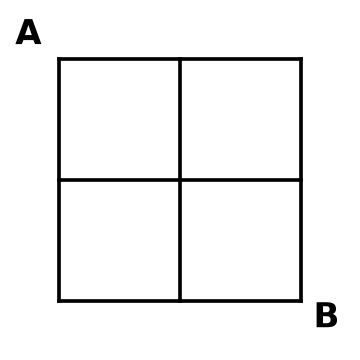
Study the following figure:
A person goes from A to B always moving to the right or downwards along the lines. How many different routes can he adopt?
Select the correct answer from the codes given below:
Answer (c) & explanation
6 routes is correct (c). Step 1: from A to B on this grid, every route needs exactly 2 steps right (R) and 2 steps down (D), in some order. Step 2: list the orders: RRDD, RDRD, RDDR, DRRD, DRDR, DDRR. That is 6 routes. Step 3: check with a formula: the number of ways to arrange 2 R's and 2 D's is 4! ÷ (2! × 2!) = 24 ÷ 4 = 6. So (a), (b) and (d) fail.
Tip: for grid routes moving only right and down, count the steps of each kind, then use (total steps)! ÷ (rights! × downs!). For bigger grids, this saves a lot of drawing.
Answer as per the official UPSC answer key.
There are four routes to travel from city A to city B and six routes from city B to city C. How many routes are possible to travel from the city A to city C?
Answer (a) & explanation
24 routes is correct (a). Step 1: there are 4 routes from A to B. Step 2: for each of those, there are 6 routes from B to C. Step 3: so the total number of A-to-C routes is 4 × 6 = 24. Adding them (4 + 6 = 10) would be wrong, because every first route pairs with every second route. So (b), (c) and (d) fail.
Tip: this is the multiplication rule of counting. When one choice is followed by another, multiply the number of ways. Add only when you choose one path or another, not one then another.
Answer as per the official UPSC answer key.