
Coding-decoding, series, patterns, cubes, dice and visual reasoning: previous-year questions
95 real UPSC Prelims questions (2011–2026) with the official answer and a clear explanation. 34 of them came in the last five papers.
How often UPSC asks this
Questions per year, counted from the official papers.
Attempt the questions
Newest papers first. Tap an option; the answer and the reason appear instantly.
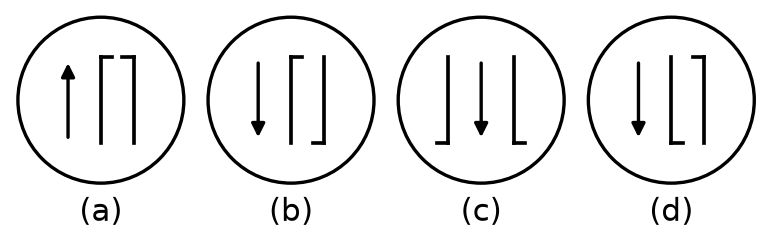
(Same directions as the question above.)
Problem figures:
Answer figures:
Answer (b) & explanation
1. Read the elements as one long chain: hook-left foot, up-arrow, right foot, hook-left top, down-arrow, hook-right top, …
2. Each figure shows three elements in a row, and the next figure slides one step along the chain (the left one drops off, a new one joins on the right).
3. Figure 4 ends with down-arrow and right-top hook. So figure 5 starts with these two, and the chain then restarts with the first element (the left-foot piece).
4. Down-arrow, right-top hook, left-foot piece: (b).
Answer as per the official UPSC answer key.
Consider the following matrix:
| 3 | 370 | 7 |
|---|---|---|
| 2 | 224 | 6 |
| 1 | 730 | X |
What is the number at 'X' in the above matrix?
Answer (c) & explanation
1. Row 1: 3 × 3 × 3 = 27 and 7 × 7 × 7 = 343. 27 + 343 = 370, the middle number.
2. Row 2: 2 × 2 × 2 = 8 and 6 × 6 × 6 = 216. 8 + 216 = 224. The rule holds.
3. Row 3: 1 + (X × X × X) = 730, so X × X × X = 729 = 9 × 9 × 9.
4. X = 9.
Answer as per the official UPSC answer key.
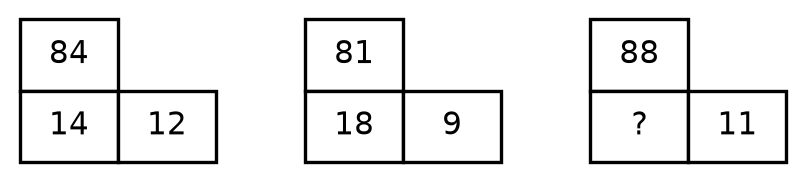
Examine the following three figures in which the numbers follow a specific pattern:
The missing number (?) in the third figure above is
Answer (b) & explanation
16 is correct (b). Step 1: in the first figure, 14 × 12 = 168, and half of 168 is 84, the top number. Step 2: in the second figure, 18 × 9 = 162, and half is 81. The rule holds: top number = (product of the two bottom numbers) ÷ 2. Step 3: in the third figure, ? × 11 must equal 2 × 88 = 176. So ? = 176 ÷ 11 = 16. So (a), (c) and (d) fail.
Tip: in number figures, try simple operations (add, multiply, half, double) on the given numbers and check the rule on every complete figure before using it on the missing one.
Answer as per the official UPSC answer key.
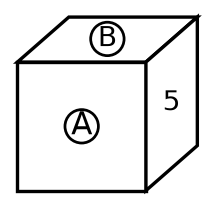
A cube has six numbers marked 1, 2, 3, 4, 5 and 6 on its faces. Three views of the cube are shown below:
What possible number can exist on the two faces marked (A) and (B), respectively on the cube?
Answer (a) & explanation
1. Find what is opposite 6. In the views, 6 sits next to 1, 4 (view 1) and 5, 3 (view 3). The only number never beside 6 is 2, so 2 is opposite 6.
2. Take view 3 (front 5, top 3, right 6) and give the cube a quarter turn so that 5 moves to the right side.
3. The top stays 3. The face that comes to the front is the one that was on the left, which is opposite 6, that is, 2.
4. So A = 2 and B = 3: (a).
Answer as per the official UPSC answer key.
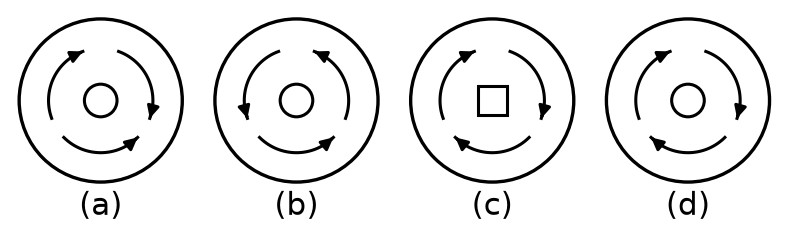
Consider the following figures:
Which one of the following figures would logically come in the 7th position indicated above by a question mark?
Answer (d) & explanation
Figure (d) is correct. Step 1: the centre shape alternates: circle, square, circle, square… Figure 7 is odd-numbered, so it has a circle. Step 2: the three arrows repeat every three figures: figure 4 matches figure 1, figure 5 matches figure 2, figure 6 matches figure 3. So figure 7 matches figure 1, with all three arrows going clockwise. Step 3: a circle with all three arrows clockwise is (d). So (a), (b) and (c) fail.
Tip: when a series has two or more changing parts, find the cycle of each separately (here 2 for the shape and 3 for the arrows). Then use the position number to find where each part is at the required step.
(a) has the circle but its bottom arrow points the other way.
Fell for this one? Most aspirants do. The PYQ Book puts every UPSC trap side by side, so the pattern finally clicks. Try the free sample
Answer as per the official UPSC answer key.
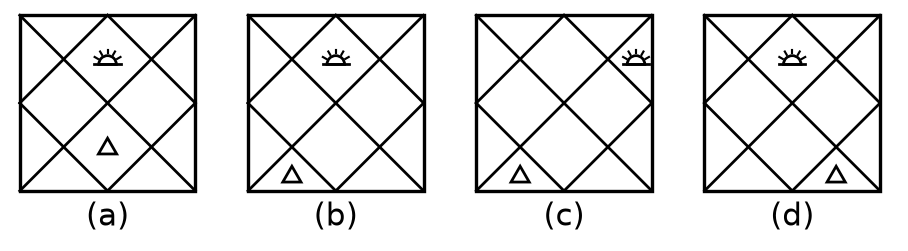
Consider the following figures 1, 2, 3 and 4:
In the figures from 1 to 4 above, two symbols are shown to change their position in a regular direction. Following the same sequence, which one of the following will appear at the fifth stage?
Answer (b) & explanation
Figure (b) is correct. Step 1: follow the sun. It moves round the four middle boxes anticlockwise: top, left, bottom, right. Next it returns to the top box. Step 2: follow the triangle. It moves down the left side one space at a time: top-left corner (upper half), top-left corner (side half), left middle box, bottom-left corner (side half). Next is the lower half of the bottom-left corner. Step 3: the figure with the sun at the top and the triangle in the lower half of the bottom-left corner is (b). So (a), (c) and (d) fail.
Tip: track each moving symbol separately. Write its path in words, find the next step, then pick the answer figure that matches both.
(d) has the sun right but puts the triangle in the wrong (bottom-right) corner.
Answer as per the official UPSC answer key.
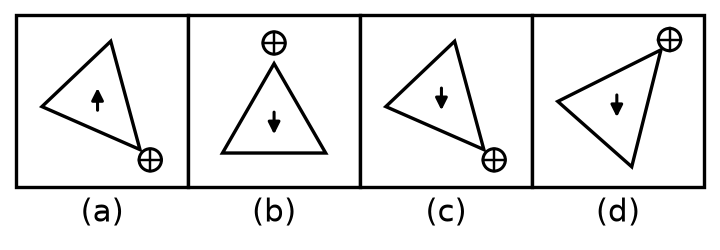
Directions for the following 2 (two) items: In each item, there are two sets of figures; first four figures named Problem figures and next four figures named Answer figures indicated as (a), (b), (c) and (d). The problem figures follow a particular sequence. In accordance with the same, which one of the four answer figures should appear as the fifth figure?
Problem figures:
Answer figures:
Answer (c) & explanation
Figure (c) is correct. Step 1: watch the arrow inside. It flips each time: down, up, down, up. So in the fifth figure it points down. Step 2: watch the triangle's position. It goes 1, 2, 3, then back to 1 in figure 4. So figure 5 repeats figure 2's position (circle at the bottom-right). Step 3: figure 2's position with a downward arrow is (c). So (a), (b) and (d) fail.
Tip: when a pattern returns to its start, it is cycling. Find the cycle length (here 3 positions) and count forward. Combine that with the simpler flipping rule to fix the next figure.
(a) has the right position but the arrow points up.
Answer as per the official UPSC answer key.
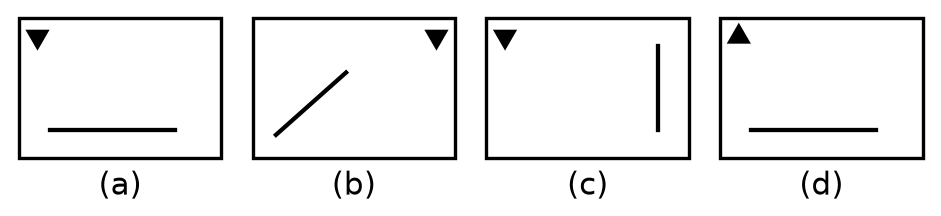
The elements of the problem figures given below are changing with a certain rule as we observe them from left to right:
According to this rule, which of the following would be the next figure if the changes were continued with the same rule?
Answer (d) & explanation
Figure (d) is correct. Step 1: watch the black triangle. It moves round the corners anticlockwise: top-left, bottom-left, bottom-right, top-right. Next it returns to the top-left. Step 2: the triangle points up, down, up, down in turn, so next it points up. Step 3: the line turns a little each time: upright, slightly tilted, slanting, nearly flat. Next it becomes flat (horizontal). A flat line with an upward triangle in the top-left corner is (d). So (a), (b) and (c) fail.
Tip: in figure series, follow one element at a time (position, direction, angle). Write a short rule for each, then combine the rules to build the next figure.
(a) has the right line and corner but the triangle points down.
Answer as per the official UPSC answer key.
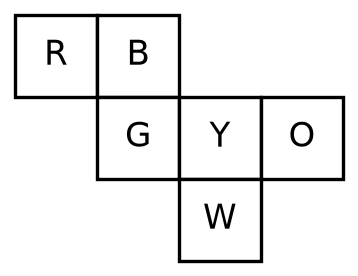
Six squares are coloured, front and back, red (R), blue (B), yellow (Y), green (G), white (W) and orange (O) and are hinged together as shown in the figure given below. If they were folded to form a cube, what would be the face opposite the white face?
Answer (c) & explanation
B is correct (c). Step 1: keep Y as the front face. In the net, G folds to the left, O to the right and W folds under to become the bottom. Step 2: B is attached to the top of G. When G folds to the left side, B lands on the top of the cube. Step 3: top and bottom are opposite, so B is opposite W. R then folds round to the back, opposite Y. So R, G and O are not opposite white, and (a), (b) and (d) fail.
Tip: in a cube net, fix one face as the front and fold the others one by one. Two faces that are separated by one square in a straight line of the net are usually opposite.
Answer as per the official UPSC answer key.
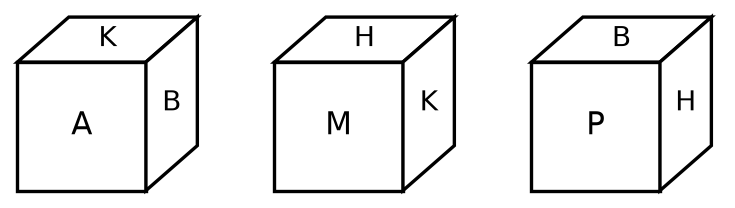
Three views of a cube following a particular motion are given below:
What is the letter opposite to A?
Answer (a) & explanation
H is correct (a). Step 1: letters seen together in one view are neighbours, so they cannot be opposite each other. Step 2: view 2 shows H with M and K. View 3 shows H with B and P. So H touches K, M, B and P. Step 3: a face touches four faces and is opposite just one. The only letter H never touches is A, so H is opposite A. B, P and M all touch H's group of neighbours, so (b), (c) and (d) fail.
Tip: list each letter's neighbours from all the views. A cube face has exactly four neighbours; the one letter left over is the opposite face.
Answer as per the official UPSC answer key.
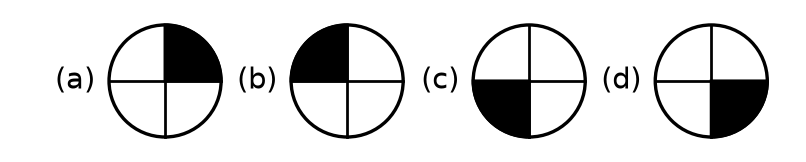
Which one of the figures shown below occupies the blank space (?) in the matrix given above?
Answer (d) & explanation
Figure (d) is correct. Step 1: in each row the first and last circles are the same. Step 2: the middle circle has its black quarter in the opposite corner. Row 1: the ends have top-right black, the middle has bottom-left black. Row 3: the ends have bottom-right black, the middle has top-left black. Step 3: row 2's ends have the top-left quarter black, so the middle must have the bottom-right quarter black. That is (d). So (a), (b) and (c) fail.
Tip: in matrix figures, check rows first, then columns. Look for 'same at both ends' and 'opposite in the middle' patterns; they are very common in UPSC CSAT.
Answer as per the official UPSC answer key.
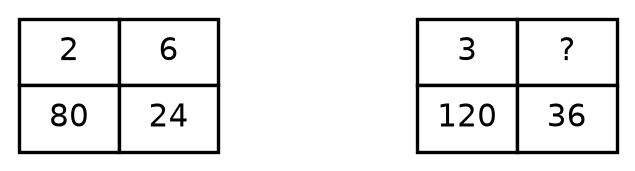
Consider the following figures:
What is the missing number?
Answer (c) & explanation
9 is correct (c). Step 1: look at the first figure. The top numbers are 2 and 6. The bottom-left number 80 = (2 + 6) × 10. The bottom-right number 24 = 6 × 4. Step 2: apply the same rule to the second figure. The bottom-right is 36, and it equals the missing number × 4. So the missing number = 36 ÷ 4 = 9. Step 3: check the bottom-left: (3 + 9) × 10 = 120, which matches the figure. So (a), (b) and (d) fail.
Tip: find the rule in the complete figure first, then test it on every number in the second figure. If one number fits and another does not, the rule is wrong.
Answer as per the official UPSC answer key.
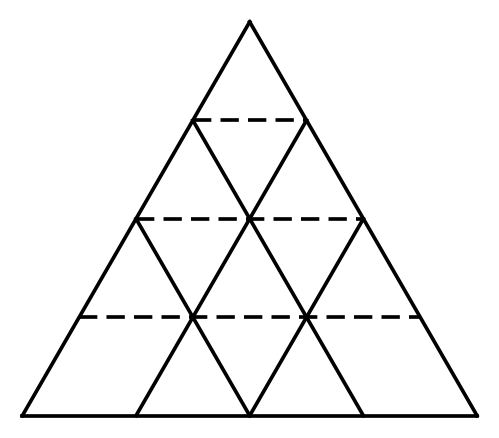
Consider the following figure and answer the item that follows:
What is the total number of triangles in the above grid?
Answer (c) & explanation
1. Count the smallest triangles (one small cell each): 8 point up and 4 point down = 12.
2. Count triangles made of 4 small cells (2 small sides long): 6 point up and 1 points down (in the middle) = 7.
3. Count triangles 3 small sides long: one at each bottom corner and one upright through the middle = 3.
4. The whole big triangle: 1.
5. Total = 12 + 7 + 3 + 1 = 23.
Answer as per the official UPSC answer key.
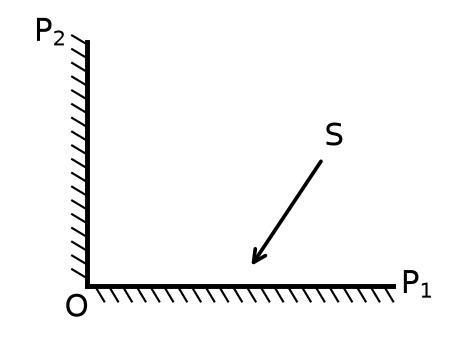
Consider the figure given below and answer the item that follows:
In the figure shown above, OP1 and OP2 are two plane mirrors kept perpendicular to each other. S is the direction of a beam of light falling on the mirror OP1. The direction of the reflected beam of light from the mirror OP2 will be
Answer (c) & explanation
Opposite and parallel to S is correct (c). Step 1: think of the beam as having two parts: an up-down part and a left-right part. Step 2: the first mirror OP₁ reverses one part, and the second mirror OP₂, at 90° to the first, reverses the other part. Step 3: with both parts reversed, the beam goes straight back the way it came, travelling opposite and parallel to S, just shifted sideways. So (a), (b) and (d) fail.
Tip: two mirrors at right angles always send light back parallel to where it came from. This is how corner reflectors on bicycles and the reflectors left on the Moon work.
Answer as per the official UPSC answer key.
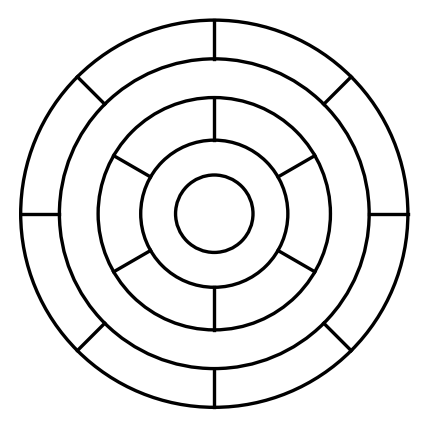
Consider the following figure and answer the item that follows:
What is the minimum number of different colours required to paint the figure given above such that no two adjacent regions have the same colour?
Answer (a) & explanation
1. Going out from the centre: centre circle, plain ring, ring cut into 6, plain ring, ring cut into 8.
2. Colour the ring of 6 red, blue, red, blue, red, blue. 6 is even, so the last piece does not touch a piece of its own colour. Do the same for the ring of 8.
3. Each plain ring touches both red and blue pieces, so it needs a third colour, green.
4. The centre circle touches only the green ring next to it, so it can be red.
5. Minimum colours = 3.
Answer as per the official UPSC answer key.