
Coding-decoding, series, patterns, cubes, dice and visual reasoning: previous-year questions
95 real UPSC Prelims questions (2011–2026) with the official answer and a clear explanation. 34 of them came in the last five papers.
How often UPSC asks this
Questions per year, counted from the official papers.
Attempt the questions
Newest papers first. Tap an option; the answer and the reason appear instantly.
If RAMON is written as 12345 and DINESH as 675849, then HAMAM will be written as
Answer (b) & explanation
HAMAM is written as 92323 (b). Step 1: from RAMON = 12345: R = 1, A = 2, M = 3, O = 4, N = 5. Step 2: from DINESH = 675849: D = 6, I = 7, N = 5, E = 8, S = 4, H = 9. Step 3: HAMAM = H A M A M = 9 2 3 2 3 = 92323. Option (a), 92233, mixes up the order. Options (c) and (d) begin with 93, which would make A = 3.
Tip: in letter-to-digit codes, make a small key of each letter and its digit. Then write the new word one letter at a time. Keep the letter order exactly; that is where most slips happen.
Answer as per the official UPSC answer key.
A solid cube of 3 cm side, painted on all its faces, is cut up into small cubes of 1 cm side. How many of the small cubes will have exactly two painted faces?
Answer (a) & explanation
12 small cubes have exactly two painted faces (a). Step 1: a cube with exactly two painted faces sits on an edge of the big cube, but not at a corner. Step 2: the 3 cm cube is cut into 3 × 3 × 3 = 27 small cubes. Each edge has 3 small cubes. The 2 at the ends are corners (three painted faces), so 1 in the middle has two. Step 3: a cube has 12 edges, so 12 × 1 = 12. Option (b), 8, is the corner count. Option (c), 6, is the number with one painted face. Option (d), 4, does not fit.
Tip: for an n-cube, two-face cubes = 12 × (n − 2). For n = 3 that is 12.
Answer as per the official UPSC answer key.
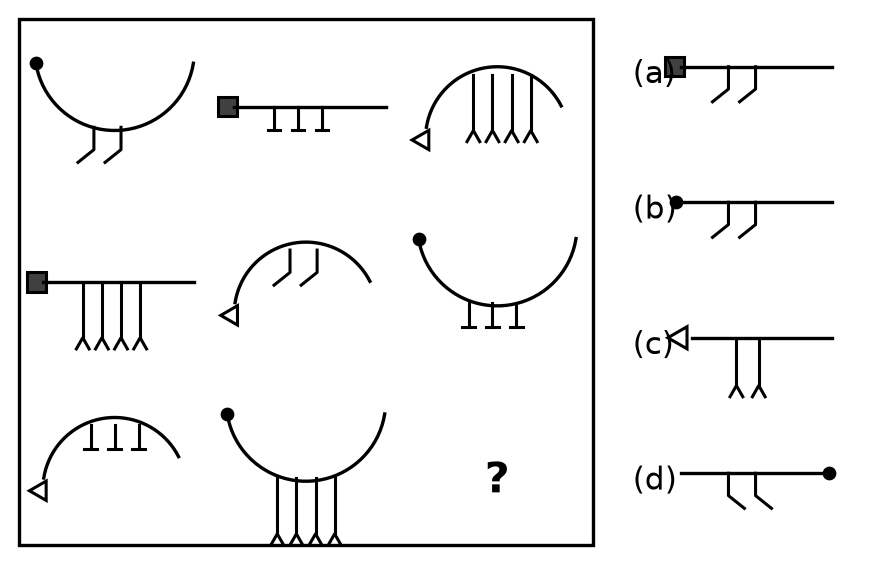
Consider the figures given below :
To fit the question mark, the correct answer is
Answer (a) & explanation
Figure (a) fits the question mark (a). Step 1: break each figure into two parts: a top (a curve with a dot, a straight line with a black square, or a half-curve with a triangle) and legs (2 bent legs, 3 short legs, or 4 forked legs). Step 2: in each row, every top and every type of legs appears exactly once. Step 3: row 3 already has the half-curve with 3 legs and the dotted curve with 4 legs. The missing pair is the square-ended line with 2 bent legs. That is figure (a). Options (b), (c) and (d) repeat a top or legs already in the row.
Tip: in 3 × 3 figure grids, split each figure into parts and check that each part appears once per row and column.
Answer as per the official UPSC answer key.
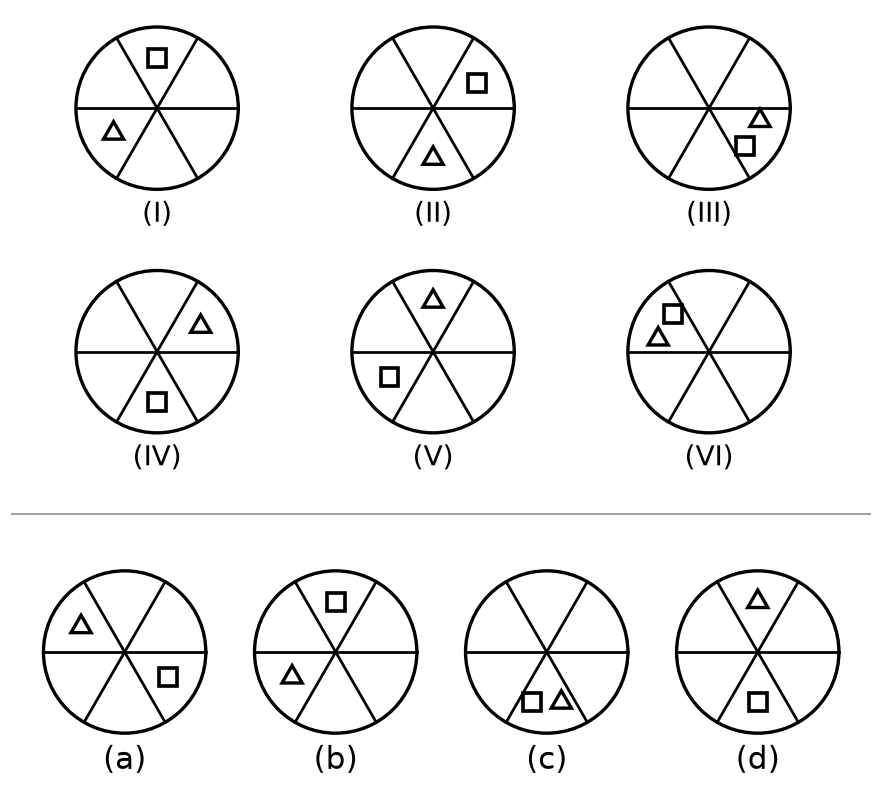
Consider the following figures :
In the figures (I) to (VI) above, some parts are shown to change their positions in regular directions. Following the same sequence, which of the figures given below will appear at (VII) stage?
Answer (b) & explanation
Figure (b) comes at stage VII (b). Step 1: track the square. It moves one part clockwise each step: top, upper-right, lower-right, bottom, lower-left, upper-left. After six moves it is back at the top. Step 2: track the triangle. It moves one part anticlockwise each step: lower-left, bottom, lower-right, upper-right, top, upper-left. Next it returns to lower-left. Step 3: so stage VII has the square at the top and the triangle at the lower-left. That is figure (b), the same as figure (I). Options (a), (c) and (d) put one shape in the wrong place.
Tip: follow one shape at a time. When a cycle has six positions, the seventh figure repeats the first.
Answer as per the official UPSC answer key.
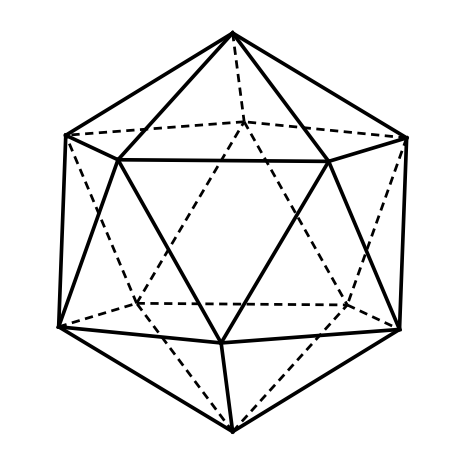
Consider the following three-dimensional figure :
How many triangles does the above figure have?
Answer (b) & explanation
The figure has 20 triangles (b). Step 1: the solid is made only of triangle faces, and 5 triangles meet at every corner. That shape is an icosahedron, a 20-faced solid. Step 2: count in layers. There are 5 triangles around the top point and 5 around the bottom point. Step 3: the middle band has 10 triangles, 5 pointing up and 5 pointing down. Total = 5 + 5 + 10 = 20. Options (a) 18, (c) 22 and (d) 24 come from missing or double-counting a layer.
Tip: count solid figures in layers, top, middle and bottom, so you neither miss nor repeat a face. Euler's rule, faces + corners − edges = 2, gives a quick check: 20 + 12 − 30 = 2.
Count the faces of the solid; the dotted lines are the hidden back edges, not extra lines.
Answer as per the official UPSC answer key.
The outer surface of a 4 cm × 4 cm × 4 cm cube is painted completely in red. It is sliced parallel to the faces to yield sixty four 1 cm × 1 cm × 1 cm small cubes. How many small cubes do not have painted faces?
Answer (a) & explanation
8 small cubes have no painted face (a). Step 1: the 4 × 4 × 4 cube is cut into 64 small cubes. Only the outer layer is painted. Step 2: the unpainted cubes form an inner block. Remove one layer from each side: 4 − 2 = 2 cubes along each edge. Step 3: the inner block is 2 × 2 × 2 = 8 cubes. Option (c), 24, is the number with exactly one painted face. Option (b), 16, and option (d), 36, do not fit.
Tip: for an n × n × n painted cube, unpainted = (n − 2)³, one face = 6(n − 2)², two faces = 12(n − 2), and three faces = 8. Learn these four formulas.
Answer as per the official UPSC answer key.
In a certain code, '256' means 'red colour chalk', '589' means 'green colour flower' and '254' means 'white colour chalk'. The digit in the code that indicates 'white' is
Answer (b) & explanation
The digit for 'white' is 4 (b). Step 1: compare '256' = 'red colour chalk' with '254' = 'white colour chalk'. Step 2: both share the words colour and chalk, and both share the digits 2 and 5. Step 3: the only change is red to white, and 6 to 4. So white = 4. Option (c), 5, is shared by all three codes, so it means 'colour'. Option (a), 2, is shared by the chalk codes, so it means 'chalk'. Option (d), 8, belongs to 'green' or 'flower'.
Tip: in word-code questions, compare two codes that differ in only one word. The digit that changes is the code for that word.
Answer as per the official UPSC answer key.
A cube has all its faces painted with different colours. It is cut into smaller cubes of equal sizes such that the side of the small cube is one-fourth the big cube. The number of small cubes with only one of the sides painted is :
Answer (b) & explanation
24 small cubes have only one face painted (b). Step 1: each side is cut into 4, so the big cube becomes 4 × 4 × 4 = 64 small cubes. Step 2: on each face there are 4 × 4 = 16 small cubes. The ones on the edges of that face also touch another face. Only the inner 2 × 2 = 4 have just one painted side. Step 3: a cube has 6 faces, so 6 × 4 = 24. Option (a), 32, does not fit. Option (d), 8, is the number of corner cubes, which have three painted faces.
Tip: for a cube cut n × n × n, one-face cubes = 6 × (n − 2)². Corner cubes are always 8.
Answer as per the official UPSC answer key.
A military code writes SYSTEM as SYSMET and NEARER as AENRER. Using the same code, FRACTION can be written as :
Answer (d) & explanation
FRACTION is written as CARFNOIT (d). Step 1: look at SYSTEM → SYSMET. Split it into halves: SYS | TEM. Each half is written backwards: SYS stays SYS, and TEM becomes MET. Step 2: check with NEARER → AENRER. NEA becomes AEN, and RER stays RER. The rule holds. Step 3: FRACTION splits into FRAC | TION. Reversed: CARF | NOIT, giving CARFNOIT. Option (a), CARFTION, reverses only the first half. Option (b), FRACNOIT, reverses only the second half. Option (c), NOITCARF, reverses the whole word.
Tip: in coding questions, test a rule on both examples before using it. Palindrome halves like SYS can hide the pattern.
Answer as per the official UPSC answer key.
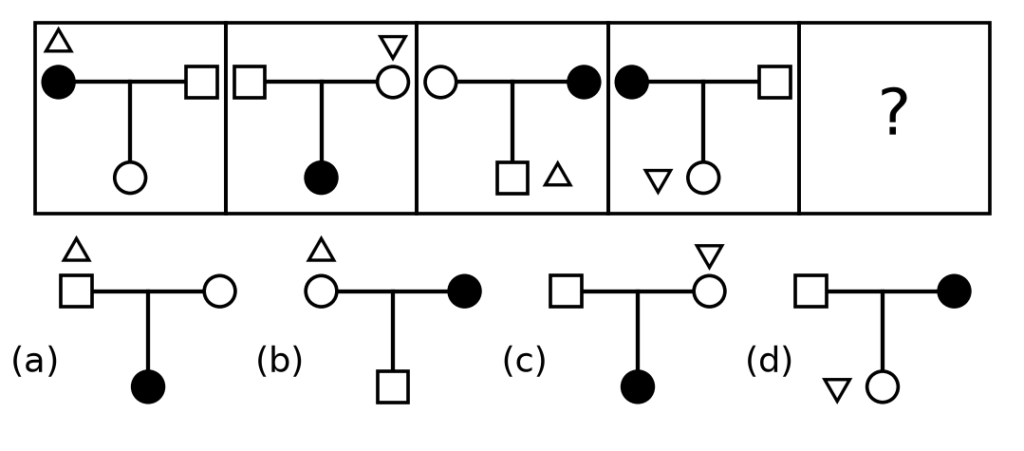
Consider the figures given below :
To fit the question mark, the correct answer is
Answer (a) & explanation
1. Look at the three end symbols (left, right, bottom). Figure 4 has the same ones as Figure 1, so they repeat every 3 figures. Figure 5 must match Figure 2: square left, open circle right, black circle at the bottom.
2. The small triangle moves round the corners: top-left, top-right, bottom-right, bottom-left, so next it is back at top-left. It points up, down, up, down, so next it points up.
3. Only (a) has both: the Figure 2 symbols and an upward triangle at the top-left.
(c) copies Figure 2 completely, but forgets that the triangle has moved on.
Answer as per the official UPSC answer key.
Consider the following matrix :
| 3 | 8 | 10 | 2 | ? | 1 |
|---|---|---|---|---|---|
| 6 | 56 | 90 | 2 | 20 | 0 |
What is the missing number at '?' in the matrix ?
Answer (a) & explanation
The missing number is 5 (a). Step 1: look for a rule linking the top and bottom numbers. 3 → 6: 3 × 2 = 6. 8 → 56: 8 × 7 = 56. 10 → 90: 10 × 9 = 90. 1 → 0: 1 × 0 = 0. So bottom = top × (top − 1). Step 2: for the missing top number, the bottom is 20. Which number times one less than itself gives 20? 5 × 4 = 20. So the answer is 5. Options (b), (c) and (d) do not fit: 0 × (−1) = 0, 7 × 6 = 42, 3 × 2 = 6.
Tip: when numbers look like 6, 56, 90, think of products of neighbours: 2 × 3, 7 × 8, 9 × 10. Spotting such pairs is a common CSAT shortcut.
Answer as per the official UPSC answer key.
What is the missing number 'X' of the series 7, X, 21, 31, 43 ?
Answer (c) & explanation
X is 13 (c). Step 1: look at the gaps between the known numbers: 21 to 31 is 10, and 31 to 43 is 12. The gaps grow by 2 each time. Step 2: work backwards. The gap before 10 is 8, and the one before that is 6. Step 3: X = 7 + 6 = 13. Check: 13 + 8 = 21. Correct. Options (a), (b) and (d) break the pattern.
Tip: in number series, first write the differences between neighbours. If the differences themselves form a simple pattern (here +2 each time), the series is easy to complete in both directions.
Answer as per the official UPSC answer key.
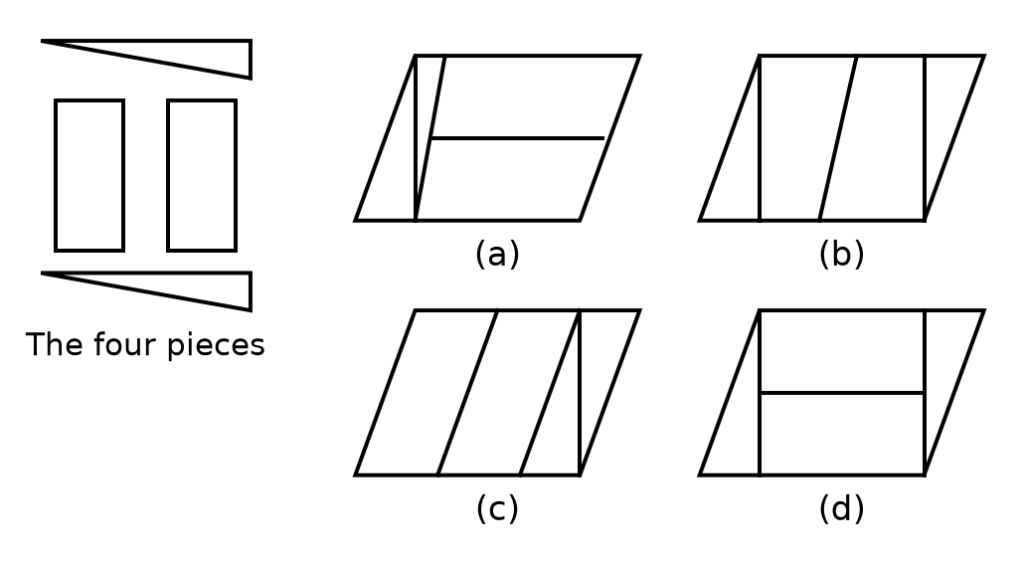
Four cardboard pieces of specific shapes are shown in the following figure :
Which one of the following figures given can be formed by joining these pieces together ?
Answer (d) & explanation
The pieces form figure (d) (d). Step 1: look at the four pieces. There are two equal rectangles and two equal right-angled triangles. Step 2: place the two rectangles flat, one on top of the other, to make a bigger rectangle (a box). Step 3: stand one triangle at each end of this box. The result is a slanted four-sided figure, like a parallelogram. Step 4: that matches figure (d), with two rectangles in the middle and one triangle on each side. Options (a), (b) and (c) need pieces of other shapes or sizes.
Tip: in shape-joining questions, first name and count the pieces, then try the simplest arrangement. Check that the total area of the answer matches the pieces.
Pieces may be turned around; only their shape and size must stay the same.
Answer as per the official UPSC answer key.
Each of the six different faces of a cube has been coated with a different colour i.e., V, I, B, G, Y and O. Following information is given :
- 1. Colours Y, O and B are on adjacent faces.
- 2. Colours I, G and Y are on adjacent faces.
- 3. Colours B, G and Y are on adjacent faces.
- 4. Colours O, V and B are on adjacent faces.
Which is the colour of the face opposite to the face coloured with O ?
Answer (c) & explanation
G is opposite O (c). Step 1: a face cannot be adjacent to its opposite face. Find each colour's neighbours. Y appears with O, B, I and G. That is four neighbours, so Y is opposite the only one left, V. Step 2: B appears with Y, O, G and V. So B is opposite the remaining one, I. Step 3: the only pair left is O and G. So G is opposite O. Options (a), (b) and (d) are adjacent to O or already paired.
Tip: on a cube, each face touches four others and is opposite one. List each colour's neighbours; once a colour has four, its opposite is the missing one.
Answer as per the official UPSC answer key.
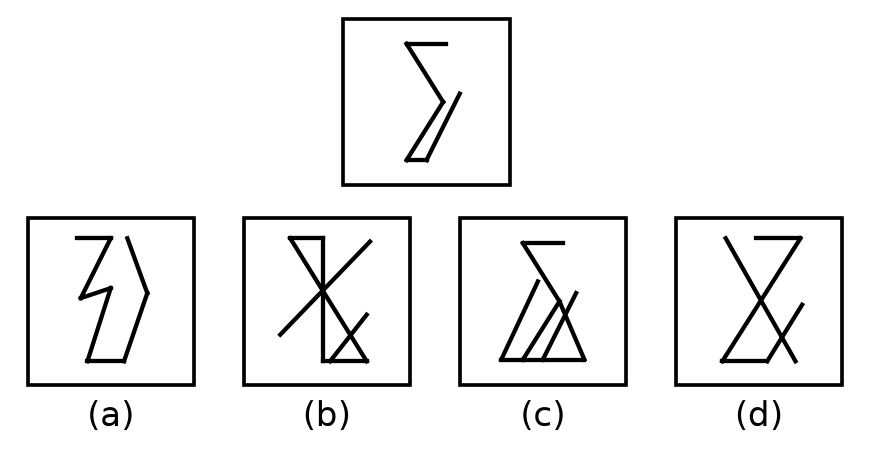
Examine the following figure :
Which one of the following figures has the above figure embedded in it ?
Answer (c) & explanation
The figure is hidden inside (c) (c). Step 1: note the parts of the given shape: a short top line, a bend pointing right, a short bottom line, and a slanting line going up from the bottom. Step 2: look for all four parts, in the same size and same direction, inside each option. In figure (c) they all appear together; the extra lines only add small triangles at the bottom. Step 3: in (a), (b) and (d), the bend or the top line is missing or turned, so the shape is not there.
Tip: for embedded-figure questions, pick the most unusual part of the shape, here the bend, and hunt for it first. The figure must not be rotated or resized.
Answer as per the official UPSC answer key.
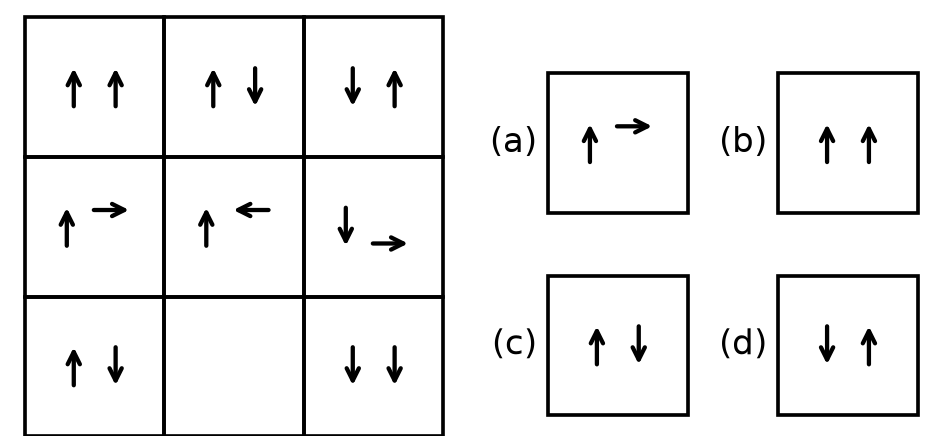
Consider the following matrix :
Which one of the following figures fits into the blank part of the above matrix ?
Answer (b) & explanation
1. Look down each column at the first (left) arrow: column 1 is always ↑, column 2 is always ↑, column 3 is always ↓. So the blank starts with ↑.
2. Look along each row at the second arrow: the middle box is the opposite of the two outer boxes (row 1: ↑ ↓ ↑; row 2: → ← →). Row 3 is ↓ ? ↓, so the middle one is ↑.
3. The blank is ↑ ↑, which is (b).
Answer as per the official UPSC answer key.
Consider the table given below in which the numbers bear certain relationship among themselves along the rows :
| 29 | 13 | 18 |
|---|---|---|
| 33 | X | 19 |
| 30 | 27 | 3 |
Which one of the following numbers is the missing number indicated above by X ?
Answer (b) & explanation
UPSC's final key accepts both 15 (b) and 8 (d). Step 1: look for a rule in the complete rows. Row 1: 29 + 13 + 18 = 60. Row 3: 30 + 27 + 3 = 60. So each row adds up to 60. Step 2: apply it to row 2: 33 + X + 19 = 60. So X = 60 − 52 = 8, option (d). Step 3: the table can also be read with a different rule that gives 15, option (b). Because the pattern is not unique, UPSC accepted both answers. Options (a) and (c) fit no rule.
Tip: in number tables, try the simplest rules first: sum of the row, then difference, then product. Check the rule on two full rows before using it.
The rule is not unique, so UPSC's final key accepts both (b) 15 and (d) 8.
Answer as per the official UPSC answer key.
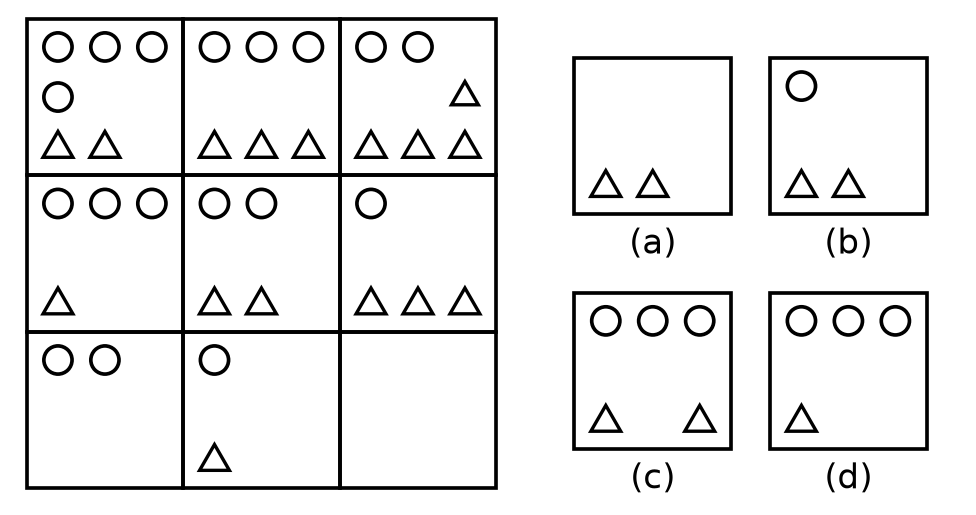
Consider the following matrix with one empty block in the lower extreme corner :
Which of the following figures could fit in the empty block and thus complete the matrix ?
Answer (a) & explanation
Figure (a) completes the matrix (a). Step 1: count the shapes in each box, left to right. Row 1: circles 4, 3, 2; triangles 2, 3, 4. Row 2: circles 3, 2, 1; triangles 1, 2, 3. Step 2: find the rule. Each step to the right, one circle goes and one triangle comes. Step 3: apply it to row 3. Circles go 2, 1, so next is 0. Triangles go 0, 1, so next is 2. The empty box needs two triangles and no circle, which is figure (a). Options (b), (c) and (d) have the wrong counts.
Tip: in figure matrices, count each kind of shape separately; a simple plus-one, minus-one rule is very common.
Answer as per the official UPSC answer key.
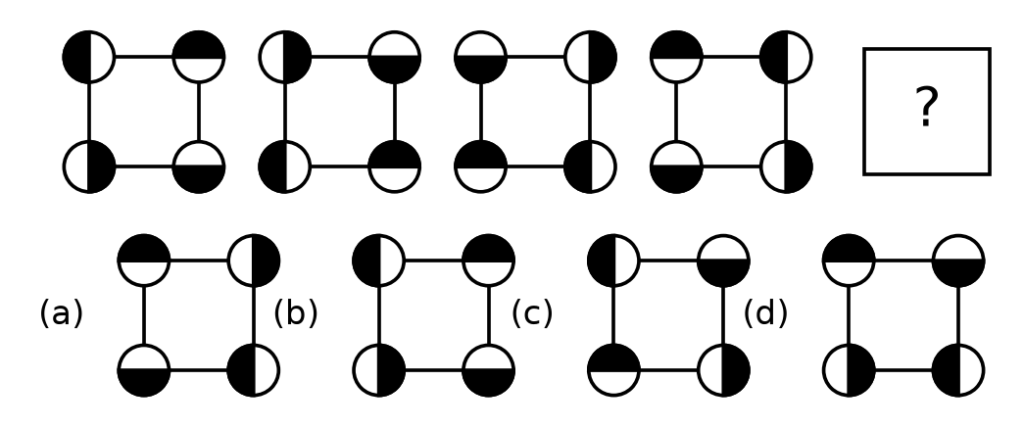
Consider the following figures :
Change in positions of beads in the four figures above follows a sequence. Following the same sequence, which of the figures below should appear as the fifth figure above ?
Answer (b) & explanation
Figure (b) comes fifth (b). Step 1: follow one bead at a time. The top-left bead's dark half moves left, then right, then bottom, then top across the four figures. Step 2: check another bead, the top-right one: top, bottom, right, left. Each bead runs through a 4-step cycle. Step 3: after four steps the cycle starts again, so the fifth figure must look like the first: dark halves left, top, right, bottom. That is figure (b). Options (a), (c) and (d) do not repeat the first figure.
Tip: in sequence questions, if a pattern seems to have four distinct positions, the fifth figure is often a repeat of the first. Check one element at a time.
Answer as per the official UPSC answer key.
The letters L, M, N, O, P, Q, R, S and T in their order are substituted by nine integers 1 to 9 but not in that order. 4 is assigned to P. The difference between P and T is 5. The difference between N and T is 3. What is the integer assigned to N ?
Answer (d) & explanation
N is 6 (d). Step 1: P is 4. The difference between P and T is 5, so T is 4 + 5 = 9 or 4 − 5 = −1. Only numbers 1 to 9 are allowed, so T = 9. Step 2: the difference between N and T is 3, so N is 9 + 3 = 12 or 9 − 3 = 6. 12 is too big, so N = 6. Options (a), (b) and (c) do not satisfy both differences.
Tip: a "difference" can go either way, plus or minus. Try both, then throw out any value outside the allowed range. Here the range 1 to 9 settles each step at once. The letter order L to T is just a distraction.
Answer as per the official UPSC answer key.