
Chapter 25 · Topic 25.3 · Prelims + Mains3 of 3
Governance: Pressure groups
Key points
- Pressure groups influence policy without contesting elections: lobbying, petitions, litigation, media, protests.
- Informal groups (2017): farmers' protests 2020–21 led to repeal of three farm laws in November 2021.
- FCRA: 1976 Act replaced by FCRA, 2010; 2020 amendment bans passing funds on and caps admin spending at 20%.
- SHGs: NABARD Bank Linkage 1992; DAY-NRLM 2011; Kudumbashree 1998.
10 PYQs 2012–2026
Prelims box: facts and traps
- Examples: FICCI, CII, ASSOCHAM; AITUC, INTUC, BMS; IMA, Bar Councils.
Pressure groups
Like students’ representatives who meet the principal: they don’t run the school, but they push for changes.
| Type | Examples |
|---|---|
| Business | FICCI, CII, ASSOCHAM |
| Trade unions | AITUC, INTUC, BMS |
| Farmers | Bharatiya Kisan Union, regional farmers’ bodies |
| Professional | Indian Medical Association, Bar Councils |
| Issue-based and informal | Environmental movements, online campaigns, caste and community bodies |
Mains 2017 asked how pressure groups influence the Indian political process, and whether informal groups are now more powerful than formal ones.
- Methods: lobbying (directly persuading) ministers and committees, petitions and litigation, media campaigns and protests.
- Informal networks matter more now: the farmers’ protests of 2020–21 led to the repeal of the three farm laws in November 2021.
Mains 2026 asked whether pressure groups, social movements and corporate lobbies deepen pluralistic democracy (where many groups compete to be heard), or whether the convergence of corporate wealth and political power threatens institutions.
How do pressure groups influence Indian political process? Do you agree with this view that informal pressure groups have emerged as more powerful than formal pressure groups in recent years?
To what extent do pressure groups, social movements and corporate lobbies deepen pluralistic democracy in India by representing excluded interests? Analyse whether the growing convergence of corporate wealth and political power poses a threat to the autonomy of formal democratic institutions.
What UPSC asks: Prelims: types and examples. Mains: influence of pressure groups (2017, 2026). Next likely angle: lobbying and money in politics.
NGOs and self-help groups
Mains 2021 asked whether civil society and NGOs (non-governmental organisations) can offer an alternative model of public service delivery.
- Strengths: they reach where the State does not (Pratham in learning surveys, SEWA for informal workers).
- Limits: funding gaps, uneven accountability and scale limits.
Foreign funding is controlled by the Foreign Contribution (Regulation) Act (FCRA). Mains 2015 asked about the changes:
- The 1976 Act was replaced by the FCRA, 2010.
- In 2015 the government cancelled registrations of thousands of NGOs for not filing returns.
- The 2020 amendment banned passing funds on to other NGOs and capped administrative spending at 20%.
Can Civil Society and Non-Governmental Organizations present an alternative model of public service delivery to benefit the common citizen? Discuss the challenges of this alternative model.
Examine critically the recent changes in the rules governing foreign funding of NGOs under the Foreign Contribution (Regulation) Act (FCRA), 1976.
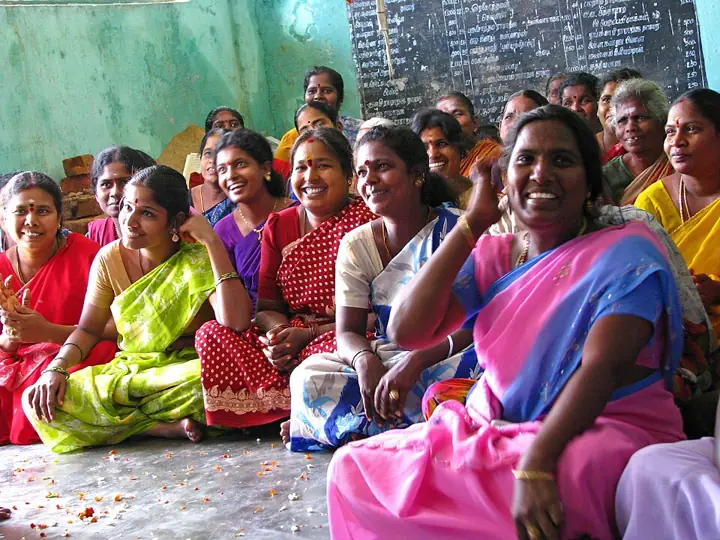
Self-help groups (SHGs) are small groups, usually of 10 to 20 women, who save together and borrow from banks.
- NABARD’s SHG–Bank Linkage Programme began in 1992.
- DAY-NRLM (2011) organises SHGs across rural India.
- Kerala’s Kudumbashree (1998) links them with panchayats.
Mains 2020 quoted “Micro-Finance as an anti-poverty vaccine”. Mains 2017 asked whether the rise of SHGs shows the State withdrawing from development. In fact the State funds and promotes them, though critics say it shifts risk onto poor women.
What UPSC asks: Prelims: FCRA; SHG–Bank Linkage. Mains: NGOs (2021); FCRA (2015); SHGs (2017, 2020). Next likely angle: Lakhpati Didi and SHG credit.
Mains box: analysis and answer points
- 2026: pluralism vs corporate–political convergence. 2021: NGOs as alternative delivery. 2017/2020: SHGs and micro-finance.
Practice
Prelims PYQs on this topic (4)
Which of the following statements with respect to the Revamped Rashtriya Gram Swaraj Abhiyan (RGSA) is/are correct ?
- 1. The period of its implementation is 1st April, 2021 to 31st March, 2026.
- 2. The key objective of the Revamped RGSA is to develop the governance capabilities of the Panchayati Raj Institutions to deliver on the Sustainable Development Goals.
- 3. The share of the Central funding for the Revamped RGSA is 100% for all States and Union Territories.
Select the answer using the code given below :
Answer (b) & explanation
Only statement 2 is correct (b). Statement 2 is right: the Revamped RGSA aims to build the governance capacity of Panchayati Raj Institutions to deliver on the SDGs. Statement 1 is wrong: it was approved in 2022 to run from 2022-23 to 2025-26, not from April 2021. Statement 3 is wrong: funding is shared 60:40 with States (90:10 for north-eastern and hill States); only Union Territories get 100%. So options (a), (c) and (d) fail.
Notice the link: the RGSA uses the Localisation of SDGs approach through nine themes, such as poverty-free and healthy villages. The 73rd Amendment (1992) gave Panchayats constitutional status. 24 April is National Panchayati Raj Day.
"100% for all" is the giveaway. Centrally sponsored schemes almost always share costs with States.
Answer as per the official UPSC answer key.
The Government enacted the Panchayat Extension to Scheduled Areas (PESA) Act in 1996. Which one of the following is *not* identified as its objective?
Answer (c) & explanation
Creating autonomous regions is not a PESA objective (c). PESA (1996) extends Part IX on panchayats to Fifth Schedule areas, with changes that give tribal communities self-governance through the Gram Sabha (a), respect their customary and traditional rights over resources (b), and protect them from exploitation such as land alienation and money-lending (d). Option (c) is wrong: autonomous district councils belong to the Sixth Schedule areas of Assam, Meghalaya, Tripura and Mizoram, not PESA.
Notice the coverage: PESA applies to Fifth Schedule areas in ten states, including Jharkhand, Chhattisgarh and Odisha; Jharkhand notified its PESA rules only in January 2026. The Bhuria Committee (1995) recommended the law. Trap: Fifth and Sixth Schedules are easily mixed up.
Answer as per the official UPSC answer key.
According to the Constitution of India, which of the following are fundamental for the governance of the country?
Answer (c) & explanation
Directive Principles of State Policy is correct (c). Article 37 says the Directive Principles are not enforceable by any court, but they are 'nevertheless fundamental in the governance of the country', and the State must apply them in making laws. (a) is wrong: Fundamental Rights are enforceable but are not described in these words. (b) and (d) are wrong: Fundamental Duties (Article 51A) apply to citizens and are not called fundamental for governance.
Notice the balance: in Minerva Mills (1980), the Supreme Court held that harmony between Fundamental Rights and DPSPs is part of the basic structure. DPSPs were borrowed from the Irish Constitution, and B.R. Ambedkar called them 'novel features'. Trap: the word 'fundamental' appears in all options, but the phrase belongs to Article 37.
Answer as per the official UPSC answer key.
Which of the following can be said to be essentially the parts of ‘Inclusive Governance’?
- 1. Permitting the Non-Banking Financial Companies to do banking
- 2. Establishing effective District Planning Committees in all the districts
- 3. Increasing the government spending on public health
- 4. Strengthening the Mid-day Meal Scheme
Select the correct answer using the codes given below :
Answer (c) & explanation
Statements 2, 3 and 4 are correct (c). Inclusive governance means planning and services reach everyone, especially the poor. Effective District Planning Committees bring local participation into planning (2). More public health spending widens access to care (3). A stronger Mid-day Meal Scheme improves nutrition and school attendance (4). Statement 1 is wrong: letting NBFCs do banking is a financial-sector reform, not essentially an inclusion measure. So (a), (b) and (d) fail.
Notice the current versions: Mid-day Meal is now PM POSHAN (2021), and the National Health Policy 2017 targets public health spending of 2.5% of GDP. Small Finance Banks and Payments Banks (2015) are the inclusion-focused route for non-bank players. Trap: 'banking' sounds inclusive but the measure as stated is not.
Answer as per the official UPSC answer key.
Mains PYQs on this topic (6)
- UPSC Mains 2026 · GS Paper II · Q15To what extent do pressure groups, social movements and corporate lobbies deepen pluralistic democracy in India by representing excluded interests? Analyse whether the growing convergence of corporate wealth and politica…How to approach: Intro: pluralism. Body: positive role; limits; corporate–political convergence and its risks; safeguards. Conclusion.
- UPSC Mains 2025 · GS Paper II · Q15What are environmental pressure groups? Discuss their role in raising awareness, influencing policies and advocating for environmental protection in India.How to approach: Intro: definition. Body: (1) Raising awareness; (2) Influencing policy; (3) Advocacy and litigation; (4) Limitations. Conclusion: Pressure groups are the consci…
- UPSC Mains 2026 · GS Paper II · Q6Does India's tribal development policy reflect the aspirations for a socially grounded and equity-based governance? Justify your answer.How to approach: Intro: the Nehru–Elwin Panchsheel and the constitutional framework. Body: evidence for (Fifth/Sixth Schedules, PESA, FRA, EMRS, PM-JANMAN) and against (displace…
- UPSC Mains 2026 · GS Paper II · Q7Malnutrition in India is not merely a public health concern; it is also a challenge of social equity, human development and effective welfare governance. Discuss.How to approach: Intro: NFHS-5 burden. Body: three lenses with evidence. Way forward. Conclusion.
- UPSC Mains 2026 · GS Paper II · Q8Analyse the advantages and limitations of the generalist structure of the Indian Civil Services in contemporary governance.How to approach: Intro: the 'steel frame' generalist model. Body: advantages; limitations; reforms (domain specialisation, lateral entry, Mission Karmayogi). Conclusion.
- UPSC Mains 2026 · GS Paper II · Q10“BRICS acts as a powerful counterweight in global governance, actively amplifying the voice and influence of the Global South.” Explain the role of BRICS in projecting itself as an alternative to other groupings.How to approach: Intro: BRICS origins and expansion. Body: tools of the alternative role; limits; India's approach. Conclusion.
Write an answer
In 150 words, explain the significance of Governance with one recent example.
Flashcards (5)
Name two business pressure groups.
FICCI and CII.
Which law controls foreign funding of NGOs
now? The FCRA, 2010.
Cap on administrative expenses under the
2020 FCRA amendment? 20%.
When did the SHG–Bank Linkage
Programme start? 1992 (NABARD).
Which Kerala programme links SHGs with
panchayats? Kudumbashree (1998).
Read more: related explainers
- Pressure Groups in India: Meaning, Types, Methods, Difference from Political Parties and Role in Democracy (UPSC Notes)
- National Sports Governance Act, 2025: National Sports Board, National Sports Tribunal, Rules for Sports Federations, Athletes' Voice, BCCI Question and Sports Policy
- Self-Help Groups in India: Meaning, SHG-Bank Linkage, DAY-NRLM, Kudumbashree, Lakhpati Didi and Challenges
In the news
- 25 Oct 2026Census 2027: can private teachers be made enumerators? The Census Rules amendment and Article 23
- 25 Oct 202611 crore Farmer IDs created five months early under the Digital Agriculture Mission and Agri Stack
- 25 Oct 2026Vehicle data sold for ₹5: Centre orders CERT-In audit of VAHAN, SARATHI and e-Challan portals
- 24 Oct 2026Panel to review pharma marketing code: UCPMP 2024 and why a voluntary code is not enough
 Indian Polity →All Indian Polity topics
Syllabus: GS-II · Development processes and the development industry —the role of NGOs, SHGs, vari…