
Coding-decoding, series, patterns, cubes, dice and visual reasoning: previous-year questions
95 real UPSC Prelims questions (2011–2026) with the official answer and a clear explanation. 34 of them came in the last five papers.
How often UPSC asks this
Questions per year, counted from the official papers.
Attempt the questions
Newest papers first. Tap an option; the answer and the reason appear instantly.
In a code language 'MATHEMATICS' is written as 'LBSIDNZUHDR'. How is 'CHEMISTRY' written in that code language ?
Answer (b) & explanation
CHEMISTRY is written BIDNHTSSX (b). Step 1: compare MATHEMATICS with LBSIDNZUHDR letter by letter. M → L (−1), A → B (+1), T → S (−1), H → I (+1). The moves alternate −1, +1. Step 2: apply this to CHEMISTRY: C−1 = B, H+1 = I, E−1 = D, M+1 = N, I−1 = H, S+1 = T, T−1 = S, R+1 = S, Y−1 = X. Step 3: the code is BIDNHTSSX. Option (c) has L and T, getting M wrong. Options (a) and (d) start with the wrong move.
Tip: in coding questions, check the first four letters to find the pattern. Then look at only the letters where the options differ.
Answer as per the official UPSC answer key.
In the series _b_a_ba_b_abab_aab; fill in the six blanks ( _ ) using one of the following given four choices such that the series follows a specific order.
Answer (d) & explanation
The blanks are filled by ababab (d). Step 1: put the letters a, b, a, b, a, b into the six blanks in order. Step 2: the series becomes abbaab abbaab abbaab. Step 3: the block "abbaab" repeats three times, so the series has a clear order. Options (a) bababa, (b) baabba and (c) bbaabb break this repeating pattern.
Tip: in letter-series questions, try each option and look for a block that repeats. The series length (18 here) often hints at the block size (6).
Answer as per the official UPSC answer key.
A simple mathematical operation in each number of the sequence 14, 18, 20, 24, 30, 32, ... results in a sequence with respect to prime numbers. Which one of the following is the next number in the sequence?
Answer (c) & explanation
The next number is 38 (c). Step 1: subtract 1 from each term: 14 − 1 = 13, 18 − 1 = 17, 20 − 1 = 19, 24 − 1 = 23, 30 − 1 = 29, 32 − 1 = 31. Step 2: these are prime numbers in order: 13, 17, 19, 23, 29, 31. Step 3: the next prime after 31 is 37. Add 1 back: 38. Option (a), 34, would need 33, not prime. Option (b), 36, needs 35, not prime. Option (d), 40, skips 37.
Tip: when a question hints at primes, try adding or subtracting 1 from each term. Know the primes up to 100 by heart.
Answer as per the official UPSC answer key.
Consider the following arrangement that has some missing letters :
abab_b_bcb_dcdcded_d
The missing letters which complete the arrangement are
Answer (c) & explanation
The missing letters are a, c, c, e (c). Step 1: there are 20 letters. Split them into blocks of five: abab_ | b_bcb | _dcdc | ded_d. Step 2: each block alternates two letters: ababa, bcbcb, cdcdc, deded. Each new block moves one letter forward. Step 3: the blanks are a, c, c, e. That is option (c). Options (a), (b) and (d) break the alternating pattern.
Tip: count the total letters, then try equal blocks. A clean split (here 4 blocks of 5) usually shows the rule at once.
Answer as per the official UPSC answer key.
Consider the following sequence of numbers :
5 1 4 7 3 9 8 5 7 2 6 3 1 5 8 6 3 8 5 2 2 4 3 4 9 6
How many odd numbers are followed by the odd number in the above sequence?
Answer (b) & explanation
6 odd numbers are followed by an odd number (b). Step 1: go through the sequence and mark each pair of neighbours where both are odd. Step 2: the pairs are: 5 1, 7 3, 3 9, 5 7, 3 1 and 1 5. Step 3: that is 6 pairs. Each pair counts one odd number followed by an odd number. Options (a), (c) and (d) miscount.
Tip: in such counting questions, move through the list once, slowly, and tick each pair. Counting in a hurry is the main source of error. Odd digits are 1, 3, 5, 7 and 9.
7 3 9 gives two pairs (7 3 and 3 9). Count overlapping pairs separately.
Answer as per the official UPSC answer key.
The letters from A to Z are numbered from 1 to 26 respectively. If GHI = 1578 and DEF = 912, then what is ABC equal to?
Answer (d) & explanation
ABC equals 246 (d). Step 1: GHI → DEF → ABC: each letter moves back 3 places at each step. So the code should change by the same amount each step. Step 2: 1578 − 912 = 666. Step 3: ABC = 912 − 666 = 246. Options (a), (b) and (c) do not fit.
Tip: if letter groups shift by a fixed step, their codes often shift by a fixed amount too. Find the gap between two known codes and apply it once more.
Answer as per the official UPSC answer key.
What is the missing term @ in the following?
ACPQ : BESU :: MNGI : @
Answer (d) & explanation
The missing term is NPJM (d). Step 1: find the rule from ACPQ to BESU. A → B (+1), C → E (+2), P → S (+3), Q → U (+4). Step 2: apply it to MNGI. M + 1 = N, N + 2 = P, G + 3 = J, I + 4 = M. Step 3: so the answer is NPJM. Option (a), NPJL, ends with +3 instead of +4. Option (b), NOJM, uses +1 for the second letter. Option (c), NPIL, gets the last two wrong.
Tip: in letter analogies, write the shift for each position. A growing pattern (+1, +2, +3, +4) is very common.
Answer as per the official UPSC answer key.
What is X in the sequence
4, 196, 16, 144, 36, 100, 64, X?
Answer (b) & explanation
X is 64 (b). Step 1: split the series into two. Odd places: 4, 16, 36, 64 = 2², 4², 6², 8². Step 2: even places: 196, 144, 100 = 14², 12², 10². They fall by 2 each time. Step 3: X is in an even place, so X = 8² = 64. Option (d), 256, continues the odd-place series (16²) by mistake. Options (a) and (c) do not fit.
Tip: when a series jumps up and down, it is often two series mixed together. Separate the odd and even places. Knowing squares up to 25² and cubes up to 15³ makes such questions quick.
Answer as per the official UPSC answer key.
Consider the following sequence that follows some arrangement :
c_accaa_aa_bc_b
The letters that appear in the gaps are
Answer (b) & explanation
The letters in the gaps are c, b, b, b (b). Step 1: split the series into blocks of five: c_acc | aa_aa | _bc_b. Step 2: each block has the pattern XXYXX: two of one letter, one different letter, then two of the first. Filling in: ccacc, aabaa, bbcbb. Step 3: the gaps, in order, are c, b, b, b. That is option (b). Options (a), (c) and (d) break the XXYXX pattern.
Tip: in letter series, count the total letters and try splitting them into equal blocks (of 4, 5 or 6). A repeating block usually becomes clear at once.
Answer as per the official UPSC answer key.
If every alternative letter of the English alphabet from B onwards (including B) is written in lower case (small letters) and the remaining letters are capitalized, then how is the first month of the second half of the year written ?
Answer (d) & explanation
July is written jUlY (d). Step 1: from B onwards, every alternate letter, B, D, F, H and so on, is written small. These are the letters at even places in the alphabet (B = 2, D = 4). The odd-place letters stay capital. Step 2: the first month of the second half of the year is JULY. Step 3: J is the 10th letter (even) → j. U is 21st (odd) → U. L is 12th (even) → l. Y is 25th (odd) → Y. So it is jUlY. Options (a), (b) and (c) get at least one letter wrong.
Tip: memorise letter positions with "EJOTY": E = 5, J = 10, O = 15, T = 20, Y = 25. It speeds up all alphabet questions.
Answer as per the official UPSC answer key.
In the sequence 1, 5, 7, 3, 5, 7, 4, 3, 5, 7, how many such 5s are there which are not immediately preceded by 3 but are immediately followed by 7 ?
Answer (a) & explanation
Only one 5 fits the rule (a). Step 1: list each 5 with its neighbours. The sequence is 1, 5, 7, 3, 5, 7, 4, 3, 5, 7. First 5: before it is 1, after it is 7. Second 5: before it is 3, after it is 7. Third 5: before it is 3, after it is 7. Step 2: we need a 5 not after 3 but followed by 7. Step 3: the second and third 5s come right after a 3, so they fail. Only the first 5 qualifies. The answer is 1. Options (b), (c) and (d) miscount.
Tip: in such questions, mark each target number and check both sides one by one. Rushing leads to missed or extra counts.
Answer as per the official UPSC answer key.
Each face of a cube can be painted in black or white colours. In how many different ways can the cube be painted ?
Answer (b) & explanation
A cube can be painted in 10 different ways (b). Step 1: count by the number of black faces. 0 black: 1 way. 1 black: 1 way (any face looks the same after turning). Step 2: 2 black: 2 ways, either next to each other or opposite. 3 black: 2 ways, either all three meeting at a corner, or in a row like a band. Step 3: 4 black is the same as 2 white: 2 ways. 5 black: 1 way. 6 black: 1 way. Total = 1 + 1 + 2 + 2 + 2 + 1 + 1 = 10. Options (a), (c) and (d) miscount.
Tip: two cube colourings are the same if one can be turned to look like the other. Count patterns, not face labels.
a cube can be turned, so two paintings that match after turning are the same.
Answer as per the official UPSC answer key.
If $ means 'divided by'; @ means 'multiplied by'; # means 'minus', then the value of 10#5@1$5 is
Answer (d) & explanation
The value is 9 (d). Step 1: replace the symbols: # is minus, @ is times, $ is divided by. So 10#5@1$5 becomes 10 − 5 × 1 ÷ 5. Step 2: by BODMAS, do multiplication and division first, left to right: 5 × 1 = 5, then 5 ÷ 5 = 1. Step 3: then subtract: 10 − 1 = 9. Option (b), 1, works left to right without BODMAS: (10 − 5) × 1 ÷ 5 = 1. Options (a) and (c) are also wrong.
Tip: after swapping symbols, always apply BODMAS: Brackets, Orders, Division and Multiplication, then Addition and Subtraction. The trap answer usually comes from working left to right.
Answer as per the official UPSC answer key.
A solid cube is painted yellow, blue and black such that opposite faces are of same colour. The cube is then cut into 36 cubes of two different sizes such that 32 cubes are small and the other four cubes are big. None of the faces of the bigger cubes is painted blue. How many cubes have only one face painted ?
Answer (c) & explanation
1. Volume check: 4 big cubes of side 2 and 32 small cubes of side 1 give 32 + 32 = 64, so the cube is 4 × 4 × 4.
2. The big cubes avoid both blue faces, so they fill the middle two layers between the blue faces. The two blue layers (16 small cubes each) hold the 32 small cubes.
3. In each blue layer only the inner 2 × 2 = 4 cubes have just the blue face painted. The big cubes each touch two side faces. Total = 4 + 4 = 8.
Answer as per the official UPSC answer key.
What is X in the sequence
132, 129, 124, 117, 106, 93, X?
Answer (c) & explanation
X is 76 (c). Step 1: find the drops: 132 − 129 = 3, 129 − 124 = 5, 124 − 117 = 7, 117 − 106 = 11, 106 − 93 = 13. Step 2: 3, 5, 7, 11, 13 are prime numbers in order. The next prime is 17. Step 3: X = 93 − 17 = 76. Option (b), 75, and option (d), 77, use the wrong drop. Option (a), 74, subtracts 19, skipping a prime.
Tip: when gaps are 2, 3, 5, 7, 11, 13 or similar, think of primes. Note that 9 is skipped because it is not prime. Always write out the differences first in number series.
Answer as per the official UPSC answer key.
Consider the following pattern of numbers :
| 8 | 10 | 15 | 13 |
|---|---|---|---|
| 6 | 5 | 7 | 4 |
| 4 | 6 | 8 | 8 |
| 6 | 11 | 16 | ? |
What is the number at ? in the above pattern?
Answer (a) & explanation
The missing number is 17 (a). Step 1: look for a rule that works down each column. Here: top − middle + third = bottom. Step 2: check it on the known columns: 8 − 6 + 4 = 6, 10 − 5 + 6 = 11, and 15 − 7 + 8 = 16. The rule works every time. Step 3: apply it to the last column: 13 − 4 + 8 = 17. Options (b) 19, (c) 21 and (d) 23 come from adding all three numbers or using a wrong sign.
Tip: in number grids, try simple operations (add, subtract, multiply) on each column or row. Only accept a rule after it works on every complete column, not just one.
Answer as per the official UPSC answer key.
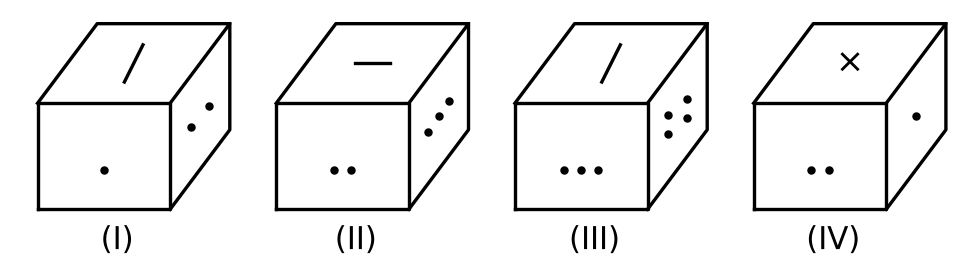
Directions for the following 3 (three) items : Rotated positions of a single solid are shown below. The various faces of the solid are marked with different symbols like dots, cross and line. Answer the three items that follow the given figures.
What is the symbol on the face opposite to that containing a single dot?
Answer (b) & explanation
1. The six faces are: line, cross, one dot, two dots, three dots, four dots.
2. The line is seen next to one, two, three and four dots, so the only face left for its opposite is the cross.
3. The four dot faces go round the middle: 1 is next to 2, 2 is next to 3, 3 is next to 4. So the order round the ring is 1, 2, 3, 4.
4. In a ring of four, the face two steps away is opposite. So one dot is opposite three dots.
Answer as per the official UPSC answer key.
(Same figures as the question above.)
What is the symbol on the face opposite to that containing two dots?
Answer (c) & explanation
Four dots are opposite two dots (c). Step 1: from the given views of the cube, the faces around the middle ring run in the order 1, 2, 3, 4 dots. Step 2: on a ring of four faces, a face is opposite the one two steps away. Step 3: two steps from two dots is four dots. Option (a), single dot, and option (b), three dots, are next to two dots, so they cannot be opposite. Option (d), line, touches all four dot faces, so it is not opposite any of them.
Tip: on a cube, each face touches four others and is opposite one. Faces that appear next to each other in any view can never be opposite.
Answer as per the official UPSC answer key.
(Same figures as the question above.)
What is the symbol on the face opposite to that containing the cross?
Answer (c) & explanation
The line is opposite the cross (c). Step 1: from the views, the line appears next to all four dot faces (one, two, three and four dots). Step 2: a face touching four others must be opposite the sixth face. Step 3: the only face left is the cross. So the cross is opposite the line. Options (a) single dot, (b) two dots and (d) four dots are all neighbours of the line in the ring, and they pair with each other as opposites.
Tip: when one face touches four others, its opposite is the one face it never touches. This shortcut solves many dice and cube questions in one step.
Answer as per the official UPSC answer key.
If LSJXVC is the code for MUMBAI, the code for DELHI is
Answer (a) & explanation
DELHI is written as CCIDD (a). Step 1: compare MUMBAI with LSJXVC letter by letter. M → L is −1, U → S is −2, M → J is −3, B → X is −4 (going back round the alphabet), A → V is −5, and I → C is −6. So each letter moves back one more step than the last. Step 2: apply it to DELHI. D − 1 = C, E − 2 = C, L − 3 = I, H − 4 = D, I − 5 = D. Step 3: the code is CCIDD. Options (b), (c) and (d) break the pattern at one or more letters.
Tip: write the alphabet with numbers (A = 1 … Z = 26) to count shifts quickly. Going back from A wraps round to Z.
Answer as per the official UPSC answer key.