
CSAT (Paper II): previous-year questions
1280 real UPSC Prelims questions (2011–2026) with the official answer and a clear explanation. 400 of them came in the last five papers.
How often UPSC asks this
Questions per year, counted from the official papers.
Subtopics
Arrangements, ranking, ordering and puzzles
142 questions
Clocks and calendars
5 questions
Coding-decoding, series, patterns, cubes, dice and visual reasoning
110 questions
Communication, interpersonal skills and decision-making
10 questions
Counting, permutations, combinations and probability
1 questions
Directions, blood relations and Venn diagrams
60 questions
General English: grammar, vocabulary and comprehension
20 questions
General Hindi: grammar, vocabulary, dialects and comprehension
25 questions
Geometry and mensuration
26 questions
Number system and basic algebra (divisibility, HCF/LCM, remainders, digits, equations)
196 questions
Percentages, profit and loss, discount, simple and compound interest
47 questions
Ratio, proportion, averages, mixtures and alligation
47 questions
Syllogisms, statements and conclusions, assumptions and arguments
89 questions
Time and work; pipes and cisterns
2 questions
Time, speed and distance; trains, boats and streams; races
48 questions
Attempt the questions
Newest papers first. Tap an option; the answer and the reason appear instantly.
(Same information as the question above.)
How many males were undecided?
Answer (a) & explanation
31 is correct (a). Step 1: everyone who was undecided = total − against − for = 2,878 − 1,226 − 1,425 = 227. Step 2: 196 of the undecided were females. Step 3: so undecided males = 227 − 196 = 31. Check with the male row: males for = 1,425 − 600 = 825; 825 + 796 + 31 = 1,652. It matches. So (b), (c) and (d) fail.
Tip: always check your answer with a second route through the table. If the row and column totals agree, you are right.
Answer as per the official UPSC answer key.
Read the passage
The concept of ‘creative society’ refers to a phase of development of a society in which a large number of potential contradictions become articulate and active. This is most evident when oppressed social groups get politically mobilised and demand their rights. The upsurge of the peasants and tribals, the movements for regional autonomy and self-determination, the environmental movements, and the women’s movements in the developing countries are signs of emergence of creative society in contemporary times. The forms of social movements and their intensity may vary from country to country and place to place within a country. But the very presence of movements for social transformation in various spheres of a society indicates the emergence of a creative society in a country.
With reference to the passage, consider the following statements :
- 1. To be a creative society, it is essential to have a variety of social movements.
- 2. To be a creative society, it is imperative to have potential contradictions and conflicts.
Which of the statements given above is/are correct ?
Answer (c) & explanation
Both statements are correct (c). Step 1: the passage says 'the very presence of movements for social transformation in various spheres' indicates a creative society. So a variety of social movements is essential: statement 1 follows. Step 2: the definition itself rests on 'potential contradictions becom[ing] articulate and active'. Without contradictions and conflicts, there is no creative society: statement 2 follows. Step 3: since both come straight from the definition, options (a), (b) and (d) fail.
Tip: when a passage defines a term, every key part of the definition becomes a necessary condition. Check each statement against those parts.
Answer as per the official UPSC answer key.
Three persons start walking together and their steps measure 40 cm, 42 cm and 45 cm respectively. What is the minimum distance each should walk so that each can cover the same distance in complete steps?
Answer (a) & explanation
25 m 20 cm is correct (a). Step 1: each person must cover the same distance in whole steps, so the distance must be a multiple of 40, 42 and 45. The minimum is their LCM. Step 2: break into primes: 40 = 2³ × 5; 42 = 2 × 3 × 7; 45 = 3² × 5. LCM = 2³ × 3² × 5 × 7 = 2,520 cm. Step 3: 2,520 cm = 25 m 20 cm. The other options are 2, 3 and 4 times this, so they are not the minimum. So (b), (c) and (d) fail.
Tip: 'minimum common distance' or 'first time together' means LCM. Take the highest power of each prime factor.
Answer as per the official UPSC answer key.
Read the passage
In spring, polar bear mothers emerge from dens with three month old cubs. The mother bear has fasted for as long as eight months but that does not stop the young from demanding full access to her remaining reserves. If there are triplets, the most persistent stands to gain an extra meal and it may have the meal at the expense of others. The smallest of the litter forfeits many meals to stronger siblings. Females are protective of their cubs but tend to ignore family rivalry over food. In 21 years of photographing polar bears, I’ve only once seen the smallest of triplets survive till autumn.
With reference to the passage, the following assumptions have been made :
- 1. Polar bears fast as long as eight months due to non-availability of prey.
- 2. Polar bears always give birth to triplets.
Which of the assumptions given above is/are valid ?
Answer (d) & explanation
Neither assumption is valid (d). Step 1: assumption 1 gives a reason for the eight-month fast: no prey. The passage says the mother 'has fasted for as long as eight months' but never gives the cause. So 1 is not valid. Step 2: assumption 2 says polar bears always give birth to triplets. The passage says 'If there are triplets', which shows that litter sizes vary. So 2 is not valid. Step 3: options (a), (b) and (c) fail.
Tip: 'if' signals a possibility, not a rule, so 'always' fails. And a fact stated without its cause cannot support an assumption about the cause.
Answer as per the official UPSC answer key.
Read the passage
Ecosystems provide people with a variety of goods and services; food, clean water, clean air, flood control, soil stabilization, pollination, climate regulation, spiritual fulfilment and aesthetic enjoyment, to name just a few. Most of these benefits either are irreplaceable or the technology necessary to replace them is prohibitively expensive. For example, potable fresh water can be provided by desalinating sea-water, but only at great cost.
The rapidly expanding human population has greatly modified the Earth’s ecosystems to meet their increased requirements of some of the goods and services, particularly food, fresh water, timber, fibre and fuel. These modifications have contributed substantially to human well being and economic development. The benefits have not been equally distributed. Some people have actually been harmed by these changes. Moreover, short-term increases in some ecosystem goods and services have come at the cost of the long-term degradation of others. For example, efforts to increase the production of food and fibre have decreased the ability of some ecosystems to provide clean water, regulate flooding and support biodiversity.
With reference to the passage, consider the following statements :
- 1. It is imperative to modify the Earth’s ecosystems for the well being of mankind.
- 2. Technology can never replace all the goods and services provided by ecosystems.
Which of the statements given above is/are correct ?
Answer (d) & explanation
Neither statement is correct (d). Step 1: statement 1 says it is imperative to modify ecosystems. The passage only records that modifications happened and helped development; it never says they are necessary, and it stresses the harm. So 1 is wrong. Step 2: statement 2 says technology can never replace ecosystem services. The passage says most are irreplaceable or the technology is 'prohibitively expensive', and gives desalination as a costly but working replacement. So 'never' overstates it. Step 3: options (a), (b) and (c) fail.
Tip: strong words like 'imperative', 'never' and 'always' are red flags. Check whether the passage is that absolute.
Answer as per the official UPSC answer key.
The houses of A and B face each other on a road going north-south, A's being on the western side. A comes out of his house, turns left, travels 5 km, turns right, travels 5 km to the front of D's house. B does exactly the same and reaches the front of C's house. In this context, which one of the following statements is correct?
Answer (c) & explanation
Less than 20 km apart is correct (c). Step 1: A lives on the west side, so he faces east when he comes out. Turning left means going north 5 km; turning right then means going east 5 km. So D's house is 5 km north and 5 km east of A. Step 2: B lives on the east side and faces west. Left means south 5 km; right then means west 5 km. So C's house is 5 km south and 5 km west of B. Step 3: C and D are about 10 km apart north–south and roughly 10 km apart east–west, so the straight distance is about 14 km, well under 20 km. (a) and (b) cannot be fixed from the data. So (a), (b) and (d) fail.
Tip: draw it. Mark which way each person faces first; 'left' depends on that.
Answer as per the official UPSC answer key.
Read the passage
A country under foreign domination seeks escape from the present in dreams of a vanished age, and finds consolation in visions of past greatness. That is a foolish and dangerous pastime in which many of us indulge. An equally questionable practice for us in India is to imagine that we are still spiritually great though we have come down in the world in other respects. Spiritual or any other greatness cannot be founded on lack of freedom and opportunity, or on starvation and misery. Many western writers have encouraged that notion that Indians are other-worldly. I suppose the poor and unfortunate in every country become to some extent other-worldly, unless they become revolutionaries, for this world is evidently not meant for them. So also subject peoples.
As a man grows to maturity he is not entirely engrossed in, or satisfied with, the external objective world. He seeks also some inner meaning, some psychological and physical satisfactions. So also with peoples and civilizations as they mature and grow adult. Every civilization and every people exhibit these parallel streams of an external life and an internal life. Where they meet or keep close to each other, there is an equilibrium and stability. When they diverge conflict arises and the crises that torture the mind and spirit.
According to the passage, the torture of the mind and spirit is caused
Answer (c) & explanation
Lack of equilibrium between external and internal life is correct (c). Step 1: find the phrase. The passage says every people has 'parallel streams of an external life and an internal life'. Step 2: 'Where they meet or keep close to each other, there is an equilibrium and stability. When they diverge conflict arises and the crises that torture the mind and spirit.' So the cause is the loss of balance between the two lives: (c). Step 3: (a) and (b) mention foreign domination, which appears in the first paragraph, not as the cause of this torture. (d) is invented. So (a), (b) and (d) fail.
Tip: when a question quotes a phrase, find that exact phrase and read the sentence just before it. The cause is usually right there.
Answer as per the official UPSC answer key.
(Same information as the question above.)
How many females were not in favour of the proposal?
Answer (a) & explanation
430 is correct (a). Step 1: 'not in favour' here means those who voted against, as UPSC's key takes it. Step 2: females against = total against − males against = 1,226 − 796 = 430. Step 3: if you also added the 196 undecided females, you would get 626, which is not an option, confirming the intended reading. (b), (c) and (d) do not match. So (b), (c) and (d) fail.
Tip: when a phrase is ambiguous ('not in favour' could include undecided), check which reading gives an option. The options often tell you the intended meaning.
Answer as per the official UPSC answer key.
Consider the following three statements:
- 1. Only students can participate in the race.
- 2. Some participants in the race are girls.
- 3. All girl participants in the race are invited for coaching.
Which one of the following conclusions can be drawn from the above statements?
Answer (c) & explanation
All participants are students is correct (c). Step 1: 'Only students can participate' means every participant is a student. That is option (c), drawn directly. Step 2: check (a). Only girl participants are invited for coaching; boys who participate may not be. So 'all participants are invited' goes too far. Step 3: check (b). Not every student takes part in the race, and only girl participants are invited, so 'all students are invited' is also wrong. So (a), (b) and (d) fail.
Tip: 'only A can do B' means 'everyone who does B is A'. Turn 'only' into 'all ... are' and the answer pops out.
Answer as per the official UPSC answer key.
If a bus travels 160 km in 4 hours and a train travels 320 km in 5 hours at uniform speeds, then what is the ratio of the distances travelled by them in one hour?
Answer (b) & explanation
5 : 8 is correct (b). Step 1: the bus covers 160 km in 4 hours, so in one hour it covers 160 ÷ 4 = 40 km. Step 2: the train covers 320 km in 5 hours, so in one hour it covers 320 ÷ 5 = 64 km. Step 3: the ratio is 40 : 64. Divide both by 8: 5 : 8. (a) reverses the order, a common trap. So (a), (c) and (d) fail.
Tip: always keep the ratio in the order the question asks (bus first, train second). Reversed answers are always among the options.
Answer as per the official UPSC answer key.
Directions: each item describes a situation and is followed by four possible responses. Indicate the response you find most appropriate. There is no penalty for wrong answers for these items. You have been asked to give an explanation for not attending an important official meeting. Your immediate boss who has not informed you about the meeting is now putting pressure on you not to place an allegation against him/her. You would
Answer (a) & explanation
UPSC's key lists two responses (a) and (b), and these items carried no negative marking. Step 1: the boss did not inform you, and now pressures you to hide this. Step 2: (a) sending a written reply that states the facts, and (b) explaining the situation to the top boss in person, both keep to the truth without making accusations beyond the facts. Step 3: (c) is wrong: admitting a fault that is not yours is dishonest. (d) is wrong: blaming the coordinator shifts responsibility unfairly.
Tip: for these interpersonal items, pick the response that is lawful, honest and keeps the public work going. Avoid options that give in to pressure, pass the buck or abandon duty.
Answer as per the official UPSC answer key.
Read the passage
A moral act must be our own act; must spring from our own will. If we act mechanically, there is no moral content in our act. Such action would be moral, if we think it proper to act like a machine and do so. For, in doing so, we use our discrimination. We should bear in mind the distinction between acting mechanically and acting intentionally. It may be moral of a king to pardon a culprit. But the messenger carrying out the order of pardon plays only a mechanical part in the king’s moral act. But if the messenger were to carry out the king’s order considering it to be his duty, his action would be a moral one. How can a man understand morality who does not use his own intelligence and power of thought, but lets himself be swept along like a log of wood by a current ? Sometimes a man defies convention and acts on his own with a view to absolute good.
Which of the following statements best describe/describes the thought of the writer ?
- 1. A moral act calls for using our discretion.
- 2. Man should react to a situation immediately.
- 3. Man must do his duty.
- 4. Man should be able to defy convention in order to be moral.
Select the correct answer from the codes given below :
Answer (d) & explanation
Statements 1 and 4 are correct per UPSC's key (d), though statement 3 is arguable. Step 1: the passage says a moral act uses 'our discrimination' and must spring from our own will: statement 1. Step 2: it says a man sometimes 'defies convention and acts on his own with a view to absolute good': statement 4. Step 3: statement 2 is wrong; the passage never asks for immediate reaction. Statement 3 is the doubt: the messenger acting from duty is called moral, so duty matters, but the writer stresses conscious choice, not duty as such; UPSC left it out. So (a), (b) and (c) fail on the key.
Tip: pick statements that capture the writer's core idea, here thinking for oneself, rather than examples used along the way.
Answer as per the official UPSC answer key.
Read the passage
Now India’s children have a right to receive at least eight years of education, the gnawing question is whether it will remain on paper or become a reality. One hardly needs a reminder that this right is different from the others enshrined in the Constitution, that the beneficiary – a six year old child cannot demand it, nor can she or he fight a legal battle when the right is denied or violated. In all cases, it is the adult society which must act on behalf of the child. In another peculiarity, where a child’s right to education is denied, no compensation offered later can be adequate or relevant. This is so because childhood does not last. If a legal battle fought on behalf of a child is eventually won, it may be of little use to the boy or girl because the opportunity missed at school during childhood cannot serve the same purpose later in life. This may be painfully true for girls because our society permits them only a short childhood, if at all. The Right to Education (RTE) has become law at a point in India’s history when the ghastly practice of female infanticide has resurfaced in the form of foeticide. This is “symptomatic of a deeper turmoil” in society which is compounding the traditional obstacles to the education of girls. Tenacious prejudice against the intellectual potential of girls runs across our cultural diversity and the system of education has not been able to address it.
With reference to the passage, consider the following statements :
- 1. When children are denied education, adult society does not act on behalf of them.
- 2. Right to Education as a law cannot be enforced in the country.
Which of the statements given above is/are correct ?
Answer (d) & explanation
Neither statement is correct (d). Step 1: statement 1 says adult society does not act for children. The passage says adult society 'must act on behalf of the child'. That is a duty, not a description of failure, so 1 is wrong. Step 2: statement 2 says RTE cannot be enforced. The passage only asks whether it will 'remain on paper or become a reality'; it worries about implementation, not that enforcement is impossible. So 2 is wrong. Step 3: options (a), (b) and (c) fail.
Tip: 'must' expresses what should happen, not what does happen. Do not turn a duty into a fact, or a worry into an impossibility.
Answer as per the official UPSC answer key.
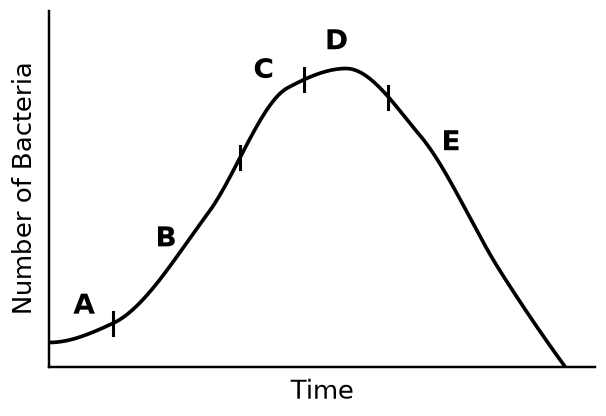
Directions for the following 3 (three) items: Read the passage given below, study the graph that follows and answer the three items given below the figure.
During a party, a person was exposed to contaminated water. A few days later, he developed fever and loose motions. He suffered for some days before going to a doctor for treatment. On starting the treatment, he soon became better and recovered completely a few days later. The following graph shows different phases of the person's disease condition as regions A, B, C, D and E of the curve.
Which region/regions of the curve correspond/corresponds to incubation phase of the infection?
Answer (a) & explanation
A only is correct (a). Step 1: the incubation phase is the quiet time after germs enter the body and before the person falls ill. Step 2: look at the curve. In region A, the bacteria count is low and almost flat: the germs have entered from the contaminated water but are only settling in, and there are no symptoms yet. Step 3: in B the count climbs fast, which means illness has begun, so B is not incubation. So (b), (c) and (d) fail.
Tip: link each part of a disease curve to a stage of the story: exposure and quiet growth, then symptoms, then the peak, then recovery after treatment.
Answer as per the official UPSC answer key.
In a queue, Mr. X is fourteenth from the front and Mr. Y is seventeenth from the end, while Mr. Z is exactly in between Mr. X and Mr. Y. If Mr. X is ahead of Mr. Y and there are 48 persons in the queue, how many persons are there between Mr. X and Mr. Z?
Answer (c) & explanation
8 is correct (c). Step 1: Y is 17th from the end in a queue of 48, so Y is 48 − 17 + 1 = 32nd from the front. Step 2: X is 14th. The people between X and Y are in places 15 to 31, which is 17 people. Z is exactly in the middle of them, so Z is in place 15 + 8 = 23rd. Step 3: the people between X (14th) and Z (23rd) are in places 15 to 22, which is 8 people. So (a), (b) and (d) fail.
Tip: convert every position to 'from the front' first, using position from front = total − position from end + 1. Then count gaps carefully.
Answer as per the official UPSC answer key.
The following item consists of four statements. Of these four statements, two cannot both be true, but both can be false. Study the statements carefully and identify the two that satisfy the above condition.
- 1. All animals are carnivorous.
- 2. Some animals are not carnivorous.
- 3. Animals are not carnivorous.
- 4. Some animals are carnivorous.
Answer (a) & explanation
Statements 1 and 3 are correct (a). Step 1: we need two statements that cannot both be true but can both be false. Step 2: 'All animals are carnivorous' (1) and 'Animals are not carnivorous', meaning none are (3), cannot both be true. But if only some animals eat meat, both are false. So 1 and 3 fit. Step 3: check the other pairs. 1 and 2 are exact opposites: one must be true. 3 and 4 are also exact opposites. 2 and 4 can both be true. So (b), (c) and (d) fail.
Tip: 'All' and 'None' are contraries: never both true, can both be false. 'All' and 'Some not' are contradictories: exactly one is true.
Answer as per the official UPSC answer key.
There are 100 students in a particular class. 60% students play cricket, 30% students play football and 10% students play both the games. What is the number of students who play neither cricket nor football?
Answer (b) & explanation
20 students is correct (b). Step 1: 60 play cricket and 30 play football. But the 10 who play both are counted twice. Step 2: students playing at least one game = 60 + 30 − 10 = 80. Step 3: students playing neither = 100 − 80 = 20. So (a), (c) and (d) fail.
Tip: for two overlapping groups, total in either = A + B − both. Drawing two overlapping circles (a Venn diagram) makes this clear at a glance.
Answer as per the official UPSC answer key.
A local thug (bad element) has started illegal construction on your vacant plot. He has refused your request to vacate and threatened you of dire consequences in case you do not sell the property at a cheap price to him. You would
Answer (b) & explanation
UPSC's key lists (b) and (d), with no negative marking; (b) is the best response. Step 1: a thug is building illegally on your plot and threatening you. Step 2: going to the police (b) is the lawful and safe course; the police must act against encroachment and criminal intimidation. Step 3: (a) selling cheap gives in to the threat and rewards crime. (c) neighbours may help but cannot enforce the law. (d) negotiating a higher price, also in the key, avoids conflict but still yields to an illegal demand, so (b) is the safer answer to mark.
Tip: for these interpersonal items, pick the response that is lawful, honest and keeps the public work going. Avoid options that give in to pressure, pass the buck or abandon duty.
Answer as per the official UPSC answer key.
Read the passage
A moral act must be our own act; must spring from our own will. If we act mechanically, there is no moral content in our act. Such action would be moral, if we think it proper to act like a machine and do so. For, in doing so, we use our discrimination. We should bear in mind the distinction between acting mechanically and acting intentionally. It may be moral of a king to pardon a culprit. But the messenger carrying out the order of pardon plays only a mechanical part in the king’s moral act. But if the messenger were to carry out the king’s order considering it to be his duty, his action would be a moral one. How can a man understand morality who does not use his own intelligence and power of thought, but lets himself be swept along like a log of wood by a current ? Sometimes a man defies convention and acts on his own with a view to absolute good.
Which of the following statements is the nearest definition of moral action, according to the writer ?
Answer (b) & explanation
An action based on our sense of discretion is correct (b). Step 1: the passage says 'a moral act must be our own act; must spring from our own will', and 'we use our discrimination'. Discrimination here means judgement or discretion. That is (b). Step 2: check (a). The messenger who acts mechanically on orders is the writer's example of a non-moral act, so (a) is the opposite. Step 3: check (c) and (d). 'Clever' action and 'religious' action are never mentioned. So (a), (c) and (d) fail.
Tip: in old-style English, 'discrimination' means the ability to judge well, not unfair treatment. Knowing this unlocks the answer.
Answer as per the official UPSC answer key.
Read the passage
Now India’s children have a right to receive at least eight years of education, the gnawing question is whether it will remain on paper or become a reality. One hardly needs a reminder that this right is different from the others enshrined in the Constitution, that the beneficiary – a six year old child cannot demand it, nor can she or he fight a legal battle when the right is denied or violated. In all cases, it is the adult society which must act on behalf of the child. In another peculiarity, where a child’s right to education is denied, no compensation offered later can be adequate or relevant. This is so because childhood does not last. If a legal battle fought on behalf of a child is eventually won, it may be of little use to the boy or girl because the opportunity missed at school during childhood cannot serve the same purpose later in life. This may be painfully true for girls because our society permits them only a short childhood, if at all. The Right to Education (RTE) has become law at a point in India’s history when the ghastly practice of female infanticide has resurfaced in the form of foeticide. This is “symptomatic of a deeper turmoil” in society which is compounding the traditional obstacles to the education of girls. Tenacious prejudice against the intellectual potential of girls runs across our cultural diversity and the system of education has not been able to address it.
According to the passage, what could be the traditional obstacles to the education of girls ?
- 1. Inability of parents to fight a legal battle when the Right to Education is denied to their children.
- 2. The traditional way of thinking about girls’ role in society.
- 3. The prejudice against the intellectual potential of girls.
- 4. Improper system of education.
Select the correct answer from the codes given below :
Answer (b) & explanation
Items 2, 3 and 4 are correct (b). Step 1: the passage says society 'permits [girls] only a short childhood', a traditional view of girls' role: item 2. Step 2: it names a 'tenacious prejudice against the intellectual potential of girls': item 3. Step 3: it says 'the system of education has not been able to address it': item 4. Item 1 is wrong: the inability to fight a legal battle is said of all children, not as a traditional obstacle to girls. So (a), (c) and (d) fail.
Tip: check whom each idea is about. The legal-battle point applies to every child, so it is not a girls-specific obstacle.
Answer as per the official UPSC answer key.