
CSAT (Paper II): previous-year questions
1280 real UPSC Prelims questions (2011–2026) with the official answer and a clear explanation. 400 of them came in the last five papers.
How often UPSC asks this
Questions per year, counted from the official papers.
Subtopics
Arrangements, ranking, ordering and puzzles
142 questions
Clocks and calendars
5 questions
Coding-decoding, series, patterns, cubes, dice and visual reasoning
110 questions
Communication, interpersonal skills and decision-making
10 questions
Counting, permutations, combinations and probability
1 questions
Directions, blood relations and Venn diagrams
60 questions
General English: grammar, vocabulary and comprehension
20 questions
General Hindi: grammar, vocabulary, dialects and comprehension
25 questions
Geometry and mensuration
26 questions
Number system and basic algebra (divisibility, HCF/LCM, remainders, digits, equations)
196 questions
Percentages, profit and loss, discount, simple and compound interest
47 questions
Ratio, proportion, averages, mixtures and alligation
47 questions
Syllogisms, statements and conclusions, assumptions and arguments
89 questions
Time and work; pipes and cisterns
2 questions
Time, speed and distance; trains, boats and streams; races
48 questions
Attempt the questions
Newest papers first. Tap an option; the answer and the reason appear instantly.

Consider the following figure and answer the item that follows:
What is the minimum number of different colours required to paint the figure given above such that no two adjacent regions have the same colour?
Answer (a) & explanation
1. Going out from the centre: centre circle, plain ring, ring cut into 6, plain ring, ring cut into 8.
2. Colour the ring of 6 red, blue, red, blue, red, blue. 6 is even, so the last piece does not touch a piece of its own colour. Do the same for the ring of 8.
3. Each plain ring touches both red and blue pieces, so it needs a third colour, green.
4. The centre circle touches only the green ring next to it, so it can be red.
5. Minimum colours = 3.
Answer as per the official UPSC answer key.
Read the passage
I opened the bag and packed the boots in; and then, just as I was going to close it, a horrible idea occurred to me. Had I packed my toothbrush ? I don’t know how it is, but I never do know whether I’ve packed my toothbrush.
My toothbrush is a thing that haunts me when I’m travelling, and makes my life a misery. I dream that I haven’t packed it, and wake up in a cold perspiration, and get out of bed and hunt for it. And, in the morning, I pack it before I have used it, and it is always the last thing I turn out of the bag; and then I repack and forget it, and have to rush upstairs for it at the last moment and carry it to the railway station, wrapped up in my pocket-handkerchief.
His toothbrush is finally
Answer (c) & explanation
In his handkerchief is correct (c). Step 1: follow the toothbrush through the story. He packs it, takes it out last, repacks and forgets it, then rushes upstairs for it. Step 2: finally he carries it 'to the railway station, wrapped up in my pocket-handkerchief'. So it ends up in his handkerchief: (c). Step 3: (a) is wrong: it was taken out of the bag and not put back. (b) is wrong: it was not left in bed. (d) is wrong: it was not lost.
Tip: 'finally' asks for the last position in the sequence. Read to the end of the passage before answering.
Answer as per the official UPSC answer key.
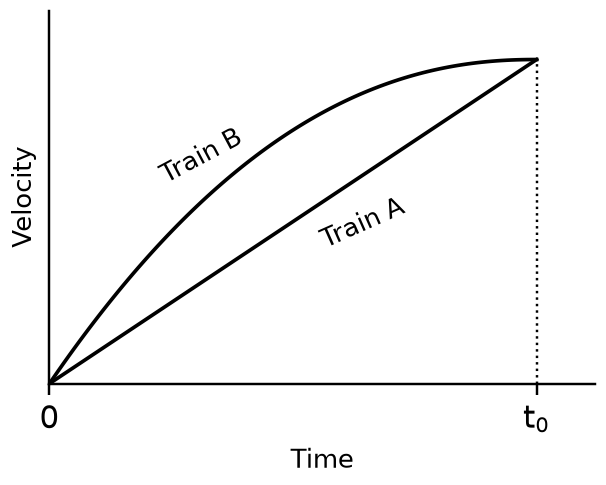
Consider the following Velocity-Time graph. It shows two trains starting simultaneously on parallel tracks.
With reference to the above graph, which one of the following statements is not correct?
Answer (d) & explanation
Option (d) is the statement that is not correct. Step 1: on a velocity–time graph, the slope shows acceleration. At the start B's line climbs more steeply, so (a) is correct. Both lines meet at t₀, so they have the same velocity then, and (c) is correct. Step 2: B's line stays above A's until t₀, so B is faster at all times up to t₀, and (b) is accepted. Step 3: distance is the area under the velocity line. B's line is above A's the whole way, so B covers more ground. 'Both travel the same distance' is wrong.
Tip: on a speed graph, the meeting point means same speed, not same distance. Distance is area, not height.
Some readers also object to (b), since the speeds are equal at the instant t0; the official answer is (d), as printed.
Answer as per the official UPSC answer key.
Consider the following argument: "In order to be a teacher one must graduate from college. All poets are poor. Some Mathematicians are poets. No college graduate is poor." Which one of the following is not a valid conclusion regarding the above argument?
Answer (b) & explanation
Option (b) is the conclusion that is not valid. Step 1: chain the facts. Teacher → college graduate → not poor. Poets are poor, so poets are not teachers (d is valid) and teachers are not poor (c is valid). Step 2: some mathematicians are poets, and those poets are not teachers, so some mathematicians are not teachers (a is valid). Step 3: nothing tells us whether any teacher is a mathematician or not. So 'some teachers are not mathematicians' cannot be concluded: (b) is not valid.
Tip: write each statement as an arrow and follow the chain. A conclusion is valid only if every link is given; if a link is missing, it does not follow.
Answer as per the official UPSC answer key.
You, as an administrative authority, have been approached, by the daughter-in-law of an influential person regarding harassment by her in-laws on account of insufficient dowry. Her parents are not able to approach you because of social pressures. You would
Answer (a) & explanation
UPSC's key lists (a) and (d), with no negative marking. Step 1: a woman reports dowry harassment by influential in-laws. Dowry demands are crimes under the Dowry Prohibition Act and Section 85 of the Bharatiya Nyaya Sanhita (formerly 498A IPC). Step 2: (a) calling the in-laws for an explanation acts at once, and (d) helping her lodge a police complaint starts legal protection. Step 3: (b) telling her to adjust leaves her in danger. (c) waiting for her parents ignores her own complaint; she is an adult entitled to act.
Tip: for these interpersonal items, pick the response that is lawful, honest and keeps the public work going. Avoid options that give in to pressure, pass the buck or abandon duty.
Answer as per the official UPSC answer key.
Read the passage
A country under foreign domination seeks escape from the present in dreams of a vanished age, and finds consolation in visions of past greatness. That is a foolish and dangerous pastime in which many of us indulge. An equally questionable practice for us in India is to imagine that we are still spiritually great though we have come down in the world in other respects. Spiritual or any other greatness cannot be founded on lack of freedom and opportunity, or on starvation and misery. Many western writers have encouraged that notion that Indians are other-worldly. I suppose the poor and unfortunate in every country become to some extent other-worldly, unless they become revolutionaries, for this world is evidently not meant for them. So also subject peoples.
As a man grows to maturity he is not entirely engrossed in, or satisfied with, the external objective world. He seeks also some inner meaning, some psychological and physical satisfactions. So also with peoples and civilizations as they mature and grow adult. Every civilization and every people exhibit these parallel streams of an external life and an internal life. Where they meet or keep close to each other, there is an equilibrium and stability. When they diverge conflict arises and the crises that torture the mind and spirit.
The passage mentions that “this world is evidently not meant for them”. It refers to people who
- 1. seek freedom from foreign domination.
- 2. live in starvation and misery.
- 3. become revolutionaries.
Which of the statements given above is/are correct ?
Answer (b) & explanation
Statement 2 only is correct (b). Step 1: find the sentence: 'the poor and unfortunate in every country become to some extent other-worldly, unless they become revolutionaries, for this world is evidently not meant for them'. So 'them' means the poor and unfortunate, people living in starvation and misery: statement 2. Step 2: statement 3 is wrong: revolutionaries are the exception ('unless'), not the people meant. Step 3: statement 1 is wrong: subject peoples are added only afterwards with 'So also'; they are compared, not referred to by 'them'. So (a), (c) and (d) fail.
Tip: for 'it refers to' questions, find the pronoun and trace it back to the nearest matching noun in the same sentence.
Answer as per the official UPSC answer key.
(Same information as the question above.)
Whose wife is the teacher?
Answer (d) & explanation
B's wife is correct (d). Step 1: the clue says 'The teacher was the wife of a lawyer who was the son of a doctor'. Step 2: from the earlier solution, D is the eldest and the doctor, and B, a male, is his son and the lawyer. Step 3: so the teacher is the wife of B. (a) C is the youngest, a child, not the lawyer. (b) D is the doctor, not the lawyer. (c) A is a female. So (a), (b) and (c) fail.
Tip: in family puzzles, chain the relationship words: teacher → wife of lawyer → lawyer is son of doctor. Each link narrows the field.
Answer as per the official UPSC answer key.
Read the passage
The concept of ‘creative society’ refers to a phase of development of a society in which a large number of potential contradictions become articulate and active. This is most evident when oppressed social groups get politically mobilised and demand their rights. The upsurge of the peasants and tribals, the movements for regional autonomy and self-determination, the environmental movements, and the women’s movements in the developing countries are signs of emergence of creative society in contemporary times. The forms of social movements and their intensity may vary from country to country and place to place within a country. But the very presence of movements for social transformation in various spheres of a society indicates the emergence of a creative society in a country.
What does the author imply by “creative society” ?
- 1. A society where diverse art forms and literary writings seek incentive.
- 2. A society where social inequalities are accepted as the norm.
- 3. A society where a large number of contradictions are recognised.
- 4. A society where the exploited and the oppressed groups grow conscious of their human rights and upliftment.
Select the correct answer using the codes given below :
Answer (c) & explanation
Items 3 and 4 are correct (c). Step 1: the passage defines a creative society as one where 'a large number of potential contradictions become articulate and active'. That matches item 3. Step 2: it says this is most evident 'when oppressed social groups get politically mobilised and demand their rights'. That matches item 4. Step 3: check the traps. Item 1 picks up the word 'creative' and talks about art and literature, which the passage never mentions. Item 2 says inequalities are accepted, but the passage says they are challenged. So (a), (b) and (d) fail.
Tip: watch for options that play on the everyday meaning of a word. Here 'creative' does not mean artistic; the passage gives its own meaning.
Answer as per the official UPSC answer key.
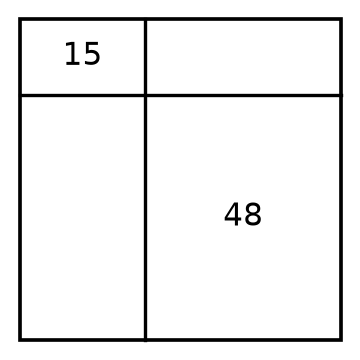
Consider the following figure and answer the item that follows:
A square is divided into four rectangles as shown above. The lengths of the sides of rectangles are natural numbers. The areas of two rectangles are indicated in the figure. What is the length of each side of the square?
Answer (b) & explanation
1. Call the side of the square s. The '15' box is a wide by b tall; the '48' box is then (s − a) wide by (s − b) tall.
2. Whole-number sides for 15: 1 × 15 or 3 × 5.
3. Try 3 and 5 with s = 11: the other box is (11 − 5) × (11 − 3) = 6 × 8 = 48. It fits.
4. Check the other options: s = 10 gives 5 × 7 = 35, not 48; s = 15 gives 10 × 12 = 120 (or 0 if 1 × 15 is used). Neither fits.
5. So each side is 11.
Answer as per the official UPSC answer key.
Read the passage
In spring, polar bear mothers emerge from dens with three month old cubs. The mother bear has fasted for as long as eight months but that does not stop the young from demanding full access to her remaining reserves. If there are triplets, the most persistent stands to gain an extra meal and it may have the meal at the expense of others. The smallest of the litter forfeits many meals to stronger siblings. Females are protective of their cubs but tend to ignore family rivalry over food. In 21 years of photographing polar bears, I’ve only once seen the smallest of triplets survive till autumn.
Female polar bears give birth during
Answer (d) & explanation
Winter is correct (d). Step 1: the passage says 'In spring, polar bear mothers emerge from dens with three month old cubs'. Step 2: if the cubs are three months old in spring, they were born about three months earlier, which is winter: (d). Step 3: (a) spring is when they come out of the den, not when they are born. (b) and (c), summer and autumn, do not fit the timeline. So (a), (b) and (c) fail.
Tip: when a passage gives an age at a certain time, count backwards. The emergence date is not the birth date.
Answer as per the official UPSC answer key.
Read the passage
Ecosystems provide people with a variety of goods and services; food, clean water, clean air, flood control, soil stabilization, pollination, climate regulation, spiritual fulfilment and aesthetic enjoyment, to name just a few. Most of these benefits either are irreplaceable or the technology necessary to replace them is prohibitively expensive. For example, potable fresh water can be provided by desalinating sea-water, but only at great cost.
The rapidly expanding human population has greatly modified the Earth’s ecosystems to meet their increased requirements of some of the goods and services, particularly food, fresh water, timber, fibre and fuel. These modifications have contributed substantially to human well being and economic development. The benefits have not been equally distributed. Some people have actually been harmed by these changes. Moreover, short-term increases in some ecosystem goods and services have come at the cost of the long-term degradation of others. For example, efforts to increase the production of food and fibre have decreased the ability of some ecosystems to provide clean water, regulate flooding and support biodiversity.
With reference to the passage, consider the following statements.
Expanding human population has an adverse effect on :
- 1. Spiritual fulfilment
- 2. Aesthetic enjoyment
- 3. Potable fresh water
- 4. Production of food and fibre
- 5. Biodiversity
Which of the statements given above are correct ?
Answer (c) & explanation
Items 3 and 5 are correct (c). Step 1: the passage says efforts to increase food and fibre 'have decreased the ability of some ecosystems to provide clean water, regulate flooding and support biodiversity'. That gives items 3 and 5. Step 2: check item 4. Production of food and fibre actually rose; it was the cause, not the victim. Step 3: check items 1 and 2. Spiritual fulfilment and aesthetic enjoyment appear only in the opening list of services; the passage never says population growth harmed them. So (a), (b) and (d) fail.
Tip: a word appearing in the passage is not enough. Check whether the passage says what the option claims about it.
Answer as per the official UPSC answer key.
A student on her first 3 tests received an average score of N points. If she exceeds her previous average score by 20 points on her fourth test, then what is the average score for the first 4 tests?
Answer (d) & explanation
N + 5 is correct (d). Step 1: the first three tests total 3N. Step 2: the fourth score is N + 20. The new total is 3N + N + 20 = 4N + 20. Step 3: the new average = (4N + 20) ÷ 4 = N + 5. In simple words, the extra 20 points are shared over four tests, adding 5 to the average. So (a), (b) and (c) fail.
Tip: when one new value is above the old average, the average rises by (excess ÷ new count). Here 20 ÷ 4 = 5.
Answer as per the official UPSC answer key.
Read the passage
A country under foreign domination seeks escape from the present in dreams of a vanished age, and finds consolation in visions of past greatness. That is a foolish and dangerous pastime in which many of us indulge. An equally questionable practice for us in India is to imagine that we are still spiritually great though we have come down in the world in other respects. Spiritual or any other greatness cannot be founded on lack of freedom and opportunity, or on starvation and misery. Many western writers have encouraged that notion that Indians are other-worldly. I suppose the poor and unfortunate in every country become to some extent other-worldly, unless they become revolutionaries, for this world is evidently not meant for them. So also subject peoples.
As a man grows to maturity he is not entirely engrossed in, or satisfied with, the external objective world. He seeks also some inner meaning, some psychological and physical satisfactions. So also with peoples and civilizations as they mature and grow adult. Every civilization and every people exhibit these parallel streams of an external life and an internal life. Where they meet or keep close to each other, there is an equilibrium and stability. When they diverge conflict arises and the crises that torture the mind and spirit.
Consider the following assumptions :
- 1. A country under foreign domination cannot indulge in spiritual pursuit.
- 2. Poverty is an impediment in the spiritual pursuit.
- 3. Subject peoples may become other-worldly.
With reference to the passage, which of the above assumptions is/are valid ?
Answer (c) & explanation
Assumptions 2 and 3 are valid (c). Step 1: the passage says 'spiritual or any other greatness cannot be founded on ... starvation and misery'. So poverty blocks spiritual pursuit: assumption 2. Step 2: after describing how the poor turn other-worldly, it adds 'So also subject peoples'. So subject peoples may become other-worldly: assumption 3. Step 3: assumption 1 is wrong: the passage says a dominated country does seek consolation in visions of past spiritual greatness, so it does indulge in such pursuits; 'cannot' is too strong. So (a), (b) and (d) fail.
Tip: 'cannot' is an absolute. If the passage shows people doing something, even foolishly, 'cannot' fails.
Answer as per the official UPSC answer key.
In a survey regarding a proposed measure to be introduced, 2878 persons took part of which 1652 were males. 1226 persons voted against the proposal of which 796 were males. 1425 persons voted for the proposal. 196 females were undecided.
How many females voted for the proposal?
Answer (b) & explanation
600 is correct (b). Step 1: females in the survey = 2,878 − 1,652 = 1,226. Step 2: females who voted against = total against − males against = 1,226 − 796 = 430. Step 3: 196 females were undecided. So females who voted for = 1,226 − 430 − 196 = 600. So (a), (c) and (d) fail.
Tip: build a small table with rows Male/Female and columns For/Against/Undecided. Fill in what is given, and every missing cell comes from simple subtraction.
Answer as per the official UPSC answer key.
Read the passage
The concept of ‘creative society’ refers to a phase of development of a society in which a large number of potential contradictions become articulate and active. This is most evident when oppressed social groups get politically mobilised and demand their rights. The upsurge of the peasants and tribals, the movements for regional autonomy and self-determination, the environmental movements, and the women’s movements in the developing countries are signs of emergence of creative society in contemporary times. The forms of social movements and their intensity may vary from country to country and place to place within a country. But the very presence of movements for social transformation in various spheres of a society indicates the emergence of a creative society in a country.
What according to the passage are the manifestations of social movements ?
- 1. Aggressiveness and being incendiary.
- 2. Instigation by external forces.
- 3. Quest for social equality and individual freedom.
- 4. Urge for granting privileges and self-respect to disparaged sections of the society.
Select the correct answer using the codes given below :
Answer (c) & explanation
Items 3 and 4 are correct (c). Step 1: list the movements the passage names: upsurges of peasants and tribals, movements for regional autonomy and self-determination, environmental movements and women's movements. Step 2: see what they show. They express a quest for equality and freedom (item 3) and an urge for rights and dignity for disparaged groups (item 4). Step 3: check the others. Item 1, aggressiveness, and item 2, external instigation, are never mentioned. So (a), (b) and (d) fail.
Tip: do not import ideas the passage does not contain. If a word like 'incendiary' or 'external forces' never appears, the item is out.
Answer as per the official UPSC answer key.
A person has only Rs. 1 and Rs. 2 coins with her. If the total number of coins that she has is 50 and the amount of money with her is Rs. 75, then the number of Rs. 1 and Rs. 2 coins are, respectively
Answer (d) & explanation
25 and 25 is correct (d). Step 1: suppose all 50 coins were Rs. 1 coins. That gives only Rs. 50. Step 2: she has Rs. 75, which is Rs. 25 more. Each time a Rs. 1 coin is swapped for a Rs. 2 coin, the total rises by Rs. 1. So there must be 25 Rs. 2 coins. Step 3: the rest, 50 − 25 = 25, are Rs. 1 coins. Check: 25 × 1 + 25 × 2 = 75. So (a), (b) and (c) fail.
Tip: the 'assume all are the cheaper kind' trick solves most two-item coin and ticket problems in seconds. Or just test each option quickly.
Answer as per the official UPSC answer key.
Read the passage
In spring, polar bear mothers emerge from dens with three month old cubs. The mother bear has fasted for as long as eight months but that does not stop the young from demanding full access to her remaining reserves. If there are triplets, the most persistent stands to gain an extra meal and it may have the meal at the expense of others. The smallest of the litter forfeits many meals to stronger siblings. Females are protective of their cubs but tend to ignore family rivalry over food. In 21 years of photographing polar bears, I’ve only once seen the smallest of triplets survive till autumn.
Mother bear
Answer (b) & explanation
Lets the cubs fend for themselves is correct (b). Step 1: the passage says mother bears 'are protective of their cubs but tend to ignore family rivalry over food'. Step 2: so the cubs must compete among themselves for meals: they fend for themselves: (b). Step 3: (a) and (c) are wrong: the strongest cub wins by its own persistence, not because the mother takes sides or picks favourites. (d) is wrong: the smallest cub 'forfeits many meals', so shares are not equal.
Tip: when the passage says 'ignore', the right option shows non-interference. Options that make the mother active are the traps.
Answer as per the official UPSC answer key.
Read the passage
Ecosystems provide people with a variety of goods and services; food, clean water, clean air, flood control, soil stabilization, pollination, climate regulation, spiritual fulfilment and aesthetic enjoyment, to name just a few. Most of these benefits either are irreplaceable or the technology necessary to replace them is prohibitively expensive. For example, potable fresh water can be provided by desalinating sea-water, but only at great cost.
The rapidly expanding human population has greatly modified the Earth’s ecosystems to meet their increased requirements of some of the goods and services, particularly food, fresh water, timber, fibre and fuel. These modifications have contributed substantially to human well being and economic development. The benefits have not been equally distributed. Some people have actually been harmed by these changes. Moreover, short-term increases in some ecosystem goods and services have come at the cost of the long-term degradation of others. For example, efforts to increase the production of food and fibre have decreased the ability of some ecosystems to provide clean water, regulate flooding and support biodiversity.
The passage mentions that “some people have actually been harmed by these changes”. What does it imply ?
- 1. The rapid expansion of population has adversely affected some people.
- 2. Sufficient efforts have not been made to increase the production of food and fibre.
- 3. In the short term some people may be harmed, but in the long term everyone will benefit from modifications in the Earth’s ecosystems.
Which of the statement given above is/are correct ?
Answer (a) & explanation
Statement 1 only is correct (a). Step 1: the passage says the rapidly expanding population 'greatly modified' ecosystems, and 'some people have actually been harmed by these changes'. So population-driven change hurt some people: statement 1. Step 2: statement 2 is wrong: the passage says efforts to increase food and fibre were made. Step 3: statement 3 is wrong: the passage warns of 'the long-term degradation' of ecosystems, not long-term benefit for everyone. So (b), (c) and (d) fail.
Tip: when an option promises a happy ending ('everyone will benefit'), check the passage's tone. Here it is a warning, so the optimistic option is out.
Answer as per the official UPSC answer key.
In a group of persons, 70% of the persons are male and 30% of the persons are married. If two-sevenths of the males are married, what fraction of the females is single?
Answer (d) & explanation
2/3 is correct (d). Step 1: take 100 people. Males = 70, females = 30. Married = 30 in total. Step 2: two-sevenths of males are married: 2/7 × 70 = 20 married males. So married females = 30 − 20 = 10. Step 3: single females = 30 − 10 = 20. The fraction of females who are single = 20 ÷ 30 = 2/3. So (a), (b) and (c) fail.
Tip: for percentage puzzles, assume a total of 100. It turns every percentage into a simple number you can add and subtract.
the fraction is of the females, not of the whole group.
Answer as per the official UPSC answer key.
Read the passage
A country under foreign domination seeks escape from the present in dreams of a vanished age, and finds consolation in visions of past greatness. That is a foolish and dangerous pastime in which many of us indulge. An equally questionable practice for us in India is to imagine that we are still spiritually great though we have come down in the world in other respects. Spiritual or any other greatness cannot be founded on lack of freedom and opportunity, or on starvation and misery. Many western writers have encouraged that notion that Indians are other-worldly. I suppose the poor and unfortunate in every country become to some extent other-worldly, unless they become revolutionaries, for this world is evidently not meant for them. So also subject peoples.
As a man grows to maturity he is not entirely engrossed in, or satisfied with, the external objective world. He seeks also some inner meaning, some psychological and physical satisfactions. So also with peoples and civilizations as they mature and grow adult. Every civilization and every people exhibit these parallel streams of an external life and an internal life. Where they meet or keep close to each other, there is an equilibrium and stability. When they diverge conflict arises and the crises that torture the mind and spirit.
The passage thematically centres on
Answer (a) & explanation
The state of mind of oppressed people is correct (a). Step 1: the passage begins with a country under foreign domination escaping into dreams of past greatness. Step 2: it then explains how the poor and subject peoples turn other-worldly, and ends with the conflict that tortures 'the mind and spirit'. All of this is about how oppressed people think and feel. Step 3: check the others. (b) starvation and misery is one cause mentioned, not the theme. (c) the growth of civilisation appears only as a comparison. (d) is too general; the passage is about oppressed people, not people in general. So (b), (c) and (d) fail.
Tip: the theme should cover the beginning, middle and end of the passage. A word that appears once is usually a detail.
Answer as per the official UPSC answer key.