Topic hub

Ancient & Medieval History

Ancient & Medieval History: syllabus hub.

Syllabus: UPSC Pre GS1 History; Mains GS1 (culture)

When UPSC asked this

2011: 4 questions1142012: 5 questions1252013: 6 questions1362014: 4 questions1442015: 5 questions1552016: 7 questions1672017: 3 questions1732018: 3 questions1832019: 6 questions1962020: 9 questions2092021: 8 questions2182022: 11 questions22112023: 7 questions2372024: 4 questions2442025: 8 questions2582026: 10 questions2610

Explainers

Previous-year questions

Attempt them here.

UPSC Prelims 2026 · GS Paper I

Consider the following statements about the Rigvedic period :

  • I. Irrigation from wells allowed agriculture to expand away from flood plains and strips on river margins into the present Punjab and Haryana plains having underground water levels reasonably close to the surface.
  • II. Draught-animal power was employed to draw up water out of the wells.

Which of the following information support/supports the above statements ?

  • 1. There is evidence in the Rigveda of the use of ashma chakra (stone pulley wheel) and ahava (strapped wooden pails) to draw up water.
  • 2. Mention has been made in the Rigveda of the use of implements like parashu/ kulisha (axe) and datra /sreni (sickle).
  • 3. There is a history of the use of ox, even before the Rigveda, for ploughing the land and pulling the carts.

Select the answer using the code given below :

Answer (c) & explanation

Information 1 and 3 support the statements (c). Item 1 is right: the ashma chakra (stone pulley wheel) and ahava (strapped wooden pails) of the Rigveda show water being lifted from wells, which supports Statement I. Item 3 is right: the ox was already used for ploughing and pulling carts before the Rigveda, so animal power was available to lift water, which supports Statement II. Item 2 is wrong: axes and sickles are farm tools, but they say nothing about wells or irrigation.

Notice the method: in such questions, ask whether each fact directly supports the claim, not just whether it is true. The Rigvedic economy was mainly pastoral, with cattle as wealth (gavishti, the search for cows, meant war). Iron and big farming came later.

Trap

Statement 2 is true, but it does not support either statement. "Supports" questions test relevance, not truth.

Answer as per the official UPSC answer key.

Open this question's page →

UPSC Prelims 2026 · GS Paper I

Consider the following assertion :

In the Pleistocene period either the Yamuna once flowed into the Indus, or the Sutlej flowed into the Yamuna and one major tributary of either had shifted from the Ganga to the Indus or vice versa.

Which of the following is/are the basis of the above assertion ?

  • 1. The Nadi-Sukta of the Rigveda
  • 2. The explorations of the Sutlej and the Yamuna by Robert Bruce Foote
  • 3. The presence of the same species of dolphins in both the Indus and the Ganga river systems

Select the answer using the code given below :

Answer (d) & explanation

Only the dolphin evidence is a basis (d). Item 3 is right: the Indus and Ganga river dolphins are so close that they were long treated as one species, which only makes sense if the two river systems were once joined. Item 1 is wrong: the Pleistocene ended about 12,000 years ago, long before the Rigveda, so the Nadi-Sukta cannot be evidence for it. Item 2 is wrong: Robert Bruce Foote worked on the stone ages of South India, not these rivers.

Notice the Ganges river dolphin is India's national aquatic animal, and is nearly blind, using echolocation. Project Dolphin (2020) protects it. The Indus dolphin lives mainly in Pakistan, with a small group in the Beas in Punjab.

Answer as per the official UPSC answer key.

Open this question's page →

UPSC Prelims 2026 · GS Paper I

Which of the following pairs of ancient and modern names of rivers is/are correctly matched ?

  • 1. Vitasta : Chenab
  • 2. Asikni : Jhelum
  • 3. Parushni : Ravi
  • 4. Yavyavati : Beas

Select the answer using the code given below :

Answer (c) & explanation

Only pair 3 is correctly matched (c). In the Rigveda, Parushni = Ravi, so pair 3 is right. Pairs 1 and 2 are swapped: Vitasta = Jhelum, and Asikni = Chenab. Pair 4 is wrong: Yavyavati is usually taken as the Zhob, a western river; the Beas is the Vipas. So options (a), (b) and (d) fail.

Notice the full list: Shutudri = Sutlej, Sindhu = Indus, Kubha = Kabul, Gomati = Gomal, and Sarasvati, often linked to the Ghaggar-Hakra. The Battle of Ten Kings (Dasarajna), won by Sudas of the Bharatas, was fought on the Parushni. These rivers form the "Sapta Sindhu" region.

Trap

Pairs 1 and 2 swap the right names, which catches a hurried reader.

Fell for this one? Most aspirants do. The PYQ Book puts every UPSC trap side by side, so the pattern finally clicks. Try the free sample

Answer as per the official UPSC answer key.

Open this question's page →
UPSC Prelims 2026 · GS Paper I

What does an empty seat represent in early Buddhist iconography ?

Answer (a) & explanation

An empty seat represents the Buddha's meditation (a). Early Buddhist art at Bharhut and Sanchi does not show the Buddha in human form. Symbols stand in for him: an empty seat, often under the Bodhi tree, for his meditation and enlightenment. Option (b) is wrong: a wheel stands for the First Sermon at Sarnath. Option (c) is wrong: a stupa stands for the Mahaparinibbana, his death. Option (d) is wrong: a horse stands for the Great Departure (Mahabhinishkramana).

Notice the later change: the Gandhara and Mathura schools, under the Kushanas, first showed the Buddha as a human. Other symbols: a lotus or elephant for his birth, and footprints for his presence. This early stage is called aniconic.

Trap

The key follows UPSC's provisional key. The usual symbol table pairs each event with a different sign, so learn all four together.

Answer as per the official UPSC answer key.

Open this question's page →
UPSC Prelims 2026 · GS Paper I

Which of the following pairs of the king and his dynasty in early historical Tamilakam is/are not correctly matched ?

  • 1. Senguttuvan : Chera
  • 2. Udiyanjeral : Chola
  • 3. Nedunjeliyan : Pandya

Select the answer using the code given below :

Answer (b) & explanation

Only pair 2 is not correctly matched (b). The Sangam poems name three crowned houses: Chera, Chola and Pandya. Pair 1 is correct: Senguttuvan, hero of the Kannagi cult, was a Chera. Pair 3 is correct: Nedunjeliyan, the victor of Talaiyalanganam, was a Pandya. Pair 2 is wrong: Udiyanjeral was a Chera, not a Chola; "-jeral" is a Chera ending. So the answer is pair 2 only.

Notice the trap: the question asks which is not correctly matched. Senguttuvan's story is told in Silappadikaram. Karikala is the most famous early Chola, linked to the Kallanai dam. The Pathitrupathu sings of Chera kings, and Madurai was the Pandya seat.

Trap

This one asks for "not correctly matched". Mark the wrong pair, not the right ones.

Answer as per the official UPSC answer key.

Open this question's page →
UPSC Prelims 2026 · GS Paper I

In which one among the following texts does the term kshetra-patni (‘mistress of the field’) originate ?

Answer (b) & explanation

The term kshetra-patni comes from the Atharvaveda (b). The Atharvaveda, a book of charms and rites, has many farming prayers. It addresses the earth and the field as female and protective, and names the kshetra-patni, wife or mistress of the field. Option (a) is wrong: the Rigveda has Kshetrapati, the male lord of the field. Option (c) is wrong: the Ashtadhyayi is Panini's grammar. Option (d) is wrong: the Arthashastra is Kautilya's work on statecraft.

Notice the Atharvaveda's wider content: spells against disease, for love and harmony, and the famous Prithvi Sukta (hymn to the Earth), with the line "Earth is my mother, I am her son". It also has early medical ideas linked to Ayurveda.

Trap

The Rigveda has the male Kshetrapati, which is why (a) looks right.

Answer as per the official UPSC answer key.

Open this question's page →
UPSC Prelims 2026 · GS Paper I

Consider the following statements :

  • I. Pali texts contain the first definite references to coins, e.g., kahapana, nikkha, kamsa, and kakanika.
  • II. The literary evidence from Pali texts is corroborated by archaeological evidence of punch-marked coins from many sites, most of them made of silver.

The above statements have been associated with which of the following ?

  • 1. Emergence of urban life
  • 2. Transition to money economy

Select the answer using the code given below :

Answer (c) & explanation

Both are linked to urban life and a money economy (c). Statement I: the Pali texts name coins such as kahapana, nikkha, kamsa and kakanika. Statement II: silver punch-marked coins turn up at many sites. Item 1 is right: coins and the cities of the second urbanisation (6th century BCE onward) grew up together. Item 2 is right: both point to trade paid for in money, not barter. So options (a), (b) and (d) fail.

Notice the context: the rise of the mahajanapadas, cities like Rajagriha, Shravasti and Kaushambi, and the Northern Black Polished Ware pottery. Punch-marked coins had symbols stamped on them, with no king's name or writing. Later the Indo-Greeks issued coins with rulers' portraits.

Answer as per the official UPSC answer key.

Open this question's page →
UPSC Prelims 2026 · GS Paper I

Among the four main forms of existence of life recognized in Jainism, which one of the following is not included ?

Answer (b) & explanation

Yaksha is not one of the four forms (b). Jainism names four gatis, or states of birth. Option (a) is one: deva, heavenly beings. Option (c) is one: manushya, humans. Option (d) is one: tiryancha, animals, plants and other beings. The fourth is naraki, beings in hell. Option (b) is not a gati: yakshas are a kind of deva in Jain texts, not a separate form.

Notice the goal: only from human birth can a soul reach moksha, freeing itself from all four gatis. Jain temples often show a yaksha and yakshi guarding each Tirthankara, such as Ambika with Neminatha. Jainism also sees life in earth, water, fire and air, so ahimsa is very strict.

Answer as per the official UPSC answer key.

Open this question's page →
In the news

GS1 · Ancient history

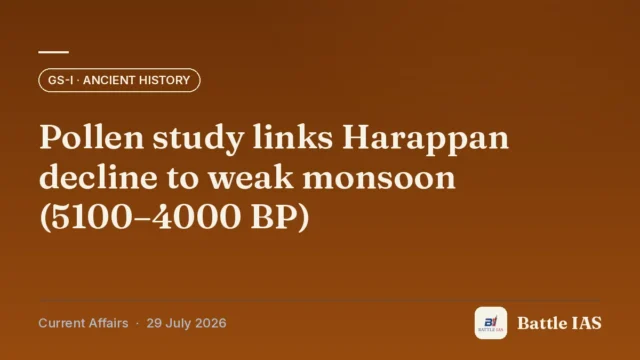
Pollen study links Harappan decline to weak monsoon (5100–4000 BP)

A pollen study by the Birbal Sahni Institute of Palaeosciences links the shrinking of the Harappan Civilization to a weak Indian Summer Monsoon between about 5100 and 4000 years before present, the Science Ministry said on 29 July 2026. Sediments from Deoria Tal in the Garhwal Himalaya show an abrupt dry spell, the "4.2 ka event".

UPSC angle: Prelims: IVC decline theories.

29 Jul 2026
GS1 · Culture, Buddhism

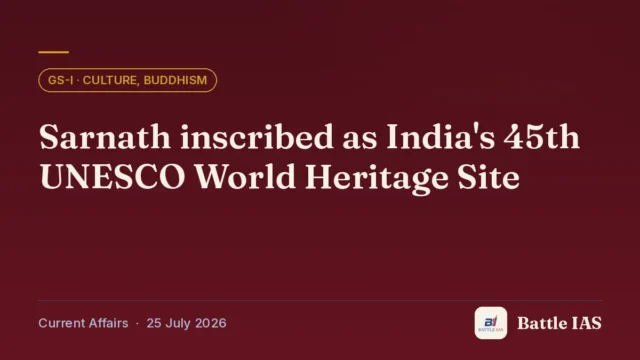
Sarnath inscribed as India’s 45th UNESCO World Heritage Site

On 25 July 2026 the 48th World Heritage Committee in Busan inscribed the "Ancient Buddhist Site of Sarnath" on the UNESCO World Heritage List. It is India's 45th property. The serial site in Varanasi covers Chaukhandi Stupa and the Archaeological Remains of Sarnath, where the Buddha gave his first sermon.

UPSC angle: Prelims: Sarnath; WH list count.

25 Jul 2026
GS1 · Harappan civilisation

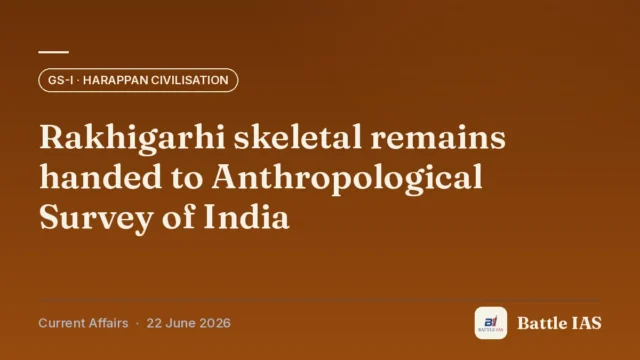
Rakhigarhi skeletal remains handed to Anthropological Survey of India

ASI handed human skeletal remains from Rakhigarhi, Haryana, to the Anthropological Survey of India under a new MoU, the Culture Ministry said on 22 June 2026. The 2025-26 dig at Mound No. 7 found eight burials; three complete skeletons plus fragments went to AnSI's Kolkata repository. Planned work includes aDNA, isotopes and palaeopathology with partner labs.

UPSC angle: Prelims: Harappan sites and States.

22 Jun 2026
GS1 · Culture / soft power

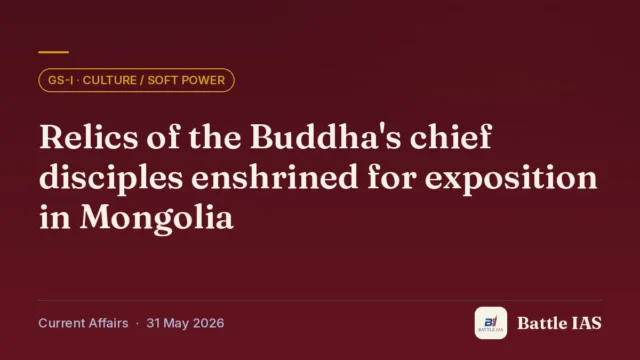
Relics of the Buddha’s chief disciples enshrined for exposition in Mongolia

The holy relics of Arhat Sariputra and Arhat Mahamoggallana, the Buddha's two chief disciples, were ceremonially enshrined at Gandantegchenling Monastery in Ulaanbaatar on Buddha Purnima (Vesak) 2026. Brought from India for a ten-day exposition from 31 May to 10 June 2026, they arrived on a special IAF IL-76 aircraft and had travelled abroad only once before, to Thailand in 2024.

UPSC angle: Prelims: Buddha's disciples, relic sites.

31 May 2026