You are one aspirant with your own strong and weak areas. Here every previous-year question is linked to its syllabus topic, its explainer and the news behind it, so one question opens up a whole subject. Attempt, see why each option is right or wrong, and find exactly where you need work.
Sirpur, an archaeological site in Chhattisgarh’s Mahasamund district with Hindu, Buddhist and Jain remains from the 5th to the 12th century CE, has been added to UNESCO’s Tentative List. The ASI now has about a year to prepare a nomination dossier proving its Outstanding Universal Value. Sirpur was once the capital of Dakshina Kosala.
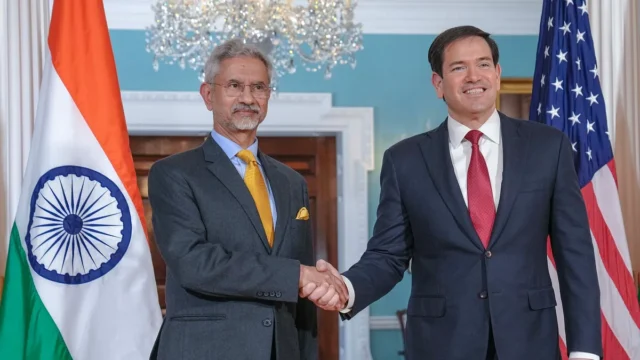
US Secretary of State Marco Rubio began his second India visit of the year in Mumbai on 20 October 2026 and met External Affairs Minister S. Jaishankar on trade, energy, technology and defence. Rubio said the two sides are ‘very, very close’ to a trade deal with ‘a small number of items left’, and praised India’s progress in diversifying energy supplies.
India has begun a national Red List assessment of its 1,211 regularly occurring bird species using the IUCN framework. By 19 October 2026, a preliminary review of 107 species was complete, with the Great Indian Bustard proposed as Critically Endangered and the Indian Roller as Vulnerable. A final assessment is expected towards the end of 2027.
With reference to India, consider the following statements :
1. Government law officers and legal firms are recognised as advocates, but corporate lawyers and patent attorneys are excluded from recognition as advocates.
2. Bar Councils have the power to lay down the rules relating to legal education and recognition of law colleges.
Which of the statements given above is/are correct?
Answer (b) & explanation
Only statement 2 is correct (b). Statement 1 is wrong: under the Advocates Act, 1961, only individuals enrol as advocates, so a law firm is not an advocate. Also, corporate lawyers and patent attorneys who are enrolled are not excluded from being advocates. Statement 2 is right: under Section 7 of the Act, the Bar Council of India sets standards of legal education and recognises universities and law colleges whose degrees qualify a person to enrol.
Notice the structure: the Bar Council of India at the top and State Bar Councils below. Since 2010, new law graduates must pass the All India Bar Examination to practise. In 2023, the BCI allowed foreign law firms to practise non-litigation work in India.
Trap
one wrong word ("legal firms") inside a long statement that is otherwise plausible.