
CSAT (Paper II): previous-year questions
1280 real UPSC Prelims questions (2011–2026) with the official answer and a clear explanation. 400 of them came in the last five papers.
How often UPSC asks this
Questions per year, counted from the official papers.
Subtopics
Arrangements, ranking, ordering and puzzles
142 questions
Clocks and calendars
5 questions
Coding-decoding, series, patterns, cubes, dice and visual reasoning
110 questions
Communication, interpersonal skills and decision-making
10 questions
Counting, permutations, combinations and probability
1 questions
Directions, blood relations and Venn diagrams
60 questions
General English: grammar, vocabulary and comprehension
20 questions
General Hindi: grammar, vocabulary, dialects and comprehension
25 questions
Geometry and mensuration
26 questions
Number system and basic algebra (divisibility, HCF/LCM, remainders, digits, equations)
196 questions
Percentages, profit and loss, discount, simple and compound interest
47 questions
Ratio, proportion, averages, mixtures and alligation
47 questions
Syllogisms, statements and conclusions, assumptions and arguments
89 questions
Time and work; pipes and cisterns
2 questions
Time, speed and distance; trains, boats and streams; races
48 questions
Attempt the questions
Newest papers first. Tap an option; the answer and the reason appear instantly.
(Same figures as the question above.)
What is the symbol on the face opposite to that containing the cross?
Answer (c) & explanation
The line is opposite the cross (c). Step 1: from the views, the line appears next to all four dot faces (one, two, three and four dots). Step 2: a face touching four others must be opposite the sixth face. Step 3: the only face left is the cross. So the cross is opposite the line. Options (a) single dot, (b) two dots and (d) four dots are all neighbours of the line in the ring, and they pair with each other as opposites.
Tip: when one face touches four others, its opposite is the one face it never touches. This shortcut solves many dice and cube questions in one step.
Answer as per the official UPSC answer key.
(Same information as the question above.)
Which one of the following statements is correct?
Answer (a) & explanation
The Engineering college is in Assam (a). Step 1: D studies in Assam, and D's college is Engineering. So option (a) is right. Step 2: option (b) says city Q is in Assam. But city Q is B's city, with the Science college in Kerala. Step 3: option (c) says C is in Kerala. But C is in Rajasthan. Option (d) says B is in Gujarat. But B is in Kerala. So options (b), (c) and (d) are wrong.
Tip: puzzles with five or six questions on one set reward a careful first solution. Spend a little extra time getting the table right; every question after that is quick.
Answer as per the official UPSC answer key.
Read the passage
A male tiger was removed from Pench Tiger Reserve and was relocated in Panna National Park. Later, this tiger trekked toward his home 250 miles away. The trek of this solitary tiger highlights a crisis. Many wildlife reserves exist as islands of fragile habitat in a vast sea of humanity, yet tigers can range over a hundred miles, seeking prey, mates and territory. Nearly a third of India’s tigers live outside tiger reserves, a situation that is dangerous for both human and animal. Prey and tigers can only disperse if there are recognized corridors of land between protected areas to allow unmolested passage.
With reference to the above passage, the following assumptions have been made :
- 1. The strategy of conservation of wildlife by relocating them from one protected area to another is not often successful.
- 2. India does not have suitable legislation to save the tigers, and its conservation efforts have failed which forced the tigers to live outside protected areas.
Which of the above assumptions is/are valid?
Answer (a) & explanation
Only assumption 1 is valid (a). Step 1: the passage tells of a relocated tiger who "trekked toward his home 250 miles away". UPSC's key reads this as showing that relocation often does not work, since animals try to return. So 1 holds. Step 2: assumption 2 says India lacks suitable laws and its efforts have failed. The passage never discusses legislation. India in fact has the Wild Life (Protection) Act, 1972 and Project Tiger. So 2 fails. Step 3: options (b), (c) and (d) fail.
Tip: an assumption must rest on something in the passage. A claim about laws, money or failure that the passage never mentions is not valid, however plausible it sounds.
Answer as per the official UPSC answer key.
Read the passage
‘Desertification’ is a term used to explain a process of decline in the biological productivity of an ecosystem, leading to total loss of productivity. While this phenomenon is often linked to the arid, semi-arid and sub-humid ecosystems, even in the humid tropics, the impact could be most dramatic. Impoverishment of human-impacted terrestrial ecosystems may exhibit itself in a variety of ways : accelerated erosion as in the mountain regions of the country, salinization of land as in the semi-arid and arid ‘green revolution’ areas of the country, e.g., Haryana and western Uttar Pradesh, and site quality decline—a common phenomenon due to general decline in tree cover and monotonous monoculture of rice/wheat across the Indian plains. A major consequence of deforestation is that it relates to adverse alterations in the hydrology and related soil and nutrient losses. The consequences of deforestation invariably arise out of site degradation through erosive losses. Tropical Asia, Africa and South America have the highest levels of erosion. The already high rates for the tropics are increasing at an alarming rate (e.g., through the major river systems—Ganga and Brahmaputra, in the Indian context), due to deforestation and ill-suited land management practices subsequent to forest clearing. In the mountain context, the declining moisture retention of the mountain soils, drying up of the underground springs and smaller rivers in the Himalayan region could be attributed to drastic changes in the forest cover. An indirect consequence is drastic alteration in the upland-lowland interaction, mediated through water. The current concern the tea planter of Assam has is about the damage to tea plantations due to frequent inundation along the flood-plains of Brahmaputra, and the damage to tea plantation and the consequent loss in tea productivity is due to rising level of the river bottom because of siltation and the changing course of the river system. The ultimate consequences of site desertification are soil degradation, alteration in available water and its quality, and the consequent decline in food, fodder and fuel-wood yields essential for the economic well-being of rural communities.
According to the passage, which of the following are the consequences of decline in forest cover?
- 1. Loss of topsoil
- 2. Loss of smaller rivers
- 3. Adverse effect on agricultural production
- 4. Declining of groundwater
Select the correct answer using the code given below.
Answer (d) & explanation
All four are consequences of falling forest cover (d). Step 1: the passage lists erosive soil losses, which means loss of topsoil. So statement 1 holds. Step 2: it mentions "drying up of the underground springs and smaller rivers". That covers the loss of smaller rivers (2) and falling groundwater (4). Step 3: it also mentions falling food and fodder yields, an effect on farm output (3). So all four are right. Options (a), (b) and (c) each leave out at least one stated effect.
Tip: one sentence in a passage can support two statements, as "springs and smaller rivers" does here. Tick every statement the passage backs, even if they come from the same line.
Answer as per the official UPSC answer key.
Consider the sequence given below :
4/12/95, 1/1/96, 29/1/96, 26/2/96, ....
What is the next term of the series?
Answer (b) & explanation
The next date is 25/3/96 (b). Step 1: find the gap. From 4 Dec 1995 to 1 Jan 1996: December has 31 days, so 31 − 4 + 1 = 28 days. From 1 Jan to 29 Jan is also 28 days. Step 2: from 29 Jan to 26 Feb: January has 31 days, so 2 + 26 = 28 days again. So each term adds 28 days. Step 3: 1996 is a leap year, so February has 29 days. From 26 Feb: 3 days finish February, then 25 more days give 25 March. Option (c), 26/3, forgets the leap day. Options (a) and (d) also fail.
Tip: in date series, always check for a leap year. A year divisible by 4 (like 1996) has 29 days in February.
forgetting the leap year gives 26/3/96.
Answer as per the official UPSC answer key.
A train 200 metres long is moving at the rate of 40 kmph. In how many seconds will it cross a man standing near the railway line?
Answer (d) & explanation
The train takes 18 seconds (d). Step 1: change the speed to metres per second. 40 km/hr × 5/18 = 100/9 m/s, about 11.1 m/s. Step 2: to pass a man standing still, the train only needs to cover its own length, 200 m. Step 3: time = 200 ÷ (100/9) = 200 × 9/100 = 18 seconds. Option (a), 12, option (b), 15, and option (c), 16, come from errors in changing the units.
Tip: to change km/hr to m/s, multiply by 5/18. A person or a pole counts as having no length. For a platform or bridge, add its length to the train's length.
Answer as per the official UPSC answer key.
A bookseller sold 'a' number of Geography textbooks at the rate of ₹ x per book, 'a + 2' number of History textbooks at the rate of ₹ (x + 2) per book and 'a – 2' number of Mathematics textbooks at the rate of ₹ (x – 2) per book. What is his total sale in ₹?
Answer (b) & explanation
The total sale is 3ax + 8 (b). Step 1: add the three sales. Geography: a × x = ax. History: (a + 2)(x + 2) = ax + 2a + 2x + 4. Mathematics: (a − 2)(x − 2) = ax − 2a − 2x + 4. Step 2: add them. The 2a and 2x terms cancel out. Total = 3ax + 8. Step 3: check with numbers: a = 3, x = 3 gives 9 + 25 + 1 = 35, and 3 × 3 × 3 + 8 = 35. Option (a), 3x + 3a, gives 18. Option (c), 9ax, gives 81. Option (d) gives 729.
Tip: putting small numbers into the question and the options is a fast, safe check in algebra questions.
Answer as per the official UPSC answer key.
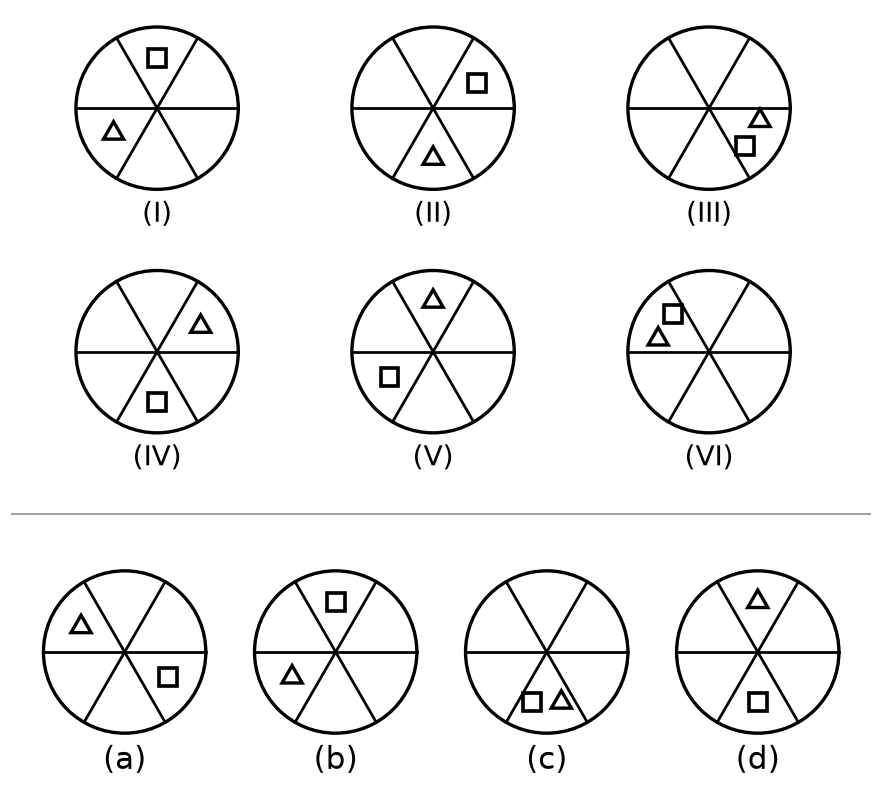
Consider the following figures :
In the figures (I) to (VI) above, some parts are shown to change their positions in regular directions. Following the same sequence, which of the figures given below will appear at (VII) stage?
Answer (b) & explanation
Figure (b) comes at stage VII (b). Step 1: track the square. It moves one part clockwise each step: top, upper-right, lower-right, bottom, lower-left, upper-left. After six moves it is back at the top. Step 2: track the triangle. It moves one part anticlockwise each step: lower-left, bottom, lower-right, upper-right, top, upper-left. Next it returns to lower-left. Step 3: so stage VII has the square at the top and the triangle at the lower-left. That is figure (b), the same as figure (I). Options (a), (c) and (d) put one shape in the wrong place.
Tip: follow one shape at a time. When a cycle has six positions, the seventh figure repeats the first.
Answer as per the official UPSC answer key.
Read the passage
It is no longer enough for us to talk about providing for universal access to education. Making available schooling facilities is an essential prerequisite, but is insufficient to ensure that all children attend school and participate in the learning process. The school may be there, but children may not attend or they may drop out after a few months. Through school and social mapping, we must address the entire gamut of social, economic, cultural and indeed linguistic and pedagogic issues, factors that prevent children from weaker sections and disadvantaged groups, as also girls, from regularly attending and complementing elementary education. The focus must be on the poorest and most vulnerable since these groups are the most disempowered and at the greatest risk of violation or denial of their right to education.
The right to education goes beyond free and compulsory education to include quality education for all. Quality is an integral part of the right to education. If the education process lacks quality, children are being denied their right. The Right of Children to Free and Compulsory Education Act lays down that the curriculum should provide for learning through activities, exploration and discovery. This places an obligation on us to change our perception of children as passive receivers of knowledge, and to move beyond the convention of using textbooks as the basis of examinations. The teaching-learning process must become stress-free; and a massive programme for curricular reform should be initiated to provide for a child-friendly learning system, that is more relevant and empowering. Teacher accountability systems and processes must ensure that children are learning, and that their right to learn in a child-friendly environment is not violated. Testing and assessment systems must be reexamined and redesigned to ensure that these do not force children to struggle between school and tuition centres, and bypass childhood.
According to the passage, which of the following is/are of paramount importance under the Right to Education?
- 1. Sending of children to school by all parents
- 2. Provision of adequate physical infrastructure in schools
- 3. Curricular reforms for developing child-friendly learning system
Select the correct answer using the code given below.
Answer (c) & explanation
Only statement 3 is of paramount importance (c). Step 1: the passage demands "a massive programme for curricular reform" to build a child-friendly learning system. That is statement 3. Step 2: it calls physical facilities "essential" but "insufficient". So statement 2 matters, but it is not of paramount importance. Step 3: parents sending children to school (1) is not discussed. So options (a), (b) and (d) fail.
Tip: "paramount" means the most important of all. When a passage says something is "essential but insufficient", it is pointing to something else as the key. The Right to Education Act came into force in 2010.
Answer as per the official UPSC answer key.
Read the passage
All actions to address climate change ultimately involve costs. Funding is vital in order for countries like India to design and implement adaptation and mitigation plans and projects. The problem is more severe for developing countries like India, which would be one of the hardest hit by climate change, given its need to finance development. Most countries do indeed treat climate change as real threat and are striving to address it in a more comprehensive and integrated manner with the limited resources at their disposal.
With reference to the above passage, the following assumptions have been made :
- 1. Climate change is not a challenge for developed countries.
- 2. Climate change is a complex policy issue and also a development issue for many countries.
- 3. Ways and means of finance must be found to enable developing countries to enhance their adaptive capacity.
Which of the above assumptions is/are valid?
Answer (c) & explanation
Assumptions 2 and 3 are valid (c). Step 1: the passage says spending on climate competes with a country's "need to finance development". So climate change is both a policy and a development issue (2). Step 2: it calls funding "vital" for adaptation plans. So ways must be found to finance developing countries' adaptation (3). Step 3: assumption 1 says climate change is not a challenge for developed countries. But the passage says "most countries" see it as a threat. So 1 contradicts the passage, and options (a), (b) and (d) fail.
Tip: climate finance is a key UN issue. Rich countries pledged money to help poorer ones adapt, a recurring theme at COP meetings.
Answer as per the official UPSC answer key.
Read the passage
‘Desertification’ is a term used to explain a process of decline in the biological productivity of an ecosystem, leading to total loss of productivity. While this phenomenon is often linked to the arid, semi-arid and sub-humid ecosystems, even in the humid tropics, the impact could be most dramatic. Impoverishment of human-impacted terrestrial ecosystems may exhibit itself in a variety of ways : accelerated erosion as in the mountain regions of the country, salinization of land as in the semi-arid and arid ‘green revolution’ areas of the country, e.g., Haryana and western Uttar Pradesh, and site quality decline—a common phenomenon due to general decline in tree cover and monotonous monoculture of rice/wheat across the Indian plains. A major consequence of deforestation is that it relates to adverse alterations in the hydrology and related soil and nutrient losses. The consequences of deforestation invariably arise out of site degradation through erosive losses. Tropical Asia, Africa and South America have the highest levels of erosion. The already high rates for the tropics are increasing at an alarming rate (e.g., through the major river systems—Ganga and Brahmaputra, in the Indian context), due to deforestation and ill-suited land management practices subsequent to forest clearing. In the mountain context, the declining moisture retention of the mountain soils, drying up of the underground springs and smaller rivers in the Himalayan region could be attributed to drastic changes in the forest cover. An indirect consequence is drastic alteration in the upland-lowland interaction, mediated through water. The current concern the tea planter of Assam has is about the damage to tea plantations due to frequent inundation along the flood-plains of Brahmaputra, and the damage to tea plantation and the consequent loss in tea productivity is due to rising level of the river bottom because of siltation and the changing course of the river system. The ultimate consequences of site desertification are soil degradation, alteration in available water and its quality, and the consequent decline in food, fodder and fuel-wood yields essential for the economic well-being of rural communities.
Which of the following is/are the correct inference/inferences that can be made from the passage?
- 1. Deforestation can cause changes in the course of rivers.
- 2. Salinization of land takes place due to human activities only.
- 3. Intense monoculture practice in plains is a major reason for desertification in Tropical Asia, Africa and South America.
Select the correct answer using the code given below.
Answer (a) & explanation
Only inference 1 is correct (a). Step 1: the passage says deforestation causes siltation and "the changing course of the river system". So deforestation can change a river's course. Inference 1 holds. Step 2: inference 2 says salinisation happens due to human activity only. The passage does not say "only", and natural causes also exist. So 2 fails. Step 3: inference 3 links heavy monoculture in plains to desertification in Asia, Africa and South America. But the passage ties monoculture to Indian plains, not other continents. So 3 fails, and options (b), (c) and (d) fail.
Tip: check that a statement keeps the passage's place and scope. Moving a point to a new region makes it unsupported.
Answer as per the official UPSC answer key.
Twelve equal squares are placed to fit in a rectangle of diagonal 5 cm. There are three rows containing four squares each. No gaps are left between adjacent squares. What is the area of each square?
Answer (c) & explanation
Each square has an area of 1 sq cm (c). Step 1: let each square have side s. Four squares across and three down make a rectangle 4s long and 3s wide. Step 2: the diagonal forms a right triangle with sides 3s and 4s. By Pythagoras, diagonal = √(9s² + 16s²) = √25s² = 5s. This is the famous 3-4-5 triangle. Step 3: the diagonal is 5 cm, so 5s = 5 and s = 1. Area = 1 × 1 = 1 sq cm. Option (d), 25/12, wrongly treats 25 (diagonal squared) as the rectangle's area. Options (a) and (b) fail.
Tip: spot Pythagorean triples like 3-4-5 and 5-12-13 at once; they save time in CSAT geometry.
Answer as per the official UPSC answer key.
Read the passage
Global population was around 1·6 billion in 1990—today it is around 7·2 billion and growing. Recent estimates on population growth predict a global population of 9·6 billion in 2050 and 10·9 billion in 2100. Unlike Europe and North America, where only three to four per cent of population is engaged in agriculture, around 47 per cent of India’s population is dependent upon agriculture. Even if India continues to do well in the service sector and the manufacturing sector picks up, it is expected that around 2030 when India overtakes China as the world’s most populous country, nearly 42 per cent of India’s population will still be predominantly dependent on agriculture.
Which of the following is the most logical and rational inference that can be made from the above passage?
Answer (a) & explanation
The inference is that the prosperity of agriculture is critically important for India (a). Step 1: the passage says that even in the future, about 42–47% of people will still depend on farming. So the farm sector's health matters a great deal. That is option (a). Step 2: option (b) says the economy greatly depends on agriculture. But the passage is about people who depend on farming, not GDP share. So (b) shifts the subject. Step 3: options (c), population control, and (d), farmers leaving farming, are not suggested.
Tip: farming's share of India's GDP is under a fifth, but it employs a much bigger share of workers. Do not confuse the two.
Answer as per the official UPSC answer key.
A bag contains 15 red balls and 20 black balls. Each ball is numbered either 1 or 2 or 3. 20% of the red balls are numbered 1 and 40% of them are numbered 3. Similarly, among the black balls, 45% are numbered 2 and 30% are numbered 3. A boy picks a ball at random. He wins if the ball is red and numbered 3 or if it is black and numbered 1 or 2. What are the chances of his winning?
Answer (b) & explanation
The chance of winning is 4/7 (b). Step 1: winning red balls are red and numbered 3: 40% of 15 = 6 balls. Step 2: winning black balls are black and numbered 1 or 2. 30% of black balls are numbered 3, so 70% are numbered 1 or 2: 70% of 20 = 14 balls. Step 3: total winning balls = 6 + 14 = 20 out of 35. Chance = 20/35 = 4/7. Option (a), 1/2, and options (c) and (d) do not fit.
Tip: for "1 or 2", use "100% minus 3" instead of adding two numbers you were not given directly. Probability = favourable ÷ total.
Answer as per the official UPSC answer key.
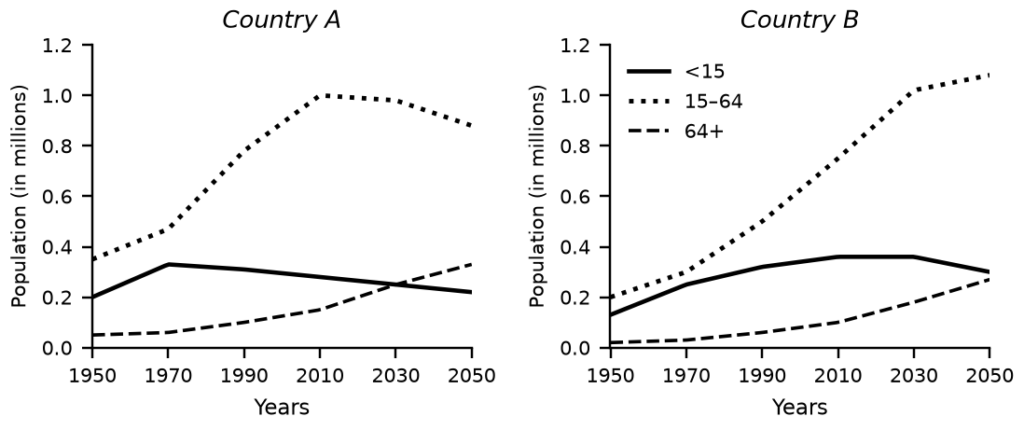
Consider the following graphs. The curves in the graphs indicate different age groups in the populations of two countries A and B over a period of few decades :
With reference to the above graphs, which of the following are the most logical and rational inferences that can be made?
- 1. Over the last two and a half decades, the dependency ratio for country B has decreased.
- 2. By the end of next two and a half decades, the dependency ratio of country A will be much less than that of country B.
- 3. In the next two decades, the work-force relative to its total population will increase in country B as compared to country A.
Select the correct answer using the code given below.
Answer (c) & explanation
1. Dependency ratio = (children under 15 + people over 64) ÷ working people (15–64).
2. Country B, last 25 years: the working group grew fast while the other two grew slowly. Ratio fell. 1 is right.
3. Country A, next 25 years: working group falls and the over-64 group rises, so A's ratio goes up. B's working group keeps rising. So A's ratio will not be 'much less' than B's. 2 is wrong.
4. Next 20 years: B's workers keep rising, A's start falling. 3 is right. Answer: 1 and 3 only.
Answer as per the official UPSC answer key.
Read the passage
It is no longer enough for us to talk about providing for universal access to education. Making available schooling facilities is an essential prerequisite, but is insufficient to ensure that all children attend school and participate in the learning process. The school may be there, but children may not attend or they may drop out after a few months. Through school and social mapping, we must address the entire gamut of social, economic, cultural and indeed linguistic and pedagogic issues, factors that prevent children from weaker sections and disadvantaged groups, as also girls, from regularly attending and complementing elementary education. The focus must be on the poorest and most vulnerable since these groups are the most disempowered and at the greatest risk of violation or denial of their right to education.
The right to education goes beyond free and compulsory education to include quality education for all. Quality is an integral part of the right to education. If the education process lacks quality, children are being denied their right. The Right of Children to Free and Compulsory Education Act lays down that the curriculum should provide for learning through activities, exploration and discovery. This places an obligation on us to change our perception of children as passive receivers of knowledge, and to move beyond the convention of using textbooks as the basis of examinations. The teaching-learning process must become stress-free; and a massive programme for curricular reform should be initiated to provide for a child-friendly learning system, that is more relevant and empowering. Teacher accountability systems and processes must ensure that children are learning, and that their right to learn in a child-friendly environment is not violated. Testing and assessment systems must be reexamined and redesigned to ensure that these do not force children to struggle between school and tuition centres, and bypass childhood.
With reference to the above passage, the following assumptions have been made :
- 1. The Right to Education guarantees teachers’ accountability for the learning process of children.
- 2. The Right to Education guarantees 100% enrolment of children in the schools.
- 3. The Right to Education intends to take full advantage of demographic dividend.
Which of the above assumptions is/are valid?
Answer (a) & explanation
Only assumption 1 is valid (a). Step 1: the passage says "teacher accountability systems and processes must ensure that children are learning". So the right to education includes teacher accountability for learning. Assumption 1 holds. Step 2: assumption 2 says RTE guarantees 100% enrolment. But the passage notes children may still "drop out". So 2 fails. Step 3: assumption 3, about the demographic dividend, is never mentioned. So options (b), (c) and (d) fail.
Tip: words like "guarantees" and "100%" are strong. Check whether the passage really promises a full result. Here it admits drop-outs, so "100%" cannot be assumed.
Answer as per the official UPSC answer key.
Read the passage
Cooking with biomass and coal in India is now recognized to cause major health problems, with women and children in poor populations facing the greatest risk. There are more than 10 lakh premature deaths each year from household air pollution due to polluting cooking fuels with another 1·5 lakh due to their contribution to general outdoor air pollution in the country. Although the fraction of the Indian population using clean cooking fuels, such as LPG, natural gas and electricity, is slowly rising, the number using polluting solid fuels as their primary cooking fuel has remained static for nearly 30 years at about 70 crore.
Which of the following is the most crucial and logical inference that can be made from the above passage?
Answer (d) & explanation
The inference is that access to cooking gas can reduce early deaths in poor homes (d). Step 1: the passage says polluting cooking fuels cause over 10 lakh premature deaths. Clean gas avoids this smoke, so it can save lives. That is option (d). Step 2: option (a) says rural people are giving up solid fuels. But the passage says solid-fuel use is "static", not falling. Step 3: option (b) says subsidies will solve the problem, which overstates it. Option (c), importing gas and making electricity, is not suggested.
Tip: the Ujjwala scheme gives LPG connections to poor households for this reason. But "will solve" claims certainty; "can reduce" is the safer inference.
Answer as per the official UPSC answer key.
Read the passage
‘Desertification’ is a term used to explain a process of decline in the biological productivity of an ecosystem, leading to total loss of productivity. While this phenomenon is often linked to the arid, semi-arid and sub-humid ecosystems, even in the humid tropics, the impact could be most dramatic. Impoverishment of human-impacted terrestrial ecosystems may exhibit itself in a variety of ways : accelerated erosion as in the mountain regions of the country, salinization of land as in the semi-arid and arid ‘green revolution’ areas of the country, e.g., Haryana and western Uttar Pradesh, and site quality decline—a common phenomenon due to general decline in tree cover and monotonous monoculture of rice/wheat across the Indian plains. A major consequence of deforestation is that it relates to adverse alterations in the hydrology and related soil and nutrient losses. The consequences of deforestation invariably arise out of site degradation through erosive losses. Tropical Asia, Africa and South America have the highest levels of erosion. The already high rates for the tropics are increasing at an alarming rate (e.g., through the major river systems—Ganga and Brahmaputra, in the Indian context), due to deforestation and ill-suited land management practices subsequent to forest clearing. In the mountain context, the declining moisture retention of the mountain soils, drying up of the underground springs and smaller rivers in the Himalayan region could be attributed to drastic changes in the forest cover. An indirect consequence is drastic alteration in the upland-lowland interaction, mediated through water. The current concern the tea planter of Assam has is about the damage to tea plantations due to frequent inundation along the flood-plains of Brahmaputra, and the damage to tea plantation and the consequent loss in tea productivity is due to rising level of the river bottom because of siltation and the changing course of the river system. The ultimate consequences of site desertification are soil degradation, alteration in available water and its quality, and the consequent decline in food, fodder and fuel-wood yields essential for the economic well-being of rural communities.
With reference to ‘desertification’, as described in the passage, the following assumptions have been made :
- 1. Desertification is a phenomenon in tropical areas only.
- 2. Deforestation invariably leads to floods and desertification.
Which of the above assumptions is/are valid?
Answer (d) & explanation
Neither assumption is valid (d). Step 1: the passage says desertification is "often linked to the arid, semi-arid and sub-humid ecosystems". These exist outside the tropics too. So assumption 1, tropics only, fails. Step 2: assumption 2 says deforestation invariably leads to floods and desertification. "Invariably" means always, and the passage never says that. Step 3: so 2 fails too, and options (a), (b) and (c) fail.
Tip: "only" and "invariably" are absolute words. A passage that says "often linked" supports a tendency, not a rule. India itself has large drylands, in Rajasthan and Gujarat, that face desertification.
Answer as per the official UPSC answer key.

Consider the following graph :
Which one of the following statements is not correct with reference to the graph given above?
Answer (d) & explanation
Statement (d) is the one that is not correct (d). Step 1: check (a). On 1st June, the actual progress line is at about 20%, while expected is about 50%. So actual is less. True. Step 2: check (b). The actual line is steepest in August, so work moved fastest then. True. Check (c). The actual line reaches 100% in mid-August, before the expected date of 1st September. True. Step 3: check (d). It says actual progress was never above expected. But in August the actual line rises above the expected line. So (d) is false, and it is the answer.
Tip: in "not correct" questions, test every option. Words like "at no time" are easy to disprove with one point on the graph.
Answer as per the official UPSC answer key.
Read the passage
Many pathogens that cause foodborne illnesses are unknown. Food contamination can occur at any stage from farm to plate. Since most cases of food poisoning go unreported, the true extent of global foodborne illnesses is unknown. Improvements in international monitoring have led to greater public awareness, yet the rapid globalization of food production increases consumers’ vulnerability by making food harder to regulate and trace. “We have the world on our plates”, says an official of WHO.
Which of the following is the most logical corollary to the above passage?
Answer (a) & explanation
The corollary is that more food options bring more risks (a). Step 1: the passage says "the world on our plates" gives wider choice. But globalisation makes food "harder to regulate and trace", so the risk of illness grows. That is option (a). Step 2: option (b) says processing is the source of all foodborne illness. "All" goes too far. Step 3: options (c), eat only local food, and (d), cut back globalisation, are prescriptions the passage avoids. It describes a risk; it does not ask us to stop.
Tip: a corollary follows directly from what the passage says. Reject options that tell us what to do unless the author does.
Answer as per the official UPSC answer key.