
CSAT (Paper II): previous-year questions
1280 real UPSC Prelims questions (2011–2026) with the official answer and a clear explanation. 400 of them came in the last five papers.
How often UPSC asks this
Questions per year, counted from the official papers.
Subtopics
Arrangements, ranking, ordering and puzzles
142 questions
Clocks and calendars
5 questions
Coding-decoding, series, patterns, cubes, dice and visual reasoning
110 questions
Communication, interpersonal skills and decision-making
10 questions
Counting, permutations, combinations and probability
1 questions
Directions, blood relations and Venn diagrams
60 questions
General English: grammar, vocabulary and comprehension
20 questions
General Hindi: grammar, vocabulary, dialects and comprehension
25 questions
Geometry and mensuration
26 questions
Number system and basic algebra (divisibility, HCF/LCM, remainders, digits, equations)
196 questions
Percentages, profit and loss, discount, simple and compound interest
47 questions
Ratio, proportion, averages, mixtures and alligation
47 questions
Syllogisms, statements and conclusions, assumptions and arguments
89 questions
Time and work; pipes and cisterns
2 questions
Time, speed and distance; trains, boats and streams; races
48 questions
Attempt the questions
Newest papers first. Tap an option; the answer and the reason appear instantly.
Two persons, A and B are running on a circular track. At the start, B is ahead of A and their positions make an angle of 30° at the centre of the circle. When A reaches the point diametrically opposite to his starting point, he meets B. What is the ratio of speeds of A and B, if they are running with uniform speeds?
Answer (a) & explanation
The ratio of speeds is 6 : 5 (a). Step 1: A runs to the point diametrically opposite his start. That is half the circle, 180°. Step 2: B started 30° ahead of A. To meet A at the same point, B covers only 180° − 30° = 150° in the same time. Step 3: in equal time, speeds are in the ratio of distances: 180 : 150 = 6 : 5. Option (c), 6 : 1, compares 180 with 30. Options (b) and (d) do not fit.
Tip: on circular tracks, angles can stand for distances. Compare the angles each runner covers in the same time to get their speed ratio.
180 : 30 = 6 : 1 compares A with the head start, not with B's run.
Answer as per the official UPSC answer key.
Lakshmi, her brother, her daughter and her son are badminton players. A game of doubles is about to begin :
- (i) Lakshmi's brother is directly across the net from her daughter.
- (ii) Her son is diagonally across the net from the worst player's sibling.
- (iii) The best player and the worst player are on the same side of the net.
Who is the best player?
Answer (a) & explanation
The best player is Lakshmi's brother (a). Step 1: by clue (i), the brother and the daughter are on opposite sides. Case 1: the brother partners Lakshmi. The son is diagonally across from the brother, whose sibling is Lakshmi. So Lakshmi is the worst player, and by clue (iii) the best is her partner, the brother. Step 2: case 2: the brother partners the son. The son is diagonal to the daughter, whose sibling is the son. So the son is the worst, and the best is his partner, the brother. Step 3: both cases give the brother. Options (b), (c) and (d) fail.
Tip: when a puzzle has two possible set-ups, try both. If they give the same answer, you are done.
Answer as per the official UPSC answer key.
Read the passage
It is no longer enough for us to talk about providing for universal access to education. Making available schooling facilities is an essential prerequisite, but is insufficient to ensure that all children attend school and participate in the learning process. The school may be there, but children may not attend or they may drop out after a few months. Through school and social mapping, we must address the entire gamut of social, economic, cultural and indeed linguistic and pedagogic issues, factors that prevent children from weaker sections and disadvantaged groups, as also girls, from regularly attending and complementing elementary education. The focus must be on the poorest and most vulnerable since these groups are the most disempowered and at the greatest risk of violation or denial of their right to education.
The right to education goes beyond free and compulsory education to include quality education for all. Quality is an integral part of the right to education. If the education process lacks quality, children are being denied their right. The Right of Children to Free and Compulsory Education Act lays down that the curriculum should provide for learning through activities, exploration and discovery. This places an obligation on us to change our perception of children as passive receivers of knowledge, and to move beyond the convention of using textbooks as the basis of examinations. The teaching-learning process must become stress-free; and a massive programme for curricular reform should be initiated to provide for a child-friendly learning system, that is more relevant and empowering. Teacher accountability systems and processes must ensure that children are learning, and that their right to learn in a child-friendly environment is not violated. Testing and assessment systems must be reexamined and redesigned to ensure that these do not force children to struggle between school and tuition centres, and bypass childhood.
According to the passage, which one of the following is critical in bringing quality in education?
Answer (d) & explanation
Learning through activities and discovery is critical for quality (d). Step 1: in the paragraph on quality, the passage says the curriculum should provide "learning through activities, exploration and discovery". That is option (d). Step 2: option (c), understanding children's social background, appears in the paragraph on access, not quality. Step 3: option (a), regular attendance, and option (b), money for teachers, are not called critical for quality.
Tip: in long passages, notice which paragraph covers which topic. Options often take a correct phrase from the wrong paragraph. Matching the question's key word, here "quality", to the right paragraph avoids that trap.
Answer as per the official UPSC answer key.
Read the passage
Scientific knowledge has its dangers, but so has every great thing. Over and beyond the dangers with which it threatens the present, it opens up as nothing else can, the vision of a possible happy world; a world without poverty, without war, with little illness. Science, whatever unpleasant consequences it may have by the way, is in its very nature a liberator.
Which one of the following is the most important implication of the passage?
Answer (a) & explanation
The key implication is that a happy world is a dream of science (a). Step 1: the passage says science "opens up the vision of a possible happy world". So science holds out the hope, or dream, of happiness. That is option (a). Step 2: option (b) says science is the only builder and also the only major threat. The passage makes neither "only" claim. Step 3: option (c) says happiness is impossible without science, and option (d) says it is impossible either way. The passage says neither; it calls a happy world possible.
Tip: an implication must stay close to the passage's own words. Options with "only", "not at all" or "impossible" usually overreach.
Answer as per the official UPSC answer key.
Read the passage
A diversity of natural assets will be needed to cope with climate change and ensure productive agriculture, forestry, and fisheries. For example, crop varieties are needed that perform well under drought, heat, and enhanced CO₂. But the private-sector and farmer-led process of choosing crops favours homogeneity adapted to past or current conditions, not varieties capable of producing consistently high yields in warmer, wetter, or drier conditions. Accelerated breeding programmes are needed to conserve a wider pool of genetic resources of existing crops, breeds, and their wild relatives. Relatively intact ecosystems, such as forested catchments, mangroves, wetlands, can buffer the impacts of climate change. Under a changing climate, these ecosystems are themselves at risk, and management approaches will need to be more proactive and adaptive. Connections between natural areas, such as migration corridors, may be needed to facilitate species movements to keep up with the change in climate.
With reference to the above passage, which of the following would assist us in coping with the climate change?
- 1. Conservation of natural water sources
- 2. Conservation of wider gene pool
- 3. Existing crop management practices
- 4. Migration corridors
Select the correct answer using the code given below.
Answer (b) & explanation
Statements 1, 2 and 4 help us cope with climate change (b). Step 1: the passage says catchments and wetlands buffer climate impacts, so conserving natural water sources helps (1). Step 2: it names a wider genetic pool (2) and migration corridors (4) as ways to cope. Corridors let animals and plants move as the climate shifts. Step 3: statement 3, existing crop practices, fails. The passage says current practice "favours homogeneity" and must change. So options (a), (c) and (d) fail.
Tip: watch for the word "existing". If a passage criticises present practice, any statement praising it is wrong.
Answer as per the official UPSC answer key.
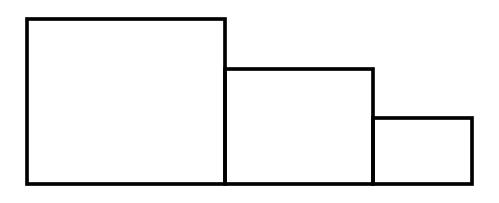
For a sports meet, a winners' stand comprising three wooden blocks is in the following form :
There are six different colours available to choose from and each of the three wooden blocks is to be painted such that no two of them has the same colour. In how many different ways can the winners' stand be painted?
Answer (a) & explanation
The stand can be painted in 120 ways (a). Step 1: the three blocks are different (first, second and third place stand at different heights). So swapping colours between blocks gives a new design; order matters. Step 2: the first block can take any of 6 colours. The second must differ, so it has 5 choices. The third has 4 left. Step 3: total = 6 × 5 × 4 = 120. Option (d), 36, and option (c), 66, do not follow any valid rule. Option (b), 81, would allow repeats, which the question forbids.
Tip: if items are distinct and no repeats are allowed, multiply the shrinking choices. This is a permutation, 6P3 = 120. If order did not matter, it would be 6C3 = 20.
Answer as per the official UPSC answer key.
Read the passage
I am a scientist, privileged to be somebody who tries to understand nature using the tools of science. But it is also clear that there are some really important questions that science cannot really answer, such as : Why is there something instead of nothing? Why are we here? In those domains, I have found that faith provides a better path to answers. I find it oddly anachronistic that in today’s culture there seems to be a widespread presumption that scientific and spiritual views are incompatible.
Which of the following is the most logical and rational inference that can be made from the above passage?
Answer (b) & explanation
The inference is that science and faith can complement each other if their domains are understood (b). Step 1: the passage gives science the study of nature and faith the question "Why are we here?". It calls the idea that they cannot fit together "anachronistic", meaning out of date. So they can work side by side. That is option (b). Step 2: option (a) says faith can solve all problems, which goes too far. Step 3: option (c), that some questions cannot be answered by either, contradicts the passage's line that faith gives a better path. Option (d) is not discussed.
Tip: "complementary" means each fills the other's gap. A passage giving each a separate area usually points to this.
Answer as per the official UPSC answer key.
A student has to get 40% marks to pass in an examination. Suppose he gets 30 marks and fails by 30 marks, then what are the maximum marks in the examination?
Answer (c) & explanation
The maximum marks are 150 (c). Step 1: he got 30 marks and failed by 30, so the pass mark is 30 + 30 = 60. Step 2: the pass mark is 40% of the maximum. Step 3: maximum = 60 ÷ 0.4 = 150. Check: 40% of 150 = 60. Option (a), 100, would make the pass mark 40. Option (b), 120, gives 48. Option (d), 300, gives 120.
Tip: "failed by x marks" means he was x marks short of the pass mark. Add it to his score to get the pass mark. Then divide by the pass percentage to find the total.
Answer as per the official UPSC answer key.
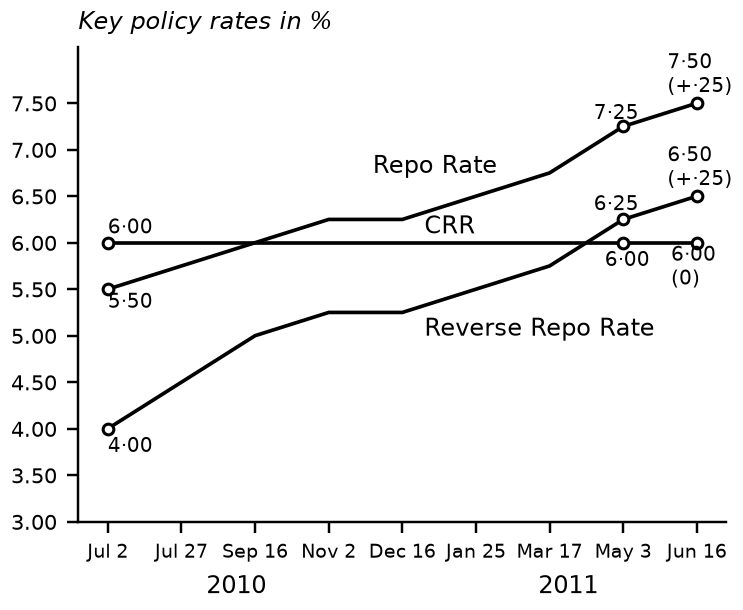
The graph given below indicates the changes in key policy rates made by the Central Bank several times in a year :
Which one of the following can be the most likely reason for the Central Bank for such an action?
Answer (d) & explanation
The likely reason is an anti-inflationary stance (d). Step 1: the graph shows the repo and reverse repo rates being raised again and again. Step 2: higher rates make loans costlier. People and firms then borrow and spend less. Less money chasing goods cools prices. Step 3: so repeated hikes signal a fight against inflation. Option (b), increasing liquidity, is the opposite; it needs rate cuts. Options (a) and (c) are not the main purpose of hiking policy rates.
Tip: rate hike = less money in the system = lower inflation. Rate cut = more money = growth push. In India, the RBI's Monetary Policy Committee sets the repo rate to keep CPI inflation near 4% (with a band of 2–6%).
Answer as per the official UPSC answer key.
Read the passage
It is no longer enough for us to talk about providing for universal access to education. Making available schooling facilities is an essential prerequisite, but is insufficient to ensure that all children attend school and participate in the learning process. The school may be there, but children may not attend or they may drop out after a few months. Through school and social mapping, we must address the entire gamut of social, economic, cultural and indeed linguistic and pedagogic issues, factors that prevent children from weaker sections and disadvantaged groups, as also girls, from regularly attending and complementing elementary education. The focus must be on the poorest and most vulnerable since these groups are the most disempowered and at the greatest risk of violation or denial of their right to education.
The right to education goes beyond free and compulsory education to include quality education for all. Quality is an integral part of the right to education. If the education process lacks quality, children are being denied their right. The Right of Children to Free and Compulsory Education Act lays down that the curriculum should provide for learning through activities, exploration and discovery. This places an obligation on us to change our perception of children as passive receivers of knowledge, and to move beyond the convention of using textbooks as the basis of examinations. The teaching-learning process must become stress-free; and a massive programme for curricular reform should be initiated to provide for a child-friendly learning system, that is more relevant and empowering. Teacher accountability systems and processes must ensure that children are learning, and that their right to learn in a child-friendly environment is not violated. Testing and assessment systems must be reexamined and redesigned to ensure that these do not force children to struggle between school and tuition centres, and bypass childhood.
What is the essential message in this passage?
Answer (c) & explanation
The message is that the Right to Free and Compulsory Education should include quality education for all (c). Step 1: the passage says "the right to education goes beyond free and compulsory education to include quality education for all". That is option (c). Step 2: option (a), that education is now a Fundamental Right, is true (Article 21A), but it is outside knowledge, not the passage's message. Step 3: options (b) and (d) cover only access, getting children into school, and miss quality.
Tip: an answer can be true in real life and still be wrong for a passage question. The essential message must come from the passage itself.
Answer as per the official UPSC answer key.
Read the passage
The Arctic’s vast reserves of fossil fuel, fish and minerals are now accessible for a longer period in a year. But unlike Antarctica, which is protected from exploitation by the Antarctic Treaty framed during the Cold War and is not subject to territorial claims by any country, there is no legal regime protecting the Arctic from industrialization, especially at a time when the world craves for more and more resources. The distinct possibility of ice-free summer has prompted countries with Arctic coastline to scramble for great chunks of the melting ocean.
Which one of the following is the most important implication of the passage?
Answer (b) & explanation
The implication is that melting Arctic summer ice is changing geopolitics (b). Step 1: the passage says ice-free summers have made coastal countries "scramble for great chunks of the melting ocean". A scramble among nations for territory and resources is geopolitics. So (b) fits. Step 2: option (a) brings in India's territorial claims. India is not mentioned, and it has no Arctic coast. Step 3: option (c), that the Arctic will solve the world's resource crunch, overstates. Option (d) compares the Arctic with Antarctica, which the passage never does.
Tip: when a passage describes a cause (melting ice) and a reaction (a scramble), the best answer usually links the two. Outside facts like India's role are traps.
Answer as per the official UPSC answer key.
Read the passage
A diversity of natural assets will be needed to cope with climate change and ensure productive agriculture, forestry, and fisheries. For example, crop varieties are needed that perform well under drought, heat, and enhanced CO₂. But the private-sector and farmer-led process of choosing crops favours homogeneity adapted to past or current conditions, not varieties capable of producing consistently high yields in warmer, wetter, or drier conditions. Accelerated breeding programmes are needed to conserve a wider pool of genetic resources of existing crops, breeds, and their wild relatives. Relatively intact ecosystems, such as forested catchments, mangroves, wetlands, can buffer the impacts of climate change. Under a changing climate, these ecosystems are themselves at risk, and management approaches will need to be more proactive and adaptive. Connections between natural areas, such as migration corridors, may be needed to facilitate species movements to keep up with the change in climate.
With reference to the above passage, the following assumptions have been made :
- 1. Diversification of livelihoods acts as a coping strategy for climate change.
- 2. Adoption of monocropping practice leads to the extinction of plant varieties and their wild relatives.
Which of the above assumptions is/are valid?
Answer (c) & explanation
Both assumptions are valid (c). Step 1: the passage links the diversity of natural assets to farming, forestry and fisheries. UPSC's key reads this as diversity of livelihoods, which helps people cope with climate shocks. So assumption 1 holds. Step 2: the passage treats homogeneity, growing one uniform crop, as a threat to genetic resources that need protection. So monocropping leads to the loss of plant varieties and their wild relatives. Assumption 2 holds. Step 3: so options (a), (b) and (d) fail.
Tip: diversity reduces risk, in farming as in money. When one crop or job fails, others carry the load. That idea runs through most climate passages.
Answer as per the official UPSC answer key.
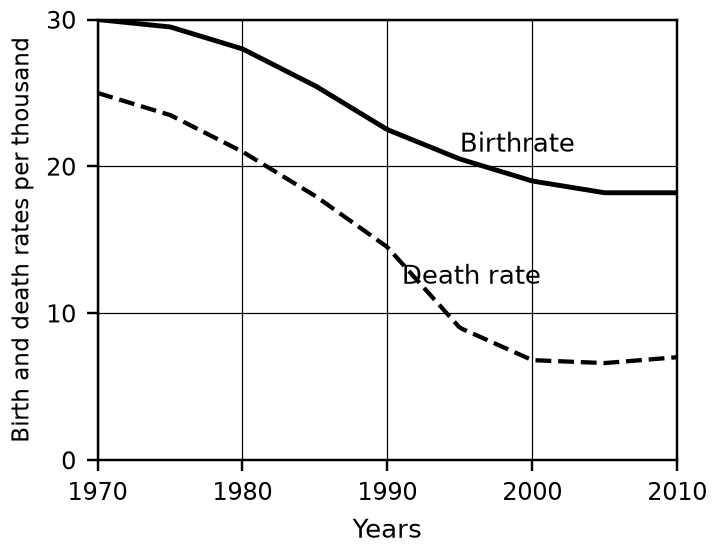
Directions for the following 2 (two) items : Consider the following graph in which the birthrate and death rate of a country are given, and answer the two items that follow.
Looking at the graph, it can be inferred that from 1990 to 2010
Answer (d) & explanation
The official answer is that population growth rate shows no trend (d). Step 1: growth rate = birth rate − death rate, the gap between the two lines. Step 2: read the graph. In 1990: about 22 − 14 = 8. In 2000: about 19 − 7 = 12. In 2010: about 18 − 7 = 11. Step 3: the gap first widens, then narrows slightly. It does not move steadily up (a) or down (b), and it is not flat (c). So UPSC's key says no trend.
Tip: never judge growth from one line alone. Natural growth rate is always the gap between births and deaths. India's own death rate fell faster than its birth rate for decades, which is why its population grew fast.
Some read the widening gap as 'increased' (a); the official answer is (d), as printed.
Answer as per the official UPSC answer key.
Read the passage
Though I have discarded much of past tradition and custom, and am anxious that India should rid herself of all shackles that bind and contain her and divide her people, and suppress vast numbers of them, and prevent the free development of the body and the spirit; though I seek all this, yet I do not wish to cut myself off from that past completely. I am proud of that great inheritance that has been and is, ours and I am conscious that I too, like all of us, am a link in that unbroken chain which goes back to the dawn of history in the immemorial past of India.
The author wants India to rid herself of certain past bonds because
Answer (d) & explanation
He wants India free of past bonds because they block her physical and spiritual growth (d). Step 1: the passage says these shackles "prevent the free development of the body and the spirit". That is option (d). Step 2: the author also says he is "proud of that great inheritance". So he does value India's past. Step 3: this rules out option (a), that he sees no relevance in the past, option (b), that there is little to be proud of, and option (c), that he has no interest in history.
Tip: this passage is from Jawaharlal Nehru. He admired India's heritage but rejected parts of it that held the country back. Watch for options that contradict the author's stated pride.
Answer as per the official UPSC answer key.
19 boys turn out for playing hockey. Of these, 11 are wearing hockey shirts and 14 are wearing hockey pants. There are no boys without shirts and/or pants. What is the number of boys wearing full uniform?
Answer (c) & explanation
6 boys wear the full uniform (c). Step 1: 11 boys wear shirts and 14 wear pants. That adds to 25, but there are only 19 boys. Step 2: every boy wears at least one item, so the extra count comes from boys wearing both. Step 3: both = 11 + 14 − 19 = 6. Option (b), 5, and option (a), 3, undercount. Option (d), 8, overcounts.
Tip: this is the overlap rule for two groups: both = A + B − total, when no one is outside both groups. A quick Venn diagram makes it clear: 5 shirts only, 8 pants only, 6 both.
Answer as per the official UPSC answer key.
Directions for the following 2 (two) items : The following table gives the GDP growth rate and Tele-density data of different States of a country in a particular year. Study the table and answer the two items that follow.
With reference to the above table, which of the following is/are the most logical and rational inference/inferences that can be made?
- 1. Higher per capita income is generally associated with higher Tele-density.
- 2. Higher GDP growth rate always ensures higher per capita income.
- 3. Higher GDP growth rate does not necessarily ensure higher Tele-density.
| States | Per capita income ($) | GDP growth rate (%) | Tele-density |
|---|---|---|---|
| State 1 | 704 | 9·52 | 70·27 |
| State 2 | 419 | 5·31 | 35·88 |
| State 3 | 254 | 10·83 | 50·07 |
| State 4 | 545 | 9·78 | 5·94 |
| State 5 | 891 | 10·8 | 76·12 |
| State 6 | 1077 | 11·69 | 77·5 |
| State 7 | 900 | 8·88 | 104·86 |
| State 8 | 395 | 5·92 | 6 |
| State 9 | 720 | 7·76 | 82·25 |
| State 10 | 893 | 9·55 | 96·7 |
| State 11 | 363 | 4·7 | 57·7 |
| State 12 | 966 | 7·85 | 63·8 |
| State 13 | 495 | 9·37 | 52·3 |
| State 14 | 864 | 5·46 | 97·9 |
| State 15 | 497 | 7·48 | 62·3 |
| State 16 | 777 | 7·03 | 93·8 |
| State 17 | 335 | 5·8 | 49·9 |
| State 18 | 599 | 7·49 | 47·84 |
Select the correct answer using the code given below.
Answer (c) & explanation
Inferences 1 and 3 are right (c). Step 1: richer states (like 7, 10, 14 and 16) mostly have high tele-density, and poorer ones (like 2 and 8) mostly have low. The word "generally" allows a few exceptions, so 1 holds. Step 2: statement 2 says high growth always means high income. But state 3 grows at 10·83% yet has the lowest income (254). So 2 fails. Step 3: state 4 grows at 9·78% but has a tele-density of only 5·94. So high growth does not always mean high tele-density. 3 holds. Options (a), (b) and (d) fail.
Tip: "generally" survives a few exceptions; "always" dies with one. Hunt for a single counter-example to test "always".
Words like 'always' fail with one counter-example; 'generally' only needs the overall pattern.
Answer as per the official UPSC answer key.
If LSJXVC is the code for MUMBAI, the code for DELHI is
Answer (a) & explanation
DELHI is written as CCIDD (a). Step 1: compare MUMBAI with LSJXVC letter by letter. M → L is −1, U → S is −2, M → J is −3, B → X is −4 (going back round the alphabet), A → V is −5, and I → C is −6. So each letter moves back one more step than the last. Step 2: apply it to DELHI. D − 1 = C, E − 2 = C, L − 3 = I, H − 4 = D, I − 5 = D. Step 3: the code is CCIDD. Options (b), (c) and (d) break the pattern at one or more letters.
Tip: write the alphabet with numbers (A = 1 … Z = 26) to count shifts quickly. Going back from A wraps round to Z.
Answer as per the official UPSC answer key.
Read the passage
Being a member of the WTO, India is bound by the agreements that have been signed and ratified by its members, including itself. According to Article 6 of the Agriculture Agreement, providing minimum support prices for agricultural products is considered distorting and is subject to limits. The subsidy arising from ‘minimal supports’ cannot exceed 10 per cent of the value of agricultural production for developing countries. PDS in India entails minimum support prices and public stockholding of food grains. It is possible that, in some years, the subsidy to producers will exceed 10 per cent of the value of agricultural production.
What is the crucial message conveyed by the above passage?
Answer (c) & explanation
The message is that, for India, food security collides with trade rules (c). Step 1: the passage says the support prices paid under the PDS may cross the WTO's 10% subsidy limit. So feeding the poor and following trade rules pull in opposite directions. That is option (c). Step 2: options (a) and (b) ask India to revise its PDS or leave the WTO. The passage only describes the conflict; it prescribes nothing. Step 3: option (d), that India gives food security to the poor, is true but is only a background fact, not the crucial message.
Tip: if a passage just lays out a clash, pick the option that names the clash. Reject options that add advice the author never gave.
Answer as per the official UPSC answer key.
Read the passage
Today, the top environmental challenge is a combination of people and their aspirations. If the aspirations are more like the frugal ones we had after the Second World War, a lot more is possible than if we view the planet as a giant shopping mall. We need to get beyond the fascination with glitter and understand that the planet works as a biological system.
Which of the following is the most crucial and logical inference that can be made from the above passage?
Answer (c) & explanation
The inference is that reducing our consumerism is in our own interest (c). Step 1: the passage says modest, frugal aspirations make "a lot more" possible than treating the planet as "a giant shopping mall". So cutting consumption benefits us. That is option (c). Step 2: option (b) says limiting population is the only way. But the passage blames aspirations, not numbers alone. Step 3: option (a), that Earth can meet only basic needs, and option (d), that biology alone can save the planet, are not supported.
Tip: the author's key image, here the "shopping mall", usually points to the main message. This links to India's Mission LiFE, which promotes mindful consumption.
Answer as per the official UPSC answer key.
(Same graph as the question above.)
With reference to the above graph, consider the following statements considering 1970 as base year :
- 1. Population has stabilized after 35 years.
- 2. Population growth rate has stabilized after 35 years.
- 3. Death rate has fallen by 10% in the first 10 years.
- 4. Birthrate has stabilized after 35 years.
Which of the above are the most logical and rational statements that can be made from the above graph?
Answer (d) & explanation
Statements 2 and 4 are the logical ones (d). Step 1: 35 years after 1970 is 2005. By then both lines are almost flat. So the birth rate is steady (4), and the gap between the lines, the growth rate, is steady (2). Step 2: statement 1 says population has stabilised. But births are still above deaths, so the population keeps growing. 1 is wrong. Step 3: statement 3 says death rate fell 10% in 10 years. It went from about 25 to 21, a fall of 4 out of 25, roughly 16%. So 3 is wrong. Options (a), (b) and (c) fail.
Tip: a steady growth rate is not a steady population. A population stops growing only when births equal deaths.
Answer as per the official UPSC answer key.