
CSAT (Paper II): previous-year questions
1280 real UPSC Prelims questions (2011–2026) with the official answer and a clear explanation. 400 of them came in the last five papers.
How often UPSC asks this
Questions per year, counted from the official papers.
Subtopics
Arrangements, ranking, ordering and puzzles
142 questions
Clocks and calendars
5 questions
Coding-decoding, series, patterns, cubes, dice and visual reasoning
110 questions
Communication, interpersonal skills and decision-making
10 questions
Counting, permutations, combinations and probability
1 questions
Directions, blood relations and Venn diagrams
60 questions
General English: grammar, vocabulary and comprehension
20 questions
General Hindi: grammar, vocabulary, dialects and comprehension
25 questions
Geometry and mensuration
26 questions
Number system and basic algebra (divisibility, HCF/LCM, remainders, digits, equations)
196 questions
Percentages, profit and loss, discount, simple and compound interest
47 questions
Ratio, proportion, averages, mixtures and alligation
47 questions
Syllogisms, statements and conclusions, assumptions and arguments
89 questions
Time and work; pipes and cisterns
2 questions
Time, speed and distance; trains, boats and streams; races
48 questions
Attempt the questions
Newest papers first. Tap an option; the answer and the reason appear instantly.
Read the passage
Monoculture carries great risks. A single disease or pest can wipe out swathes of the world’s food production, an alarming prospect given that its growing and wealthier population will eat 70% more by 2050. The risks are magnified by the changing climate. As the planet warms and monsoon rains intensify, farmlands in Asia will flood. North America will suffer more intense droughts, and crop diseases will spread to new latitudes.
Which of the following is the most logical, rational and crucial message given by the passage?
Answer (a) & explanation
The message is that crop genetic diversity is insurance against climate change (a). Step 1: the passage says a single disease can wipe out a monoculture, a field of one crop variety. Climate change makes such shocks more likely. Keeping many varieties spreads the risk. That is (a). Step 2: option (b) calls monoculture the only way to food security. This contradicts the passage, which warns against monoculture. Step 3: option (c) praises GM crops, which the passage does not discuss. Option (d) takes the examples of Asia and North America and treats them as the main message.
Tip: examples in a passage support the message; they are not the message. India's gene banks, like the one at NBPGR in Delhi, store seeds for this very reason.
Answer as per the official UPSC answer key.
Consider the following pattern of numbers :
| 8 | 10 | 15 | 13 |
|---|---|---|---|
| 6 | 5 | 7 | 4 |
| 4 | 6 | 8 | 8 |
| 6 | 11 | 16 | ? |
What is the number at ? in the above pattern?
Answer (a) & explanation
The missing number is 17 (a). Step 1: look for a rule that works down each column. Here: top − middle + third = bottom. Step 2: check it on the known columns: 8 − 6 + 4 = 6, 10 − 5 + 6 = 11, and 15 − 7 + 8 = 16. The rule works every time. Step 3: apply it to the last column: 13 − 4 + 8 = 17. Options (b) 19, (c) 21 and (d) 23 come from adding all three numbers or using a wrong sign.
Tip: in number grids, try simple operations (add, subtract, multiply) on each column or row. Only accept a rule after it works on every complete column, not just one.
Answer as per the official UPSC answer key.
A solid cube of 3 cm side, painted on all its faces, is cut up into small cubes of 1 cm side. How many of the small cubes will have exactly two painted faces?
Answer (a) & explanation
12 small cubes have exactly two painted faces (a). Step 1: a cube with exactly two painted faces sits on an edge of the big cube, but not at a corner. Step 2: the 3 cm cube is cut into 3 × 3 × 3 = 27 small cubes. Each edge has 3 small cubes. The 2 at the ends are corners (three painted faces), so 1 in the middle has two. Step 3: a cube has 12 edges, so 12 × 1 = 12. Option (b), 8, is the corner count. Option (c), 6, is the number with one painted face. Option (d), 4, does not fit.
Tip: for an n-cube, two-face cubes = 12 × (n − 2). For n = 3 that is 12.
Answer as per the official UPSC answer key.
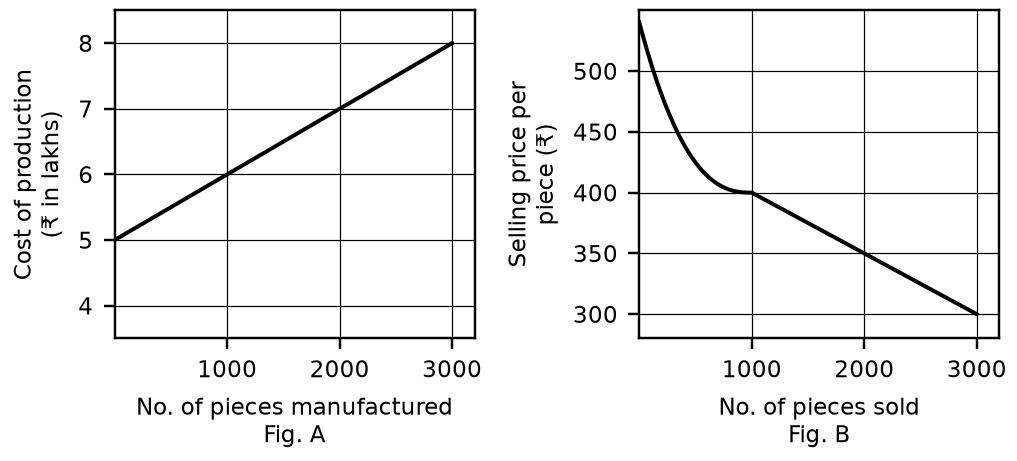
Consider the following figures A and B :
The manufacturing cost and projected sales for a product are shown in the above figures A and B respectively. What is the minimum number of pieces that should be manufactured to avoid a loss?
Answer (a) & explanation
The minimum number is 2000 pieces (a). Step 1: there is no loss when sales ≥ cost. Step 2: at 2000 pieces, Figure A gives a cost of ₹ 7 lakh. Figure B gives a price of ₹ 350 a piece, so sales = 2000 × 350 = ₹ 7 lakh. Cost equals sales, so there is no loss. Step 3: check a smaller number. At 1000 pieces, cost is ₹ 6 lakh but sales are 1000 × 400 = ₹ 4 lakh, a loss. So 2000 is the least. Options (b), (c) and (d) also avoid a loss, but they are not the minimum.
Tip: the break-even point is where cost equals revenue. When asked for the "minimum", stop at the first value that works.
Answer as per the official UPSC answer key.
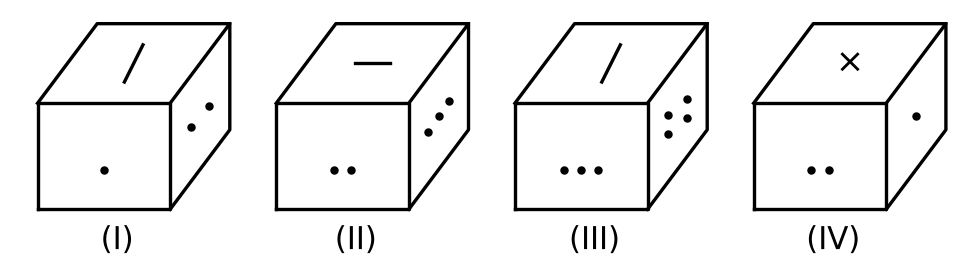
Directions for the following 3 (three) items : Rotated positions of a single solid are shown below. The various faces of the solid are marked with different symbols like dots, cross and line. Answer the three items that follow the given figures.
What is the symbol on the face opposite to that containing a single dot?
Answer (b) & explanation
1. The six faces are: line, cross, one dot, two dots, three dots, four dots.
2. The line is seen next to one, two, three and four dots, so the only face left for its opposite is the cross.
3. The four dot faces go round the middle: 1 is next to 2, 2 is next to 3, 3 is next to 4. So the order round the ring is 1, 2, 3, 4.
4. In a ring of four, the face two steps away is opposite. So one dot is opposite three dots.
Answer as per the official UPSC answer key.
(Same information as the question above.)
Which one of the following statements is correct?
Answer (a) & explanation
The correct statement is that D does not study in city S (a). Step 1: city S belongs to C, who is in the Arts college in Rajasthan. So D is not in city S. Option (a) is right. Step 2: option (b) says A is in the Science college. But A is in Commerce. Step 3: option (c) says A is in Kerala. But A is in Gujarat. Option (d) says the Engineering college is in Gujarat. But it is in Assam. So options (b), (c) and (d) are wrong.
Tip: in "which is correct" questions, check each option against your table. A "not" statement, like option (a), is often the safe right answer.
Answer as per the official UPSC answer key.
Read the passage
The quest for cheap and plentiful meat has resulted in factory farms where more and more animals are squeezed into smaller lots in cruel and shocking conditions. Such practices have resulted in many of the world’s health pandemics such as the avian flu. Worldwide, livestock are increasingly raised in cruel, cramped conditions, where animals spend their short lives under artificial light, pumped full of antibiotics and growth hormones, until the day they are slaughtered. Meat production is water-intensive. 15000 litres of water is needed for every kilogram of meat compared with 3400 litres for rice, 3300 litres for eggs and 255 litres for a kilogram of potatoes.
What is the most rational and crucial message given by the passage?
Answer (d) & explanation
The message is that industrial meat farming has an unsustainable environmental cost (d). Step 1: the passage links factory farming to pandemics and says one kilogram of meat needs about 15,000 litres of water. These point to a heavy, unsustainable cost. That is (d). Step 2: option (a) praises it as cheap protein for poor countries; the passage does not support this. Option (b) talks of laws against cruelty, but the passage cites no laws. Step 3: option (c) says it should be stopped immediately. That goes too far; the passage warns but does not demand an instant ban.
Tip: words like "immediately" or "only" make an option extreme. The best answer matches the passage's tone, which here is concern, not command.
Answer as per the official UPSC answer key.
The plan of an office block for six officers A, B, C, D, E and F is as follows : Both B and C occupy offices to the right of the corridor (as one enters the office block) and A occupies on the left of the corridor. E and F occupy offices on opposite sides of the corridor but their offices do not face each other. The offices of C and D face each other. E does not have a corner office. F's office is further down the corridor than A's, but on the same side.
If E sits in his office and faces the corridor, whose office is to his left?
Answer (c) & explanation
1. C faces D, so D is on the left side. F is on A's side, so the left side has A, D, F and the right side B, C, E.
2. E is not in a corner: E is in the middle on the right. F is not opposite E and is beyond A, so F is at the far end and A in the middle. C faces D, so both are at the entrance end and B is at the far end.
3. E faces the corridor from the right side, so his left is towards the entrance: C.
Answer as per the official UPSC answer key.
A shopkeeper sells an article at ₹ 40 and gets X% profit. However, when he sells it at ₹ 20, he faces same percentage of loss. What is the original cost of the article?
Answer (c) & explanation
The cost price is ₹ 30 (c). Step 1: the profit % and the loss % are equal and are worked out on the same cost price. So the rupee profit equals the rupee loss. Step 2: profit = 40 − C and loss = C − 20. Set them equal: 40 − C = C − 20, so 2C = 60 and C = ₹ 30. Step 3: check: selling at 40 gives a profit of 10, which is 33⅓% of 30. Selling at 20 gives a loss of 10, also 33⅓%. Option (b), ₹ 20, gives zero loss. Options (a) and (d) also fail.
Tip: when profit % and loss % are the same, the cost price is simply the average of the two selling prices: (40 + 20) ÷ 2 = 30.
Answer as per the official UPSC answer key.
How many diagonals can be drawn by joining the vertices of an octagon?
Answer (a) & explanation
An octagon has 20 diagonals (a). Step 1: an octagon has 8 corners. From each corner, you can draw a diagonal to every other corner except itself and its 2 neighbours. That is 8 − 3 = 5 diagonals. Step 2: 8 corners × 5 = 40. But each diagonal joins two corners, so it is counted twice. Step 3: 40 ÷ 2 = 20. Option (d), 64, is 8 × 8. Option (c), 28, counts all lines between corners, including the 8 sides. Option (b), 24, does not fit.
Tip: the formula for diagonals of an n-sided shape is n(n − 3) ÷ 2. For a hexagon it is 6 × 3 ÷ 2 = 9.
Answer as per the official UPSC answer key.
While writing all the numbers from 700 to 1000, how many numbers occur in which the digit at hundred's place is greater than the digit at ten's place, and the digit at ten's place is greater than the digit at unit's place?
Answer (c) & explanation
1. Pick the hundreds digit h, then any two different smaller digits. They can sit only one way (bigger one in the tens place).
2. h = 7: two digits from 0 to 6 (7 digits): 6 + 5 + 4 + 3 + 2 + 1 = 21 pairs.
3. h = 8: from 0 to 7: 7 + 6 + … + 1 = 28. h = 9: from 0 to 8: 8 + 7 + … + 1 = 36.
4. Total 21 + 28 + 36 = 85. (1000 does not qualify.)
Answer as per the official UPSC answer key.
A lift has the capacity of 18 adults or 30 children. How many children can board the lift with 12 adults?
Answer (b) & explanation
10 children can board with 12 adults (b). Step 1: the lift holds 18 adults, so 12 adults use 12/18 = 2/3 of its capacity. Step 2: the remaining space is 1/3 of the lift. Step 3: the full lift holds 30 children, so 1/3 of it holds 30 ÷ 3 = 10 children. Another way: 18 adults = 30 children, so 1 adult = 5/3 child. The 6 missing adults = 6 × 5/3 = 10 children. Option (a), 6, just subtracts 12 from 18. Options (c) and (d) do not fit.
Tip: in capacity questions, turn everything into a fraction of the whole, or into one common unit. Both ways give the answer in seconds.
Answer as per the official UPSC answer key.
(Same figures as the question above.)
What is the symbol on the face opposite to that containing two dots?
Answer (c) & explanation
Four dots are opposite two dots (c). Step 1: from the given views of the cube, the faces around the middle ring run in the order 1, 2, 3, 4 dots. Step 2: on a ring of four faces, a face is opposite the one two steps away. Step 3: two steps from two dots is four dots. Option (a), single dot, and option (b), three dots, are next to two dots, so they cannot be opposite. Option (d), line, touches all four dot faces, so it is not opposite any of them.
Tip: on a cube, each face touches four others and is opposite one. Faces that appear next to each other in any view can never be opposite.
Answer as per the official UPSC answer key.
(Same information as the question above.)
Which one of the following statements is correct regarding Engineering college?
Answer (d) & explanation
D studies in the Engineering college (d). Step 1: D is in Assam. The Arts college is in Rajasthan and the Science college is in Kerala, so D cannot be in either. Step 2: A is in Commerce. So the only college left for D is Engineering, in Assam. Step 3: option (a), C, is in Arts. Option (b), B, is in Science. Option (c) puts Engineering in Gujarat, but Gujarat has the Commerce college.
Tip: when the same puzzle has many questions, each answer should agree with one master table. If two answers clash, recheck the table. Here every answer fits: A Commerce Gujarat, B Science Kerala, C Arts Rajasthan, D Engineering Assam.
Answer as per the official UPSC answer key.
Read the passage
A male tiger was removed from Pench Tiger Reserve and was relocated in Panna National Park. Later, this tiger trekked toward his home 250 miles away. The trek of this solitary tiger highlights a crisis. Many wildlife reserves exist as islands of fragile habitat in a vast sea of humanity, yet tigers can range over a hundred miles, seeking prey, mates and territory. Nearly a third of India’s tigers live outside tiger reserves, a situation that is dangerous for both human and animal. Prey and tigers can only disperse if there are recognized corridors of land between protected areas to allow unmolested passage.
Which of the following is the most rational and crucial message given by the passage?
Answer (b) & explanation
The message is that safe wildlife corridors are essential for conservation (b). Step 1: the passage calls reserves "islands of fragile habitat" and says tigers "can only disperse if there are recognized corridors". So linking reserves is the key point. That is (b). Step 2: option (c) asks for more reserves. The passage wants links between reserves, not more islands. Step 3: option (a) says conflict cannot be resolved; that is defeatist and not the author's view. Option (d), professional management, is not discussed.
Tip: an author's repeated image ("islands") often signals the problem; the fix they name is the message. India's tiger corridors, such as those linking Kanha and Pench, follow this idea.
Answer as per the official UPSC answer key.
The plan of an office block for six officers A, B, C, D, E and F is as follows : Both B and C occupy offices to the right of the corridor (as one enters the office block) and A occupies on the left of the corridor. E and F occupy offices on opposite sides of the corridor but their offices do not face each other. The offices of C and D face each other. E does not have a corner office. F's office is further down the corridor than A's, but on the same side.
Who is/are F's immediate neighbour/neighbours?
Answer (a) & explanation
A is F's only neighbour (a). Step 1: B and C are on the right of the corridor, and A is on the left. C and D face each other, so D is on the left. E and F are on opposite sides but do not face each other, and E has no corner office. Step 2: F is further down than A on the same side, so F is on the left. The layout is: left side, from the entrance, D, A, F; right side C, E, B. Step 3: F is at the far end of the left side. Its only neighbour on that side is A. Option (b) adds D, who is not next to F. Options (c) and (d) are across the corridor, not neighbours.
Tip: draw the corridor with two columns of offices before placing anyone.
Answer as per the official UPSC answer key.
There are 24 equally spaced points lying on the circumference of a circle. What is the maximum number of equilateral triangles that can be drawn by taking sets of three points as the vertices?
Answer (c) & explanation
The maximum is 8 equilateral triangles (c). Step 1: in a circle, the corners of an equilateral triangle are 120° apart. The 24 points are 360 ÷ 24 = 15° apart, so 120° is every 8th point. Step 2: start at point 1: the triangle is 1, 9, 17. Start at point 2: 2, 10, 18. And so on. Step 3: starting at point 9 gives the same triangle as starting at point 1. So only starts 1 to 8 give new triangles: 24 ÷ 3 = 8. Option (a), 4, and option (b), 6, are too few. Option (d), 12, counts each triangle more than once.
Tip: for n equally spaced points (n divisible by 3), the number of equilateral triangles is n ÷ 3.
Answer as per the official UPSC answer key.
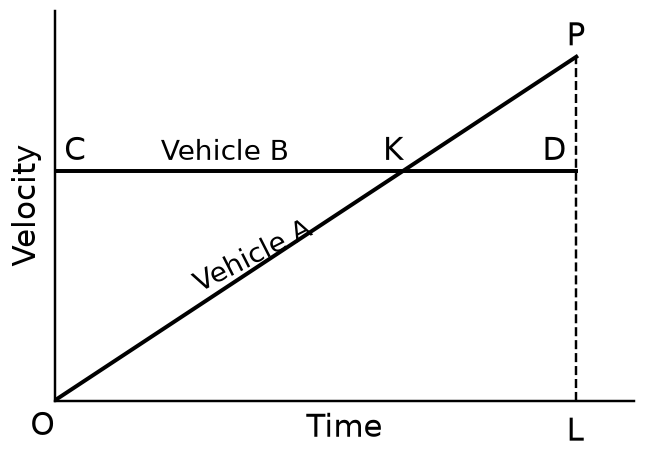
The figure drawn below gives the velocity graphs of two vehicles A and B. The straight line OKP represents the velocity of vehicle A at any instant, whereas the horizontal straight line CKD represents the velocity of vehicle B at any instant. In the figure, D is the point where perpendicular from P meets the horizontal line CKD such that PD = ½ LD :
What is the ratio between the distances covered by vehicles A and B in the time interval OL?
Answer (c) & explanation
The ratio of distances is 3 : 4 (c). Step 1: on a speed–time graph, distance = the area under the line. Let LD = 2 units, so PD = 1 and PL = 3. Let the time OL = 1 unit. Step 2: B moves at a steady speed of 2. Its area is a rectangle: 1 × 2 = 2. Step 3: A starts at 0 and speeds up evenly to 3. Its area is a triangle: ½ × 1 × 3 = 1.5. So A : B = 1.5 : 2 = 3 : 4. Option (d), 1 : 1, wrongly assumes equal distances because the lines cross at K. Options (a) and (b) do not fit.
Tip: on speed graphs, compare areas, not the heights of the lines.
Answer as per the official UPSC answer key.
If Pen < Pencil, Pencil < Book and Book > Cap, then which one of the following is always true?
Answer (b) & explanation
Pen < Book is always true (b). Step 1: chain the facts: Pen < Pencil and Pencil < Book. So Pen < Pencil < Book, and Pen < Book always. Step 2: Cap is only linked to Book: Book > Cap. That tells us Cap is below Book, but not where it stands against Pen or Pencil. Step 3: so option (a), Pen > Cap, option (c), Pencil = Cap, and option (d), Pencil > Cap, are only possible, not certain.
Tip: join signs that point the same way into a chain. When two items are both smaller than the same thing (here Pencil and Cap are both below Book), you cannot compare them with each other.
Answer as per the official UPSC answer key.
A person bought a refrigerator worth ₹ 22,800 with 12·5% interest compounded yearly. At the end of first year he paid ₹ 8,650 and at the end of second year ₹ 9,125. How much will he have to pay at the end of third year to clear the debt?
Answer (d) & explanation
He must pay ₹ 11,250 at the end of the third year (d). Step 1: 12·5% = 1/8. So each year the amount owed is multiplied by 9/8, and then the payment is subtracted. Step 2: year 1: 22,800 × 9/8 = 25,650. Minus 8,650 leaves 17,000. Year 2: 17,000 × 9/8 = 19,125. Minus 9,125 leaves 10,000. Step 3: year 3: 10,000 × 9/8 = ₹ 11,250. This clears the debt. Option (b), ₹ 10,000, forgets the third year's interest. Options (a) and (c) do not fit.
Tip: change common percentages into fractions: 12·5% = 1/8, 20% = 1/5, 25% = 1/4. Multiplying by 9/8 is far quicker than working out 12·5% each time.
₹ 10,000 is the balance before the third year's interest.
Answer as per the official UPSC answer key.