
CSAT (Paper II): previous-year questions
1280 real UPSC Prelims questions (2011–2026) with the official answer and a clear explanation. 400 of them came in the last five papers.
How often UPSC asks this
Questions per year, counted from the official papers.
Subtopics
Arrangements, ranking, ordering and puzzles
142 questions
Clocks and calendars
5 questions
Coding-decoding, series, patterns, cubes, dice and visual reasoning
110 questions
Communication, interpersonal skills and decision-making
10 questions
Counting, permutations, combinations and probability
1 questions
Directions, blood relations and Venn diagrams
60 questions
General English: grammar, vocabulary and comprehension
20 questions
General Hindi: grammar, vocabulary, dialects and comprehension
25 questions
Geometry and mensuration
26 questions
Number system and basic algebra (divisibility, HCF/LCM, remainders, digits, equations)
196 questions
Percentages, profit and loss, discount, simple and compound interest
47 questions
Ratio, proportion, averages, mixtures and alligation
47 questions
Syllogisms, statements and conclusions, assumptions and arguments
89 questions
Time and work; pipes and cisterns
2 questions
Time, speed and distance; trains, boats and streams; races
48 questions
Attempt the questions
Newest papers first. Tap an option; the answer and the reason appear instantly.
Examine the following statements :
- 1. Lady's finger is tastier than cabbage.
- 2. Cauliflower is tastier than lady's finger.
- 3. Cabbage is not tastier than peas.
The conclusion that can be drawn from these statements is that
Answer (d) & explanation
Cauliflower is tastier than cabbage (d). Step 1: put the clear comparisons in a line. Cauliflower > lady's finger (statement 2). Lady's finger > cabbage (statement 1). So cauliflower > lady's finger > cabbage. That gives option (d) directly. Step 2: what about peas? Statement 3 says cabbage is not tastier than peas, so peas are at least as tasty as cabbage. We do not know where peas stand against lady's finger or cauliflower. Step 3: so (a) and (b) are not certain, and (c) is not certain either, because peas might be equal to cabbage.
Tip: "not tastier than" means "less than or equal to". It does not fix an exact position.
Answer as per the official UPSC answer key.
Read the passage
Climate change is a complex policy issue with major implications in terms of finance. All actions to address climate change ultimately involve costs. Funding is vital for countries like India to design and implement adaptation and mitigation plans and projects. Lack of funding is a large impediment to implementing adaptation plans. The scale and magnitude of the financial support required by developing countries to enhance their domestic mitigation and adaptation actions are a matter of intense debate in the multilateral negotiations under the United Nations Framework Convention on Climate Change (UNFCCC). The Convention squarely puts the responsibility for provision of financial support on the developed countries, taking into account their contribution to the stock of greenhouse gases (GHGs) in the atmosphere. Given the magnitude of the task and the funds required, domestic finances are likely to fall short of the current and projected needs of the developing countries. Global funding through the multilateral mechanism of the Convention will enhance their domestic capacity to finance the mitigation efforts.
According to the passage, which of the following is/are a matter of intense debate in the multilateral negotiations under UNFCCC regarding the role of developing countries in climate change ?
- 1. The scale and size of required financial support.
- 2. The crop loss due to climate change in the developing countries.
- 3. To enhance the mitigation and adaptation actions in the developing countries.
Select the correct answer using the code given below :
Answer (c) & explanation
Financial support and mitigation-adaptation actions are debated (c). Step 1: find the line. "The scale and magnitude of the financial support required by developing countries to enhance their domestic mitigation and adaptation actions are a matter of intense debate" under the UNFCCC. That gives items 1 and 3. Step 2: test item 2. Crop loss due to climate change is never mentioned. So options (b) and (d) fail. Option (a) misses item 3.
Tip: break the sentence into parts. The debate is about the size of finance (1), and the purpose, enhancing mitigation and adaptation (3). Then tick each item that is actually in that sentence.
Answer as per the official UPSC answer key.
Read the passage
Open defecation is disastrous when practised in very densely populated areas, where it is impossible to keep away human faeces from crops, wells, food and children’s hands. Groundwater is also contaminated by open defecation. Many ingested germs and worms spread diseases. They prevent the body from absorbing calories and nutrients. Nearly one-half of India’s children remain malnourished. Lakhs of them die from preventable conditions. Diarrhoea leaves Indians’ bodies smaller on average than those of people in some poorer countries where people eat fewer calories. Underweight mothers produce stunted babies prone to sickness who may fail to develop their full cognitive potential. The germs released into environment harm rich and poor alike, even those who use latrines.
Which among the following is the most critical inference that can be made from the above passage ?
Answer (c) & explanation
Open defecation reduces the human capital of India's workforce (c). Step 1: follow the chain. Open defecation spreads germs, which stop the body absorbing nutrients. Children stay malnourished, bodies stay smaller, and underweight mothers have stunted babies who may not reach their full cognitive potential. Weaker, less healthy people mean lower human capital. Step 2: test the others. Option (a) is wrong: the cost of latrines is not discussed. Option (b) is wrong: "most important" problem is too strong. Option (d) is wrong: "all developing countries" is not stated.
Tip: "human capital" means the health, skills and abilities of people. When a passage links a problem to poor health and lower brain development, it is about human capital.
Answer as per the official UPSC answer key.
Two men, Anil and David, and two women, Shabnam and Rekha are in a sales group. Only two speak Tamil. The other two speak Marathi. Only one man and one woman can drive a car. Shabnam speaks Marathi. Anil speaks Tamil. Both Rekha and David can drive.
Which of the following statements is true ?
Answer (d) & explanation
One of the drivers speaks Tamil (d). Step 1: list what we know. Anil speaks Tamil. Shabnam speaks Marathi. Rekha and David are the drivers (one man, one woman). Step 2: exactly two speak Tamil and two speak Marathi. Anil has one Tamil and Shabnam one Marathi, so Rekha and David share the other Tamil and the other Marathi between them. Step 3: so one driver speaks Tamil and one speaks Marathi. That is option (d). Options (a), (b) and (c) need both drivers to speak the same language, which is impossible here.
Tip: in grouping puzzles, place the known people first. Then the remaining slots must be split among the unknown people.
Answer as per the official UPSC answer key.
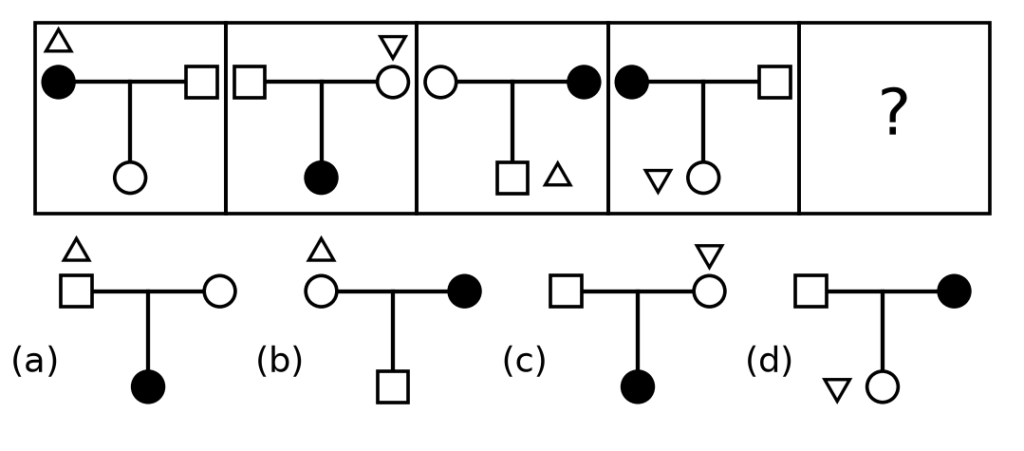
Consider the figures given below :
To fit the question mark, the correct answer is
Answer (a) & explanation
1. Look at the three end symbols (left, right, bottom). Figure 4 has the same ones as Figure 1, so they repeat every 3 figures. Figure 5 must match Figure 2: square left, open circle right, black circle at the bottom.
2. The small triangle moves round the corners: top-left, top-right, bottom-right, bottom-left, so next it is back at top-left. It points up, down, up, down, so next it points up.
3. Only (a) has both: the Figure 2 symbols and an upward triangle at the top-left.
(c) copies Figure 2 completely, but forgets that the triangle has moved on.
Answer as per the official UPSC answer key.
Read the passage
Set against a rural backdrop, ‘Stench of kerosene’ is the story of a couple, Guleri and Manak, who have been happily married for several years but do not have a child. Manak’s mother is desperate to have a grandchild to carry on the family name. Hence, she gets Manak remarried in Guleri’s absence. Manak, who acts as a reluctant but passive spectator, is meanwhile, informed by a friend that Guleri, on hearing about her husband’s second marriage, poured kerosene on her clothes and set fire to them. Manak is heartbroken and begins to live as if he were a dead man. When his second wife delivers a son, Manak stares at the child for a long time and blurts out, “Take him away! He stinks of kerosene.”
This is a sensitive issue-based story which tries to sensitise the readers about
Answer (d) & explanation
The story sensitises readers to the influence of a patriarchal mindset (d). Step 1: find what drives the tragedy. Manak's mother is desperate for a grandchild "to carry on the family name", so she gets him remarried. Wanting a male heir to continue the family name is a patriarchal idea. Guleri's death follows. Step 2: test the others. Option (a) is wrong: Manak is a "reluctant but passive spectator", not a man seeking another woman, so infidelity misreads him. Option (b) is too general. Option (c) is wrong: legal safeguards are not discussed.
Tip: for theme questions, find the root cause of events in the story, not just the events themselves. Here the root cause is the pressure for an heir.
Answer as per the official UPSC answer key.
Each of the six different faces of a cube has been coated with a different colour i.e., V, I, B, G, Y and O. Following information is given :
- 1. Colours Y, O and B are on adjacent faces.
- 2. Colours I, G and Y are on adjacent faces.
- 3. Colours B, G and Y are on adjacent faces.
- 4. Colours O, V and B are on adjacent faces.
Which is the colour of the face opposite to the face coloured with O ?
Answer (c) & explanation
G is opposite O (c). Step 1: a face cannot be adjacent to its opposite face. Find each colour's neighbours. Y appears with O, B, I and G. That is four neighbours, so Y is opposite the only one left, V. Step 2: B appears with Y, O, G and V. So B is opposite the remaining one, I. Step 3: the only pair left is O and G. So G is opposite O. Options (a), (b) and (d) are adjacent to O or already paired.
Tip: on a cube, each face touches four others and is opposite one. List each colour's neighbours; once a colour has four, its opposite is the missing one.
Answer as per the official UPSC answer key.
Shahid and Rohit start from the same point in opposite directions. After each 1 km, Shahid always turns left and Rohit always turns right. Which of the following statements is correct ?
Answer (b) & explanation
They meet after each has travelled 3 km (b). Step 1: Shahid walks north and Rohit south, in opposite directions. After 1 km, Shahid turns left (west) and Rohit turns right (also west, since he faces south). Step 2: after 2 km each, both have gone 1 km west. They are still 2 km apart (one north, one south of the start). So (a), saying 4 km, is wrong. Step 3: now Shahid turns left again, to south, and Rohit turns right again, to north. They walk toward each other and meet after 1 km more. Each has travelled 3 km. Options (c) and (d) are wrong.
Tip: draw the paths on paper. "Left" and "right" depend on which way a person is facing.
Answer as per the official UPSC answer key.
Read the passage
Climate change is a complex policy issue with major implications in terms of finance. All actions to address climate change ultimately involve costs. Funding is vital for countries like India to design and implement adaptation and mitigation plans and projects. Lack of funding is a large impediment to implementing adaptation plans. The scale and magnitude of the financial support required by developing countries to enhance their domestic mitigation and adaptation actions are a matter of intense debate in the multilateral negotiations under the United Nations Framework Convention on Climate Change (UNFCCC). The Convention squarely puts the responsibility for provision of financial support on the developed countries, taking into account their contribution to the stock of greenhouse gases (GHGs) in the atmosphere. Given the magnitude of the task and the funds required, domestic finances are likely to fall short of the current and projected needs of the developing countries. Global funding through the multilateral mechanism of the Convention will enhance their domestic capacity to finance the mitigation efforts.
In this passage, the Convention puts the responsibility for the provision of financial support on the developed countries because of
- 1. their higher level of per capita incomes.
- 2. their large quantum of GDP.
- 3. their large contribution to the stock of GHGs in the atmosphere.
Select the correct answer using the code given below :
Answer (c) & explanation
Their contribution to greenhouse gases is the reason (c). Step 1: find the line. The Convention puts the responsibility on developed countries, "taking into account their contribution to the stock of greenhouse gases (GHGs) in the atmosphere". That is item 3. Step 2: test items 1 and 2. Higher per capita income and large GDP are not given as reasons, even though they are true facts about rich countries. So options (a), (b) and (d) fail.
Tip: this is the idea of historical responsibility: those who polluted most in the past should pay most now. It underlies the UNFCCC principle of Common But Differentiated Responsibilities (CBDR). In "according to the passage" questions, accept only the reason the text actually gives.
Answer as per the official UPSC answer key.
Read the passage
Human history abounds in claims and theories confining the right of governing to a few select citizens. Exclusion of the many is justified on the ground that human beings may be rightfully segregated for the good of society and viability of the political process.
Which one of the following statements is least essential as a part of the argument in the above passage ?
Answer (a) & explanation
Statement (a) is least essential to the argument (a). Step 1: find the argument. The passage says some theories give the right to govern to "a few select citizens", excluding the many "for the good of society and viability of the political process". Step 2: check what this argument needs. It needs humans to be unequal, some "super" and some "sub" (b). It needs exclusion to help the system work (c). It needs the idea that people have different capacities to govern (d). Step 3: option (a), man seeking control over external things, plays no part in the argument. So it is least essential.
Tip: for "least essential" questions, ask of each option: "If I remove this, does the argument collapse?" The one whose removal changes nothing is the answer.
Answer as per the official UPSC answer key.
Read the passage
We generally talk about democracy but when it comes to any particular thing, we prefer a belonging to our caste or community or religion. So long as we have this kind of temptation, our democracy will remain a phoney kind of democracy. We must be in a position to respect a man as a man and to extend opportunities for development to those who deserve them and not to those who happen to belong to our community or race. This fact of favouritism has been responsible for much discontent and ill-will in our country.
Which one of the following statements best sums up the above passage ?
Answer (b) & explanation
True democracy needs equal opportunities for all (b). Step 1: find the main point. The author says we prefer people of our own caste, community or religion. This makes our democracy "phoney". We must "respect a man as a man" and give opportunities to those who deserve them. That is equal opportunity. Step 2: test the others. Option (a) is wrong: diversity is the background, not the message. Option (c) is wrong: "none of us" is too strong. Option (d) is wrong: "never" is too pessimistic; the author suggests a fix.
Tip: when a passage criticises a problem and then says "we must...", the "must" line is usually the summary.
Answer as per the official UPSC answer key.
In a plane, line X is perpendicular to line Y and parallel to line Z; line U is perpendicular to both lines V and W; line X is perpendicular to line V. Which one of the following statements is correct?
Answer (d) & explanation
Y, V and W are parallel (d). Step 1: use one rule: in a flat plane, two lines perpendicular to the same line are parallel. Step 2: Y and V are both perpendicular to X, so Y ∥ V. Step 3: U is perpendicular to V, and X is also perpendicular to V, so U ∥ X. Step 4: W is perpendicular to U. U is parallel to X, so W is perpendicular to X too. Like Y and V, W is perpendicular to X, so W ∥ V ∥ Y. Options (a), (b) and (c) mix up parallel and perpendicular lines.
Tip: sort the lines into two families: lines like X (here X, Z, U) and lines at right angles to them (Y, V, W). Lines within a family are parallel.
Answer as per the official UPSC answer key.
Consider the following matrix :
| 3 | 8 | 10 | 2 | ? | 1 |
|---|---|---|---|---|---|
| 6 | 56 | 90 | 2 | 20 | 0 |
What is the missing number at '?' in the matrix ?
Answer (a) & explanation
The missing number is 5 (a). Step 1: look for a rule linking the top and bottom numbers. 3 → 6: 3 × 2 = 6. 8 → 56: 8 × 7 = 56. 10 → 90: 10 × 9 = 90. 1 → 0: 1 × 0 = 0. So bottom = top × (top − 1). Step 2: for the missing top number, the bottom is 20. Which number times one less than itself gives 20? 5 × 4 = 20. So the answer is 5. Options (b), (c) and (d) do not fit: 0 × (−1) = 0, 7 × 6 = 42, 3 × 2 = 6.
Tip: when numbers look like 6, 56, 90, think of products of neighbours: 2 × 3, 7 × 8, 9 × 10. Spotting such pairs is a common CSAT shortcut.
Answer as per the official UPSC answer key.
Read the passage
The ultimate aim of government is not to rule or control by fear, nor to demand obedience, but conversely, to free every man from fear, that he may live in all possible security. In other words, to strengthen his natural right to exist and work without injury to himself or others. The object of government is not to change men from rational beings into beasts or puppets. It should enable them to develop their minds and bodies in security, and to employ their reason unshackled.
Which among the following is the most logical and rational inference that can be made from the above passage ?
Answer (a) & explanation
Government's true aim is to secure citizens' social and political freedom (a). Step 1: find the aim. Government should "free every man from fear", let him live "in all possible security", and let him "employ his reason unshackled". This is about freedom with security. Step 2: test the others. Options (b), (c) and (d) all use "absolute". The passage limits freedom: man should act "without injury to himself or others". So absolute security or absolute liberty goes beyond it. Option (c) also misses the role of security.
Tip: watch for extreme words like "absolute", "all" and "only". If the passage puts limits on an idea, an option that removes those limits is wrong.
Answer as per the official UPSC answer key.
Consider the following statements followed by two conclusions :
Statements : Some men are great. Some men are wise.
Conclusion I : Men are either great or wise.
Conclusion II : Some men are neither great nor wise.
Which one of the following is correct ?
Answer (d) & explanation
Neither conclusion is valid (d). Step 1: "Some men are great" and "Some men are wise" tell us only about some men. They say nothing about the rest. Step 2: test conclusion I: "Men are either great or wise." This would mean every man is at least one of the two. The statements do not say that. So I fails. Step 3: test conclusion II: "Some men are neither great nor wise." This might be true, but it is not certain: perhaps every man is great or wise. So II fails too. Options (a), (b) and (c) fail.
Tip: "some" gives no information about the others. A valid conclusion must be certain, not just possible.
Answer as per the official UPSC answer key.
In a 500 metres race, B starts 45 metres ahead of A, but A wins the race while B is still 35 metres behind. What is the ratio of the speeds of A to B assuming that both start at the same time?
Answer (a) & explanation
The speed ratio of A to B is 25 : 21 (a). Step 1: A runs the full 500 m. Step 2: B starts 45 m ahead, so B has only 455 m to run. When A finishes, B is still 35 m short. So B has run 455 − 35 = 420 m. Step 3: in the same time, A ran 500 m and B ran 420 m. Speed ratio = 500 : 420. Divide both by 20: 25 : 21. Options (b), (c) and (d) do not match.
Tip: when two runners run for the same time, their speeds are in the same ratio as their distances. Work out exactly how far each actually ran.
500 : 400 (= 25 : 20) forgets one of the two gaps.
Answer as per the official UPSC answer key.
Read the passage
Climate change is a complex policy issue with major implications in terms of finance. All actions to address climate change ultimately involve costs. Funding is vital for countries like India to design and implement adaptation and mitigation plans and projects. Lack of funding is a large impediment to implementing adaptation plans. The scale and magnitude of the financial support required by developing countries to enhance their domestic mitigation and adaptation actions are a matter of intense debate in the multilateral negotiations under the United Nations Framework Convention on Climate Change (UNFCCC). The Convention squarely puts the responsibility for provision of financial support on the developed countries, taking into account their contribution to the stock of greenhouse gases (GHGs) in the atmosphere. Given the magnitude of the task and the funds required, domestic finances are likely to fall short of the current and projected needs of the developing countries. Global funding through the multilateral mechanism of the Convention will enhance their domestic capacity to finance the mitigation efforts.
With regards to developing countries, it can be inferred from the passage that climate change is likely to have implications on their
- 1. domestic finances.
- 2. capacity for multilateral trade.
Select the correct answer using the code given below :
Answer (a) & explanation
Only domestic finances are affected (a). Step 1: test item 1. The passage says "domestic finances are likely to fall short of the current and projected needs of the developing countries". So climate change affects their domestic finances. 1 holds. Step 2: test item 2. The word "multilateral" appears, but only in "multilateral negotiations" and the "multilateral mechanism" for funding. Trade is never mentioned. So 2 fails. Options (b), (c) and (d) fail.
Tip: UPSC often reuses a passage word ("multilateral") in a new context ("trade") to trap careless readers. Check that the whole phrase, not just one word, is in the passage.
Answer as per the official UPSC answer key.
Read the passage
By 2050, the Earth’s population will likely have swelled from seven to nine billion people. To fill all those stomachs — while accounting for shifting consumption patterns, climate change, and a finite amount of arable land and potable water — some experts say food production will have to double. How can we make the numbers add up ? Experts say higher yielding crop varieties and more efficient farming methods will be crucial. So will waste reduction. Experts urge cities to reclaim nutrients and water from waste streams and preserve farmland. Poor countries, they say, can improve crop storage and packaging and rich nations could cut back on resource-intensive foods like meat.
Which one of the following statements best sums up the above passage ?
Answer (d) & explanation
Food security is increasingly a collective challenge (d). Step 1: see who has a role in the passage. Experts propose better crops and methods; cities should reclaim nutrients and water; poor countries should improve storage; rich nations should eat less meat. Everyone must act together, so it is a collective challenge. Step 2: test the others. Option (a) is only the starting fact, not the summary. Option (b) is wrong: the word "only" fails, as rich nations are also involved. Option (c) is wrong: it is defeatist, while the passage offers solutions to "make the numbers add up".
Tip: a good summary covers the whole passage. When a passage lists many actors with many roles, the summary is usually about shared responsibility.
Answer as per the official UPSC answer key.
Read the passage
The existence/establishment of formal financial institutions that offer safe, reliable, and alternative financial instruments is fundamental in mobilising savings. To save, individuals need access to safe and reliable financial institutions, such as banks, and to appropriate financial instruments and reasonable financial incentives. Such access is not always available to all people in developing countries like India and more so, in rural areas. Savings help poor households manage volatility in cash flow, smoothen consumption, and build working capital. Poor households without access to a formal savings mechanism encourage immediate spending temptations.
With reference to the above passage, consider the following statements :
- 1. Indian financial institutions do not offer any financial instruments to rural households to mobilise their savings.
- 2. Poor households tend to spend their earnings/savings due to lack of access to appropriate financial instruments.
Which of the statements given above is/are correct ?
Answer (b) & explanation
Only statement 2 is correct (b). Step 1: test statement 2. The passage says poor households without access to a formal savings mechanism face "immediate spending temptations". So they spend their earnings because they lack suitable instruments. 2 holds. Step 2: test statement 1. The passage says access is "not always available to all people", especially in rural areas. That is different from saying institutions offer no instruments at all. So 1 goes too far. Options (a), (c) and (d) fail.
Tip: "not always available" means some people lack access, not everyone. UPSC often turns a partial problem into a total one to make a wrong statement.
Answer as per the official UPSC answer key.
A cow costs more than 4 goats but less than 5 goats. If a goat costs between ₹ 600 and ₹ 800, which of the following is a most valid conclusion?
Answer (d) & explanation
A cow costs between ₹2,400 and ₹4,000 (d). Step 1: the cow costs more than 4 goats and less than 5 goats. A goat costs between ₹600 and ₹800. Step 2: the lowest a cow could cost is just over 4 × 600 = ₹2,400. Step 3: the highest is just under 5 × 800 = ₹4,000. Step 4: only option (d) covers every possible price. Option (a) is too narrow at the bottom (a cow might cost ₹2,450). Option (b) misses prices up to ₹4,000. Option (c) misses both ends.
Tip: for a "most valid" range, use the smallest values together for the minimum and the largest values together for the maximum.
(a), (b) and (c) can fail. A cow could cost ₹ 2,450 or ₹ 3,900. The most valid conclusion is the one that always holds.
Answer as per the official UPSC answer key.