
CSAT (Paper II): previous-year questions
1280 real UPSC Prelims questions (2011–2026) with the official answer and a clear explanation. 400 of them came in the last five papers.
How often UPSC asks this
Questions per year, counted from the official papers.
Subtopics
Arrangements, ranking, ordering and puzzles
142 questions
Clocks and calendars
5 questions
Coding-decoding, series, patterns, cubes, dice and visual reasoning
110 questions
Communication, interpersonal skills and decision-making
10 questions
Counting, permutations, combinations and probability
1 questions
Directions, blood relations and Venn diagrams
60 questions
General English: grammar, vocabulary and comprehension
20 questions
General Hindi: grammar, vocabulary, dialects and comprehension
25 questions
Geometry and mensuration
26 questions
Number system and basic algebra (divisibility, HCF/LCM, remainders, digits, equations)
196 questions
Percentages, profit and loss, discount, simple and compound interest
47 questions
Ratio, proportion, averages, mixtures and alligation
47 questions
Syllogisms, statements and conclusions, assumptions and arguments
89 questions
Time and work; pipes and cisterns
2 questions
Time, speed and distance; trains, boats and streams; races
48 questions
Attempt the questions
Newest papers first. Tap an option; the answer and the reason appear instantly.
What is the missing number 'X' of the series 7, X, 21, 31, 43 ?
Answer (c) & explanation
X is 13 (c). Step 1: look at the gaps between the known numbers: 21 to 31 is 10, and 31 to 43 is 12. The gaps grow by 2 each time. Step 2: work backwards. The gap before 10 is 8, and the one before that is 6. Step 3: X = 7 + 6 = 13. Check: 13 + 8 = 21. Correct. Options (a), (b) and (d) break the pattern.
Tip: in number series, first write the differences between neighbours. If the differences themselves form a simple pattern (here +2 each time), the series is easy to complete in both directions.
Answer as per the official UPSC answer key.
Read the passage
Our municipal corporations are understaffed. The issue of skills and competencies of the staff poses an even greater challenge. Urban services delivery and infrastructure are complex to plan and execute. They require a high degree of specialization and professionalism. The current framework within which municipal employees, including senior Management, are recruited does not adequately factor in the technical and managerial competencies required. Cadre and recruitment rules only specify the bare minimum in academic qualifications. There is no mention of managerial or technical competencies, or of relevant work experience. This is the case with most municipal corporations. They also suffer from weak organisation design and structure.
Which among the following is the most logical and rational assumption that can be made from the above passage ?
Answer (b) & explanation
Cities can do better if local bodies have adequate skilled staff (b). Step 1: find the problems. Municipal bodies are "understaffed", and the bigger challenge is staff skills and competencies. Recruitment rules ignore technical and managerial abilities. So the hidden assumption is that more and better-skilled staff would improve city life. Step 2: test the others. Option (a) is wrong: expanding organisations ignores the skills problem. Option (c) is wrong: the cause given is recruitment rules, not missing training institutions. Option (d) is wrong: the demographic dividend is not mentioned.
Tip: an assumption links the problem described to the result the author wants. Here: fix staff and skills, and services improve.
Answer as per the official UPSC answer key.
Consider the following statements :
- 1. Some claim to have seen UFOs (Unidentified Flying Objects).
- 2. Life on other heavenly bodies is considered to be a possibility.
- 3. Voyage to space is now an established fact.
From the above statements, it may be concluded that
Answer (d) & explanation
Nothing definite can be said about UFOs (d). Step 1: weigh each statement. Statement 1 is only a claim that some people have seen UFOs. Statement 2 says life elsewhere is only a possibility. Statement 3 is about human space travel, not UFOs. Step 2: none of these tells us what UFOs are or where they come from. Step 3: test the others. Option (a), saying UFOs are heavenly bodies, is not supported. Option (b), saying they come from other worlds, is a guess. Option (c), about more intelligent species, is not mentioned at all.
Tip: claims and possibilities cannot be joined into a definite conclusion. When statements are weak, the safe answer is often "nothing definite".
Answer as per the official UPSC answer key.
Two equal glasses of same type are respectively 1/3 and 1/4 full of milk. They are then filled up with water and the contents are mixed in a pot. What is the ratio of milk and water in the pot?
Answer (a) & explanation
The milk to water ratio is 7 : 17 (a). Step 1: pick a glass size that both fractions divide into easily. 12 units works for 1/3 and 1/4. Step 2: glass 1 is 1/3 milk: 4 units of milk, 8 of water. Glass 2 is 1/4 milk: 3 units of milk, 9 of water. Step 3: in the pot: milk = 4 + 3 = 7, water = 8 + 9 = 17. Total 24. Ratio 7 : 17. Options (b), (c) and (d) do not match.
Tip: choose a size equal to the LCM of the denominators (here 3 and 4 give 12). This turns fractions into whole numbers and makes mixing easy.
Answer as per the official UPSC answer key.
Read the passage
Climate change is a complex policy issue with major implications in terms of finance. All actions to address climate change ultimately involve costs. Funding is vital for countries like India to design and implement adaptation and mitigation plans and projects. Lack of funding is a large impediment to implementing adaptation plans. The scale and magnitude of the financial support required by developing countries to enhance their domestic mitigation and adaptation actions are a matter of intense debate in the multilateral negotiations under the United Nations Framework Convention on Climate Change (UNFCCC). The Convention squarely puts the responsibility for provision of financial support on the developed countries, taking into account their contribution to the stock of greenhouse gases (GHGs) in the atmosphere. Given the magnitude of the task and the funds required, domestic finances are likely to fall short of the current and projected needs of the developing countries. Global funding through the multilateral mechanism of the Convention will enhance their domestic capacity to finance the mitigation efforts.
Which one of the following is essentially discussed in the passage ?
Answer (a) & explanation
The passage discusses the conflict over support for mitigation (a). Step 1: find the centre of the passage. It explains that climate action costs money, that funding is "a matter of intense debate" between countries, and that the Convention puts the duty on developed countries. So the core topic is the disagreement between developed and developing countries over financial support. Step 2: test the others. Option (b) is wrong: the causes of climate change are not discussed. Option (c) is wrong: political will is not mentioned. Option (d) is wrong: governance problems are not discussed.
Tip: "essentially discussed" means the main topic. Check which option runs through most sentences of the passage.
Answer as per the official UPSC answer key.
Read the passage
Many people in India feel that if we cut our defence expenditure on weapon-building, we can create a climate of peace with our neighbours, subsequently reducing the conflict or creating a no-war situation. People who proclaim such ideas are either the victims of war or the propagators of false argument.
With reference to the above passage, which of the following is the most valid assumption ?
Answer (b) & explanation
The author assumes that more weapon spending lessens the chance of conflict (b). Step 1: find the author's view. Many people feel that cutting defence spending will create peace. The author says such people are "victims of war or the propagators of false argument". So he rejects the idea. Step 2: if cutting spending does not bring peace, he must believe that spending deters war. That is option (b). Step 3: test the others. Option (a) is wrong: it says our weapons cause war, the opposite of his view. Option (c) is close but goes beyond the passage, which talks about conflict with neighbours, not state-of-the-art systems. Option (d) is wrong: it restates the view he rejects, not his assumption.
Tip: an assumption is the unstated belief behind the author's conclusion.
Answer as per the official UPSC answer key.
Read the passage
The existence/establishment of formal financial institutions that offer safe, reliable, and alternative financial instruments is fundamental in mobilising savings. To save, individuals need access to safe and reliable financial institutions, such as banks, and to appropriate financial instruments and reasonable financial incentives. Such access is not always available to all people in developing countries like India and more so, in rural areas. Savings help poor households manage volatility in cash flow, smoothen consumption, and build working capital. Poor households without access to a formal savings mechanism encourage immediate spending temptations.
What is the crucial message conveyed in the passage ?
Answer (d) & explanation
The crucial message is to promote financial inclusion (d). Step 1: find the theme. Savings need access to "safe and reliable financial institutions" and "appropriate financial instruments". Such access is not always available, especially in rural areas, and lack of it pushes the poor to spend. Bringing everyone into formal finance is financial inclusion. Step 2: test the others. Option (a) is wrong: more banks is only one narrow means. Option (b) is wrong: GDP is not discussed. Option (c) is wrong: interest rates are not discussed; incentives are mentioned only in passing.
Tip: the "crucial message" names the big idea that covers the whole passage, not a single tool.
Answer as per the official UPSC answer key.
A society consists of only two types of people — fighters and cowards. Two cowards are always friends. A fighter and a coward are always enemies. Fighters are indifferent to one another. If A and B are enemies, C and D are friends, E and F are indifferent to each other, A and E are not enemies, while B and F are enemies.
Which of the following statements is correct ?
Answer (b) & explanation
A, E and F are fighters (b). Step 1: use the rules. Two cowards are always friends. A fighter and a coward are always enemies. Fighters are indifferent to each other. Step 2: E and F are indifferent, so both are fighters. Step 3: B and F are enemies, and F is a fighter, so B is a coward. Step 4: A and B are enemies, and B is a coward, so A is a fighter. Check: A and E are both fighters, so they are not enemies. That fits. Options (a), (c) and (d) contradict these steps.
Tip: start with the relationship that fixes both people at once. Here "indifferent" can only mean two fighters.
Answer as per the official UPSC answer key.
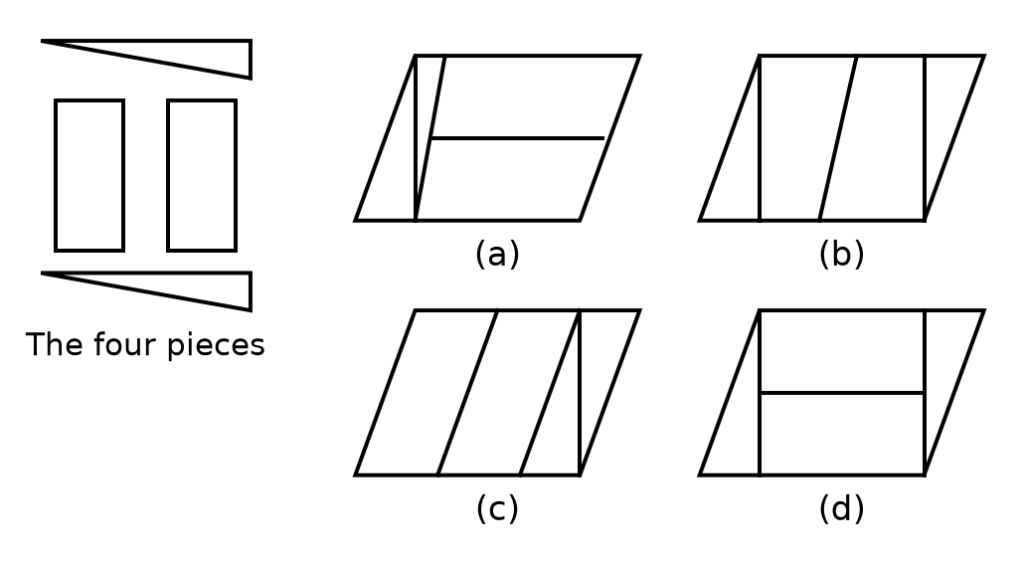
Four cardboard pieces of specific shapes are shown in the following figure :
Which one of the following figures given can be formed by joining these pieces together ?
Answer (d) & explanation
The pieces form figure (d) (d). Step 1: look at the four pieces. There are two equal rectangles and two equal right-angled triangles. Step 2: place the two rectangles flat, one on top of the other, to make a bigger rectangle (a box). Step 3: stand one triangle at each end of this box. The result is a slanted four-sided figure, like a parallelogram. Step 4: that matches figure (d), with two rectangles in the middle and one triangle on each side. Options (a), (b) and (c) need pieces of other shapes or sizes.
Tip: in shape-joining questions, first name and count the pieces, then try the simplest arrangement. Check that the total area of the answer matches the pieces.
Pieces may be turned around; only their shape and size must stay the same.
Answer as per the official UPSC answer key.
Read the passage
Flamingos in large flocks in the wild are social and extremely loyal. They perform group mating dances. Parents are very fond of their chicks, gathering them into crèches for protection while both males and females fly off to search for food.
Which among the following is the most logical corollary to the above passage ?
Answer (c) & explanation
Social behaviour in some birds improves survival (c). Step 1: find the example. Flamingos are social and loyal, and parents gather chicks "into crèches for protection" while both go for food. This shows that social behaviour helps chicks survive. Step 2: the passage is about one species, so the safe corollary is about "some species". Step 3: test the others. Option (a) is wrong: "all species" and "complete survival" are too strong. Option (b) is wrong: "only birds" is not supported. Option (d) is wrong: "all species" set up crèches, and crèches are for protection, not to teach loyalty.
Tip: one example can support "some", never "all" or "only".
Answer as per the official UPSC answer key.
If ABC × DEED = ABCABC; where A, B, C, D and E are different digits, what are the values of D and E?
Answer (c) & explanation
D = 1 and E = 0 (c). Step 1: look at ABCABC. It is the number ABC written twice. Writing a three-digit number twice is the same as multiplying it by 1001. For example, 123 × 1001 = 123123. Step 2: so ABC × DEED = ABC × 1001, and DEED = 1001. Step 3: reading 1001 as D E E D gives D = 1 and E = 0. Options (a), (b) and (d) give 2002, 0110 and 1221, which do not work.
Tip: remember the 1001 trick: abc × 1001 = abcabc. Similarly, ab × 101 = abab. These patterns come up in CSAT digit puzzles.
Answer as per the official UPSC answer key.
Out of 130 students appearing in an examination, 62 failed in English, 52 failed in Mathematics, whereas 24 failed in both English and Mathematics. The number of students who passed finally is
Answer (a) & explanation
40 students passed (a). Step 1: students who failed in at least one subject = English fails + Maths fails − both. That is 62 + 52 − 24 = 90. We subtract 24 because those students were counted in both 62 and 52. Step 2: students who passed both = 130 − 90 = 40. Options (b), (c) and (d) miss the overlap.
Tip: "passed finally" means passed both subjects. In two-set questions, always remove the double count: total in either = A + B − both. A two-circle diagram makes this clear.
Answer as per the official UPSC answer key.
Between 6 PM and 7 PM the minute hand of a clock will be ahead of the hour hand by 3 minutes at
Answer (c) & explanation
1. Between 6 and 7, the hour hand starts at the 30-minute mark and moves 1 minute-mark every 12 minutes.
2. Check (c) 6:36. The hour hand has moved 36 ÷ 12 = 3 marks, so it is at 33. The minute hand is at 36. It is 3 ahead. Works.
3. Quick check of the others: at 6:48 the hour hand is at 34 and the minute hand at 48 (14 ahead), so (d) fails; at 6:15 and 6:18 the minute hand is still behind.
4. Answer: 6:36 PM.
Answer as per the official UPSC answer key.
Read the passage
India accounts for nearly a fifth of the world’s child deaths. In terms of numbers, it is the highest in the world — nearly 16 lakhs every year. Of these, more than half die in the first month of life. Officials believe that the reason for this is the absence of steps to propagate basic health practices relating to breast feeding and immunisation. Also the large reproductive population of 2·6 crore remains bereft of care during the critical phases of pregnancy and post-delivery. Added to this is the prevalence of child marriages, anaemia among young women and lack of focus on adolescent sanitation, all of which impact child death rates.
Which is the critical inference that can be made from the above passage ?
Answer (c) & explanation
Joint maternal and child health services can address the problem (c). Step 1: list the causes of child deaths in the passage. Some concern infants: poor practices on breast feeding and immunisation. Others concern mothers: no care during pregnancy and after delivery, child marriages, anaemia among young women. Step 2: since causes lie with both mother and child, universal and integrated maternal and child services fit best. Step 3: test the others. Option (a) is wrong: illiteracy is not mentioned. Option (b) is wrong: the passage does not say the government cannot manage. Option (d) is wrong: it contradicts the passage, which links anaemia among young women to child deaths.
Tip: a "critical inference" often joins several causes into one solution.
Answer as per the official UPSC answer key.
Read the passage
Governments may have to take steps which would otherwise be an infringement on the Fundamental Rights of individuals, such as acquiring a person’s land against his will, or refusing permission for putting up a building, but the larger public interest for which these are done must be authorized by the people (Parliament). Discretionary powers to the administration can be done away with. It is becoming more and more difficult to keep this power within limits as the government has many number of tasks to perform. Where discretion has to be used, there must be rules and safeguards to prevent misuse of that power. Systems have to be devised which minimise, if not prevent, the abuse of discretionary power. Government work must be conducted within a framework of recognised rules and principles, and decisions should be similar and predictable.
Which among the following is the most logical assumption that can be made from the above passage ?
Answer (b) & explanation
Rules and safeguards should prevail over unchecked discretion (b). Step 1: find the main idea. Where discretion is used, "there must be rules and safeguards to prevent misuse". Government work "must be conducted within a framework of recognised rules and principles", and decisions should be predictable. So rules should rule, not personal discretion. Step 2: test the others. Option (a) is wrong: "always... wide discretionary power" reverses the passage. Option (c) is wrong: it also reverses it, linking democracy to more discretion. Option (d) is wrong because (b) fits.
Tip: this is the idea of the Rule of Law, associated with A.V. Dicey: government by fixed rules, not by the whims of officials.
Answer as per the official UPSC answer key.
In a box of marbles, there are three less white marbles than the red ones and five more white marbles than the green ones. If there are a total of 10 white marbles, how many marbles are there in the box?
Answer (b) & explanation
There are 28 marbles (b). Step 1: there are 10 white marbles. Step 2: white is 3 less than red, so red = 10 + 3 = 13. Step 3: white is 5 more than green, so green = 10 − 5 = 5. Step 4: total = 10 + 13 + 5 = 28. Options (a), (c) and (d) come from adding or subtracting the wrong way.
Tip: read "three less white marbles than the red ones" carefully: white = red − 3, so red = white + 3. Write each sentence as a simple equation before working it out to avoid flipping the direction.
Answer as per the official UPSC answer key.
In a test, a candidate attempted only 8 questions and secured 50% marks in each of the questions. If he obtained a total of 40% in the test and all questions in the test carried equal marks, how many questions were there in the test?
Answer (b) & explanation
There were 10 questions (b). Step 1: he got half marks on each of 8 questions. That equals the full marks of 4 questions. Step 2: those marks are 40% of the total. So 4 questions = 40% of all questions. Step 3: all questions = 4 ÷ 0.4 = 10. Check: 50% of 8 questions = 4 questions' marks; 4 out of 10 = 40%. Options (a), (c) and (d) fail the check.
Tip: turn percentages into "question-equivalents". Half marks on 8 questions is the same as full marks on 4. This avoids having to know the marks per question.
Answer as per the official UPSC answer key.
Read the passage
Vast numbers of Indian citizens without bank accounts live in rural areas, are financially and functionally illiterate, and have little experience with technology. A research study was conducted in a particular area in which electronic wage payments in Mahatma Gandhi National Rural Employment Guarantee Scheme (MGNREGS) are meant to go directly to the poor. It was observed that recipients often assume that the village leader needs to mediate the process, as was the case under the previous paper-based system. Among households under this research study area who claimed to have at least one bank account, over a third reported still receiving MGNREGS wages in cash directly from a village leader.
What is the most logical, rational and crucial message that is implied in the above passage ?
Answer (d) & explanation
The crucial message is the need for financial literacy (d). Step 1: find the problem. Rural citizens are "financially and functionally illiterate". Even with electronic payments meant to go directly to them, they assume a village leader must mediate, and over a third of account holders still took wages in cash from a leader. The root problem is lack of awareness, so financial literacy is the answer. Step 2: test the others. Option (a) is wrong: limiting MGNREGS to account holders is never suggested. Option (b) is wrong: the passage does not praise the paper-based system. Option (c) reverses the goal: direct payment was meant to remove middlemen.
Tip: the "crucial message" is the fix for the root cause the passage describes.
Answer as per the official UPSC answer key.
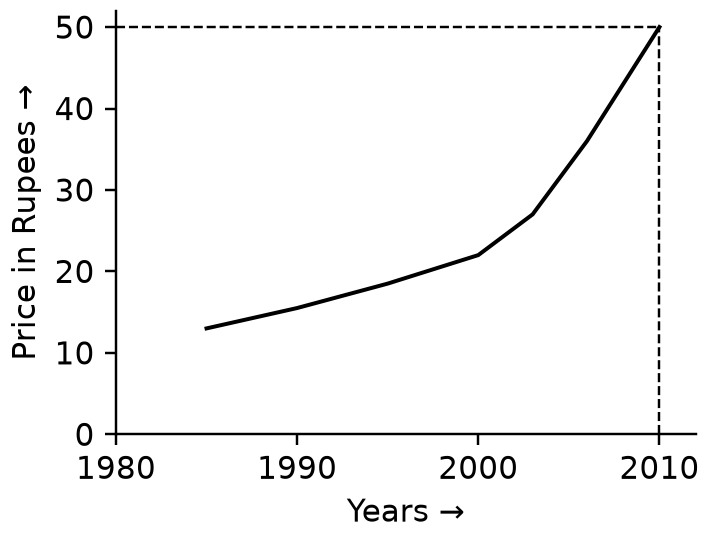
Year-wise variation of the price of a certain commodity is shown in the following graph :
The price of the commodity in the year 1990
Answer (c) & explanation
The 1990 price was somewhere between ₹10 and ₹20 (c). Step 1: look at 1990 on the graph. The line sits a little above the ₹10 mark and below the ₹20 mark. Step 2: the graph's scale is too rough to read an exact value, so options (a) and (b), which say "must have been" a precise number, are not safe. Step 3: the line rises all the time, so the 1990 price is lower than the 1991 price. Option (d) is wrong. Only a range can be stated with certainty.
Tip: when a graph does not give exact grid lines at a point, choose the answer that gives a safe range. "Must have been" an exact number needs exact data.
Answer as per the official UPSC answer key.
In a group of persons travelling in a bus, 6 persons can speak Tamil, 15 can speak Hindi and 6 can speak Gujarati. In that group none can speak any other language. If 2 persons in the group can speak two languages only and one person can speak all the three languages, then how many persons are there in the group ?
Answer (c) & explanation
There are 23 persons (c). Step 1: add the language counts: 6 + 15 + 6 = 27. But this counts some people more than once. Step 2: each person who speaks two languages is counted twice, so is counted 1 extra time. There are 2 such persons: 2 extra counts. Step 3: the person who speaks all three is counted three times, so 2 extra counts. Step 4: people = 27 − 2 − 2 = 23. Options (a), (b) and (d) remove too much or too little.
Tip: think "extra counts". Someone in two groups adds one extra; someone in three groups adds two extra. Subtract all extras from the raw total.
Answer as per the official UPSC answer key.