
CSAT (Paper II): previous-year questions
1280 real UPSC Prelims questions (2011–2026) with the official answer and a clear explanation. 400 of them came in the last five papers.
How often UPSC asks this
Questions per year, counted from the official papers.
Subtopics
Arrangements, ranking, ordering and puzzles
142 questions
Clocks and calendars
5 questions
Coding-decoding, series, patterns, cubes, dice and visual reasoning
110 questions
Communication, interpersonal skills and decision-making
10 questions
Counting, permutations, combinations and probability
1 questions
Directions, blood relations and Venn diagrams
60 questions
General English: grammar, vocabulary and comprehension
20 questions
General Hindi: grammar, vocabulary, dialects and comprehension
25 questions
Geometry and mensuration
26 questions
Number system and basic algebra (divisibility, HCF/LCM, remainders, digits, equations)
196 questions
Percentages, profit and loss, discount, simple and compound interest
47 questions
Ratio, proportion, averages, mixtures and alligation
47 questions
Syllogisms, statements and conclusions, assumptions and arguments
89 questions
Time and work; pipes and cisterns
2 questions
Time, speed and distance; trains, boats and streams; races
48 questions
Attempt the questions
Newest papers first. Tap an option; the answer and the reason appear instantly.
Read the passage
Crude mineral oil comes out of the earth as a thick brown or black liquid with a strong smell. It is a complex mixture of many different substances, each with its own individual qualities. Most of them are combinations of hydrogen and carbon in varying proportions. Such hydrocarbons are also found in other forms such as bitumen, asphalt and natural gas. Mineral oil originates from the carcasses of tiny animals and from plants that live in the sea. Over millions of years, these dead creatures form large deposits under the sea-bed; and ocean currents cover them with a blanket of sand and silt. As this mineral hardens, it becomes sedimentary rock and effectively shuts out the oxygen, so preventing the complete decomposition of the marine deposits underneath. The layers of sedimentary rock become thicker and heavier. Their pressure produces heat, which transforms the tiny carcasses into crude oil in a process that is still going on today.
Mineral oil deposits under the sea do not get completely decomposed because they
Answer (b) & explanation
(b) is correct. Step 1: the passage says the sediment 'becomes sedimentary rock and effectively shuts out the oxygen, so preventing the complete decomposition' of the deposits. So they do not fully decompose because rock forms and keeps oxygen out. Step 2: (a) is wrong: ocean currents only cover the deposits with sand and silt; they do not keep washing them. Step 3: (c) is wrong: being made of hydrogen and carbon describes oil, not why decay stops. (d) is wrong: saline conditions are not given as the reason. So (a), (c) and (d) fail.
Tip: decomposition needs oxygen. When a passage says something 'shuts out the oxygen', it is explaining why decay stops.
Answer as per the official UPSC answer key.
In a garrison, there was food for 1000 soldiers for one month. After 10 days, 1000 more soldiers joined the garrison. How long would the soldiers be able to carry on with the remaining food?
Answer (d) & explanation
10 days is correct (d). Step 1: taking a month as 30 days, food is for 1,000 soldiers × 30 days. After 10 days, food is left for 1,000 soldiers for 20 days. Step 2: now 2,000 soldiers share it. Double the soldiers, half the time: 20 ÷ 2 = 10 days. Step 3: (b) 20 days ignores the new soldiers; (a) and (c) do not fit the numbers. So (a), (b) and (c) fail. Note: the answer assumes a 30-day month, the usual convention in such questions.
Tip: think in 'soldier-days': total food = soldiers × days. What is left (1,000 × 20 = 20,000 soldier-days) divided by the new number of soldiers (2,000) gives the days.
Answer as per the official UPSC answer key.
Directions for the following 4 (four) items: Read the following statements and answer the four items that follow:
Five cities P, Q, R, S and T are connected by different modes of transport as follows:
P and Q are connected by boat as well as rail.
S and R are connected by bus and boat.
Q and T are connected by air only.
P and R are connected by boat only.
T and R are connected by rail and bus.
Which mode of transport would help one to reach R starting from Q, but without changing the mode of transport?
Answer (a) & explanation
Boat is correct (a). Step 1: list the links. P–Q: boat, rail. S–R: bus, boat. Q–T: air. P–R: boat. T–R: rail, bus. Step 2: from Q, one route is Q → P → R. Q to P can be done by boat, and P to R is by boat only, so the whole trip works by boat. Step 3: the other route, Q → T → R, needs air to T and then rail or bus to R, so you must change. Rail (Q–P by rail) fails because P–R is boat only. Bus and air do not connect Q to R either. So (b), (c) and (d) fail.
Tip: write each link with its modes in a small list. Then follow one mode at a time from start to finish.
Answer as per the official UPSC answer key.
Read the passage
The miseries of the world cannot be cured by physical help only. Until man’s nature changes, his physical needs will always arise, and miseries will always be felt, and no amount of physical help will remove them completely. The only solution of the problem is to make mankind pure. Ignorance is the mother of evil and of all the misery we see. Let men have light, let them be pure and spiritually strong and educated; then alone will misery cease in the world. We may convert every house in the country into a charitable asylum, we may fill the land with hospitals, but human misery will continue until man’s character changes.
With reference to the passage, the following assumptions have been made :
- 1. The author gives primary importance to physical and material help in eradicating human misery.
- 2. Charitable homes, hospitals, etc. can remove human misery to a great extent.
Which of the assumptions is/are valid ?
Answer (d) & explanation
Neither assumption is valid (d). Step 1: assumption 1 says the author gives primary importance to physical help. The passage says misery 'cannot be cured by physical help only' and that the 'only solution' is to make mankind pure. So 1 is wrong. Step 2: assumption 2 says charitable homes and hospitals can remove misery to a great extent. The author says even if we fill the land with them, 'human misery will continue'. So 2 is wrong. Step 3: so (a), (b) and (c) fail.
Tip: when an author uses 'only' and 'then alone', he is ranking one solution above all others. Assumptions that put any other solution first go against him.
Answer as per the official UPSC answer key.
Directions: each item describes a situation and is followed by four possible responses. Indicate the response you find most appropriate. There is no penalty for wrong answers for these items. You are the head of your office. There are certain houses reserved for the allotment to the office staff and you have been given the discretion to do so. A set of rules for the allotment of the houses has been laid down by you and has been made public. Your personal secretary, who is very close to you, comes to you and pleads that as his father is seriously ill, he should be given priority in allotment of a house. The office secretariat that examined the request as per the rules turns down the request and recommends the procedure to be followed according to the rules. You do not want to annoy your personal secretary. In such circumstances, what would you do ?
Answer (a) & explanation
(a) and (c) are both correct (UPSC accepted both; no negative marking). Step 1: you made the allotment rules public, and your office has applied them and refused the request. Step 2: (c) agreeing with the office note shows you follow your own rules without favouritism. (a) explaining the decision to him personally is also fair and keeps a good working relationship. Step 3: (b) allotting the house to win his loyalty is favouritism. (d) sitting on the file avoids a decision and is poor administration.
Tip: for these interpersonal items, pick the response that is lawful, honest and fixes the real problem through proper channels. Avoid options that give in to pressure, show favouritism or dodge a decision.
Answer as per the official UPSC answer key.
(Same information as the question above.)
Which game do B, C and D play?
Answer (b) & explanation
Hockey is correct (b). Step 1: from the lists, B plays football, cricket, hockey; C plays cricket, hockey, basketball; D plays football, basketball, hockey. Step 2: the only game all three share is hockey. Step 3: basketball is not played by B, cricket is not played by D, and football is not played by C. So (a), (c) and (d) fail.
Tip: to find a common game, write the three lists side by side and look for the item present in all of them. Here, A is the only one without hockey, so the other three must share it. Using the earlier answer ('A does not play hockey') gives this in seconds.
Answer as per the official UPSC answer key.
(Same figures as the question above.)
What percentage of all Psychology professors are females?
Answer (c) & explanation
60% is correct (c). Step 1: from Figure 1, Psychology has 4 men and 6 women, so 10 professors in all. Step 2: women's share = 6 ÷ 10 = 0.6. Step 3: as a percentage, 0.6 × 100 = 60%. (a) 40% is the share of men, a common trap. (b) and (d) do not match the figures. So (a), (b) and (d) fail.
Tip: percentage = part ÷ whole × 100. Make sure the 'whole' is the total of the group (men + women), not the number of men. When the total is 10, the percentage is simply the part × 10.
Answer as per the official UPSC answer key.
Read the passage
The subject of democracy has become severely muddled because of the way the rhetoric surrounding it has been used in recent years. There is, increasingly, an oddly confused dichotomy between those who want to ‘impose’ democracy on countries in the non-Western world (in these countries’ ‘own interest’, of course) and those who are opposed to such ‘imposition’ (because of the respect for the countries’ ‘own ways’). But the entire language of ‘imposition’, used by both sides, is extraordinarily inappropriate since it makes the implicit assumption that democracy belongs exclusively to the West, taking it to be a quintessentially ‘Western’ idea which has originated and flourished only in the West.
But the thesis and the pessimism it generates about the possibility of democratic practice in the world would be extremely hard to justify. There were several experiments in local democracy in ancient India. Indeed, in understanding the roots of democracy in the world, we have to take an interest in the history of people participation and public reasoning in different parts of the world. We have to look beyond thinking of democracy only in terms of European and American evolution. We would fail to understand the pervasive demands for participatory living, on which Aristotle spoke with far-reaching insight, if we take democracy to be a kind of a specialized cultural product of the West.
It cannot, of course, be doubted that the institutional structure of the contemporary practice of democracy is largely the product of European and American experience over the last few centuries. This is extremely important to recognize since these developments in institutional formats were immensely innovative and ultimately effective. There can be little doubt that there is a major ‘Western’ achievement here.
Which of the following is closest to the view of democracy as mentioned in the above passage ?
Answer (c) & explanation
(c) is correct. Step 1: the author makes two points. Democracy is not a purely Western idea; there were experiments in local democracy in ancient India, and participation and public reasoning existed in many places. But the institutional structure of today's democracy is 'largely the product of European and American experience', a 'major Western achievement'. (c) states both points. Step 2: (a) is wrong: the muddle comes from the confused rhetoric of 'imposition', and no one is said to call democracy 'alien'. Step 3: (b) is wrong: its second half adopts the 'own ways' position that the author criticises. So (a), (b) and (d) fail.
Tip: when a passage says 'X, but also Y', the best option keeps both halves.
Answer as per the official UPSC answer key.
Read the passage
Crude mineral oil comes out of the earth as a thick brown or black liquid with a strong smell. It is a complex mixture of many different substances, each with its own individual qualities. Most of them are combinations of hydrogen and carbon in varying proportions. Such hydrocarbons are also found in other forms such as bitumen, asphalt and natural gas. Mineral oil originates from the carcasses of tiny animals and from plants that live in the sea. Over millions of years, these dead creatures form large deposits under the sea-bed; and ocean currents cover them with a blanket of sand and silt. As this mineral hardens, it becomes sedimentary rock and effectively shuts out the oxygen, so preventing the complete decomposition of the marine deposits underneath. The layers of sedimentary rock become thicker and heavier. Their pressure produces heat, which transforms the tiny carcasses into crude oil in a process that is still going on today.
Sedimentary rock leads to the formation of oil deposits because
Answer (c) & explanation
(c) is correct. Step 1: the passage says the rock layers 'become thicker and heavier. Their pressure produces heat, which transforms the tiny carcasses into crude oil'. So the weight of the layers above makes heat, which forms oil. Step 2: (a) is wrong: saline conditions are never mentioned. (b) is wrong: the rock shuts out oxygen, the opposite of letting it in. Step 3: (d) is wrong: the passage mentions no catalysts in the rock. So (a), (b) and (d) fail.
Tip: follow the chain of cause and effect in a process passage: rock layers grow → pressure rises → heat is produced → oil forms. The question usually asks about one link in this chain.
Answer as per the official UPSC answer key.
The tank-full petrol in Arun's motorcycle lasts for 10 days. If he starts using 25% more everyday, how many days will the tank-full petrol last?
Answer (d) & explanation
8 days is correct (d). Step 1: let the tank hold 10 units, so he uses 1 unit a day for 10 days. Step 2: using 25% more means 1.25 units a day. Step 3: days = 10 ÷ 1.25 = 8. So (a), (b) and (c) fail.
Tip: when use per day goes up by 25%, the days do not fall by 25% (which would give 7.5). They fall to 1 ÷ 1.25 = 4/5 of the old figure, a 20% drop. Remember: a 25% rise is undone by a 20% fall. This pair (25% up, 20% down) appears often in CSAT, so it is worth memorising, along with 50% up and 33⅓% down.
Answer as per the official UPSC answer key.
(Same information as the question above.)
If a person visits each of the places starting from P and gets back to P, which of the following places must he visit twice?
Answer (b) & explanation
R is correct (b). Step 1: from the links (P–Q, S–R, Q–T, P–R, T–R), S is linked only to R. So to visit S you must go R → S and then come back to R. Step 2: this means R is passed through twice in any round trip from P back to P. Example trip: P → Q → T → R → S → R → P. Step 3: Q, T and S can each be visited once on this route, so (a), (c) and (d) fail.
Tip: look for a 'dead end': a place with only one link. To leave it you must return the way you came, so its only neighbour gets visited twice. Draw the five cities as dots with lines to see this at once.
Answer as per the official UPSC answer key.
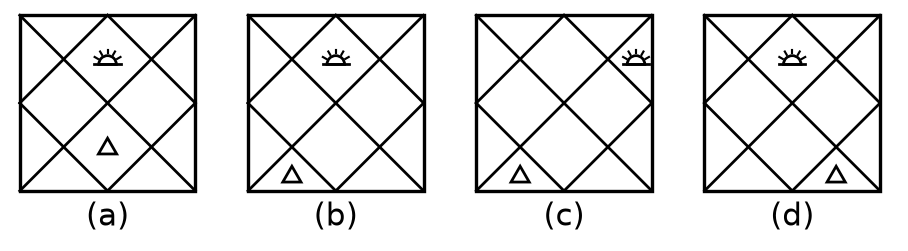
Consider the following figures 1, 2, 3 and 4:
In the figures from 1 to 4 above, two symbols are shown to change their position in a regular direction. Following the same sequence, which one of the following will appear at the fifth stage?
Answer (b) & explanation
Figure (b) is correct. Step 1: follow the sun. It moves round the four middle boxes anticlockwise: top, left, bottom, right. Next it returns to the top box. Step 2: follow the triangle. It moves down the left side one space at a time: top-left corner (upper half), top-left corner (side half), left middle box, bottom-left corner (side half). Next is the lower half of the bottom-left corner. Step 3: the figure with the sun at the top and the triangle in the lower half of the bottom-left corner is (b). So (a), (c) and (d) fail.
Tip: track each moving symbol separately. Write its path in words, find the next step, then pick the answer figure that matches both.
(d) has the sun right but puts the triangle in the wrong (bottom-right) corner.
Answer as per the official UPSC answer key.
While travelling in a Delhi-registered commercial taxi from Delhi to an adjacent city (another State), your taxi driver informs you that as he has no permit for running the taxi in that city, he will stop at its Transport Office and pay the prescribed fee of ₹ forty for a day. While paying the fee at the counter you find that the transport clerk is taking an extra fifty rupees for which no receipt is being given. You are in a hurry for your meeting. In such circumstances, what would you do ?
Answer (a) & explanation
(a) and (c) are both correct (UPSC accepted both; no negative marking). Step 1: the clerk is taking an extra Rs. 50 with no receipt, which is plain corruption. Step 2: (a) asking him on the spot to return the money, or (c) noting the details and reporting it later when you have time, both act against it. Step 3: (b) saying it is only the driver's business, and (d) treating it as normal, both let corruption continue. A good citizen does not ignore it because he is in a hurry.
Tip: for these interpersonal items, pick the response that is lawful, honest and fixes the real problem through proper channels. Avoid options that give in to pressure, show favouritism or dodge a decision.
Answer as per the official UPSC answer key.
Geeta is older than her cousin Meena. Meena's brother Bipin is older than Geeta. When Meena and Bipin visit Geeta, they like to play chess. Meena wins the game more often than Geeta. Based on the above information, four conclusions, as given below, have been made. Which one of these logically follows from the information given above?
Answer (d) & explanation
'Meena is the youngest' is correct (d). Step 1: Geeta is older than Meena: Geeta > Meena. Bipin is older than Geeta: Bipin > Geeta. So the order is Bipin > Geeta > Meena, and Meena is youngest. Step 2: (b) is wrong: Bipin, not Geeta, is the oldest. Step 3: (a) is wrong: we only know Meena wins more than Geeta; nothing is said about Bipin's results. (c) is wrong: Geeta's feelings about losing are never mentioned. So (a), (b) and (c) fail.
Tip: separate facts (ages) from extra details (chess). Conclusions about feelings or unstated results are guesses, not logical conclusions.
Answer as per the official UPSC answer key.
(Same figures as the question above.)
If the number of female Physics professors in the age group 25 – 34 equals 25% of all the Physics professors in that age group, then what is the number of male Physics professors in the age group 25 – 34?
Answer (a) & explanation
9 is correct (a). Step 1: Physics has 40 professors in all, and Figure 2 shows 30% of them are aged 25–34. So 30% of 40 = 12 professors in that age group. Step 2: women are 25% (one quarter) of these 12, so women = 3. Step 3: men = 12 − 3 = 9. (c) 3 is the number of women, a common trap. So (b), (c) and (d) fail.
Tip: in multi-step percentage questions, find the size of the sub-group first, then apply the second percentage to that sub-group, not to the whole. Read the last line of the question again to check whether it asks for men or women.
Answer as per the official UPSC answer key.
Read the passage
The subject of democracy has become severely muddled because of the way the rhetoric surrounding it has been used in recent years. There is, increasingly, an oddly confused dichotomy between those who want to ‘impose’ democracy on countries in the non-Western world (in these countries’ ‘own interest’, of course) and those who are opposed to such ‘imposition’ (because of the respect for the countries’ ‘own ways’). But the entire language of ‘imposition’, used by both sides, is extraordinarily inappropriate since it makes the implicit assumption that democracy belongs exclusively to the West, taking it to be a quintessentially ‘Western’ idea which has originated and flourished only in the West.
But the thesis and the pessimism it generates about the possibility of democratic practice in the world would be extremely hard to justify. There were several experiments in local democracy in ancient India. Indeed, in understanding the roots of democracy in the world, we have to take an interest in the history of people participation and public reasoning in different parts of the world. We have to look beyond thinking of democracy only in terms of European and American evolution. We would fail to understand the pervasive demands for participatory living, on which Aristotle spoke with far-reaching insight, if we take democracy to be a kind of a specialized cultural product of the West.
It cannot, of course, be doubted that the institutional structure of the contemporary practice of democracy is largely the product of European and American experience over the last few centuries. This is extremely important to recognize since these developments in institutional formats were immensely innovative and ultimately effective. There can be little doubt that there is a major ‘Western’ achievement here.
With reference to the passage, the following assumptions have been made :
- 1. Many of the non-Western countries are unable to have democracy because they take democracy to be a specialized cultural product of the West.
- 2. Western countries are always trying to impose democracy on non-Western countries.
Which of the above is/are valid assumption/assumptions ?
Answer (d) & explanation
Neither assumption is valid (d). Step 1: assumption 1 says non-Western countries are unable to have democracy because they see it as a Western product. The passage says the 'Western idea' thesis is held by those debating imposition, and it calls the resulting pessimism 'hard to justify'. It never says these countries cannot have democracy. Step 2: assumption 2 says Western countries always try to impose democracy. The passage speaks only of 'those who want to impose' it, without naming the West as a whole or saying 'always'. Step 3: so (a), (b) and (c) fail.
Tip: an assumption must be something the author takes for granted. Strong words like 'unable' and 'always' rarely pass that test.
Answer as per the official UPSC answer key.
In a class of 45 students, a boy is ranked 20th. When two boys joined, his rank was dropped by one. What is his new rank from the end?
Answer (c) & explanation
27th is correct (c). Step 1: two boys joined, so the class now has 45 + 2 = 47 students. His rank dropped by one, so he is now 21st from the top. Step 2: rank from the end = total − rank from top + 1 = 47 − 21 + 1 = 27. Step 3: check: 20 students above him plus himself is 21, and 26 students are below him, so he is 27th from the bottom. So (a), (b) and (d) fail.
Tip: remember the rule: rank from top + rank from bottom = total + 1. Always update both the total and the rank when people join or leave before using it.
Answer as per the official UPSC answer key.
A person can walk a certain distance and drive back in six hours. He can also walk both ways in 10 hours. How much time will he take to drive both ways?
Answer (a) & explanation
2 hours is correct (a). Step 1: walking both ways takes 10 hours, so one walk takes 5 hours. Step 2: walking one way and driving back takes 6 hours, so one drive takes 6 − 5 = 1 hour. Step 3: driving both ways takes 1 + 1 = 2 hours. So (b), (c) and (d) fail.
Tip: break 'both ways' into one-way trips and use the information that has the same activity twice (walking both ways) to find one unit first. Then the mixed trip gives the other unit. A shortcut: drive both ways = 2 × (walk + drive) − (walk both ways) = 12 − 10 = 2 hours.
Answer as per the official UPSC answer key.
(Same information as the question above.)
Which one of the following pairs of cities is connected by any of the routes directly without going to any other city?
Answer (d) & explanation
None of these is correct (d). Step 1: the direct links given are P–Q, S–R, Q–T, P–R and T–R. No other pairs are joined directly. Step 2: (a) P and T: no direct link (you must go through Q or R). (b) T and S: no direct link (you must go through R). Step 3: (c) Q and R: no direct link (you must go through P or T). Since none of the three pairs is directly connected, (a), (b) and (c) fail and the answer is 'none of these'.
Tip: copy the list of direct links before answering. Then check each pair against it; anything not in the list needs a stop in another city, which the question rules out.
Answer as per the official UPSC answer key.
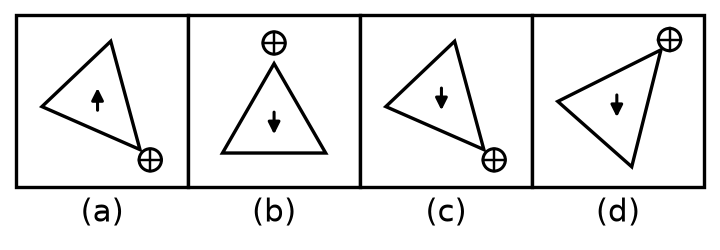
Directions for the following 2 (two) items: In each item, there are two sets of figures; first four figures named Problem figures and next four figures named Answer figures indicated as (a), (b), (c) and (d). The problem figures follow a particular sequence. In accordance with the same, which one of the four answer figures should appear as the fifth figure?
Problem figures:
Answer figures:
Answer (c) & explanation
Figure (c) is correct. Step 1: watch the arrow inside. It flips each time: down, up, down, up. So in the fifth figure it points down. Step 2: watch the triangle's position. It goes 1, 2, 3, then back to 1 in figure 4. So figure 5 repeats figure 2's position (circle at the bottom-right). Step 3: figure 2's position with a downward arrow is (c). So (a), (b) and (d) fail.
Tip: when a pattern returns to its start, it is cycling. Find the cycle length (here 3 positions) and count forward. Combine that with the simpler flipping rule to fix the next figure.
(a) has the right position but the arrow points up.
Answer as per the official UPSC answer key.