
CSAT (Paper II): previous-year questions
1280 real UPSC Prelims questions (2011–2026) with the official answer and a clear explanation. 400 of them came in the last five papers.
How often UPSC asks this
Questions per year, counted from the official papers.
Subtopics
Arrangements, ranking, ordering and puzzles
142 questions
Clocks and calendars
5 questions
Coding-decoding, series, patterns, cubes, dice and visual reasoning
110 questions
Communication, interpersonal skills and decision-making
10 questions
Counting, permutations, combinations and probability
1 questions
Directions, blood relations and Venn diagrams
60 questions
General English: grammar, vocabulary and comprehension
20 questions
General Hindi: grammar, vocabulary, dialects and comprehension
25 questions
Geometry and mensuration
26 questions
Number system and basic algebra (divisibility, HCF/LCM, remainders, digits, equations)
196 questions
Percentages, profit and loss, discount, simple and compound interest
47 questions
Ratio, proportion, averages, mixtures and alligation
47 questions
Syllogisms, statements and conclusions, assumptions and arguments
89 questions
Time and work; pipes and cisterns
2 questions
Time, speed and distance; trains, boats and streams; races
48 questions
Attempt the questions
Newest papers first. Tap an option; the answer and the reason appear instantly.
A person lives in a far off village which is almost two hours by bus. The villager’s neighbour is a very powerful landlord who is trying to occupy the poor villager’s land by force. You are the District Magistrate and busy in a meeting called by a local Minister. The villager has come all the way, by bus and on foot, to see you and give an application seeking protection from the powerful landlord. The villager keeps on waiting outside the meeting hall for an hour. You come out of the meeting and are rushing to another meeting. The villager follows you to submit his application. What would you do ?
Answer (c) & explanation
(c) and (d) are both correct (UPSC accepted both; no negative marking). Step 1: a poor villager has travelled far and waited an hour for protection from a powerful landlord. His complaint is urgent. Step 2: (d) quickly taking his application and asking key questions, or (c) handing it to a senior officer to resolve, both ensure action today. Step 3: (a) asking him to wait two more hours is unkind and delays protection. (b) sending him to a junior officer passes the buck and may leave him unheard.
Tip: for these interpersonal items, pick the response that is lawful, honest and fixes the real problem through proper channels. Avoid options that give in to pressure, show favouritism or dodge a decision.
Answer as per the official UPSC answer key.
Read the passage
Financial markets in India have acquired greater depth and liquidity over the years. Steady reforms since 1991 have led to growing linkages and integration of the Indian economy and its financial system with the global economy. Weak global economic prospects and continuing uncertainties in the international financial markets therefore, have had their impact on the emerging market economies. Sovereign risk concerns, particularly in the Euro area, affected financial markets for the greater part of the year, with the contagion of Greece’s sovereign debt problem spreading to India and other economies by way of higher-than-normal levels of volatility.
The funding constraints in international financial markets could impact both the availability and cost of foreign funding for banks and corporates. Since the Indian financial system is bank dominated, banks’ ability to withstand stress is critical to overall financial stability. Indian banks, however, remain robust, notwithstanding a decline in capital to risk-weighted assets ratio and a rise in non-performing asset levels in the recent past. Capital adequacy levels remain above the regulatory requirements. The financial market infrastructure continues to function without any major disruption. With further globalization, consolidation, deregulation, and diversification of the financial system, the banking business may become more complex and riskier. Issues like risk and liquidity management and enhancing skill therefore assume greater significance.
According to the passage, the financial markets in the emerging market economies including India had the adverse impact in recent years due to
- 1. weak global economic prospects.
- 2. uncertainties in the international financial markets.
- 3. sovereign risk concerns in the Euro area.
- 4. bad monsoons and the resultant crop loss.
Select the correct answer using the code given below :
Answer (b) & explanation
1, 2 and 3 are correct (b). Step 1: the passage names 'weak global economic prospects' (1) and 'continuing uncertainties in the international financial markets' (2) as affecting emerging markets. Step 2: it adds that 'sovereign risk concerns, particularly in the Euro area' hit markets, with Greece's debt problem spreading to India (3). Step 3: point 4, bad monsoons and crop loss, is never mentioned. So (a), (c) and (d) fail; (a) and (c) leave out true points, and (d) includes 4.
Tip: in 'select the correct points' questions, tick each point only if you can find it in the passage. A point that sounds reasonable for India (monsoon) but is absent from the text is a trap.
Answer as per the official UPSC answer key.
(Same figures as the question above.)
If the Psychology professors in the University constitute 2% of all the professors in the University, then what is the number of professors in the University?
Answer (b) & explanation
500 is correct (b). Step 1: from Figure 1, Psychology has 4 men + 6 women = 10 professors. Step 2: these 10 are 2% of all professors. So 1% = 10 ÷ 2 = 5. Step 3: 100% = 5 × 100 = 500. Check: 2% of 500 = 10. So (a), (c) and (d) fail; for example, 2% of 400 is only 8, and 2% of 600 is 12.
Tip: when a part and its percentage are given, find 1% first and then multiply by 100. Or simply divide the part by the percentage as a decimal: 10 ÷ 0.02 = 500. Always check by working backwards from your answer.
Answer as per the official UPSC answer key.
Read the passage
Corporate governance is based on principles such as conducting the business with all integrity and fairness, being transparent with regard to all transactions, making all the necessary disclosures and decisions, complying with all the laws of the land, accountability and responsibility towards the stakeholders and commitment to conducting business in an ethical manner. Another point which is highlighted on corporate governance is the need for those in control to be able to distinguish between what are personal and corporate funds while managing a company.
Fundamentally, there is a level of confidence that is associated with a company that is known to have good corporate governance. The presence of an active group of independent directors on the board contributes a great deal towards ensuring confidence in the market. Corporate governance is known to be one of the criteria that foreign institutional investors are increasingly depending on when deciding on which companies to invest in. It is also known to have a positive influence on the share price of the company. Having a clean image on the corporate governance front could also make it easier for companies to source capital at more reasonable costs. Unfortunately, corporate governance often becomes the centre of discussion only after the exposure of a large scam.
According to the passage, which of the following should be the practice/practices in good corporate governance ?
- 1. Companies should always comply with labour and tax laws of the land.
- 2. Every company in the country should have a government representative as one of the independent directors on the board to ensure transparency.
- 3. The manager of a company should never invest his personal funds in the company.
Select the correct answer using the codes given below :
Answer (a) & explanation
Only practice 1 is correct (a). Step 1: the passage lists 'complying with all the laws of the land' as a principle of corporate governance. Labour and tax laws are laws of the land, so 1 fits. Step 2: practice 2 is wrong: the passage praises an active group of independent directors, but never says one must be a government representative. Step 3: practice 3 is wrong: the passage only asks those in control to distinguish between personal and corporate funds. It does not ban managers from investing their own money. So (b), (c) and (d) fail.
Tip: 'keep separate' is not 'never mix at all'. Watch for options that turn a mild rule into a strict ban.
Answer as per the official UPSC answer key.
A thief running at 8 km/hr is chased by a policeman whose speed is 10 km/hr. If the thief is 100 m ahead of the policeman, then the time required for the policeman to catch the thief will be
Answer (b) & explanation
3 minutes is correct (b). Step 1: both are running the same way, so the policeman gains on the thief at the relative speed: 10 − 8 = 2 km/hr. Step 2: the gap is 100 m = 0.1 km. Step 3: time = 0.1 ÷ 2 = 1/20 hour = 60/20 = 3 minutes. So (a), (c) and (d) fail.
Tip: when two things move in the same direction, subtract their speeds; when they move towards each other, add them. Then convert units carefully: metres to km and hours to minutes. A quick check: at 2 km/hr, the policeman gains about 33 m per minute, so 100 m takes 3 minutes.
Answer as per the official UPSC answer key.
Read the passage
Seven-year-old Jim came home from the park without his new bicycle. “An old man and a little boy borrowed it,” he explained. “They are going to bring it back at four o’clock.” His parents were upset that he had given his expensive new bicycle, but were secretly proud of his kindness and faith. Came four o’clock, no bicycle. The parents were anxious. But at 4:30, the door bell rang, and there stood a happy man and a boy, with the bicycle and a box of chocolates. Jim suddenly disappeared into his bedroom, and then came running out. “All right,” he said, after examining the bicycle. “You can have your watch back !”
When Jim came home without his bicycle, his parents
Answer (b) & explanation
'Were worried' is correct (b). Step 1: the passage says his parents 'were upset that he had given his expensive new bicycle', and at four o'clock with no bicycle 'the parents were anxious'. Being upset and anxious means worried. Step 2: (a) is wrong: they were 'secretly proud of his kindness and faith', so not angry with him. Step 3: (c) is wrong: they clearly were concerned. (d) is wrong: nothing says they were eager to meet the man and the boy. So (a), (c) and (d) fail.
Tip: collect all the emotion words in the passage (upset, proud, anxious). The answer should fit them together; 'angry' clashes with 'proud'.
Answer as per the official UPSC answer key.
(Same information as the question above.)
Between which two cities among the pairs of cities given below are there maximum travel options available?
Answer (a) & explanation
1. Count the ways by multiplying the number of modes on each leg.
2. Q to S: Q → P (2 ways) → R (1) → S (2) = 4; Q → T (1) → R (2) → S (2) = 4. Total 8.
3. P to R: direct boat 1; P → Q → T → R = 2 × 1 × 2 = 4. Total 5.
4. P to T: P → Q → T = 2; P → R → T = 2. Total 4. Q to R: via P = 2, via T = 2. Total 4.
5. The most options are between Q and S.
Answer as per the official UPSC answer key.
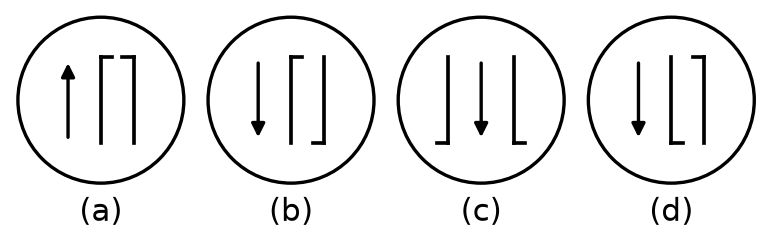
(Same directions as the question above.)
Problem figures:
Answer figures:
Answer (b) & explanation
1. Read the elements as one long chain: hook-left foot, up-arrow, right foot, hook-left top, down-arrow, hook-right top, …
2. Each figure shows three elements in a row, and the next figure slides one step along the chain (the left one drops off, a new one joins on the right).
3. Figure 4 ends with down-arrow and right-top hook. So figure 5 starts with these two, and the chain then restarts with the first element (the left-foot piece).
4. Down-arrow, right-top hook, left-foot piece: (b).
Answer as per the official UPSC answer key.
There is a shortage of sugar in your District where you are the District Magistrate. The Government has ordered that only a maximum amount of 30 kg sugar is to be released for wedding celebrations. A son of your close friend is getting married and your friend requests you to release at least 50 kg sugar for his son’s wedding. He expresses annoyance when you tell him about the Government’s restrictions on this matter. He feels that since you are the District Magistrate you can release any amount. You do not want to spoil your friendship with him. In such circumstances, how would you deal with the situation ?
Answer (b) & explanation
(b) and (c) are both correct (UPSC accepted both; no negative marking). Step 1: there is a sugar shortage and a government limit of 30 kg per wedding. Your friend wants 50 kg. Step 2: (b) refusing and strictly following the rule, and (c) showing him the government order and persuading him to accept 30 kg, both obey the rule; (c) also tries to save the friendship. Step 3: (a) releasing extra sugar misuses your office. (d) sending him to another authority dodges your own responsibility.
Tip: for these interpersonal items, pick the response that is lawful, honest and fixes the real problem through proper channels. Avoid options that give in to pressure, show favouritism or dodge a decision.
Answer as per the official UPSC answer key.
Read the passage
Financial markets in India have acquired greater depth and liquidity over the years. Steady reforms since 1991 have led to growing linkages and integration of the Indian economy and its financial system with the global economy. Weak global economic prospects and continuing uncertainties in the international financial markets therefore, have had their impact on the emerging market economies. Sovereign risk concerns, particularly in the Euro area, affected financial markets for the greater part of the year, with the contagion of Greece’s sovereign debt problem spreading to India and other economies by way of higher-than-normal levels of volatility.
The funding constraints in international financial markets could impact both the availability and cost of foreign funding for banks and corporates. Since the Indian financial system is bank dominated, banks’ ability to withstand stress is critical to overall financial stability. Indian banks, however, remain robust, notwithstanding a decline in capital to risk-weighted assets ratio and a rise in non-performing asset levels in the recent past. Capital adequacy levels remain above the regulatory requirements. The financial market infrastructure continues to function without any major disruption. With further globalization, consolidation, deregulation, and diversification of the financial system, the banking business may become more complex and riskier. Issues like risk and liquidity management and enhancing skill therefore assume greater significance.
The Indian financial markets are affected by global changes mainly due to the
Answer (c) & explanation
(c) is correct. Step 1: the passage says reforms since 1991 'have led to growing linkages and integration' of India's economy with the global economy, and global troubles 'therefore' affected emerging markets. So integration is the main reason. Step 2: (a) remittances and (b) foreign exchange reserves are never mentioned. Step 3: (d) Greece's debt problem is one example of a shock that spread to India; it travelled through the linkages, so it is not the main reason. So (a), (b) and (d) fail.
Tip: distinguish the channel (the reason things spread) from a single event that used it. 'Mainly due to' asks for the general cause, not one instance.
Answer as per the official UPSC answer key.
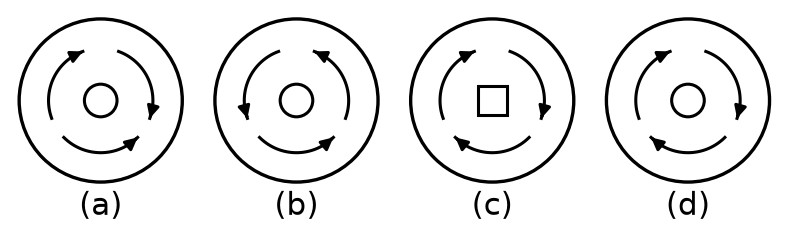
Consider the following figures:
Which one of the following figures would logically come in the 7th position indicated above by a question mark?
Answer (d) & explanation
Figure (d) is correct. Step 1: the centre shape alternates: circle, square, circle, square… Figure 7 is odd-numbered, so it has a circle. Step 2: the three arrows repeat every three figures: figure 4 matches figure 1, figure 5 matches figure 2, figure 6 matches figure 3. So figure 7 matches figure 1, with all three arrows going clockwise. Step 3: a circle with all three arrows clockwise is (d). So (a), (b) and (c) fail.
Tip: when a series has two or more changing parts, find the cycle of each separately (here 2 for the shape and 3 for the arrows). Then use the position number to find where each part is at the required step.
(a) has the circle but its bottom arrow points the other way.
Fell for this one? Most aspirants do. The PYQ Book puts every UPSC trap side by side, so the pattern finally clicks. Try the free sample
Answer as per the official UPSC answer key.
Read the passage
Corporate governance is based on principles such as conducting the business with all integrity and fairness, being transparent with regard to all transactions, making all the necessary disclosures and decisions, complying with all the laws of the land, accountability and responsibility towards the stakeholders and commitment to conducting business in an ethical manner. Another point which is highlighted on corporate governance is the need for those in control to be able to distinguish between what are personal and corporate funds while managing a company.
Fundamentally, there is a level of confidence that is associated with a company that is known to have good corporate governance. The presence of an active group of independent directors on the board contributes a great deal towards ensuring confidence in the market. Corporate governance is known to be one of the criteria that foreign institutional investors are increasingly depending on when deciding on which companies to invest in. It is also known to have a positive influence on the share price of the company. Having a clean image on the corporate governance front could also make it easier for companies to source capital at more reasonable costs. Unfortunately, corporate governance often becomes the centre of discussion only after the exposure of a large scam.
According to the passage, which of the following is/are the major benefit/benefits of good corporate governance ?
- 1. Good corporate governance leads to increase in share price of the company.
- 2. A company with good corporate governance always increases its business turnover rapidly.
- 3. Good corporate governance is the main criterion for foreign institutional investors when they decide to buy a company.
Select the correct answer using the codes given below :
Answer (a) & explanation
Only benefit 1 is correct (a). Step 1: the passage says good corporate governance has 'a positive influence on the share price'. So 1 is right. Step 2: benefit 2 is wrong: business turnover is never mentioned, and 'always increases rapidly' is far too strong. Step 3: benefit 3 is wrong: the passage calls governance 'one of the criteria' foreign investors use, not the main criterion. So (b), (c) and (d) fail.
Tip: compare small words: 'one of the' never equals 'the main'. Also note the other benefits named in the passage, such as market confidence and cheaper capital; UPSC often tests whether you notice which one the options actually match.
Answer as per the official UPSC answer key.
A train travels at a certain average speed for a distance of 63 km and then travels a distance of 72 km at an average speed of 6 km/hr more than its original speed. If it takes 3 hours to complete the total journey, what is the original speed of the train in km/hr?
Answer (c) & explanation
42 km/hr is correct (c). Step 1: let the speed be v. Time for 63 km = 63/v; time for 72 km = 72/(v + 6). Total = 3 hours. Step 2: solving the quadratic is slow, so test the options. v = 42: 63/42 = 1.5 hours and 72/48 = 1.5 hours. Total = 3 hours. It fits. Step 3: v = 24 gives 2.6 + 2.4 = 5 hours; v = 33 gives about 1.9 + 1.85 = 3.75 hours; v = 66 gives about 0.95 + 1 = 1.95 hours. So (a), (b) and (d) fail.
Tip: in CSAT, plugging options back in is often quicker than algebra. Start with a number that divides evenly (63 and 42 share 21).
Answer as per the official UPSC answer key.
Read the passage
Seven-year-old Jim came home from the park without his new bicycle. “An old man and a little boy borrowed it,” he explained. “They are going to bring it back at four o’clock.” His parents were upset that he had given his expensive new bicycle, but were secretly proud of his kindness and faith. Came four o’clock, no bicycle. The parents were anxious. But at 4:30, the door bell rang, and there stood a happy man and a boy, with the bicycle and a box of chocolates. Jim suddenly disappeared into his bedroom, and then came running out. “All right,” he said, after examining the bicycle. “You can have your watch back !”
Jim returned the watch to the old man and the little boy because
Answer (c) & explanation
(c) is correct. Step 1: Jim said 'All right… You can have your watch back!' only 'after examining the bicycle'. So the watch was security for the bicycle's safe return, and he gave it back once he was satisfied with the bicycle's condition. Step 2: (a) is wrong: the chocolates were a thank-you gift; Jim's reply depends on checking the bicycle. Step 3: (b) is wrong: his father's pride is not linked to the watch. (d) is wrong: being late by 30 minutes is not a reason to return the watch. So (a), (b) and (d) fail.
Tip: the twist at the end of such stories shows the real reason. Read the last lines carefully: here Jim was not just trusting; he was also careful.
Answer as per the official UPSC answer key.
Directions for the following 3 (three) items: Read the following passage and answer the three items that follow:
A tennis coach is trying to put together a team of four players for the forthcoming tournament. For this 7 players are available: males A, B and C; and females W, X, Y and Z. All players have equal capability and at least 2 males will be there in the team. For a team of four, all players must be able to play with each other. But, B cannot play with W, C cannot play with Z and W cannot play with Y.
If Y is selected and B is rejected, the team will consist of which one of the following groups?
Answer (b) & explanation
A, C, X and Y is correct (b). Step 1: B is rejected, and the team needs at least 2 males, so both A and C must play. Y is selected, so the team so far is A, C, Y. One more woman is needed. Step 2: W cannot play with Y, so W is out. Z cannot play with C, so Z is out. Only X is left. Step 3: the team is A, C, X and Y. (a) puts W with Y, (c) puts Z with C, and (d) has only one male and puts W with Y. So (a), (c) and (d) fail.
Tip: first fix the people forced in or out, then use each 'cannot play with' rule to remove candidates one by one.
Answer as per the official UPSC answer key.
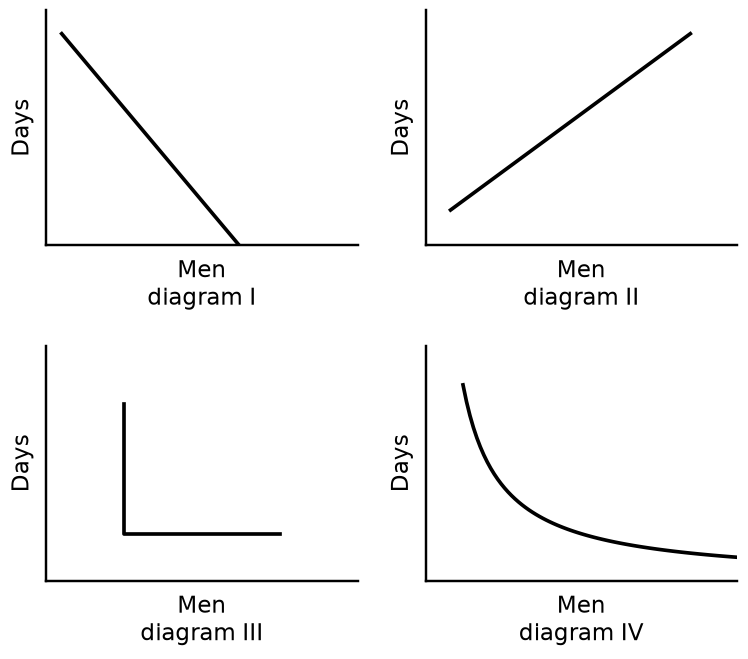
Consider the following diagrams:
x men, working at constant speed, do a certain job in y days. Which one of these diagrams shows the relation between x and y?
Answer (d) & explanation
Diagram IV is correct (d). Step 1: the job is fixed, so men × days = constant. More men finish the job in fewer days: double the men, half the days. This is inverse proportion. Step 2: on a graph, inverse proportion is a smooth curve that falls steeply at first and then more slowly, but never reaches zero. Step 3: diagram I hits zero days, which is impossible. Diagram II rises, which is the wrong direction. Diagram III has a sharp corner, which does not fit a steady rule. Diagram IV shows the smooth falling curve. So (a), (b) and (c) fail.
Tip: xy = constant always gives a smooth curve (a hyperbola) that approaches but never touches the axes.
Answer as per the official UPSC answer key.
You are in-charge of implementing the Family Planning programme in an area where there is a strong opposition to the present policy. You want to convince the residents of the need for keeping small families. What would be the best way of communicating this message ?
Answer (a) & explanation
(a) and (c) are both correct (UPSC accepted both; no negative marking). Step 1: people strongly oppose the policy, so you must win them over. Step 2: (a) explaining calmly how small families improve health and living standards, and (c) offering incentives to adopt family planning, both give people good reasons to agree. Step 3: (b) late marriage and spacing are related ideas but do not directly address keeping families small. (d) using people who were sterilised may meet the same hostility and does not explain the benefits.
Tip: for these interpersonal items, pick the response that is lawful, honest and fixes the real problem through proper channels. Avoid options that give in to pressure, show favouritism or dodge a decision.
Answer as per the official UPSC answer key.
Read the passage
Financial markets in India have acquired greater depth and liquidity over the years. Steady reforms since 1991 have led to growing linkages and integration of the Indian economy and its financial system with the global economy. Weak global economic prospects and continuing uncertainties in the international financial markets therefore, have had their impact on the emerging market economies. Sovereign risk concerns, particularly in the Euro area, affected financial markets for the greater part of the year, with the contagion of Greece’s sovereign debt problem spreading to India and other economies by way of higher-than-normal levels of volatility.
The funding constraints in international financial markets could impact both the availability and cost of foreign funding for banks and corporates. Since the Indian financial system is bank dominated, banks’ ability to withstand stress is critical to overall financial stability. Indian banks, however, remain robust, notwithstanding a decline in capital to risk-weighted assets ratio and a rise in non-performing asset levels in the recent past. Capital adequacy levels remain above the regulatory requirements. The financial market infrastructure continues to function without any major disruption. With further globalization, consolidation, deregulation, and diversification of the financial system, the banking business may become more complex and riskier. Issues like risk and liquidity management and enhancing skill therefore assume greater significance.
According to the passage, in the Indian financial system, banks’ ability to withstand stress is critical to ensure overall financial stability because Indian financial system is
Answer (d) & explanation
(d) is correct. Step 1: the passage says: 'Since the Indian financial system is bank dominated, banks' ability to withstand stress is critical to overall financial stability.' So the reason is that banks dominate the system. Step 2: (a) and (c) are wrong: control by the Government or the RBI is not mentioned as the reason. Step 3: (b) is wrong: 'less integrated with banks' contradicts the passage, which says the system is dominated by banks. So (a), (b) and (c) fail.
Tip: words like 'since' and 'because' introduce the reason. When the question repeats a sentence from the passage, find it and read the clause beginning with 'since'; that is your answer.
Answer as per the official UPSC answer key.
Read the passage
Ecological research over the last quarter of the century has established the deleterious effects of habitat fragmentation due to mining, highways and such other intrusions on forests. When a large block of forests gets fragmented into smaller bits, the edges of all these bits come into contact with human activities resulting in the degradation of the entire forests. Continuity of forested landscapes and corridors gets disrupted affecting several extinction-prone species of wildlife. Habitat fragmentation is therefore considered as the most serious threat to biodiversity conservation. Ad hoc grants of forest lands to mining companies coupled with rampant illegal mining is aggravating this threat.
What is the central focus of this passage ?
Answer (d) & explanation
'Disruption of habitat' is correct (d). Step 1: the passage is about habitat fragmentation: mining and highways break forests into bits, edges are degraded, corridors are cut, and this is 'the most serious threat to biodiversity conservation'. Every sentence returns to the disruption of habitat. Step 2: (a) illegal mining is only one cause, mentioned in the last sentence. (b) extinction of wildlife is one effect. Step 3: (c) conservation of nature is too broad: the passage is about one specific threat, not conservation in general. So (a), (b) and (c) fail.
Tip: the central focus is usually the idea linking the cause and the effect. Options naming only a cause or only an effect are too narrow.
Answer as per the official UPSC answer key.
Read the passage
Malnutrition most commonly occurs between the ages of six months and two years. This happens despite the child’s food requirements being less than that of an older child. Malnutrition is often attributed to poverty, but it has been found that even in households where adults eat adequate quantities of food, more than 50 per cent of children-under-five do not consume enough food. The child’s dependence on someone else to feed him/her is primarily responsible for the malnutrition. Very often the mother is working and the responsibility of feeding the young child is left to an older sibling. It is therefore crucial to increase awareness regarding the child’s food needs and how to satisfy them.
According to the passage, malnutrition in children can be reduced
Answer (c) & explanation
(c) is correct. Step 1: the passage ends: 'It is therefore crucial to increase awareness regarding the child's food needs and how to satisfy them.' So malnutrition falls when the food needs of young children are known. Step 2: (a) regular intake sounds good, but the passage blames the lack of awareness of how much a child needs; it does not offer 'regular food' as the remedy. Step 3: (b) is wrong: the problem peaks at six months to two years; waiting until age five is no remedy. (d) is wrong: the passage does not say feeding by adults solves it; even in households where adults eat well, children go hungry. So (a), (b) and (d) fail.
Tip: look for 'therefore' or 'it is crucial'; the solution usually follows.
Answer as per the official UPSC answer key.