
CSAT (Paper II): previous-year questions
1280 real UPSC Prelims questions (2011–2026) with the official answer and a clear explanation. 400 of them came in the last five papers.
How often UPSC asks this
Questions per year, counted from the official papers.
Subtopics
Arrangements, ranking, ordering and puzzles
142 questions
Clocks and calendars
5 questions
Coding-decoding, series, patterns, cubes, dice and visual reasoning
110 questions
Communication, interpersonal skills and decision-making
10 questions
Counting, permutations, combinations and probability
1 questions
Directions, blood relations and Venn diagrams
60 questions
General English: grammar, vocabulary and comprehension
20 questions
General Hindi: grammar, vocabulary, dialects and comprehension
25 questions
Geometry and mensuration
26 questions
Number system and basic algebra (divisibility, HCF/LCM, remainders, digits, equations)
196 questions
Percentages, profit and loss, discount, simple and compound interest
47 questions
Ratio, proportion, averages, mixtures and alligation
47 questions
Syllogisms, statements and conclusions, assumptions and arguments
89 questions
Time and work; pipes and cisterns
2 questions
Time, speed and distance; trains, boats and streams; races
48 questions
Attempt the questions
Newest papers first. Tap an option; the answer and the reason appear instantly.
You have been made responsible to hire boats at a short notice to be used for an area under flood. On seeing the price mentioned by the boat owners you found that the lowest price was approximately three times more than the approved rate of the Government. You would
Answer (b) & explanation
UPSC's key lists (b) and (d), with no negative marking. Step 1: a flood is an emergency, and boats are needed now, but the lowest price is about three times the approved rate. Step 2: (b) accepting the lowest price saves lives without delay; emergency rules allow this with proper recording. (d) warning owners that exploiting a disaster may cost them their licence can bring the price down quickly. Step 3: (a) a fresh call for prices and (c) waiting for Government approval both lose precious time while people are stranded.
Tip: for these interpersonal items, pick the response that is lawful, honest and keeps the public work going. Avoid options that give in to pressure, pass the buck or abandon duty.
Answer as per the official UPSC answer key.
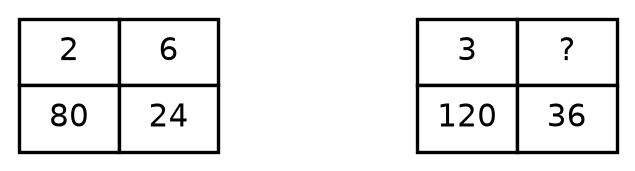
Consider the following figures:
What is the missing number?
Answer (c) & explanation
9 is correct (c). Step 1: look at the first figure. The top numbers are 2 and 6. The bottom-left number 80 = (2 + 6) × 10. The bottom-right number 24 = 6 × 4. Step 2: apply the same rule to the second figure. The bottom-right is 36, and it equals the missing number × 4. So the missing number = 36 ÷ 4 = 9. Step 3: check the bottom-left: (3 + 9) × 10 = 120, which matches the figure. So (a), (b) and (d) fail.
Tip: find the rule in the complete figure first, then test it on every number in the second figure. If one number fits and another does not, the rule is wrong.
Answer as per the official UPSC answer key.
Read the passage
Now India’s children have a right to receive at least eight years of education, the gnawing question is whether it will remain on paper or become a reality. One hardly needs a reminder that this right is different from the others enshrined in the Constitution, that the beneficiary – a six year old child cannot demand it, nor can she or he fight a legal battle when the right is denied or violated. In all cases, it is the adult society which must act on behalf of the child. In another peculiarity, where a child’s right to education is denied, no compensation offered later can be adequate or relevant. This is so because childhood does not last. If a legal battle fought on behalf of a child is eventually won, it may be of little use to the boy or girl because the opportunity missed at school during childhood cannot serve the same purpose later in life. This may be painfully true for girls because our society permits them only a short childhood, if at all. The Right to Education (RTE) has become law at a point in India’s history when the ghastly practice of female infanticide has resurfaced in the form of foeticide. This is “symptomatic of a deeper turmoil” in society which is compounding the traditional obstacles to the education of girls. Tenacious prejudice against the intellectual potential of girls runs across our cultural diversity and the system of education has not been able to address it.
Which one of the following statements conveys the inference of the passage ?
Answer (d) & explanation
There is no substitute for childhood education is correct (d). Step 1: an inference is something that follows from the passage but is not said word for word. Step 2: the passage says 'no compensation offered later can be adequate', and the missed opportunity 'cannot serve the same purpose later in life'. From this we infer that nothing can replace education missed in childhood: (d). Step 3: (a) is stated directly, so it is not an inference. (b) and (c) go beyond the passage; it never says adults are unreliable or that legal fights are prohibitive. So (a), (b) and (c) fail.
Tip: in inference questions, a statement copied from the passage is usually not the answer. Look for the idea the passage clearly implies.
Answer as per the official UPSC answer key.
Read the passage
For achieving inclusive growth there is a critical need to rethink the role of the State. The early debate among economists about the size of the Government can be misleading. The need of the hour is to have an enabling Government. India is too large and complex a nation for the State to be able to deliver all that is needed. Asking the Government to produce all the essential goods, create all the necessary jobs, and keep a curb on the prices of all goods is to lead to a large cumbersome bureaucracy and widespread corruption.
The aim must be to stay with the objective of inclusive growth that was laid down by the founding fathers of the nation and also to take a more modern view of what the State can realistically deliver.
This is what leads to the idea of an enabling State, that is, a Government that does not try to directly deliver to the citizens everything that they need. Instead, it (1) creates an enabling ethos for the market so that individual enterprise can flourish and citizens can, for the most part, provide for the needs of one another, and (2) steps in to help those who do not manage to do well for themselves, for there will always be individuals, no matter what the system, who need support and help. Hence we need a Government that, when it comes to the market, sets effective, incentive-compatible rules and remains on the sidelines with minimal interference, and, at the same time, plays an important role in directly helping the poor by ensuring that they get basic education and health services and receive adequate nutrition and food.
What constitutes an enabling Government ?
- 1. A large bureaucracy.
- 2. Implementation of welfare programmes through representatives.
- 3. Creating an ethos that helps individual enterprise.
- 4. Providing resources to those who are underprivileged.
- 5. Offering direct help to the poor regarding basic services.
Select the correct answer from the codes given below :
Answer (c) & explanation
Items 3, 4 and 5 are correct (c). Step 1: the passage says an enabling State 'creates an enabling ethos for the market so that individual enterprise can flourish'. That is item 3. Step 2: it 'steps in to help those who do not manage to do well' and directly helps the poor with basic services. Those are items 4 and 5. Step 3: check the rest. Item 1 is wrong: a large bureaucracy is named as a problem leading to corruption. Item 2 is wrong: the passage never mentions working through representatives. So (a), (b) and (d) fail.
Tip: anything the passage criticises cannot be part of its ideal. Spot the warnings first, then strike those items.
Answer as per the official UPSC answer key.
A contract on construction job specifies a penalty for delay in completion of the work beyond a certain date is as follows: Rs. 200 for the first day, Rs. 250 for the second day, Rs. 300 for the third day etc., the penalty for each succeeding day being Rs. 50 more than that of the preceding day. How much penalty should the contractor pay if he delays the work by 10 days?
Answer (b) & explanation
Rs. 4,250 is correct (b). Step 1: the penalties form a series rising by Rs. 50 each day: 200, 250, 300 and so on. The 10th day's penalty = 200 + 9 × 50 = Rs. 650. Step 2: the total of an evenly rising series = number of days × (first + last) ÷ 2 = 10 × (200 + 650) ÷ 2 = 10 × 425 = Rs. 4,250. Step 3: (d) Rs. 650 is only the last day's penalty, a trap. (a) and (c) come from wrong sums. So (a), (c) and (d) fail.
Tip: for any steady increase, the average of the first and last term, times the number of terms, gives the total. No need to add ten numbers.
Rs. 650 is only the 10th day, not the total.
Answer as per the official UPSC answer key.
Read the passage
I opened the bag and packed the boots in; and then, just as I was going to close it, a horrible idea occurred to me. Had I packed my toothbrush ? I don’t know how it is, but I never do know whether I’ve packed my toothbrush.
My toothbrush is a thing that haunts me when I’m travelling, and makes my life a misery. I dream that I haven’t packed it, and wake up in a cold perspiration, and get out of bed and hunt for it. And, in the morning, I pack it before I have used it, and it is always the last thing I turn out of the bag; and then I repack and forget it, and have to rush upstairs for it at the last moment and carry it to the railway station, wrapped up in my pocket-handkerchief.
When he was going to close the bag, the idea that occurred to him was
Answer (a) & explanation
Unpleasant is correct (a). Step 1: the passage says 'a horrible idea occurred to me': that he might not have packed his toothbrush. Step 2: 'horrible' means very bad or disturbing, which is closest to unpleasant: (a). Step 3: (b) sad is the wrong kind of feeling; he was worried, not sorrowful. (c) fantastic is wrong. (d) amusing is how the reader may find it, since the passage is comic, but the narrator himself did not find it funny.
Tip: answer from the character's point of view, not yours as a reader. The narrator calls it 'horrible', so pick the matching feeling.
Answer as per the official UPSC answer key.
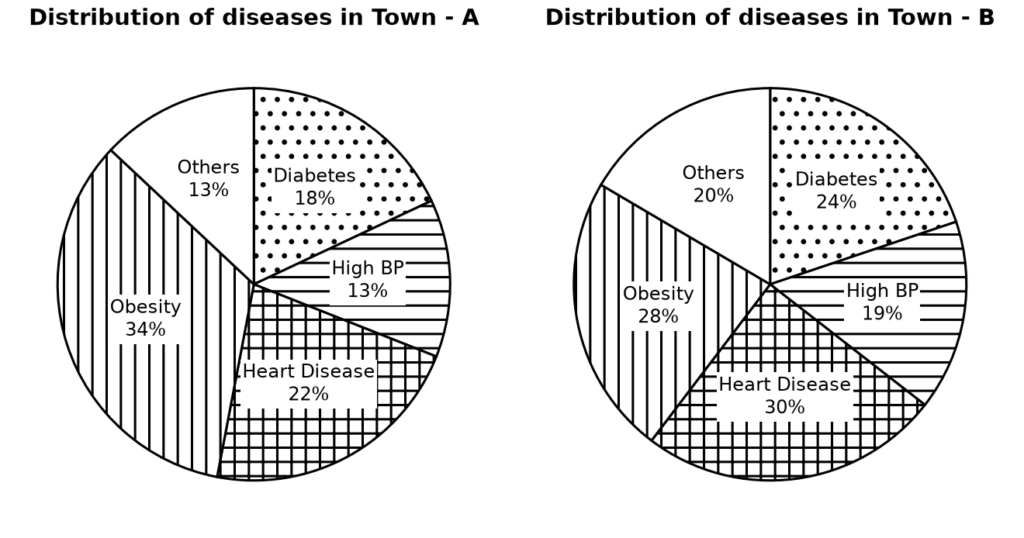
Directions for the following 2 (two) items: The following pie charts show the break-up of disease categories recorded in the patients from two towns, Town A and Town B. Pie charts plot the disease categories as percentage of the total number of patients. Based on these, answer the two items that follow the charts.
Which of the two towns has a higher number of persons with Diabetes?
Answer (d) & explanation
No inference can be drawn is correct (d). Step 1: the pie charts give only percentages: diabetes is 18% of patients in Town A and 24% in Town B. Step 2: we are not told how many patients each town has. Step 3: 24% of a small number can be less than 18% of a big number. For example, 24% of 100 is 24, but 18% of 1,000 is 180. So we cannot say which town has more diabetics. Options (a), (b) and (c) fail.
Tip: a percentage alone never tells you the actual number. Always ask 'percentage of what total?' before comparing two groups.
Answer as per the official UPSC answer key.
Read the passage
A species that exerts an influence out of proportion to its abundance in an ecosystem is called a keystone species. The keystone species may influence both the species richness of communities and the flow of energy and materials through ecosystems. The sea star Pisaster ochraceus, which lives in rocky intertidal ecosystems on the Pacific coast of North America, is also an example of a keystone species. Its preferred prey is the mussel Mytilus californianus. In the absence of sea stars, these mussels crowd out other competitors in a broad belt of the intertidal zone. By consuming mussels, sea star creates bare spaces that are taken over by a variety of other species.
A study at the University of Washington demonstrated the influence of Pisaster on species richness by removing sea stars from selected parts of the intertidal zone repeatedly over a period of five years. Two major changes occurred in the areas from which sea stars were removed. First, the lower edge of the mussel bed extended farther down into the intertidal zone, showing that sea stars are able to eliminate mussels completely where they are covered with water most of the time. Second, and more dramatically, 28 species of animals and algae disappeared from the sea star removal zone. Eventually only Mytilus, the dominant competitor, occupied the entire substratum. Through its effect on competitive relationships, predation by Pisaster largely determines which species live in these rocky intertidal ecosystems.
Which of the following is/are implied by the passage ?
- 1. Mussels are always hard competitors for sea stars.
- 2. Sea stars of the Pacific coast have reached the climax of their evolution.
- 3. Sea stars constitute an important component in the energy flow in intertidal ecosystem.
Which of the statements given above is/are correct ?
Answer (d) & explanation
Statement 3 only is correct (d). Step 1: the passage says keystone species influence 'the flow of energy and materials through ecosystems', and the sea star is a keystone species. So it is an important part of energy flow: statement 3. Step 2: statement 1 is wrong: mussels are the sea star's prey, not its competitors; mussels compete with other species for space. Step 3: statement 2 is wrong: the passage never discusses evolution or a 'climax'. So (a), (b) and (c) fail.
Tip: check each role carefully. Prey and competitor are different relationships, and options love to swap them.
Answer as per the official UPSC answer key.
You are the officer-in-charge of a village administering distribution of vaccine in an isolated epidemic hit village, and you are left with only one vaccine. There is a requirement of that vaccine from the Gram Pradhan and also a poor villager. You are being pressurised by the Gram Pradhan to issue the vaccine to him. You would
Answer (b) & explanation
UPSC's key lists (b) and (d), with no negative marking. Step 1: there is only one vaccine, two people need it, and the Gram Pradhan is using pressure. Step 2: (b) and (d) both arrange a second dose from another area's distributor, so both people get vaccinated. Option (b), arranging for the poor villager from outside while the local dose goes by need, resists undue pressure. Step 3: (a) leaves both unprotected during an epidemic. (c) delays care and passes the decision to someone else.
Tip: for these interpersonal items, pick the response that is lawful, honest and keeps the public work going. Avoid options that give in to pressure, pass the buck or abandon duty.
Answer as per the official UPSC answer key.
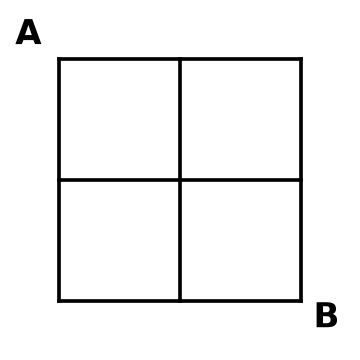
Study the following figure:
A person goes from A to B always moving to the right or downwards along the lines. How many different routes can he adopt?
Select the correct answer from the codes given below:
Answer (c) & explanation
6 routes is correct (c). Step 1: from A to B on this grid, every route needs exactly 2 steps right (R) and 2 steps down (D), in some order. Step 2: list the orders: RRDD, RDRD, RDDR, DRRD, DRDR, DDRR. That is 6 routes. Step 3: check with a formula: the number of ways to arrange 2 R's and 2 D's is 4! ÷ (2! × 2!) = 24 ÷ 4 = 6. So (a), (b) and (d) fail.
Tip: for grid routes moving only right and down, count the steps of each kind, then use (total steps)! ÷ (rights! × downs!). For bigger grids, this saves a lot of drawing.
Answer as per the official UPSC answer key.
Read the following passage and answer the 3 (three) items that follow:
A, B, C, D and E are members of the same family. There are two fathers, two sons, two wives, three males and two females. The teacher was the wife of a lawyer who was the son of a doctor. E is not a male, neither also a wife of a professional. C is the youngest person in the family and D is the eldest. B is a male.
How is D related to E?
Answer (a) & explanation
1. Three generations: doctor → his son the lawyer → the lawyer's child. The eldest, D, is the doctor; the youngest, C, is the grandchild.
2. Two sons means the lawyer and C are both sons, so C is male. With B male, the males are D, the lawyer and C, so the lawyer is B.
3. The two females are then A and E. The teacher is the lawyer's wife, and E is not the wife of a professional, so the teacher is A (B's wife). The other wife, E, is D's wife.
4. So D is E's husband.
The wording "neither also a wife of a professional" is loose; the official answer is (a), as printed.
Answer as per the official UPSC answer key.
Read the passage
For achieving inclusive growth there is a critical need to rethink the role of the State. The early debate among economists about the size of the Government can be misleading. The need of the hour is to have an enabling Government. India is too large and complex a nation for the State to be able to deliver all that is needed. Asking the Government to produce all the essential goods, create all the necessary jobs, and keep a curb on the prices of all goods is to lead to a large cumbersome bureaucracy and widespread corruption.
The aim must be to stay with the objective of inclusive growth that was laid down by the founding fathers of the nation and also to take a more modern view of what the State can realistically deliver.
This is what leads to the idea of an enabling State, that is, a Government that does not try to directly deliver to the citizens everything that they need. Instead, it (1) creates an enabling ethos for the market so that individual enterprise can flourish and citizens can, for the most part, provide for the needs of one another, and (2) steps in to help those who do not manage to do well for themselves, for there will always be individuals, no matter what the system, who need support and help. Hence we need a Government that, when it comes to the market, sets effective, incentive-compatible rules and remains on the sidelines with minimal interference, and, at the same time, plays an important role in directly helping the poor by ensuring that they get basic education and health services and receive adequate nutrition and food.
Why is the State unable to deliver “all that is needed” ?
- 1. It does not have sufficient bureaucracy.
- 2. It does not promote inclusive growth.
Select the correct answer from the codes given below :
Answer (d) & explanation
Neither statement is correct (d). Step 1: find the passage's reason. It says 'India is too large and complex a nation for the State to be able to deliver all that is needed'. Step 2: check statement 1. The passage does not blame a shortage of bureaucracy; it warns that trying to do everything would create a large, cumbersome bureaucracy and corruption. So 1 is wrong. Step 3: check statement 2. The State failing to promote inclusive growth is not the reason given; inclusive growth remains the goal. So 2 is wrong too. Options (a), (b) and (c) fail.
Tip: 'why' questions want the reason the passage actually states. Find that sentence first; anything else, however logical, is outside the passage.
Answer as per the official UPSC answer key.
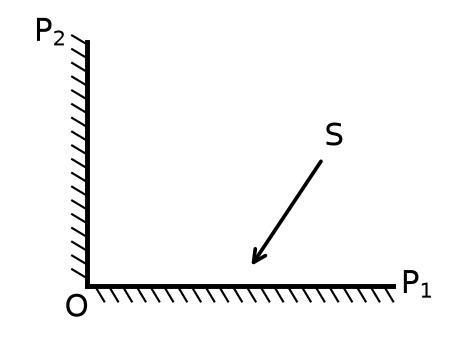
Consider the figure given below and answer the item that follows:
In the figure shown above, OP1 and OP2 are two plane mirrors kept perpendicular to each other. S is the direction of a beam of light falling on the mirror OP1. The direction of the reflected beam of light from the mirror OP2 will be
Answer (c) & explanation
Opposite and parallel to S is correct (c). Step 1: think of the beam as having two parts: an up-down part and a left-right part. Step 2: the first mirror OP₁ reverses one part, and the second mirror OP₂, at 90° to the first, reverses the other part. Step 3: with both parts reversed, the beam goes straight back the way it came, travelling opposite and parallel to S, just shifted sideways. So (a), (b) and (d) fail.
Tip: two mirrors at right angles always send light back parallel to where it came from. This is how corner reflectors on bicycles and the reflectors left on the Moon work.
Answer as per the official UPSC answer key.
Read the passage
I opened the bag and packed the boots in; and then, just as I was going to close it, a horrible idea occurred to me. Had I packed my toothbrush ? I don’t know how it is, but I never do know whether I’ve packed my toothbrush.
My toothbrush is a thing that haunts me when I’m travelling, and makes my life a misery. I dream that I haven’t packed it, and wake up in a cold perspiration, and get out of bed and hunt for it. And, in the morning, I pack it before I have used it, and it is always the last thing I turn out of the bag; and then I repack and forget it, and have to rush upstairs for it at the last moment and carry it to the railway station, wrapped up in my pocket-handkerchief.
What makes his life miserable whenever he undertakes travelling ?
Answer (b) & explanation
Forgetting the toothbrush is correct (b). Step 1: the passage says 'My toothbrush is a thing that haunts me when I'm travelling, and makes my life a misery'. His fear is about forgetting it. Step 2: so the cause of his misery is the worry of forgetting the toothbrush: (b). Step 3: (a) and (c), going to the station and packing, are where the worry plays out, not the cause. (d) bad dreams are only one symptom of the same worry. So (a), (c) and (d) fail.
Tip: separate the cause from its effects. The dreams and the last-minute rush are effects; the toothbrush worry is the cause.
Answer as per the official UPSC answer key.
(Same pie charts as the question above.)
What can we say about persons with more than one disease from these graphs?
Answer (b) & explanation
Town B is correct (b). Step 1: add the slices of Town A: 13 + 18 + 13 + 22 + 34 = 100%. So each patient is counted exactly once. Step 2: add the slices of Town B: 20 + 24 + 19 + 30 + 28 = 121%. That is more than 100%. Step 3: the extra 21% can only come from patients counted in two disease groups. So Town B is likely to have persons with more than one disease. So (a), (c) and (d) fail.
Tip: when pie-chart slices add up to more than 100%, some items are counted twice. That simple sum is the whole question.
Answer as per the official UPSC answer key.
Read the passage
A species that exerts an influence out of proportion to its abundance in an ecosystem is called a keystone species. The keystone species may influence both the species richness of communities and the flow of energy and materials through ecosystems. The sea star Pisaster ochraceus, which lives in rocky intertidal ecosystems on the Pacific coast of North America, is also an example of a keystone species. Its preferred prey is the mussel Mytilus californianus. In the absence of sea stars, these mussels crowd out other competitors in a broad belt of the intertidal zone. By consuming mussels, sea star creates bare spaces that are taken over by a variety of other species.
A study at the University of Washington demonstrated the influence of Pisaster on species richness by removing sea stars from selected parts of the intertidal zone repeatedly over a period of five years. Two major changes occurred in the areas from which sea stars were removed. First, the lower edge of the mussel bed extended farther down into the intertidal zone, showing that sea stars are able to eliminate mussels completely where they are covered with water most of the time. Second, and more dramatically, 28 species of animals and algae disappeared from the sea star removal zone. Eventually only Mytilus, the dominant competitor, occupied the entire substratum. Through its effect on competitive relationships, predation by Pisaster largely determines which species live in these rocky intertidal ecosystems.
Consider the following assumptions :
- 1. The food chains/food web in an ecosystem are influenced by keystone species.
- 2. The presence of keystone species is a specific characteristic of aquatic ecosystems.
- 3. If the keystone species is completely removed from an ecosystem, it will lead to the collapse of the ecosystem.
With reference to the passage, which of the above assumptions is/are valid ?
Answer (c) & explanation
Assumptions 1 and 3 are valid per UPSC's key (c). Step 1: the passage says predation by the sea star 'largely determines which species live' there, so keystone species shape the food web: assumption 1. Step 2: when sea stars were removed, 28 species vanished and only mussels remained, a collapse of the community: UPSC accepts assumption 3, though 'collapse of the ecosystem' slightly overstates a single study. Step 3: assumption 2 is wrong: one marine example cannot show that keystone species are found only in aquatic ecosystems. So (a), (b) and (d) fail.
Tip: one example never proves 'specific to' or 'only'. Generalising from a single case is the trap.
Answer as per the official UPSC answer key.
You have taken up a project to create night shelters for homeless people during the winter season. Within a week of establishing the shelters, you have received complaints from the residents of the area about the increase in theft cases with a demand to remove the shelters. You would
Answer (b) & explanation
UPSC's key lists (b) and (c), with no negative marking. Step 1: residents complain about thefts and want the night shelters removed. Step 2: (b) assuring an enquiry takes their complaint seriously, and (c) asking them to consider the humanitarian purpose explains why the shelters matter for homeless people in winter. Both keep the shelters running while addressing concerns. Step 3: (d) ignoring the complaint damages trust. (a) only redirects residents to the police without any action of your own.
Tip: for these interpersonal items, pick the response that is lawful, honest and keeps the public work going. Avoid options that give in to pressure, pass the buck or abandon duty.
Answer as per the official UPSC answer key.
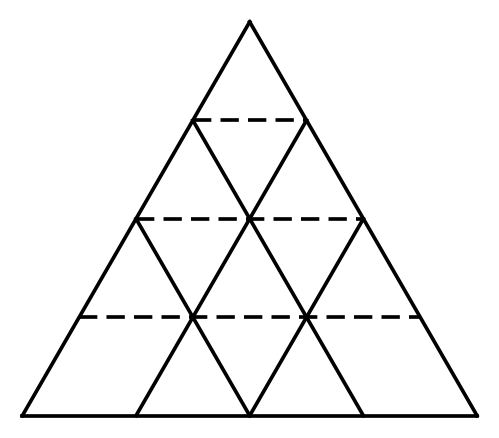
Consider the following figure and answer the item that follows:
What is the total number of triangles in the above grid?
Answer (c) & explanation
1. Count the smallest triangles (one small cell each): 8 point up and 4 point down = 12.
2. Count triangles made of 4 small cells (2 small sides long): 6 point up and 1 points down (in the middle) = 7.
3. Count triangles 3 small sides long: one at each bottom corner and one upright through the middle = 3.
4. The whole big triangle: 1.
5. Total = 12 + 7 + 3 + 1 = 23.
Answer as per the official UPSC answer key.
(Same information as the question above.)
Who are the females in the group?
Answer (c) & explanation
E and A is correct (c). Step 1: the family has three males and two females, with two fathers, two sons and two wives. Step 2: work out the males. B is male (given). The teacher is the wife of a lawyer, who is the son of a doctor, so there are two professional men, father and son. D is the eldest, so D is the grandfather-doctor; B is his son, the lawyer; and C, the youngest, is B's son. So the males are D, B and C. Step 3: that leaves E and A as the two females. The clue that E is 'not a male' confirms E is one of them. So (a), (b) and (d) fail.
Tip: once you know the males, the rest are females. Solve the clue chain (teacher → lawyer → doctor) first, then use 'eldest' and 'youngest' to place people.
Answer as per the official UPSC answer key.
Read the passage
For achieving inclusive growth there is a critical need to rethink the role of the State. The early debate among economists about the size of the Government can be misleading. The need of the hour is to have an enabling Government. India is too large and complex a nation for the State to be able to deliver all that is needed. Asking the Government to produce all the essential goods, create all the necessary jobs, and keep a curb on the prices of all goods is to lead to a large cumbersome bureaucracy and widespread corruption.
The aim must be to stay with the objective of inclusive growth that was laid down by the founding fathers of the nation and also to take a more modern view of what the State can realistically deliver.
This is what leads to the idea of an enabling State, that is, a Government that does not try to directly deliver to the citizens everything that they need. Instead, it (1) creates an enabling ethos for the market so that individual enterprise can flourish and citizens can, for the most part, provide for the needs of one another, and (2) steps in to help those who do not manage to do well for themselves, for there will always be individuals, no matter what the system, who need support and help. Hence we need a Government that, when it comes to the market, sets effective, incentive-compatible rules and remains on the sidelines with minimal interference, and, at the same time, plays an important role in directly helping the poor by ensuring that they get basic education and health services and receive adequate nutrition and food.
What is the essential message being conveyed by the author of the passage ?
Answer (d) & explanation
Rethinking the role of the State is correct (d). Step 1: read the first line: 'For achieving inclusive growth there is a critical need to rethink the role of the State.' Step 2: see how the rest supports it. The passage explains why the State cannot do everything and describes the enabling State as the new role. So the central message is (d). Step 3: check the others. (a) is a supporting detail about the founding fathers. (b) is too narrow: schools and health are only part of the poor's support. (c) is the opposite: the State should not run markets and industries. So (a), (b) and (c) fail.
Tip: the main message is often in the first or last line. A detail, however true, is not the 'essential message'.
Answer as per the official UPSC answer key.