
CSAT (Paper II): previous-year questions
1280 real UPSC Prelims questions (2011–2026) with the official answer and a clear explanation. 400 of them came in the last five papers.
How often UPSC asks this
Questions per year, counted from the official papers.
Subtopics
Arrangements, ranking, ordering and puzzles
142 questions
Clocks and calendars
5 questions
Coding-decoding, series, patterns, cubes, dice and visual reasoning
110 questions
Communication, interpersonal skills and decision-making
10 questions
Counting, permutations, combinations and probability
1 questions
Directions, blood relations and Venn diagrams
60 questions
General English: grammar, vocabulary and comprehension
20 questions
General Hindi: grammar, vocabulary, dialects and comprehension
25 questions
Geometry and mensuration
26 questions
Number system and basic algebra (divisibility, HCF/LCM, remainders, digits, equations)
196 questions
Percentages, profit and loss, discount, simple and compound interest
47 questions
Ratio, proportion, averages, mixtures and alligation
47 questions
Syllogisms, statements and conclusions, assumptions and arguments
89 questions
Time and work; pipes and cisterns
2 questions
Time, speed and distance; trains, boats and streams; races
48 questions
Attempt the questions
Newest papers first. Tap an option; the answer and the reason appear instantly.
There are 5 tasks and 5 persons. Task-1 cannot be assigned to either person-1 or person-2. Task-2 must be assigned to either person-3 or person-4. Every person is to be assigned one task. In how many ways can the assignment be done ?
Answer (c) & explanation
There are 24 ways (c). Step 1: Task-2 must go to person-3 or person-4: 2 ways. Step 2: Task-1 cannot go to person-1 or person-2, so it must go to one of persons 3, 4 or 5. One of 3 or 4 is already used by Task-2, so 2 choices are left. Step 3: the remaining 3 tasks go to the remaining 3 persons in 3 × 2 × 1 = 6 ways. Step 4: total = 2 × 2 × 6 = 24. Options (a), (b) and (d) miss or double a step.
Tip: in assignment problems, place the most restricted items first (here Task-2, then Task-1). Then the rest can be arranged freely: n items in n! ways.
Answer as per the official UPSC answer key.
Read the passage
Foods travel more than the people who eat them. Grocery stores and supermarkets are loaded with preserved and processed foods. This, however, often leads to environmental threats, such as pollution generated by long distance food transportation and wastage of food during processing and transportation, destruction of rain forests, reduced nutritional content, increased demand for preservation and packaging. Food insecurity also increases as the produce comes from regions that are not feeding their own population properly.
With reference to the above passage, which of the following statements is/are true ?
- 1. Consuming regionally grown food and not depending on long travelled food is a part of eco-friendly behaviour.
- 2. Food processing industry puts a burden on our natural resources.
Select the correct answer using the code given below :
Answer (c) & explanation
Both statements are true (c). Step 1: test statement 1. The passage says food that travels long distances causes pollution, wastage and destruction of rain forests. So eating locally grown food, which does not travel far, is eco-friendly. Statement 1 holds. Step 2: test statement 2. Processed foods lead to "wastage of food during processing" and "increased demand for preservation and packaging". These use up natural resources. Statement 2 holds. So options (a), (b) and (d) fail.
Tip: a statement can be true even if the passage does not use the same words, as long as it follows directly. Here "regionally grown food" is the opposite of "long distance food", which the passage criticises.
Answer as per the official UPSC answer key.
A selection is to be made for one post of Principal and two posts of Vice-Principal. Amongst the six candidates called for the interview, only two are eligible for the post of Principal while they all are eligible for the post of Vice-Principal. The number of possible combinations of selectees is
Answer (d) & explanation
The answer is 20, which is none of the given numbers (d). Step 1: choose the Principal. Only 2 candidates are eligible, so 2 ways. Step 2: choose two Vice-Principals from the remaining 5 people (everyone is eligible). Pairs from 5 = 5 × 4 ÷ 2 = 10 ways. We divide by 2 because the two posts are equal and order does not matter. Step 3: total = 2 × 10 = 20. 20 is not among (a), (b) or (c), so the answer is (d).
Tip: once a person is picked for one post, remove them before choosing the next. For choosing 2 from n without order, use n × (n − 1) ÷ 2.
Answer as per the official UPSC answer key.
Candidates in a competitive examination consisted of 60% men and 40% women. 70% men and 75% women cleared the qualifying test and entered the final test where 80% men and 70% women were successful. Which of the following statements is correct?
Answer (c) & explanation
More men cleared the exam than women (c). Step 1: take 100 candidates: 60 men and 40 women. Step 2: men who passed both tests: 60 × 0.7 × 0.8 = 33.6. Women: 40 × 0.75 × 0.7 = 21. So more men cleared (c). Step 3: test (a). Men's success rate = 33.6 ÷ 60 = 56%. Women's = 21 ÷ 40 = 52.5%. Women's rate is lower, so (a) is wrong. Step 4: test (b). Overall = 33.6 + 21 = 54.6%, above 50%, so (b) is wrong. Option (d) is wrong too.
Tip: for multi-stage pass rates, multiply the stages. Taking 100 as the total turns every answer into a percentage directly.
Answer as per the official UPSC answer key.
A father is nine times as old as his son and the mother is eight times as old as the son. The sum of the father's and the mother's age is 51 years. What is the age of the son?
Answer (d) & explanation
The son is 3 years old (d). Step 1: call the son's age s. The father is 9s and the mother is 8s. Step 2: father + mother = 9s + 8s = 17s = 51. Step 3: s = 51 ÷ 17 = 3. Check: father 27, mother 24, total 51. Options (a), (b) and (c) give totals of 119, 85 and 68.
Tip: when everyone's age is a multiple of one person's age, add the multiples first (9 + 8 = 17) and divide the total by that. You can also test options: 3 × 17 = 51 works straight away.
Answer as per the official UPSC answer key.
Read the passage
Individuals, groups and leaders who promote human development operate under strong institutional, structural and political constraints that affect policy options. But experience suggests broad principles for shaping an appropriate agenda for human development. One important finding from several decades of human development experience is that focusing exclusively on economic growth is problematic. While we have good knowledge about how to advance health and education, the causes of growth are much less certain and growth is often elusive. Further, an unbalanced emphasis on growth is often associated with negative environmental consequences and adverse distributional effects. The experience of China, with its impressive growth record, reflects these broader concerns and underlines the importance of balanced approaches that emphasize investments in the non-income aspects of human development.
With reference to the above passage, consider the following statements :
- 1. In developing countries, a strong institutional framework is the only requirement for human development and policy options.
- 2. Human development and economic growth are not always positively inter-related.
- 3. Focusing only on human development should be the goal of economic growth.
Which of the above statements is/are correct ?
Answer (c) & explanation
Only statement 2 is correct (c). Step 1: test statement 2. The passage says focusing only on growth brings "adverse distributional effects" and environmental harm. So growth does not always improve human development; the two are not always positively linked. 2 holds. Step 2: test statement 1. It says a strong institutional framework is the "only" requirement. The passage never says this; it mentions constraints but not a single requirement. 1 fails. Step 3: test statement 3. It says growth should focus "only" on human development. The passage calls for "balanced approaches", not an exclusive focus. 3 fails. Options (a), (b) and (d) fail.
Tip: "only" in a statement usually clashes with a passage that asks for balance.
Answer as per the official UPSC answer key.
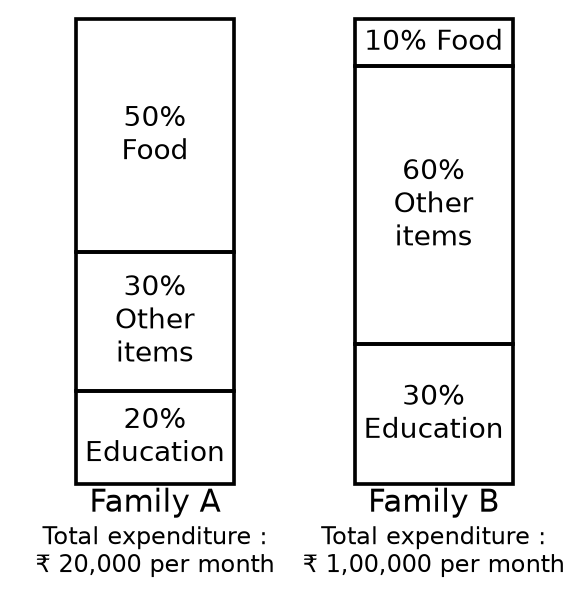
The proportion of expenditure on various items by two families A and B are represented in the following Bar Charts :
From these charts, we can conclude that
Answer (c) & explanation
Both families spent the same on food (c). Step 1: Family A's income is ₹20,000, and food is 50% of spending. 50% of 20,000 = ₹10,000. Step 2: Family B's income is ₹1,00,000, and food is 10%. 10% of 1,00,000 = ₹10,000. Step 3: both spent ₹10,000. Options (a) and (b) are wrong. Option (d) is wrong: the amounts can be compared because the totals are given.
Tip: percentages from different totals cannot be compared directly. Always convert each percentage into an actual amount first. Here a big share of a small income equals a small share of a big income.
A bigger percentage does not mean more money; multiply by the total first.
Answer as per the official UPSC answer key.
In a parking area, the total number of wheels of all the cars (four-wheelers) and scooters/motorbikes (two-wheelers) is 100 more than twice the number of parked vehicles. The number of cars parked is
Answer (c) & explanation
There are 50 cars (c). Step 1: let c be cars and s be two-wheelers. Total wheels = 4c + 2s. Twice the number of vehicles = 2c + 2s. Step 2: the wheels are 100 more: 4c + 2s = 2c + 2s + 100. Step 3: the 2s appears on both sides, so it cancels. That leaves 2c = 100, so c = 50. The number of two-wheelers does not matter. Options (a), (b) and (d) do not fit.
Tip: a simple way to see it: give every vehicle 2 wheels first. That uses "twice the vehicles". The extra 100 wheels are the 2 more wheels each car has. 100 ÷ 2 = 50 cars.
Answer as per the official UPSC answer key.
The monthly incomes of Peter and Paul are in the ratio of 4 : 3. Their expenses are in the ratio of 3 : 2. If each saves ₹ 6,000 at the end of the month, their monthly incomes respectively are (in ₹)
Answer (a) & explanation
Their incomes are ₹24,000 and ₹18,000 (a). Step 1: every option keeps incomes in the ratio 4 : 3, so test each one using savings of ₹6,000. Step 2: option (a): expenses = 24,000 − 6,000 = 18,000 and 18,000 − 6,000 = 12,000. 18,000 : 12,000 = 3 : 2. This matches. Step 3: check option (b): expenses 22,000 and 15,000, which is not 3 : 2. Options (c) and (d) also fail.
Tip: when all options satisfy one condition, use the other condition to test them. Testing options is often faster than setting up two equations.
Answer as per the official UPSC answer key.
Read the passage
I must say that, beyond occasionally exposing me to laughter, my constitutional shyness has been of no disadvantage whatever. In fact I can see that, on the contrary, it has been all to my advantage. My hesitancy in speech, which was once an annoyance, is now a pleasure. Its greatest benefit has been that it has taught me the economy of words. I have naturally formed the habit of restraining my thoughts. And I can now give myself the certificate that a thoughtless word hardly ever escapes my tongue or pen. I do not recollect ever having had to regret anything in my speech or writing. I have thus been spared many a mishap and waste of time. Experience has taught me that silence is part of the spiritual discipline of a votary of truth. Proneness to exaggerate, to suppress or modify the truth, wittingly or unwittingly, is a natural weakness of man, and silence is necessary in order to surmount it. A man of few words will rarely be thoughtless in his speech; he will measure every word. We find so many people impatient to talk. There is no chairman of a meeting who is not pestered with notes for permission to speak. And whenever the permission is given the speaker generally exceeds the time-limit, asks for more time, and keeps on talking without permission. All this talking can hardly be said to be of any benefit to the world. It is so much waste of time. My shyness has been in reality my shield and buckler. It has allowed me to grow. It has helped me in my discernment of truth.
The author says that a thoughtless word hardly ever escapes his tongue or pen. Which one of the following is not a valid reason for this ?
Answer (a) & explanation
Wanting to save time is not a valid reason (a). Step 1: find the reasons the author gives. His hesitancy in speech (d) "taught me the economy of words" (b). "I have naturally formed the habit of restraining my thoughts" (c). These lead to: "a thoughtless word hardly ever escapes my tongue or pen." Step 2: test option (a). The author says he has been spared "waste of time", but that is a result of speaking carefully, not the cause. He never says he speaks carefully because he wants to save time. So (a) is not a valid reason.
Tip: separate causes from results. Linking words like "taught me" show a cause; "thus been spared" shows a result. UPSC often offers a result dressed up as a reason.
Answer as per the official UPSC answer key.
A student has to opt for 2 subjects out of 5 subjects for a course, namely, Commerce, Economics, Statistics, Mathematics I and Mathematics II. Mathematics II can be offered only if Mathematics I is also opted. The number of different combinations of two subjects which can be opted is
Answer (c) & explanation
There are 7 combinations (c). Step 1: count all possible pairs of 2 subjects from 5. That is 5 × 4 ÷ 2 = 10 pairs. Step 2: remove pairs that break the rule. Maths II can be taken only with Maths I. So pairs with Maths II but not Maths I are not allowed: Maths II with Commerce, with Economics, and with Statistics. That is 3 pairs. Step 3: allowed pairs = 10 − 3 = 7. Options (a), (b) and (d) do not match.
Tip: when there is a restriction, count everything first, then subtract the forbidden cases. This is often faster than counting the allowed cases one by one.
Answer as per the official UPSC answer key.
Four persons A, B, C and D consisting of two married couples are in a group. Both the women are shorter than their respective husbands. A is the tallest among the four. C is taller than B. D is B's brother. In this context, which one of the following statements is not correct ?
Answer (c) & explanation
Statement (c) is not correct (c). Step 1: A is the tallest. Each wife is shorter than her husband, so the tallest person must be a husband: A is a man. D is B's brother, so D is also a man. Step 2: that leaves B and C as the two wives. Step 3: D cannot marry his own sister B, so the couples are A–B and D–C. Step 4: C is D's wife, so C is shorter than D. Option (c), "C is taller than D", is wrong. Check the others: (a) all are linked by family; (b) B is shorter than C, and C is shorter than her husband D and than A, so B is the shortest; (d) A is B's husband. These are correct.
Tip: in such puzzles, first fix who is a man and who is a woman, then pair the couples.
Answer as per the official UPSC answer key.
Read the passage
Individuals, groups and leaders who promote human development operate under strong institutional, structural and political constraints that affect policy options. But experience suggests broad principles for shaping an appropriate agenda for human development. One important finding from several decades of human development experience is that focusing exclusively on economic growth is problematic. While we have good knowledge about how to advance health and education, the causes of growth are much less certain and growth is often elusive. Further, an unbalanced emphasis on growth is often associated with negative environmental consequences and adverse distributional effects. The experience of China, with its impressive growth record, reflects these broader concerns and underlines the importance of balanced approaches that emphasize investments in the non-income aspects of human development.
With reference to the above passage, the following assumptions have been made :
- 1. Higher economic growth is essential to ensure reduction in economic disparity.
- 2. Environmental degradation is sometimes a consequence of economic growth.
Which of the above is/are valid assumption/assumptions ?
Answer (b) & explanation
Only assumption 2 is valid (b). Step 1: test assumption 2. The passage says "an unbalanced emphasis on growth is often associated with negative environmental consequences". So environmental harm is sometimes a result of growth. 2 holds. Step 2: test assumption 1. It says higher growth is essential to reduce disparity. The passage says growth often brings "adverse distributional effects", meaning it can widen disparity. So 1 contradicts the passage. Options (a), (c) and (d) fail.
Tip: the word "sometimes" in assumption 2 matches "often" in the passage. Mild words that match the passage's tone are usually safe. A strong claim like "essential" needs strong support.
Answer as per the official UPSC answer key.
Usha runs faster than Kamala, Priti runs slower than Swati, Swati runs slower than Kamala. Who is the slowest runner ?
Answer (b) & explanation
Priti is the slowest (b). Step 1: write each clue as a comparison. Usha > Kamala. Swati > Priti. Kamala > Swati. Step 2: link them into one line, fastest to slowest: Usha > Kamala > Swati > Priti. Step 3: the slowest is Priti. Options (a), (c) and (d) are faster than Priti.
Tip: change "runs slower than" into ">" pointing the right way. "Priti runs slower than Swati" means Swati > Priti. Turning every clue into the same symbol avoids mistakes. Then join the chains at the shared name.
Answer as per the official UPSC answer key.
Read the passage
The mangroves can shed tons of leaves per acre every year; fungi and bacteria break down this leaf litter and consume it, they then are consumed by tiny worms and crustaceans, which in turn feed small fish, which feed larger fish and birds and crocodiles.
Which among the following is the most logical inference of the above statement ?
Answer (c) & explanation
Mangroves play a crucial role in some coastal food chains (c). Step 1: see what the passage shows. Mangrove leaf litter feeds fungi and bacteria, which feed worms and crustaceans, then small fish, larger fish, birds and crocodiles. So mangroves start an important food chain. Step 2: one example supports "some" food chains. Step 3: test the others. Option (a) is wrong: "cannot" have food chains without mangroves is too strong. Option (b) is wrong: "all marine ecosystems" goes far beyond. Option (d) is wrong: "largely determined" is not shown.
Tip: one example supports a modest conclusion. Strong words like "cannot", "all" and "largely" need much more evidence.
Answer as per the official UPSC answer key.
Two cities A and B are 360 km apart. A car goes from A to B with a speed of 40 km/hr and returns to A with a speed of 60 km/hr. What is the average speed of the car ?
Answer (b) & explanation
The average speed is 48 km/hr (b). Step 1: going from A to B at 40 km/hr takes 360 ÷ 40 = 9 hours. Step 2: coming back at 60 km/hr takes 360 ÷ 60 = 6 hours. Step 3: total distance = 360 + 360 = 720 km. Total time = 9 + 6 = 15 hours. Average speed = 720 ÷ 15 = 48 km/hr. Option (c), 50 km/hr, is the trap: the simple average of 40 and 60. Options (a) and (d) are wrong.
Tip: average speed = total distance ÷ total time, never the simple average of speeds. For equal distances, a shortcut is 2 × a × b ÷ (a + b) = 2 × 40 × 60 ÷ 100 = 48.
50 km/hr is the plain average of 40 and 60. The car spends more time at the slower speed, so the true average is lower.
Answer as per the official UPSC answer key.
Read the passage
I must say that, beyond occasionally exposing me to laughter, my constitutional shyness has been of no disadvantage whatever. In fact I can see that, on the contrary, it has been all to my advantage. My hesitancy in speech, which was once an annoyance, is now a pleasure. Its greatest benefit has been that it has taught me the economy of words. I have naturally formed the habit of restraining my thoughts. And I can now give myself the certificate that a thoughtless word hardly ever escapes my tongue or pen. I do not recollect ever having had to regret anything in my speech or writing. I have thus been spared many a mishap and waste of time. Experience has taught me that silence is part of the spiritual discipline of a votary of truth. Proneness to exaggerate, to suppress or modify the truth, wittingly or unwittingly, is a natural weakness of man, and silence is necessary in order to surmount it. A man of few words will rarely be thoughtless in his speech; he will measure every word. We find so many people impatient to talk. There is no chairman of a meeting who is not pestered with notes for permission to speak. And whenever the permission is given the speaker generally exceeds the time-limit, asks for more time, and keeps on talking without permission. All this talking can hardly be said to be of any benefit to the world. It is so much waste of time. My shyness has been in reality my shield and buckler. It has allowed me to grow. It has helped me in my discernment of truth.
The most appropriate reason for the author to be spared many a mishap is that
Answer (a) & explanation
He was spared mishaps because he rarely uttered a thoughtless word (a). Step 1: find the sentence. "A thoughtless word hardly ever escapes my tongue or pen. I do not recollect ever having had to regret anything... I have thus been spared many a mishap." The word "thus" links the mishaps directly to his careful speech. Step 2: test the others. Option (b) is wrong: patience is not mentioned; in fact he criticises impatient talkers. Option (c) is wrong: silence is part of spiritual discipline, but that is not why he was spared mishaps. Option (d) is wrong: being a votary of truth comes later and explains silence, not the mishaps.
Tip: words like "thus", "hence" and "therefore" point back to the cause in the previous sentence.
Answer as per the official UPSC answer key.
A person ordered 5 pairs of black socks and some pairs of brown socks. The price of a black pair was thrice that of a brown pair. While preparing the bill, the bill clerk interchanged the number of black and brown pairs by mistake which increased the bill by 100%. What was the number of pairs of brown socks in the original order ?
Answer (d) & explanation
The original order had 25 brown pairs (d). Step 1: let a brown pair cost ₹1, so a black pair costs ₹3. Step 2: test the options. Try 25 brown pairs. Correct bill: 5 black × 3 + 25 brown × 1 = 15 + 25 = ₹40. Step 3: wrong bill, with the numbers swapped: 25 black × 3 + 5 brown × 1 = 75 + 5 = ₹80. Step 4: ₹80 is double ₹40, a 100% increase. This matches. Options (a), (b) and (c) do not double the bill: for example, 10 brown gives ₹25 and ₹35.
Tip: when an algebra setup seems long, test the options. Give prices simple values like 1 and 3 to keep the arithmetic easy.
Answer as per the official UPSC answer key.
Consider the following statements :
- 1. A man had a wife, two sons and two daughters in his family.
- 2. The daughters were invited to a feast and the male members of the family went out to take part in a picnic.
- 3. The man's father did not return from his work.
Which of the following statements is true ?
Answer (b) & explanation
It is likely that the wife was at home (b). Step 1: account for each person. The two daughters went to a feast. The male members (the man and his two sons) went on a picnic. The man's father did not return from work. Step 2: the only person not accounted for is the man's wife. Step 3: but we are not told where she was. She might have stayed home or gone out. So it is only likely, not certain, that she was home. Option (a) is too certain. Option (c) is not supported. Option (d) is wrong: no one else could be home.
Tip: CSAT logic rewards careful wording. If the facts do not settle a point, prefer "likely" or "possibly" over a definite claim.
Answer as per the official UPSC answer key.
If A runs less fast than B, and B runs as fast but not faster than C; then, as compared to A, C runs
Answer (b) & explanation
C runs faster than A (b). Step 1: "A runs less fast than B" means A < B. Step 2: "B runs as fast but not faster than C" means B = C. Step 3: so A < B = C, which means A < C. C is faster than A. Option (a) is the reverse. Option (c) is wrong: A is slower than B, so it cannot equal C. Option (d) is wrong: the data are enough.
Tip: turn wordy comparisons into simple symbols (<, =, >). "As fast but not faster" is a roundabout way of saying "equal". Once written as A < B = C, the answer is immediate.
Answer as per the official UPSC answer key.