
CSAT (Paper II): previous-year questions
1280 real UPSC Prelims questions (2011–2026) with the official answer and a clear explanation. 400 of them came in the last five papers.
How often UPSC asks this
Questions per year, counted from the official papers.
Subtopics
Arrangements, ranking, ordering and puzzles
142 questions
Clocks and calendars
5 questions
Coding-decoding, series, patterns, cubes, dice and visual reasoning
110 questions
Communication, interpersonal skills and decision-making
10 questions
Counting, permutations, combinations and probability
1 questions
Directions, blood relations and Venn diagrams
60 questions
General English: grammar, vocabulary and comprehension
20 questions
General Hindi: grammar, vocabulary, dialects and comprehension
25 questions
Geometry and mensuration
26 questions
Number system and basic algebra (divisibility, HCF/LCM, remainders, digits, equations)
196 questions
Percentages, profit and loss, discount, simple and compound interest
47 questions
Ratio, proportion, averages, mixtures and alligation
47 questions
Syllogisms, statements and conclusions, assumptions and arguments
89 questions
Time and work; pipes and cisterns
2 questions
Time, speed and distance; trains, boats and streams; races
48 questions
Attempt the questions
Newest papers first. Tap an option; the answer and the reason appear instantly.
Read the passage
India has suffered from persistent high inflation. Increase in administered prices, demand and supply imbalances, imported inflation aggravated by rupee depreciation, and speculation — have combined to keep high inflation going. If there is an element common to all of them, it is that many of them are the outcomes of economic reforms. India’s vulnerability to the effects of changes in international prices has increased with trade liberalisation. The effort to reduce subsidies has resulted in a continuous increase in the prices of commodities that are administered.
What is the most logical, rational and crucial message that is implied in the above passage ?
Answer (d) & explanation
Economic reforms can often create high inflation (d). Step 1: find the link. The passage lists causes of inflation: higher administered prices, demand-supply gaps, imported inflation and speculation. It then says, "many of them are the outcomes of economic reforms". Trade liberalisation increased exposure to world prices, and subsidy cuts raised administered prices. So reforms can create inflation. Step 2: test the others. Option (a) is wrong: "completely avoid all" is too extreme. Option (b) is wrong: the passage does not say India is not ready. Option (c) is wrong: poverty is not discussed.
Tip: the "crucial message" is often in the sentence that names a common element, here "If there is an element common to all of them".
Answer as per the official UPSC answer key.
Read the passage
“By liberty I mean the eager maintenance of that atmosphere in which men have the opportunity to be their best selves.”
Which one of the following expresses the view implied in the above statement ?
Answer (d) & explanation
Liberty means keeping conditions for people to grow (d). Step 1: read the definition. Liberty is "the eager maintenance of that atmosphere in which men have the opportunity to be their best selves." An "atmosphere" is a set of conditions, and being one's best self is the growth of personality. That is option (d). Step 2: test the others. Options (a) and (c) give the negative idea of liberty, simply no restraint or doing what one likes. Option (b) is wrong: liberty as only what law permits is not mentioned.
Tip: this is the positive idea of liberty (associated with Harold Laski): freedom to develop, not just freedom from control. Spot key words like "atmosphere" and "opportunity".
Answer as per the official UPSC answer key.
A, B, C, D, E and F are cousins. No two cousins are of the same age, but all have birthdays on the same day of the same month. The youngest is 17 years old and the oldest E is 22 years old. F is somewhere between B and D in age. A is older than B. C is older than D. A is one year older than C.
Which one of the following is possible ?
Answer (b) & explanation
F can be 18 years old (b). Step 1: all six have the same birthday and different ages from 17 to 22. So their ages are exactly 17, 18, 19, 20, 21, 22. E is the oldest, 22. Step 2: A is one year older than C. A is older than B, and C is older than D. A and C must be high to have people below them, so A = 21 and C = 20. Step 3: B, D and F share 17, 18, 19, with F between B and D. So F = 18. Options (a), (c) and (d) fail: D is 17 or 19, and F cannot be 19 or 20.
Tip: when ages are whole numbers in a fixed range with no repeats, list them all first.
Answer as per the official UPSC answer key.
Read the passage
I must say that, beyond occasionally exposing me to laughter, my constitutional shyness has been of no disadvantage whatever. In fact I can see that, on the contrary, it has been all to my advantage. My hesitancy in speech, which was once an annoyance, is now a pleasure. Its greatest benefit has been that it has taught me the economy of words. I have naturally formed the habit of restraining my thoughts. And I can now give myself the certificate that a thoughtless word hardly ever escapes my tongue or pen. I do not recollect ever having had to regret anything in my speech or writing. I have thus been spared many a mishap and waste of time. Experience has taught me that silence is part of the spiritual discipline of a votary of truth. Proneness to exaggerate, to suppress or modify the truth, wittingly or unwittingly, is a natural weakness of man, and silence is necessary in order to surmount it. A man of few words will rarely be thoughtless in his speech; he will measure every word. We find so many people impatient to talk. There is no chairman of a meeting who is not pestered with notes for permission to speak. And whenever the permission is given the speaker generally exceeds the time-limit, asks for more time, and keeps on talking without permission. All this talking can hardly be said to be of any benefit to the world. It is so much waste of time. My shyness has been in reality my shield and buckler. It has allowed me to grow. It has helped me in my discernment of truth.
For the author, silence is necessary in order to surmount
Answer (d) & explanation
Silence is needed to overcome the tendency to overstate (d). Step 1: find the sentence. "Proneness to exaggerate, to suppress or modify the truth... is a natural weakness of man, and silence is necessary in order to surmount it." To exaggerate means to overstate. Step 2: test the others. Options (a) and (b) are wrong: the author values his shyness and hesitancy; he calls them his "shield and buckler", not weaknesses to overcome. Option (c) is wrong: suppression of truth is part of the weakness, but option (c) says suppression of thoughts, which he sees as a good habit ("restraining my thoughts").
Tip: "surmount" means overcome. Look for the weakness the passage says must be overcome, and match the word, here "exaggerate" = "overstate".
Answer as per the official UPSC answer key.
The number of persons who read magazine X only is thrice the number of persons who read magazine Y. The number of persons who read magazine Y only is thrice the number of persons who read magazine X. Then, which of the following conclusions can be drawn ?
- 1. The number of persons who read both the magazines is twice the number of persons who read only magazine X.
- 2. The total number of persons who read either one magazine or both the magazines is twice the number of persons who read both the magazines.
Select the correct answer using the code given below :
No official answer (question dropped) & notes
1. Call the readers of only X 'x', only Y 'y', and both 'b'. All Y readers = y + b; all X readers = x + b.
2. The facts say x = 3 × (y + b) and y = 3 × (x + b). So x is bigger than 3y, and y is bigger than 3x.
3. Both cannot be true at the same time for any real counts. The question has no valid answer as worded, which is why UPSC dropped it.
UPSC dropped this question from evaluation, so it has no official answer. It is printed here for practice only.
UPSC dropped this question from evaluation; there is no official answer.
Geeta : Naresh has become a better boxer since he started meditation.
Radha : Impossible. A boxer's most important asset is his aggressiveness.
Radha's statement reflects her belief that
Answer (a) & explanation
Radha believes meditation makes a person less aggressive (a). Step 1: read Radha's words. She says it is "impossible" that meditation made Naresh a better boxer, because a boxer's most important asset is aggressiveness. Step 2: for her reasoning to work, she must believe meditation reduces aggression. That is her hidden belief, option (a). Step 3: test the others. Option (b) is wrong: if meditation had no effect, it could not make him worse, and she would not call improvement "impossible" for that reason. Option (c) is wrong: she says nothing about his past. Option (d) is wrong: she does not deny he meditates.
Tip: to find someone's belief, ask: "What must they think for their argument to make sense?"
Answer as per the official UPSC answer key.
Each of A, B, C and D has ₹ 100. A pays ₹ 20 to B, who pays ₹ 10 to C, who gets ₹ 30 from D. In this context, which one of the following statements is not correct?
Answer (c) & explanation
Statement (c) is not correct (c). Step 1: everyone starts with ₹100. Step 2: A pays ₹20 to B: A = 80, B = 120. B pays ₹10 to C: B = 110, C = 110. C gets ₹30 from D: C = 140, D = 70. Step 3: final amounts: A 80, B 110, C 140, D 70. Step 4: test each option. (a) C is the richest, with 140: correct. (b) D is the poorest, with 70: correct. (c) A + D = 80 + 70 = 150, which is more than C's 140. So (c) is not correct. (d) B (110) is richer than D (70): correct.
Tip: in money-transfer questions, track each person in a small table step by step. Then check every option against the final numbers.
the question asks for the statement that is not correct.
Answer as per the official UPSC answer key.
Read the passage
No Right is absolute, exclusive or inviolable. The Right of personal property, similarly, has to be perceived in the larger context of its assumed legitimacy. The Right of personal property should unite the principle of liberty with that of equality, and both with the principle of cooperation.
In the light of the argument in the above passage, which one of the following statements is the most convincing explanation ?
Answer (d) & explanation
Each person's right to property must be balanced with others' (d). Step 1: read the passage. "No Right is absolute." The right to property must unite liberty with equality and with cooperation. So one person's right has to be reconciled with the rights of others. That is option (d). Step 2: test the others. Option (a) is wrong: calling it a natural right backed by scriptures goes beyond the passage, which says no right is absolute. Options (b) and (c) are wrong: they reject the right outright, while the passage accepts it with limits.
Tip: when a passage says "no right is absolute" but does not abolish the right, the answer is about balance, not rejection.
Answer as per the official UPSC answer key.
Read the passage
Climate change is already making many people hungry all over the world, by disrupting crop yields and pushing up prices. And it is not just food but nutrients that are becoming scarcer as the climate changes. It is the poorest communities that will suffer the worst effects of climate change, including increased hunger and malnutrition as crop production and livelihoods are threatened. On the other hand, poverty is a driver of climate change, as desperate communities resort to unsustainable use of resources to meet current needs.
Which among the following is the most logical corollary to the above passage ?
Answer (b) & explanation
Poverty and climate impacts reinforce each other, so food systems must change (b). Step 1: find both directions. Climate change makes the poor hungrier by hitting crops and prices. And "poverty is a driver of climate change", as desperate people overuse resources. Each worsens the other: a two-way loop. Step 2: breaking the loop needs a new approach to food systems. Step 3: test the others. Option (a) is wrong: more subsidies address only one side. Option (c) is wrong: it ignores climate. Option (d) is wrong: "immediately" is too strong, and food prices are only part of the story.
Tip: a "corollary" follows naturally from the whole passage. When a passage shows two things causing each other, the answer usually mentions both.
Answer as per the official UPSC answer key.
(Same information as the question above.)
What is the number of logically possible orders of all six cousins in terms of increasing age ?
Answer (b) & explanation
There are 2 possible orders (b). Step 1: from the question above, E = 22, A = 21, C = 20 and F = 18. Step 2: B and D take the ages 17 and 19, with F in between. Either B is 17 and D is 19, or D is 17 and B is 19. Both fit all the clues: A is older than B, and C is older than D, in both cases. Step 3: so there are 2 orders. Options (a), (c) and (d) do not match.
Tip: in follow-up questions, reuse the fixed results and look only at the people who are still free to move. Count their possible arrangements.
Answer as per the official UPSC answer key.
Twelve people form a club. By picking lots, one of them will host a dinner for all once in a month. The number of dinners a particular member has to host in one year is
Answer (d) & explanation
It cannot be predicted (d). Step 1: understand the rule. Every month, a lot is drawn from all twelve members to choose the host. Step 2: lots are drawn fresh each month, so the same person can be picked again, and someone may never be picked. Step 3: in one year (12 draws), a member might host zero, one, two or more dinners. No single number is certain. Option (a) is the trap: "one" would be true only if each member took a turn, which the question does not say. Options (b) and (c) are also only possibilities.
Tip: "picking lots" means chance. With chance, an exact count cannot be fixed; only an average could be estimated (here one a year on average).
12 dinners for 12 people does not mean one each. Lots are drawn at random every time.
Answer as per the official UPSC answer key.
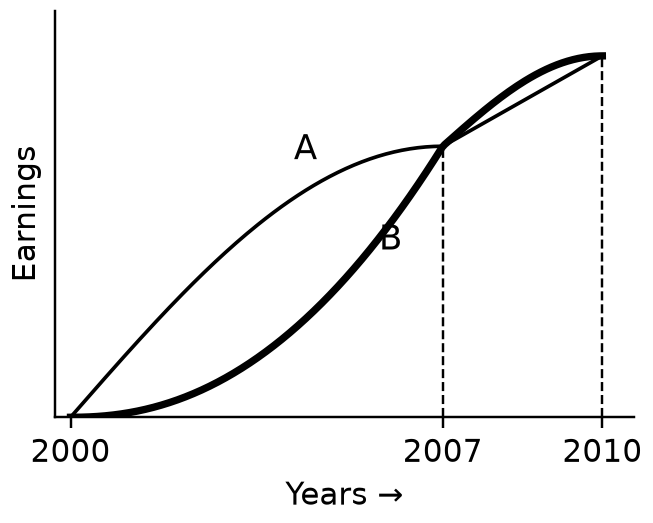
The graph below depicts the earnings of A and B over the period 2000 to 2010 :
From the graph, which one of the following can be concluded ?
Answer (a) & explanation
On average, A earned more than B (a). Step 1: read the graph from 2000 to 2007. A's curve stays well above B's, for seven years. Step 2: the two curves meet at 2007. From 2007 to 2010, B is only a little above A, for three years. Step 3: A's big lead over a long period outweighs B's small lead over a short period. So on average A earned more. Option (b) is wrong for the same reason. Option (c) is wrong: they were equal only at one point. Option (d) is wrong: A earned less only in the last few years.
Tip: "on average" over a period depends on both how big the gap is and how long it lasts. Compare the area between the curves on each side of the crossing point.
Do not judge by the end point alone; look at the whole period.
Answer as per the official UPSC answer key.
All good athletes want to win and all athletes who want to win eat a well-balanced diet; therefore all athletes who do not eat a well-balanced diet are bad athletes.
The best conclusion from this statement is that
Answer (b) & explanation
No athlete who skips a balanced diet is a good athlete (b). Step 1: write the chain. Good athlete → wants to win → eats a balanced diet. Step 2: if something always leads to a result, then no result means no cause. So an athlete who does not eat a balanced diet cannot be a good athlete. That is option (b). Step 3: test the others. Option (a) is not supported: bad athletes might also want to win. Option (c) reverses the chain: eating well does not prove someone is good. Option (d) also reverses it: wanting to win does not prove someone is good.
Tip: "If A then B" also means "if not B then not A". It does not mean "if B then A". Reversing the arrow is the most common logic trap.
Answer as per the official UPSC answer key.
In a town, 45% population read magazine A, 55% read magazine B, 40% read magazine C, 30% read magazines A and B, 15% read magazines B and C, 25% read magazines A and C; and 10% read all the three magazines. What percentage do not read any magazine ?
Answer (c) & explanation
20% read no magazine (c). Step 1: use the three-set rule. Readers of at least one magazine = (A + B + C) − (each pair) + (all three). Step 2: A + B + C = 45 + 55 + 40 = 140. Pairs: 30 + 15 + 25 = 70. All three: 10. Step 3: at least one = 140 − 70 + 10 = 80%. Step 4: none = 100 − 80 = 20%. Options (a), (b) and (d) miss a step.
Tip: why add the "all three" back? When we subtract the pairs, people who read all three are taken away three times, after being added three times, so they vanish. Adding them once restores them. Draw a three-circle Venn diagram if unsure.
Answer as per the official UPSC answer key.
Read the passage
The conflict between man and State is as old as State history. Although attempts have been made for centuries to bring about a proper adjustment between the competing claims of State and the individual, the solution seems to be still far off. This is primarily because of the dynamic nature of human society where old values and ideas constantly yield place to new ones. It is obvious that if individuals are allowed to have absolute freedom of speech and action, the result would be chaos, ruin and anarchy.
The author’s viewpoint can be best summed up in which of the following statements ?
Answer (a) & explanation
The State-individual conflict remains unresolved (a). Step 1: find the author's view. Attempts have been made "for centuries" to balance State and individual, but "the solution seems to be still far off". That is option (a). Step 2: test the others. Option (b) is wrong: anarchy follows absolute freedom, not democratic traditions. Option (c) is wrong: the passage says old values "constantly yield place to new ones", the opposite of persisting. Option (d) is wrong: the author warns against absolute freedom of speech, not against a constitutional guarantee.
Tip: the author's viewpoint is often stated plainly in a short line, here "still far off". Options that twist a detail, like "absolute freedom" into "democracy", are traps.
Answer as per the official UPSC answer key.
Read the passage
The Global Financial Stability Report finds that the share of portfolio investments from advanced economies in the total debt and equity investments in emerging economies has doubled in the past decade to 12 percent. The phenomenon has implications for Indian policy makers as foreign portfolio investments in the debt and equity markets have been on the rise. The phenomenon is also flagged as a threat that could compromise global financial stability in a chain reaction, in the event of United States Federal Reserve’s imminent reversal of its “Quantitative Easing” policy.
Which among the following is the most rational and critical inference that can be made from the above passage ?
Answer (d) & explanation
Emerging economies face a risk of shock from advanced economies (d). Step 1: find the warning. Portfolio money from advanced economies into emerging markets has doubled to 12%. This is "flagged as a threat" that could start "a chain reaction" if the US Federal Reserve reverses Quantitative Easing. So emerging economies are at risk of shock. Step 2: test the others. Option (a) is wrong: the passage flags a risk, not that such investment is bad. Option (b) is wrong: it does not say advanced economies undermine stability on purpose. Option (c) is wrong: it never suggests India should stop accepting such investment.
Tip: a passage that flags a risk does not recommend a ban. Choose the option that matches the strength of the passage.
Answer as per the official UPSC answer key.
In a society it is customary for friends of the same sex to hug and for friends of opposite sex to shake hands when they meet. A group of friends met in a party and there were 24 handshakes.
Which one among the following numbers indicates the possible number of hugs ?
Answer (c) & explanation
1. Handshakes happen only between a man and a woman, so men × women = 24.
2. Hugs happen between each pair of the same sex. Among 4 people there are 3 + 2 + 1 = 6 pairs; among 6 people there are 5 + 4 + 3 + 2 + 1 = 15 pairs.
3. 4 men and 6 women (4 × 6 = 24 handshakes) give 6 + 15 = 21 hugs.
4. The other splits (3 and 8, 2 and 12, 1 and 24) give 31, 67 and 276 hugs, which are not options.
Answer as per the official UPSC answer key.
An automobile owner reduced his monthly petrol consumption when the prices went up. The price-consumption relationship is as follows :
| Price (in ₹ per litre) | 40 | 50 | 60 | 75 |
|---|---|---|---|---|
| Monthly consumption (in litres) | 60 | 48 | 40 | 32 |
If the price goes up to ₹ 80 per litre, his expected consumption (in litres) will be
Answer (a) & explanation
He will use 30 litres at ₹80 (a). Step 1: look at the table. Multiply price by consumption in each column: in every case the answer is 2,400. So he always spends ₹2,400 a month on petrol, whatever the price. Step 2: at ₹80 a litre: 2,400 ÷ 80 = 30 litres. Options (b), (c) and (d) would mean a different monthly spend.
Tip: in price-quantity tables, check whether price × quantity stays the same. If it does, the person has a fixed budget, and the new quantity is simply budget ÷ new price. This is quicker than looking for a pattern in the differences.
the drops (12, 8, 8) do not follow a steady pattern. Look for the constant product.
Answer as per the official UPSC answer key.
Two pipes A and B can independently fill a tank completely in 20 and 30 minutes respectively. If both the pipes are opened simultaneously, how much time will they take to fill the tank completely?
Answer (b) & explanation
Together they fill the tank in 12 minutes (b). Step 1: pick a tank size that both times divide into: the LCM of 20 and 30 is 60 units. Step 2: pipe A fills 60 ÷ 20 = 3 units a minute. Pipe B fills 60 ÷ 30 = 2 units a minute. Step 3: together they fill 3 + 2 = 5 units a minute. Time = 60 ÷ 5 = 12 minutes. Options (a) and (c) do not fit the rates. Option (d), 25 minutes, is the trap: the plain average of 20 and 30.
Tip: when two pipes work together, the time is always less than the faster pipe alone (here less than 20). That alone rules out (d).
25 minutes is the average of 20 and 30. Two pipes must be faster than either alone.
Answer as per the official UPSC answer key.
Read the passage
The richer States have a responsibility to cut down carbon emissions and promote clean energy investments. These are the States that got electricity, grew faster and now have high per capita income, making them capable of sharing India’s burden of becoming eco-friendly. Delhi, for example, can help by generating its own clean electricity using solar rooftop panels or even help poor States finance their clean energy projects. It is no secret that State Electricity Boards, which control 95% of the distribution network, are neck-deep in losses. These losses further discourage State utilities from adopting renewable energy as it is more expensive than fossil fuels.
Which among the following is the most logical and rational assumption that can be made from the above passage ?
Answer (a) & explanation
The richer States must lead in renewable energy (a). Step 1: find the main point. The richer States "have a responsibility" to cut emissions and promote clean energy; they grew faster and have high incomes, making them capable of sharing the burden. Delhi can make its own solar power or help finance poor States. So rich States should lead. Step 2: test the others. Option (b) is wrong: "always" is too strong. Option (c) is wrong: renewables are "more expensive", so they would worsen, not improve, Board finances. Option (d) is wrong: disparity is not said to cause emissions.
Tip: an assumption must fit the passage's direction. Option (c) uses passage words but flips the logic.
Answer as per the official UPSC answer key.