
CSAT (Paper II): previous-year questions
1280 real UPSC Prelims questions (2011–2026) with the official answer and a clear explanation. 400 of them came in the last five papers.
How often UPSC asks this
Questions per year, counted from the official papers.
Subtopics
Arrangements, ranking, ordering and puzzles
142 questions
Clocks and calendars
5 questions
Coding-decoding, series, patterns, cubes, dice and visual reasoning
110 questions
Communication, interpersonal skills and decision-making
10 questions
Counting, permutations, combinations and probability
1 questions
Directions, blood relations and Venn diagrams
60 questions
General English: grammar, vocabulary and comprehension
20 questions
General Hindi: grammar, vocabulary, dialects and comprehension
25 questions
Geometry and mensuration
26 questions
Number system and basic algebra (divisibility, HCF/LCM, remainders, digits, equations)
196 questions
Percentages, profit and loss, discount, simple and compound interest
47 questions
Ratio, proportion, averages, mixtures and alligation
47 questions
Syllogisms, statements and conclusions, assumptions and arguments
89 questions
Time and work; pipes and cisterns
2 questions
Time, speed and distance; trains, boats and streams; races
48 questions
Attempt the questions
Newest papers first. Tap an option; the answer and the reason appear instantly.
Read the passage
It is essential that we mitigate the emissions of greenhouse gases and thus avoid some of the worst impacts of climate change that would take place in coming years and decades. Mitigation would require a major shift in the way we produce and consume energy. A shift away from overwhelming dependence on fossil fuels is now long overdue, but unfortunately, technological development has been slow and inadequate largely because government policies have not promoted investments in research and development, myopically as a result of relatively low prices of oil. It is now, therefore, imperative for a country like India treating the opportunity of harnessing renewable energy on a large scale as a national imperative. This country is extremely well endowed with solar, wind and biomass sources of energy. Where we have lagged, unfortunately, is in our ability to develop and to create technological solutions for harnessing these resources.
One particular trajectory for carrying out stringent mitigation of greenhouse gas emissions assessed by the Intergovernmental Panel on Climate Change (IPCC) clearly shows the need for ensuring that global emissions of greenhouse gases peak no later than 2015 and reduce rapidly thereafter. The cost associated with such a trajectory is truly modest and would amount, in the estimation of IPCC, to not more than 3 percent of the global GDP in 2030. In other words, the level of prosperity that the world would have reached without mitigation would at worst be postponed by a few months or a year at the most. This is clearly not a very high price to pay for protecting hundreds of millions of people from the worst risks associated with climate change. Any such effort, however, would require lifestyles to change appropriately also. Mitigation of greenhouse gas emissions is not a mere technological fix, and clearly requires changes in lifestyles and transformation of a country’s economic structure, whereby effective reduction in emissions is brought about, such as through the consumption of much lower quantities of animal protein. The Food and Agriculture Organization (FAO) has determined that the emissions from the livestock sector amount to 18 percent of the total. The reduction of emissions from this source is entirely in the hands of human beings, who have never questioned the impacts that their dietary habits of consuming more and more animal protein are bringing about. Mitigation overall has huge co-benefits, such as lower air pollution and health benefits, higher energy security and greater employment.
Why do we continue to depend on the fossil fuels heavily ?
- 1. Inadequate technological development
- 2. Inadequate funds for research and development
- 3. Inadequate availability of alternative sources of energy
Select the correct answer using the code given below :
Answer (d) & explanation
All three reasons are accepted (d). Step 1: find the line. A shift from fossil fuels is "long overdue", but "technological development has been slow and inadequate" (item 1), "largely because government policies have not promoted investments in research and development" (item 2). Step 2: item 3, the lack of usable alternative sources, follows because India has "lagged" in creating ways of "harnessing" its solar, wind and biomass resources, so in practice they are not available. Step 3: UPSC's key accepts all three, so options (a), (b) and (c) fall short.
Tip: India is "well endowed" with renewables, so the sources exist in nature. The point is that they are not yet available for use, because the technology is missing.
Answer as per the official UPSC answer key.
A and B decide to travel from place X to place Y by bus. A has ₹ 10 with him and he finds that it is 80% of the bus fare for two persons. B finds that he has ₹ 3 with him and hands it over to A. In this context, which one of the following statements is correct?
Answer (c) & explanation
A is left with 50 paise (c). Step 1: A's ₹10 is 80% of the fare for two people. So full fare = 10 ÷ 0.8 = ₹12.50. Step 2: B gives ₹3, so A now has 10 + 3 = ₹13. Step 3: after buying two tickets: 13 − 12.50 = ₹0.50 left. Option (a) is wrong: ₹13 is more than "just enough". Option (b) is wrong: A needs nothing extra. Option (d) is wrong: the money is enough.
Tip: to find the whole from a percentage, divide by the percentage as a decimal: whole = part ÷ 0.8. Quick check: 80% of 12.50 = 10.
Answer as per the official UPSC answer key.
(Same information as the question above.)
What is the profession of D ?
Answer (b) & explanation
D is the stenographer (b). Step 1: from the earlier working, B is the judge. The only jobs left for B and D were judge and stenographer. Step 2: so D is the stenographer. Step 3: check: A, the engineer, is married to the lady stenographer, and D is a lady, the grandmother of F. This fits. Option (a) is wrong: B is the judge. Option (c) is wrong: E is the doctor. Option (d) is wrong: the answer can be fixed.
Tip: in a set of linked questions, solve the puzzle once in a small table of names and jobs. Each question then takes seconds.
Answer as per the official UPSC answer key.
Read the passage
The Himalayan ecosystem is highly vulnerable to damage, both due to geological reasons and on account of the stress caused by increased pressure of population, exploitation of natural resources and other related challenges. These aspects may be exacerbated due to the impact of climate change. It is possible that climate change may adversely impact the Himalayan ecosystem through increased temperature, altered precipitation patterns, episodes of drought and biotic influences. This would not only impact the very sustenance of the indigenous communities in uplands but also the life of downstream dwellers across the country and beyond. Therefore, there is an urgent need for giving special attention to sustain the Himalayan ecosystem. This would require conscious efforts for conserving all the representative systems.
Further, it needs to be emphasized that the endemics with restricted distribution, and most often with specialized habitat requirements, are among the most vulnerable elements. In this respect the Himalayan biodiversity hotspot, with rich endemic diversity, is vulnerable to climate change. The threats include possible loss of genetic resources and species, habitats and concomitantly a decrease in ecosystem services. Therefore, conservation of endemic elements in representative ecosystems/habitats assumes a great significance while drawing conservation plans for the region.
Towards achieving the above, we will have to shift toward contemporary conservation approaches, which include a paradigm of landscape level interconnectivity between protected area systems. The concept advocates a shift from the species-habitat focus to an inclusive focus on expanding the biogeographic range so that natural adjustments to climate change can proceed without being restrictive.
Which one of the following statements best implies the need to shift toward contemporary conservation approach ?
Answer (d) & explanation
The need is to let the Himalaya adapt smoothly (d). Step 1: find why the new approach is wanted. The shift to landscape-level conservation is made "so that natural adjustments to climate change can proceed without being restrictive". Option (d) says exactly this. Step 2: test the others. Option (a) is wrong: resource exploitation is a cause of stress, the problem, not the reason for the new method. Option (b) is wrong: it lists climate impacts, also part of the problem. Option (c) is wrong: rich endemic diversity explains why the region matters, not why the method must change.
Tip: "justify the shift" asks for the purpose of the change. Look for the "so that" clause in the passage.
Answer as per the official UPSC answer key.
A question paper must have a question on one of the eight poets : A, B, C, D, E, F, G or H. The first four belong to the medieval period while the rest are considered modern poets. Generally, modern poets figure in the question paper in alternate years. Generally those who like H like G also; and those who like F like E also. The paper-setter does not like to ask about F as he has written a book on F, but he likes F. Last year, the paper contained a question on A. On the basis of the information given, this year's paper is most likely to contain a question on
Answer (b) & explanation
E is the most likely poet (b). Step 1: last year's paper had A, a medieval poet. Modern poets "generally" come in alternate years, so this year a modern poet is likely: E, F, G or H. Options (a) C is ruled out, as C is medieval. Step 2: the setter likes F but will not ask about F, as he wrote a book on F. So (c) is ruled out. Step 3: "those who like F like E also". The setter likes F, so he likely likes E too, and will choose E. Option (d) H is wrong: nothing says he likes H or G.
Tip: in "most likely" puzzles, use every "generally" rule to narrow choices, then pick the option the clues point to, not one that is merely possible.
Answer as per the official UPSC answer key.
Five persons fire bullets at a target at an interval of 6, 7, 8, 9 and 12 seconds respectively. The number of times they would fire the bullets together at the target in an hour is
Answer (b) & explanation
UPSC's final key accepts both 7 (b) and 8 (c). Step 1: find when all five fire together again. That is the smallest number that 6, 7, 8, 9 and 12 all divide into, the LCM. 8 covers 2 and 4; 9 covers 3; 7 is separate; 6 and 12 are already covered by 8 × 9. So LCM = 7 × 8 × 9 = 504 seconds. Step 2: one hour is 3,600 seconds. 3,600 ÷ 504 = 7 and a bit. So after the first shot they fire together 7 more times, option (b). If you also count the starting shot, it is 8, option (c). The question does not say which, so both were accepted. Options (a) and (d) fit neither count.
Tip: for "together again" questions, always use the LCM, and check whether the start is counted.
The question does not say whether to count the first shot, so UPSC's final key accepts both (b) 7 and (c) 8.
Answer as per the official UPSC answer key.
The following table shows the marks obtained by two students in different subjects :
| Student A | Maximum Marks | Student B | Maximum Marks | |
|---|---|---|---|---|
| English | 60 | 100 | 80 | 150 |
| Psychology | 70 | 100 | 70 | 100 |
| History | 50 | 100 | 60 | 100 |
| Sanskrit | 30 | 50 | 15 | 25 |
The difference in the mean aggregate percentage marks of the students is
Answer (d) & explanation
The difference is zero (d). Step 1: Student A's marks are 60 + 70 + 50 + 30 = 210 out of a maximum of 350. 210 ÷ 350 = 0.6, that is 60%. Step 2: Student B's marks are 80 + 70 + 60 + 15 = 225 out of a maximum of 375. 225 ÷ 375 = 0.6, that is 60%. Step 3: both aggregate percentages are 60%, so the difference is zero. Options (a), (b) and (c) come from adding subject percentages or using the wrong maximum.
Tip: aggregate percentage = total marks obtained ÷ total maximum marks × 100. Do not average the subject-wise percentages when the maximum marks differ.
Add up the marks first, then find one percentage. Do not average the subject percentages.
Answer as per the official UPSC answer key.
Read the passage
Directions : The following six items are based on two passages in English to test the comprehension of English language and therefore these items do not have Hindi version. Read each passage and answer the items that follow.
Passage - 1
In front of us was walking a bare-headed old man in tattered clothes. He was driving his beasts. They were all laden with heavy loads of clay from the hills and looked tired. The man carried a long whip which perhaps he himself had made. As he walked down the road he stopped now and then to eat the wild berries that grew on bushes along the uneven road. When he threw away the seeds, the bold birds would fly to peck at them. Sometimes a stray dog watched the procession philosophically and then began to bark. When this happened, my two little sons would stand still holding my hands firmly. A dog can sometimes be dangerous indeed.
The author's children held his hands firmly because
No official answer (question dropped) & notes
The answer is (a), they were scared of the barking dog. UPSC did not evaluate the six English-only items of 2014 (Q70 to Q75), so this answer is for practice. Step 1: find the line. "Sometimes a stray dog watched the procession philosophically and then began to bark. When this happened, my two little sons would stand still holding my hands firmly." So they held his hands when the dog barked, out of fear. The last line, "A dog can sometimes be dangerous indeed," confirms it. Step 2: test the others. Option (b) is wrong: the berries were eaten by the old man. Option (c) is wrong: the whip is mentioned but did not scare the boys. Option (d) is wrong: the road was uneven, but that is not when they held on.
Tip: "When this happened" points back to the sentence just before it.
UPSC did not evaluate the six English-only items of 2014 (Q70 to Q75), so there is no official key. The answer given in the explanation is for practice.
UPSC dropped this question from evaluation; there is no official answer.
Read the passage
It is essential that we mitigate the emissions of greenhouse gases and thus avoid some of the worst impacts of climate change that would take place in coming years and decades. Mitigation would require a major shift in the way we produce and consume energy. A shift away from overwhelming dependence on fossil fuels is now long overdue, but unfortunately, technological development has been slow and inadequate largely because government policies have not promoted investments in research and development, myopically as a result of relatively low prices of oil. It is now, therefore, imperative for a country like India treating the opportunity of harnessing renewable energy on a large scale as a national imperative. This country is extremely well endowed with solar, wind and biomass sources of energy. Where we have lagged, unfortunately, is in our ability to develop and to create technological solutions for harnessing these resources.
One particular trajectory for carrying out stringent mitigation of greenhouse gas emissions assessed by the Intergovernmental Panel on Climate Change (IPCC) clearly shows the need for ensuring that global emissions of greenhouse gases peak no later than 2015 and reduce rapidly thereafter. The cost associated with such a trajectory is truly modest and would amount, in the estimation of IPCC, to not more than 3 percent of the global GDP in 2030. In other words, the level of prosperity that the world would have reached without mitigation would at worst be postponed by a few months or a year at the most. This is clearly not a very high price to pay for protecting hundreds of millions of people from the worst risks associated with climate change. Any such effort, however, would require lifestyles to change appropriately also. Mitigation of greenhouse gas emissions is not a mere technological fix, and clearly requires changes in lifestyles and transformation of a country’s economic structure, whereby effective reduction in emissions is brought about, such as through the consumption of much lower quantities of animal protein. The Food and Agriculture Organization (FAO) has determined that the emissions from the livestock sector amount to 18 percent of the total. The reduction of emissions from this source is entirely in the hands of human beings, who have never questioned the impacts that their dietary habits of consuming more and more animal protein are bringing about. Mitigation overall has huge co-benefits, such as lower air pollution and health benefits, higher energy security and greater employment.
According to the passage, how does the mitigation of greenhouse gases help us ?
- 1. Reduces expenditure on public health
- 2. Reduces dependence on livestock
- 3. Reduces energy requirements
- 4. Reduces rate of global climate change
Select the correct answer using the code given below :
Answer (b) & explanation
Mitigation helps public health, energy needs and climate change (b). Step 1: find the benefits. Mitigation has "co-benefits, such as lower air pollution and health benefits" (item 1, lower health spending), "higher energy security" (item 3, read by UPSC as reduced energy needs), and it helps "avoid some of the worst impacts of climate change" (item 4). Step 2: test item 2. It is wrong: livestock is a source of emissions to cut by eating less animal protein, not a dependence that mitigation reduces. So options (a), (c) and (d) fail.
Tip: match each option to a phrase in the passage. Item 2 uses a passage word, "livestock", but twists its role.
Answer as per the official UPSC answer key.
As per agreement with a bank, a businessman had to refund a loan in some equal instalments without interest. After paying 18 instalments he found that 60 percent of his loan was refunded. How many instalments were there in the agreement?
Answer (c) & explanation
There were 30 instalments (c). Step 1: 18 instalments cleared 60% of the loan. The instalments are equal and there is no interest, so every instalment clears the same share. Step 2: each instalment clears 60 ÷ 18 = 3⅓%. Step 3: to clear 100%, he needs 100 ÷ 3⅓ = 30 instalments. A faster way: 18 is 60%, so 100% is 18 ÷ 0.6 = 30. Options (a), (b) and (d) do not give 100%.
Tip: this is simple proportion. If 60% takes 18, then 10% takes 3, and 100% takes 30. Breaking it into 10% chunks makes the maths easy without a calculator.
Answer as per the official UPSC answer key.
Read the passage
The Himalayan ecosystem is highly vulnerable to damage, both due to geological reasons and on account of the stress caused by increased pressure of population, exploitation of natural resources and other related challenges. These aspects may be exacerbated due to the impact of climate change. It is possible that climate change may adversely impact the Himalayan ecosystem through increased temperature, altered precipitation patterns, episodes of drought and biotic influences. This would not only impact the very sustenance of the indigenous communities in uplands but also the life of downstream dwellers across the country and beyond. Therefore, there is an urgent need for giving special attention to sustain the Himalayan ecosystem. This would require conscious efforts for conserving all the representative systems.
Further, it needs to be emphasized that the endemics with restricted distribution, and most often with specialized habitat requirements, are among the most vulnerable elements. In this respect the Himalayan biodiversity hotspot, with rich endemic diversity, is vulnerable to climate change. The threats include possible loss of genetic resources and species, habitats and concomitantly a decrease in ecosystem services. Therefore, conservation of endemic elements in representative ecosystems/habitats assumes a great significance while drawing conservation plans for the region.
Towards achieving the above, we will have to shift toward contemporary conservation approaches, which include a paradigm of landscape level interconnectivity between protected area systems. The concept advocates a shift from the species-habitat focus to an inclusive focus on expanding the biogeographic range so that natural adjustments to climate change can proceed without being restrictive.
What is the most important message conveyed by the passage ?
Answer (b) & explanation
The main message is to conserve biogeographic ranges, not just species or habitats (b). Step 1: see where the passage ends. It builds to "a shift from the species-habitat focus to an inclusive focus on expanding the biogeographic range". That is its conclusion. Step 2: test the others. Option (a) is wrong: endemism is a supporting detail. Option (c) is wrong: climate change harming the Himalaya is the starting point, not the message. Option (d) is wrong: it overstates the text; the passage says communities' sustenance will be impacted, not that they will have none.
Tip: in long passages, the last paragraph often holds the main message, especially when it begins "Towards achieving the above".
Answer as per the official UPSC answer key.
In a group of six women there are four dancers, four vocal musicians, one actress and three violinists. Girija and Vanaja are among the violinists while Jalaja and Shailaja do not know how to play on the violin. Shailaja and Tanuja are among the dancers. Jalaja, Vanaja, Shailaja and Tanuja are all vocal musicians and two of them are also violinists. If Pooja is an actress, who among the following is certainly a dancer and a violinist ?
Answer (d) & explanation
Tanuja is certainly a dancer and a violinist (d). Step 1: the four vocal musicians are Jalaja, Vanaja, Shailaja and Tanuja, and two of them play the violin. Step 2: Jalaja and Shailaja do not play the violin. So the two violinists among them must be Vanaja and Tanuja. Step 3: Tanuja is also among the dancers. So she is certainly both. Option (a) is wrong: Jalaja does not play the violin. Option (b) is wrong: Pooja is the actress, with no sure link to violin. Option (c) is wrong: Shailaja is a dancer but not a violinist.
Tip: use the "two of them" clue with the "do not" clue. Removing who cannot be in a group often leaves exactly who must be.
Answer as per the official UPSC answer key.
A group of 630 children is seated in rows for a group photo session. Each row contains three less children than the row in front of it. Which one of the following number of rows is not possible ?
Answer (d) & explanation
1. Try each option by writing the rows out (each row has 3 fewer than the one in front).
2. 3 rows: 213 + 210 + 207 = 630. Works.
3. 4 rows: 162 + 159 + 156 + 153 = 630. Works.
4. 5 rows: 132 + 129 + 126 + 123 + 120 = 630. Works.
5. 6 rows: the average row would be 630 ÷ 6 = 105, so the two middle rows would be 106·5 and 103·5. Half a child is impossible, so 6 rows cannot be done.
Answer as per the official UPSC answer key.
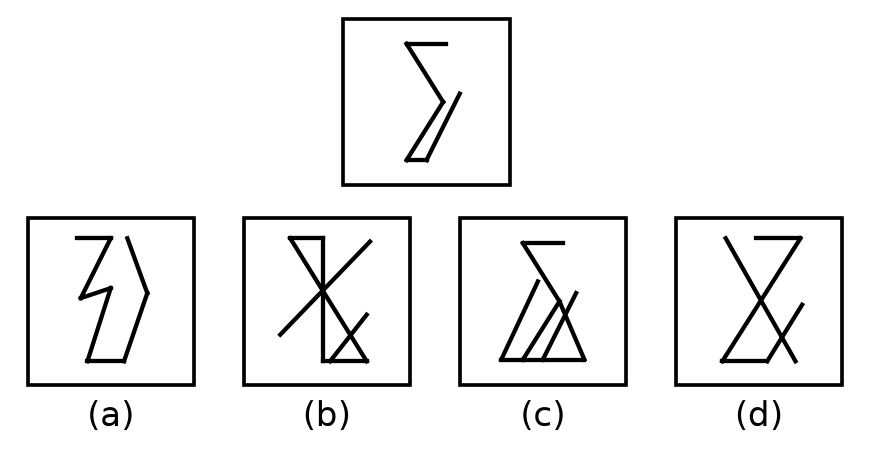
Examine the following figure :
Which one of the following figures has the above figure embedded in it ?
Answer (c) & explanation
The figure is hidden inside (c) (c). Step 1: note the parts of the given shape: a short top line, a bend pointing right, a short bottom line, and a slanting line going up from the bottom. Step 2: look for all four parts, in the same size and same direction, inside each option. In figure (c) they all appear together; the extra lines only add small triangles at the bottom. Step 3: in (a), (b) and (d), the bend or the top line is missing or turned, so the shape is not there.
Tip: for embedded-figure questions, pick the most unusual part of the shape, here the bend, and hunt for it first. The figure must not be rotated or resized.
Answer as per the official UPSC answer key.
Read the passage
Directions : The following six items are based on two passages in English to test the comprehension of English language and therefore these items do not have Hindi version. Read each passage and answer the items that follow.
Passage - 1
In front of us was walking a bare-headed old man in tattered clothes. He was driving his beasts. They were all laden with heavy loads of clay from the hills and looked tired. The man carried a long whip which perhaps he himself had made. As he walked down the road he stopped now and then to eat the wild berries that grew on bushes along the uneven road. When he threw away the seeds, the bold birds would fly to peck at them. Sometimes a stray dog watched the procession philosophically and then began to bark. When this happened, my two little sons would stand still holding my hands firmly. A dog can sometimes be dangerous indeed.
The expression "a stray dog watched the procession philosophically" means that
No official answer (question dropped) & notes
The answer is (b), the dog stood aloof, watching seriously. UPSC did not evaluate the six English-only items of 2014 (Q70 to Q75), so this answer is for practice. Step 1: understand the word. "Philosophically" here means calmly, thoughtfully, as if from a distance, the way a philosopher might watch the world. Step 2: test the others. Option (a) is wrong: the dog was not restless while watching; it barked only afterwards ("and then began to bark"). Option (c) is wrong: "big, wondering eyes" suggests surprise, not calm thought. Option (d) is wrong: a dog with its eyes closed cannot watch.
Tip: for word-in-context questions, think of the everyday meaning of the word and check that it fits the sentence before and after. The order of events, watching and then barking, matters here.
UPSC did not evaluate the six English-only items of 2014 (Q70 to Q75), so there is no official key. The answer given in the explanation is for practice.
UPSC dropped this question from evaluation; there is no official answer.
Read the passage
It is essential that we mitigate the emissions of greenhouse gases and thus avoid some of the worst impacts of climate change that would take place in coming years and decades. Mitigation would require a major shift in the way we produce and consume energy. A shift away from overwhelming dependence on fossil fuels is now long overdue, but unfortunately, technological development has been slow and inadequate largely because government policies have not promoted investments in research and development, myopically as a result of relatively low prices of oil. It is now, therefore, imperative for a country like India treating the opportunity of harnessing renewable energy on a large scale as a national imperative. This country is extremely well endowed with solar, wind and biomass sources of energy. Where we have lagged, unfortunately, is in our ability to develop and to create technological solutions for harnessing these resources.
One particular trajectory for carrying out stringent mitigation of greenhouse gas emissions assessed by the Intergovernmental Panel on Climate Change (IPCC) clearly shows the need for ensuring that global emissions of greenhouse gases peak no later than 2015 and reduce rapidly thereafter. The cost associated with such a trajectory is truly modest and would amount, in the estimation of IPCC, to not more than 3 percent of the global GDP in 2030. In other words, the level of prosperity that the world would have reached without mitigation would at worst be postponed by a few months or a year at the most. This is clearly not a very high price to pay for protecting hundreds of millions of people from the worst risks associated with climate change. Any such effort, however, would require lifestyles to change appropriately also. Mitigation of greenhouse gas emissions is not a mere technological fix, and clearly requires changes in lifestyles and transformation of a country’s economic structure, whereby effective reduction in emissions is brought about, such as through the consumption of much lower quantities of animal protein. The Food and Agriculture Organization (FAO) has determined that the emissions from the livestock sector amount to 18 percent of the total. The reduction of emissions from this source is entirely in the hands of human beings, who have never questioned the impacts that their dietary habits of consuming more and more animal protein are bringing about. Mitigation overall has huge co-benefits, such as lower air pollution and health benefits, higher energy security and greater employment.
What is the essential message of the passage ?
Answer (b) & explanation
The essential message is that mitigation is imperative (b). Step 1: look at the opening and the flow. The passage begins, "It is essential that we mitigate the emissions of greenhouse gases", then shows the cost is modest (under 3% of global GDP in 2030) and lists the co-benefits. Step 2: test the others. Option (a) is wrong: dependence on fossil fuels is the problem described, not the message. Option (c) is wrong: R&D is one means to the goal. Option (d) is wrong: lifestyle change is also a means.
Tip: the "essential message" is the goal that every other point supports. Means and problems are supporting details.
Answer as per the official UPSC answer key.
A worker reaches his factory 3 minutes late if his speed from his house to the factory is 5 km/hr. If he walks at a speed of 6 km/hr, then he reaches the factory 7 minutes early. The distance of the factory from his house is
Answer (c) & explanation
The factory is 5 km away (c). Step 1: at 5 km/hr he is 3 minutes late; at 6 km/hr he is 7 minutes early. So the two journey times differ by 3 + 7 = 10 minutes, which is 1/6 hour. Step 2: time = distance ÷ speed. Distance ÷ 5 − distance ÷ 6 = 1/6. Step 3: distance ÷ 5 − distance ÷ 6 = distance ÷ 30. So distance ÷ 30 = 1/6, and distance = 5 km. Check: 5 km takes 60 minutes at 5 km/hr and 50 minutes at 6 km/hr, a 10-minute gap. Options (a), (b) and (d) fail the check.
Tip: "late" and "early" times add to give the gap between the two journeys.
the gap is 3 + 7, not 7 – 3. One trip is late and the other early.
Answer as per the official UPSC answer key.
Read the passage
The Himalayan ecosystem is highly vulnerable to damage, both due to geological reasons and on account of the stress caused by increased pressure of population, exploitation of natural resources and other related challenges. These aspects may be exacerbated due to the impact of climate change. It is possible that climate change may adversely impact the Himalayan ecosystem through increased temperature, altered precipitation patterns, episodes of drought and biotic influences. This would not only impact the very sustenance of the indigenous communities in uplands but also the life of downstream dwellers across the country and beyond. Therefore, there is an urgent need for giving special attention to sustain the Himalayan ecosystem. This would require conscious efforts for conserving all the representative systems.
Further, it needs to be emphasized that the endemics with restricted distribution, and most often with specialized habitat requirements, are among the most vulnerable elements. In this respect the Himalayan biodiversity hotspot, with rich endemic diversity, is vulnerable to climate change. The threats include possible loss of genetic resources and species, habitats and concomitantly a decrease in ecosystem services. Therefore, conservation of endemic elements in representative ecosystems/habitats assumes a great significance while drawing conservation plans for the region.
Towards achieving the above, we will have to shift toward contemporary conservation approaches, which include a paradigm of landscape level interconnectivity between protected area systems. The concept advocates a shift from the species-habitat focus to an inclusive focus on expanding the biogeographic range so that natural adjustments to climate change can proceed without being restrictive.
With reference to the passage, the following assumptions have been made :
- 1. To maintain natural ecosystems, exploitation of natural resources should be completely avoided.
- 2. Not only anthropogenic but also natural reasons can adversely affect ecosystems.
- 3. Loss of endemic diversity leads to the extinction of ecosystems.
Which of the above assumptions is/are correct ?
Answer (b) & explanation
Only assumption 2 is valid (b). Step 1: test assumption 2. The passage says the Himalaya is vulnerable "both due to geological reasons and on account of the stress" from people. So both natural and human causes can harm ecosystems. 2 holds. Step 2: test assumption 1. The passage never says exploitation must be "completely avoided". That extreme word makes 1 wrong. Step 3: test assumption 3. Losing endemic species reduces ecosystem services; the passage never says ecosystems go extinct. So 3 is wrong. Options (a), (c) and (d) fail.
Tip: words like "completely", "always" and "never" make an assumption too strong unless the passage itself uses them.
Answer as per the official UPSC answer key.
The letters L, M, N, O, P, Q, R, S and T in their order are substituted by nine integers 1 to 9 but not in that order. 4 is assigned to P. The difference between P and T is 5. The difference between N and T is 3. What is the integer assigned to N ?
Answer (d) & explanation
N is 6 (d). Step 1: P is 4. The difference between P and T is 5, so T is 4 + 5 = 9 or 4 − 5 = −1. Only numbers 1 to 9 are allowed, so T = 9. Step 2: the difference between N and T is 3, so N is 9 + 3 = 12 or 9 − 3 = 6. 12 is too big, so N = 6. Options (a), (b) and (c) do not satisfy both differences.
Tip: a "difference" can go either way, plus or minus. Try both, then throw out any value outside the allowed range. Here the range 1 to 9 settles each step at once. The letter order L to T is just a distraction.
Answer as per the official UPSC answer key.
There are seven persons up on a ladder, A, B, C, D, E, F and G (not in that order). A is further up than E but is lower than C. B is in the middle. G is between A and B. E is between B and F. If F is between E and D, the person on the bottom step of the ladder will be
Answer (c) & explanation
D is on the bottom step (c). Step 1: there are seven people, so the middle step is 4th. B is there. Step 2: E is between B and F, and F is between E and D. So below B the order runs B, E, F, D. That fills steps 4 to 7. Step 3: A is above E but below C, and G is between A and B. So above B the order runs C, A, G, B. Step 4: full order from top: C, A, G, B, E, F, D. The bottom step is D. Options (a), (b) and (d) are on steps 4, 6 and 5.
Tip: in ladder or row puzzles, start with the fixed position (here B in the middle), then attach the chains of "between" clues to it.
Answer as per the official UPSC answer key.